1. ArchDaily
  2. Urban Design

Urban Design: The Latest Architecture and News

OMA Masterplans Airport City in Qatar

OMA Masterplans Airport City in Qatar - Urbanism
Courtesy of OMA

After winning an international competition, OMA has been commissioned to masterplan a new 10km2 Airport City for a population of 200,000, linking the new Hamad International Airport with the city of Doha, Qatar. OMA’s masterplan is a series of four circular districts along a spine parallel to the HIA runways, intended to create a strong visual identity and districts with unique identities. Phase One of the 30-year masterplan, which links airside and landside developments for business, logistics, retail, hotels, and residences, will be mostly complete in time for the 2022 World Cup, hosted by Qatar.

Rem Koolhaas commented: “We are delighted and honored to participate in the exciting growth of Doha, in a project that is perhaps the first serious effort anywhere in the world to interface between an international airport and the city it serves.”

More on OMA's airport city after the break...

Urban Coffee Farm and Brew Bar / HASSELL

Text description provided by the architects. Designed for the 2013 Melbourne Food and Wine Festival, the Urban Coffee Farm and Brew Bar by HASSELL attempts to play on this element of intrigue and surprise, creating an unexpected landscape in a familiar urban setting. The architects’ design brings a jungle of coffee trees on the edge of a central business district which opened just last week and runs until March 17. More images and architects’ description after the break.

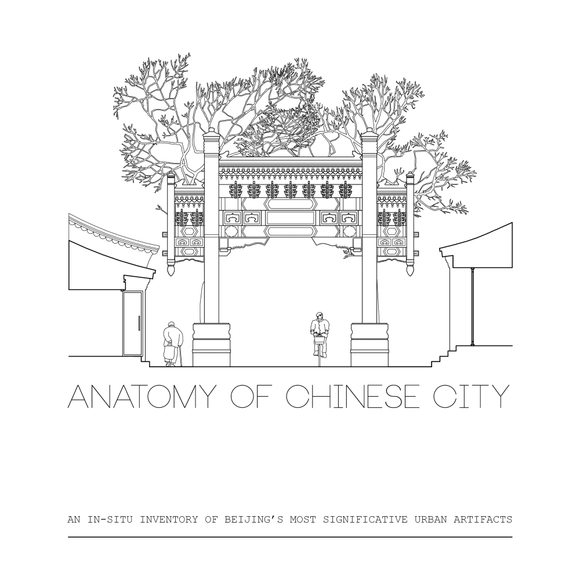
Anatomy of a Chinese City

Subscriber Access | 

In cities around the globe, change happens almost instantly. Buildings rise, buildings disappear, and skylines morph before one’s eyes. There is no better example of this, of course, than China. From Ordos to Shanghai, Chinese cities are in a constant state of flux, as the Chinese people willfully abandon signs of the past and embrace the new.

Of course, it’s one thing to know this fact; it’s quite another to witness it firsthand, to experience this urgent impetus to demolish and demolish in order to build, build, build, and build. In the face of such large-scale, exponential urban development, it’s easy to feel powerless to suggest another path.

However, in publishing Anatomy of a Chinese City, that is exactly what two young architects have done. By taking the time to observe the “urban artifacts” that make a Chinese city unique, compiling over 100 drawings of everything from buildings to bicycles, Thomas Batzenschlager and Clémence Pybaro have preserved a piece of Chinese history that is quickly going extinct. 

In a world where, in the race for progress, quotidian realities are erased unthinkingly, Anatomy of a Chinese City is not just a resource, but a call-to-action, reminding us to slow down and observe the very human context that surrounds us.

Read more about Anatomy of a Chinese City, after the break...

India's Evolution vs. China's Revolution

Subscriber Access | 

This article, by Austin Williams, originally appeared in The Asian Age as "India, China: Talk of the Town." Williams is the co-author of Lure of the City: From Slums to Suburbs and director of the Future Cities Project. He teaches architecture and urban studies at XJTL University in Suzhou, China. Email him at futurecitiesproject@gmail.com

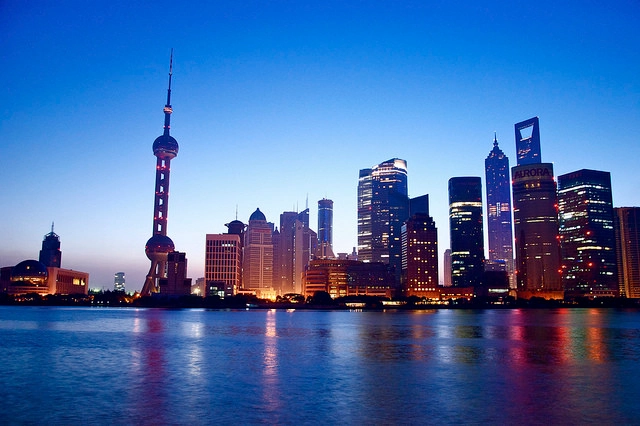
As an architect living in Suzhou, just outside Shanghai, I have become blasé about the skyline being transformed before my very eyes. The classic view of Shanghai’s towering waterfront may not represent great architecture, but it’s impressive all the same… and constantly improving. In most cities across China it is the same story: high-speed construction activity, modernisation, transformation and skyscrapers everywhere. There is a palpable sense of opportunity pending — what the émigrés to America must have felt when arriving in New York 100 years ago.

While many Western commentators point to the failures (the accidents, the pollution and the corruption) with an unremitting Schadenfreude, China marches on. Where else can you watch a modern city grow and change in real time? Where else, indeed?

Read more of Austin Williams' account of the different kinds of urban development happening in China and India, after the break...

Future Floda Winning Proposal / Mandaworks + Hosper Sweden

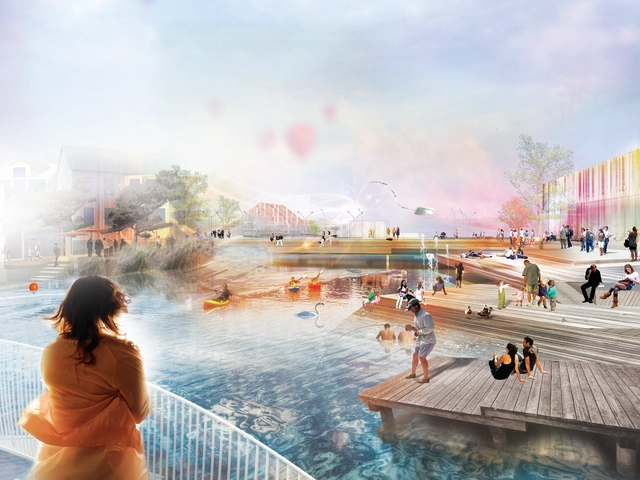
With the goal to inspire new visions for the future development of the central part of Floda, Mandaworks and Hosper Sweden’s proposal was recently selected as the the winner of the architectural competition for the future planning of Floda’s city center. Their ‘Down by the River’ concept focuses on and develops Floda’s strongest qualities: water, nature and Garveriet. The public spaces along Säveån refine and develop Floda’s existing character and identity as a community around the water. The proposal’s hook is the Blue Square - an innovative reinterpretation of the square as a public space where the rushing river creates a natural spectacle all year round. More images and architects’ description after the break.

ULI Announces Finalist Teams for 2013 Student Urban Design Competition

The Urban Land Institute (ULI) has selected the finalist teams in the eleventh annual ULI Gerald D. Hines Student Urban Design Competition. Graduate-level student teams representing Harvard University, Yale University, a joint team from Ball State University and Purdue University, as well as another join team from Kansas State University, the University of Missouri-Kansas City, and the University of Kansas are all advancing to the final round of competition, scheduled to take place in March and April. This year’s finalists were charged with proposing a long-term development plan for downtown Minneapolis that creates value for property owners, city residents, and the greater Twin Cities region.

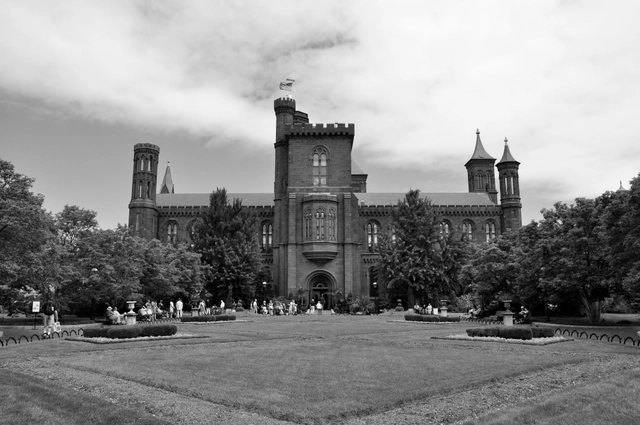
Smithsonian Hires BIG to Rethink Historic D.C. Campus

The Smithsonian Institution has commissioned the innovative practice of Bjarke Ingles to reimagine the heart of its antiquated Washington D.C. campus. The Danish architect has agreed to an eight- to 12- month, $2.4 million contract to draft the first phase of a master plan that seeks to dissolve the notable impediments and discontinuous pathways that plagues the area.

More on this news after the break...
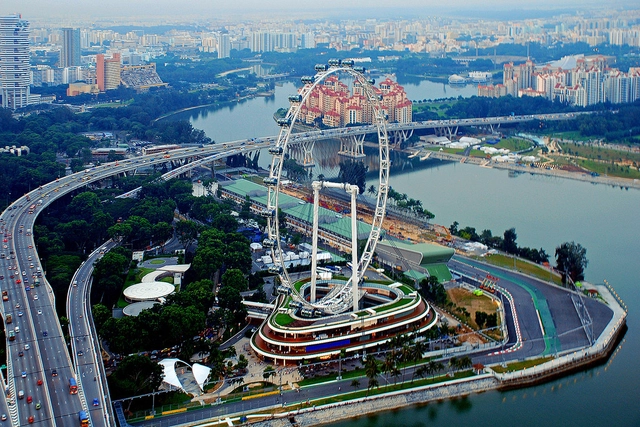
Ten Points for Liveable Cities: Lessons from Singapore

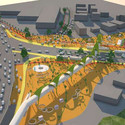
Urban populations are expanding at an exponential rate as people are migrating to city centers where economic opportunities promise social mobility and access to education, health resources, and where employment is more abundant than in rural areas. Nations once considered in the "third world" are making leaps to accommodate growing populations with thoughtful considerations in designing these new urban capitals. Population trends have shifted considerable and have contributed to some of the densest urban cities never before seen in history. The rise in the classification of cities as "mega-cities" and the problems that such high population densities face speak to the fact that our cities have reached a saturation point that needs to addressing.

Mary Ann Lazarus, FAIA of HOK Joins AIA in Sustainability and Health Initiative as a Resident Fellow

The AIA has appointed green-building leader Mary Ann Lazarus, FAIA, to a consulting position as a Resident Fellow. In this position, Lazarus will help guide and influence a program heavily based in sustainability and health as the AIA implements its ten-year pledge to the Decade of Design: Global Urban Solutions Challenge, a Clinton Global Initiative Commitment to Action. The purpose of the commitment is to document, envision and implement solutions that leverage the design of urban environments through research, community participation, and design frameworks. It is a commitment based in the interest of public health with special attention to the use of natural, economic, and human resources.

More about Mary Ann Lazarus's work and future at the AIA after the break.

How to Design Safer Cities

How to Design Safer Cities - Featured Image
Copenhagen, Superkilen

Can a good public space influence social behavior and make a city more secure?

In 1969, Philip Zimbardo, professor at the University of Stanford, performed a social psychological experiment. He placed an unlicensed car with a lifted hood in a neglected street in The Bronx, New York, and another similar car in a wealthy neighborhood of Palo Alto, California. The car in The Bronx was attacked in less than ten minutes, its apparent state of abandonment enabling the looting. The car in Palo Alto, however, remained untouched for more than a week.

Zimbardo then took his experiment one step further and broke a window of the car in Palo Alto. Almost immediately, passersby began to take things out of the car and within a few hours, the car had been completely dismantled. In both cases, many of the looters did not appear to be dangerous people. This experiment lead Harvard Professors George Kelling and James Wilson to develop the Broken Windows Theory in 1982: “If a broken window is left without repair, people will come to the conclusion that no one cares about it and that there is no one watching it. Then more windows will be broken and the lack of control will spread from the buildings to the streets, sending a signal that anything goes and that there is no authority.”

Read more about designing safer cities after the break...

Arup Envisions the Skyscrapers of 2050

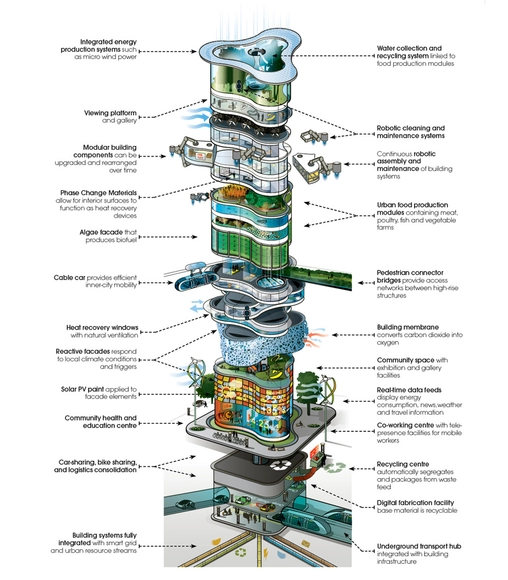
It is estimated that by 2050, 75 percent of the worlds - then 9 billion strong - population will live in cities. Urban Sprawl is already problematic and planners are faced with new challenges as they aim to build towards the sky rather than the horizon. In addition, cities are increasingly faced with climate change, resource scarcity, rising energy costs, and the possibility of future natural or man-made disasters. In response to these issues, Arup has proposed their vision of an urban building and city of the future.

In their proposal, titled “It’s Alive!”, they imagine an urban ecosystem of connected ‘living’ buildings, that not only create space, but also craft the environment. According to Arup, buildings of the future will not only produce energy and food, but will also provide its occupants with clean air and water.

More info on Arup's vision after the break...
Regeneration of Part of the Piraeus Port Authority (OLP) Coastal Zone Competition Entry / Kokkinou - Kourkoulas Architects

Subscriber Access | 
Regeneration of Part of the Piraeus Port Authority (OLP) Coastal Zone Competition Entry / Kokkinou - Kourkoulas Architects - Image 26 of 4
Courtesy of Kokkinou - Kourkoulas Architects

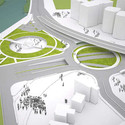
Kokkinou – Kourkoulas Architects shared with us their proposal in the competition for the redesign of the existing cereals stock house building facilities (SILO) and its surrounding open space into a Museum for Underwater Antiquities. This also includes the regeneration of part of the Piraeus Port Authority (OLP) Coastal Zone – transformation into an open public space for outdoor activities. With their main strategy based on preserving the memory and the effective wealth of the industrial past of the port, their goal is the creation of a cultural center at the western edge of the port amongst the wharfs and other industrial infrastructure. More images and architects’ description after the break.

AD Classics: Parc Güell / Antoni Gaudí

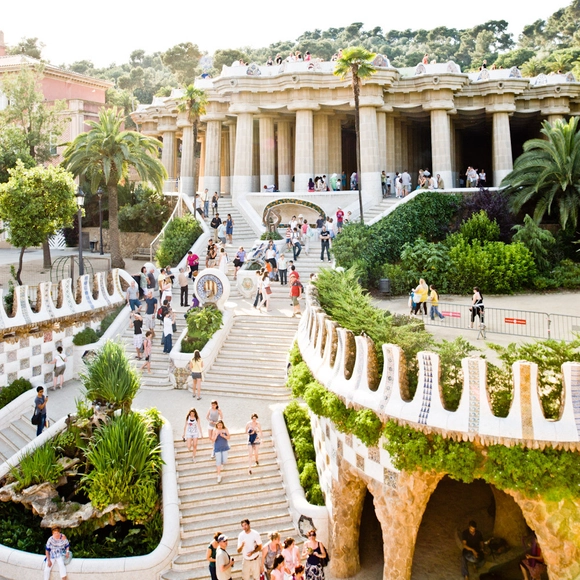
Parc Güell is a park designed by Antoni Gaudí upon the request of Count Eusebi Güell, who wanted to build a stylish park for the aristocrats of Barcelona. The Count had planned to build a housing development that would take advantage of the area's views and fresh air; however, only two show houses were completed. Gaudí himself inhabited one of them, designed by architect Francesc Berenguer in 1904. The house is now a museum showcasing some of Gaudí's work. The park is a common tourist attraction in Barcelona, and is known for its famous terrace and iconic entrance, flanked by two Gaudí buildings.

AD Classics: Parc Güell / Antoni Gaudí - Park, Facade, Arch, CityscapeAD Classics: Parc Güell / Antoni Gaudí - Park, Arch, Arcade, ColumnAD Classics: Parc Güell / Antoni Gaudí - Park, Garden, Fence, Arch, Arcade, ForestAD Classics: Parc Güell / Antoni Gaudí - Park, Garden, CoastAD Classics: Parc Güell / Antoni Gaudí - More Images+ 1

'Networked Ecologies: Rethinking Remediation' Competition Entry / Studio One

Subscriber Access | 
'Networked Ecologies: Rethinking Remediation' Competition Entry / Studio One - Image 23 of 4
Courtesy of Studio One

A finalist entry in the Transiting Cities – Low Carbon Futures competition, Studio One‘s proposal, titled, ‘Networked Ecologies: Rethinking Remediation’ a variety of programs ranging from landscape / mining remediation, to urban agriculture are defined. These “in-between” sites will grow and develop according to the specific conditions and uses, eventually creating a network of infrastructure that will provide robustness to the city. More images and architects’ description after the break.

AECOM Announces Urban SOS Winners

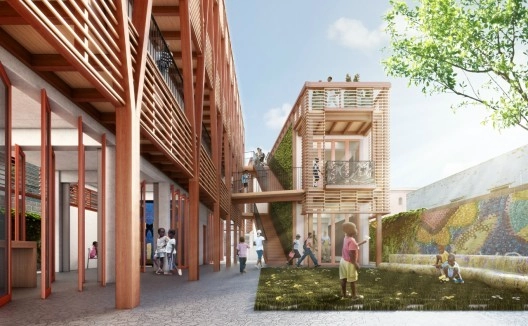
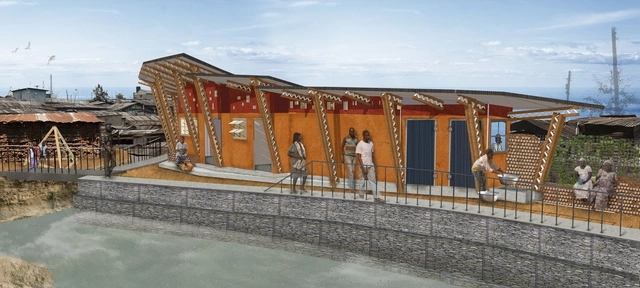
AECOM has announced 'Unslumming Kibera' as winner of the fourth annual Urban SOS competition.

The student competition received submissions from 118 universities in 41 countries. Three projects were shortlisted for a presentation to a panel of judges in New York on Jan 16.

Read about the finalists and their projects after the break

Studio Gang Breaks Ground on Ecologically Diverse Urban Mecca

Studio Gang Breaks Ground on Ecologically Diverse Urban Mecca - Featured Image
© Studio Gang Architects

For the past several years the Chicago Park District and the City of Chicago have been working on appropriate uses for Northerly Island, a 91-acre man-made peninsula in Chicago, Illinois. The lakefront site branches off from Museum Campus, a section along Lake Michigan that is home to the Field Museum, Shedd Aquarium, and Adler Planetarium. Serving as an expansion to these cultural programs, Studio Gang Architects have created an innovate design that integrates educational, cultural, social, and recreational activities into Northerly Island.

Read more about Northerly Island's future after the break!

Rethinking Kala Nagar Traffic Junction - Winners Announced

Rethinking Kala Nagar Traffic Junction - Winners Announced - Image 1 of 4
Andres Perez and Team - Student Category; Image Courtesy of BMW Guggenheim Lab

Mumbai, like many populous modern cities, has a traffic problem that may be better be categorized as a traffic nightmare. At the Kala Nagar Junction, where five main traffic arteries merge to connect nearly 60,000 commuters per hour from the Island City to the western suburbs of Mumbai, the BMW Guggenheim Lab and Mumbai Environmental Social Network launched a competition to search for realistic solutions to the infrastructural tangle. Likely designed when traffic congestion was not as severe, the Kala Nagar Junction is no longer capable of accommodating the daily commuter demand. The competition, open to students and professionals, called on participants to consider solutions that not only resolved the traffic problems, but also produced public spaces and safe pedestrian routes. The six winning designs - 3 from the professional category, 2 from the student category and 1 people's choice that was decided by community votes and visitors to the Guggenheim Design Lab.

Rethinking Kala Nagar Traffic Junction - Winners Announced - Featured ImageRethinking Kala Nagar Traffic Junction - Winners Announced - Image 1 of 4Rethinking Kala Nagar Traffic Junction - Winners Announced - Image 5 of 4Rethinking Kala Nagar Traffic Junction - Winners Announced - Image 11 of 4Rethinking Kala Nagar Traffic Junction - Winners Announced - More Images+ 8

OLIN Leads Master Planning for UC Berkeley’s California Memorial Stadium

Subscriber Access | 
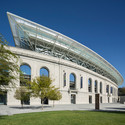
OLIN Leads Master Planning for UC Berkeley’s California Memorial Stadium - Image 3 of 4
UC Berkeley's Memorial Stadium, Athletic Center and Plaza; Photograph © Tim Grifftih

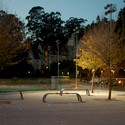
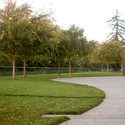
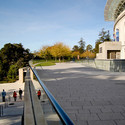
In 2005, OLIN - a landscape architecture, urban design and planning studio - developed a master plan for University of California Berkley's southeastern campus in an effort to unify its distinct elements and strengthen the social spaces of the campus. HNTB Architects led the renovation of the California Memorial Stadium and worked with STUDIOS Architecture and OLIN to design the Simpson Center for Student-Athlete High Performance. These are unified by OLIN's design of the grounds which are just part of the transformation planned for the campus, which also includes the renovations and landscape design for the Haas School of Business, UC Berkley School of Law and the Piedmont Avenue.

OLIN Leads Master Planning for UC Berkeley’s California Memorial Stadium - Featured ImageOLIN Leads Master Planning for UC Berkeley’s California Memorial Stadium - Image 5 of 4OLIN Leads Master Planning for UC Berkeley’s California Memorial Stadium - Image 7 of 4OLIN Leads Master Planning for UC Berkeley’s California Memorial Stadium - Image 8 of 4OLIN Leads Master Planning for UC Berkeley’s California Memorial Stadium - More Images+ 4