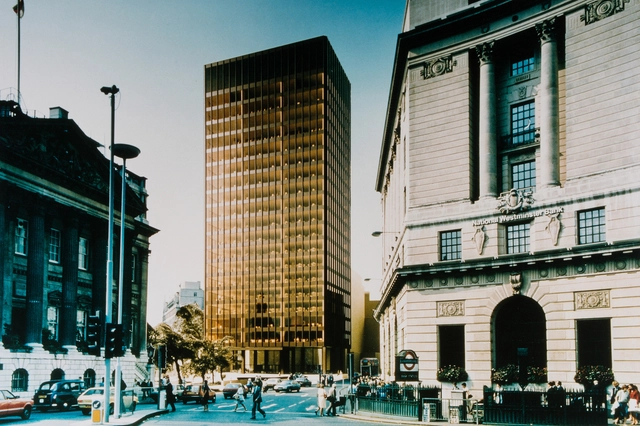
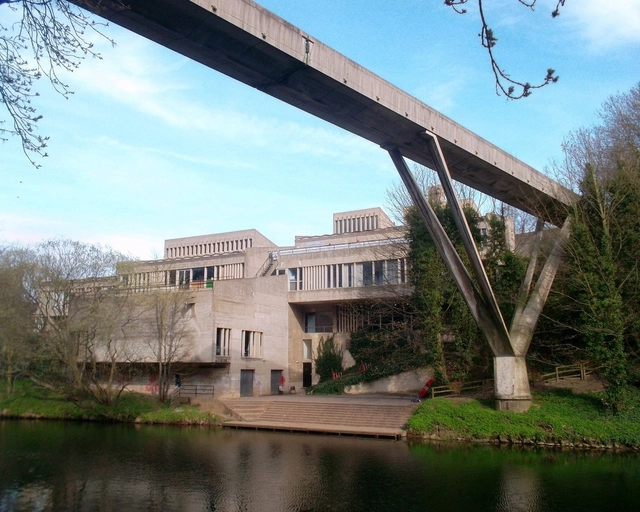
In the 1960s James Stirling asked Ludwig Mies van der Rohe why he didn’t design utopian visions for new societies, like those of Frank Lloyd Wright’s Broadacre City or Corbusier’s Cité Radieuse. Mies replied that he wasn’t interested in fantasies, but only in “making the existing city beautiful.” When Stirling recounted the conversation several decades later it was to the audience of a public enquiry convened in London – he was desperately trying to save Mies’ only UK design from being rejected in planning.
In a recent episiode of Section D, Monocle 24 visit a new exhibition at London's Serpentine Galleries presenting the paintings of Zaha Hadid. The show, first conceived with Hadid herself, "reveals her as an artist with drawing at the very heart of her work." According to the gallery, it "includes the architect’s calligraphic drawings and rarely seen private notebooks with sketches that reveal her complex thoughts about architectural forms and their relationships." This episode takes the listener on a tour of the display with commentary from the exhibition's curator.
https://www.archdaily.com/804667/zaha-hadid-explosive-paintings-drawings-sketches-on-display-london-serpentineAD Editorial Team
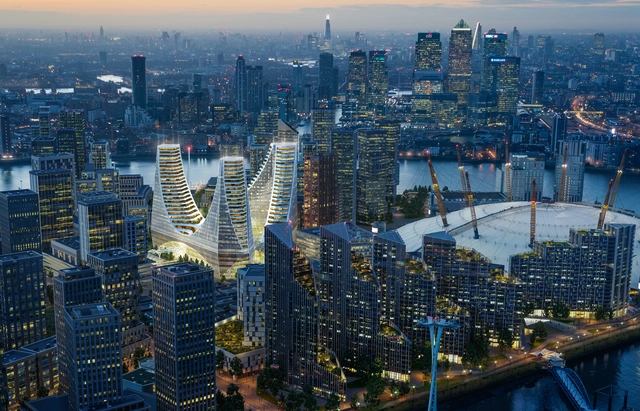
Santiago Calatrava has unveiled designs for a £1-billion mixed-use project in Greenwich Peninsula, East London. Named Peninsula Place, the 1.4-million-square-foot (130,000-square-meter) project will be located adjacent to the Roger Stirk Harbour + Partners-designed O2 Arena (formerly known as the Millennium Dome). It will include a new tube and bus station, a theater, cinema and performance venue, bars, shops and a wellbeing hub on the lower levels, with three towers rising above featuring offices, hotels, and apartments. The scheme will also be served by a new land bridge, also designed by Calatrava.
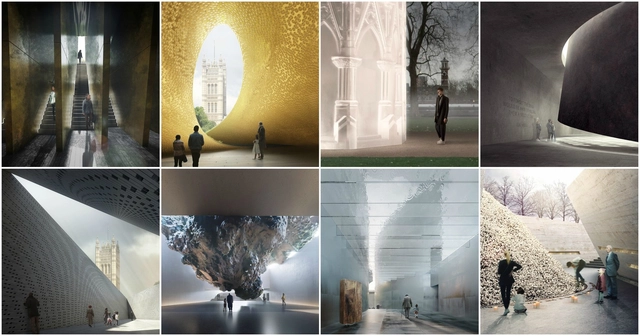
The UK Holocaust Memorial Foundation and Malcolm Reading Consultants have revealed the designs of 10 teams shortlisted to design a new Holocaust Memorial, to be located in London's Victoria Tower Gardens next to the Houses of Parliament. After a call for expressions of interest was launched in September, 10 star-studded teams were selected in November and invited to submit their designs for an "emotionally powerful and sensitively designed memorial."
With the designs now revealed to the public, competition organizer Malcolm Reading Consultants and the government-led Memorial Foundation are now consulting with the public and are inviting people to submit feedback about the designs here. The feedback received in this consultation period "will play a crucial role in informing the jury’s final decision on the memorial," they explained in a press release. Read on to see all 10 shortlisted designs.
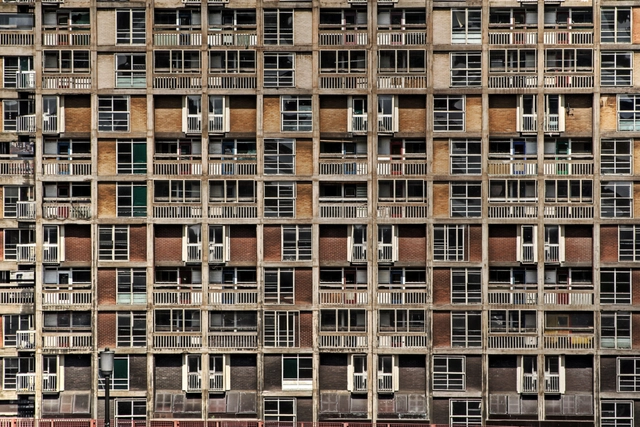
From its hilltop vantage point in the east end of Sheffield, UK, the Park Hill Estate surveys the post-industrial city which sprawls westwards. Its prominent location makes the estate highly visible and it has, over time, become engrained in the popular consciousness – a part of the fabric of the city. Although today it divides opinion, following its completion in 1961 it was hailed as an exemplary model for social housing. Designed by architects Jack Lynn and Ivor Smith under the supervision of Sheffield’s visionary City Architect John Lewis Womersley, the estate now stands as testament to an era when young British architects were revolutionizing the field of residential architecture with radical housing programs.
The Park Hill Estate was part of Womersley’s strategy to introduce more high-density housing to Sheffield, which he believed would foster a stronger sense of community than the ubiquitous back-to-back terraces.[1] This policy went hand in hand with an urgent need for slum clearance; The Park, a slum so notorious for its high crime rate that it was known locally as ‘Little Chicago,’ was demolished to make way for the estate.
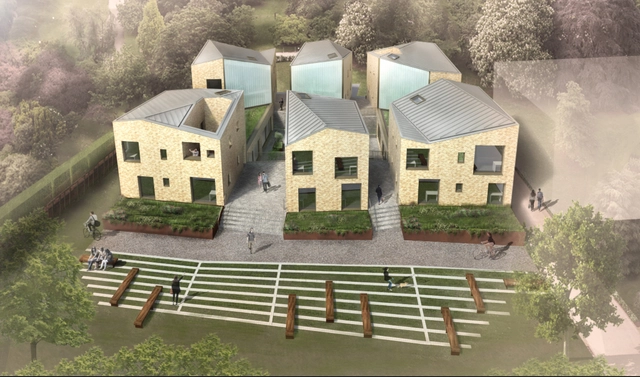
Belsize Architects has released the plans for 6 Pavilions, a new student accommodation project that will form a part of the University College’s larger masterplan in north Oxford.
To be built on the site of a Victorian residential home, the project will feature 30 units arranged within six pavilions around a central courtyard. Communal areas of the pavilions will be connected at the ground level.
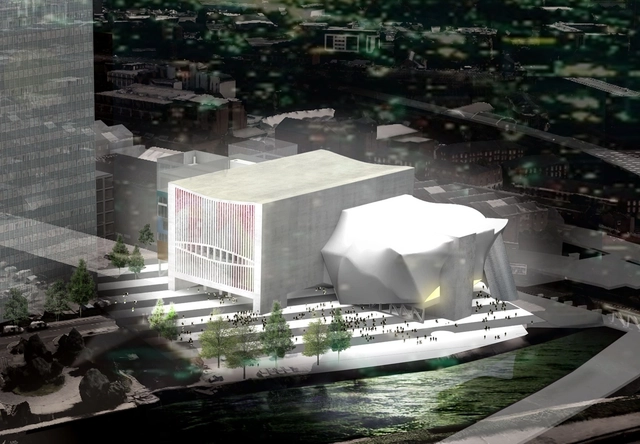
OMA’s first major public building in the UK has been granted planning approval. Known as “Factory,” the groundbreaking new cultural center will serve as a the new home of the Manchester International Festival (MIF) and as a year-round concert and arts venue.
Herzog & de Meuron’s Chelsea Football Club stadium has been given approval by Hammersmith and Fulham council’s planning committee, reports BBC. The new £500 million stadium, which is estimated to be completed by 2020, will replace the existing stadium at Stamford Bridge, increasing the capacity of the space by almost 20,000 spectators to 60,000 seats.
The design of the new stadium is inspired by Gothic architecture, as well as nearby Victorian-era brick terraces, which will wrap around the entirety of the building.
Committee decision to approve the stadium plans does not mean that work can begin on site; various other permissions will be necessary before the final decision will be made by London Mayor Sadiq Khan.
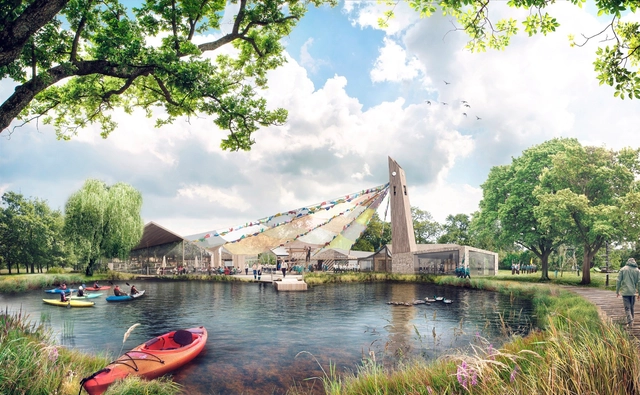
London-based firm Tate Harmer has won a competition to design a new £6 million ($7.4 million USD) museum for The Scout Association (TSA) at the group’s headquarters in Chingford, east London. Their proposal takes the form of a big, colorful tent that will tell the story of the Scouting movement within a fun, environmentally conscious structure.
Yesterday, the UK Government announced plans for 3 new garden towns and 14 new "garden villages" across England, expanding a plan that already includes 7 previously announced garden towns. Explaining the concept of the garden villages, the Department for Communities and Local Government described settlements of 1,500 to 10,000 homes, saying that together the 14 locations have the potential to deliver 48,000 new houses. In order to expedite the creation of these new settlements, the government has set aside a fund of £6 million (US$7.4 million), which housebuilders will be permitted to use in order to accelerate development at the sites.
However, the architectural community in the UK has mocked the proposals and the government's use of language, highlighting what appears to be a poor understanding of Ebenezer Howard's Garden Cities concept. Many have also pointed out that the plans are relatively meager in a country that, by many estimates, is falling hundreds of thousands of new homes short of the number needed every year.
David Adjaye OBE, principal of Adjaye Associates, will be Knighted by Her Majesty Queen Elizabeth II for his services to architecture at an investiture in 2017. The Central Chancery of the Orders of Knighthood at St. James's Palace, who administer the Knight Batchelor awards that will be bestowed upon the architect, described Adjaye as "one of the leading architects of his generation and a global cultural ambassador for the UK."
https://www.archdaily.com/802706/david-adjaye-to-be-knighted-by-queen-elizabeth-iiAD Editorial Team
BDP and Wolfgang Buttress’ pavilion, The Hive, has been awarded the 2016 Landscape Institute Award for Best Design for a Temporary Landscape as part of their 2016 awards program.
Judges for the award noted the project’s ability to interact with its site, remarking that they were ‘impressed by the quality and simplicity of the design and execution, in particular the way in which the design works with a sensitive landscape to provide a beautiful and functional temporary setting for the installation, and a longer-term facility for events and education.”
In 2017, British news magazine The Economist will move to a new home, leaving behind its iconic home of 52 years, Economist Plaza.
The project represents the first major commission by British duo Alison and Peter Smithson, who would go on to have esteemed careers as champions of the Brutalist style. Located at 22 Ryder Street, not far from Hyde Park and Buckingham Palace, Economist Plaza marked a significant breakthrough in tall building design, replacing the traditional streetfront of a podium and tower design with stairs and a ramp leading to an elevated plaza from which 3 buildings would rise.
Watch the video above to learn the story behind the project, and read more about the legacy the Economist will leave behind, here.
Last week, Richard Murphy Architects’ ‘Murphy House’ in Edinburgh was named the Royal Institute of British Architects’ 2016 RIBA House of the Year. Built into a hillside lot, the unusual site presented the architects with the opportunity to play, loading the house with an assortment of clever architectural details and mechanics, including a hidden bath in the master bedroom, folding walls, sliding bookshelf ladders and operable clerestory panels.
To capture all these moving parts in their full effect, the architect himself created a video walkthrough of the house. Check it out below.
The Sir John Soane’s Museum is often cited as a seminal inspiration for architects of all generations. Located in London's Lincoln's Inn Fields, the house—designed by Soane (born in 1753), architect of the Bank of England—is a remarkable biographical bricolage of unique spaces, objects and ideas. Kept exactly as it was at the time of Soane's death in 1837, the museum is packed with paintings, sculpture, furniture and drawings – all curated and composed by the architect himself to "enhance their poetic qualities."
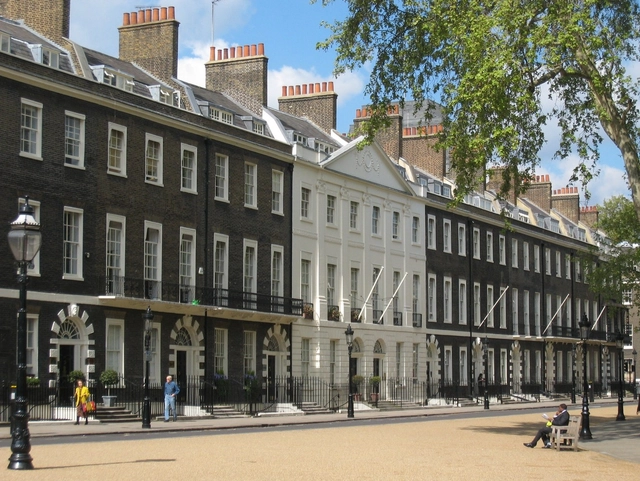
The Architectural Association on Bedford Square, London
Brett Steele, Director of London's Architectural Association (AA) since 2005, has announced that he will become Dean of UCLA School of the Arts and Architecture in August 2017. Although American-born, Steele has since become a naturalized British citizen. He studied at the AA, the University of Oregon, and the San Francisco Art Institute respectively, before working as a Project Architect at Zaha Hadid Architects in the late 1980s and early 1990s.
https://www.archdaily.com/801567/brett-steele-aa-to-become-ucla-deanAD Editorial Team


.jpg?1487076478&format=webp&width=640&height=580)