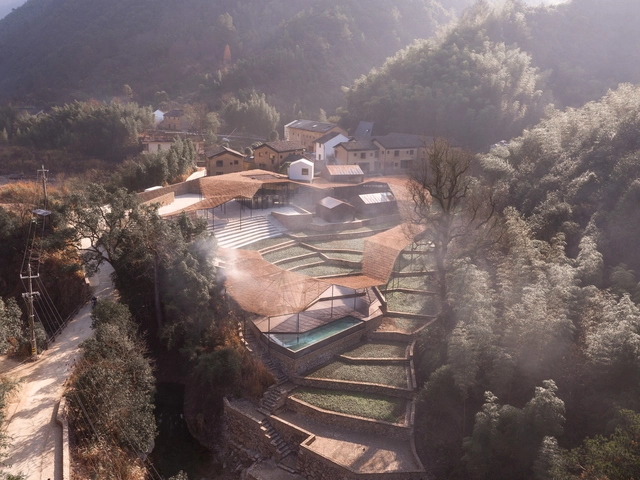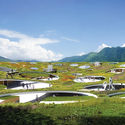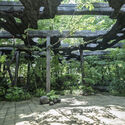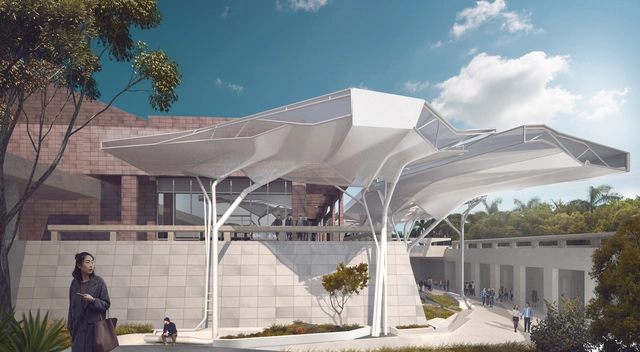
Sou Fujimoto Architects has unveiled its design for the Hida Takayama University, a new academic institute tucked in a small rural area of Japan. The project aims to revitalize the rural areas which are often overlooked, especially by academic institutes, and nurture the sense of community and appreciation of the rich culture provided by nature. The design features an organic-shaped structure inspired the surrounding landscape and a walkable roof. The university is set to open in 2024, and will be followed by 11 other regional learning centers across the country.
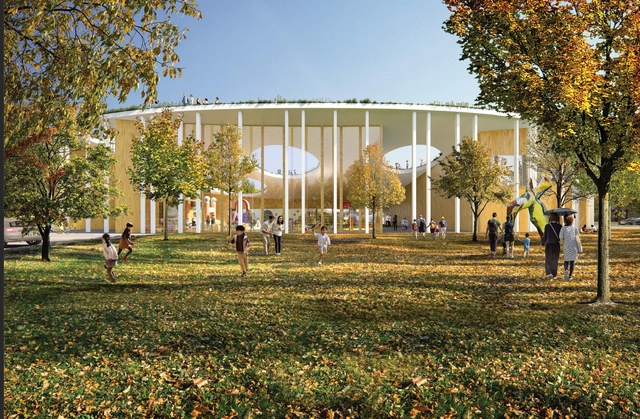
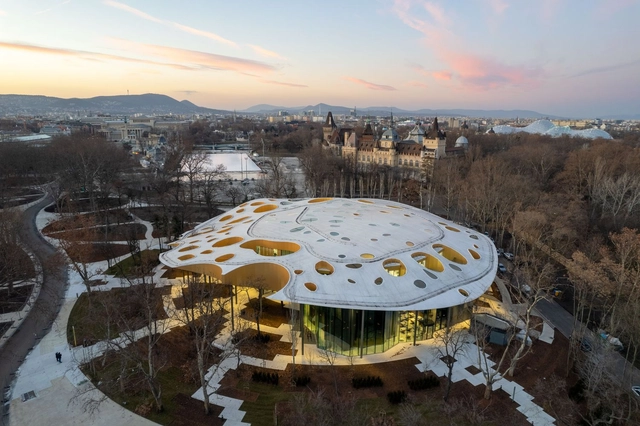
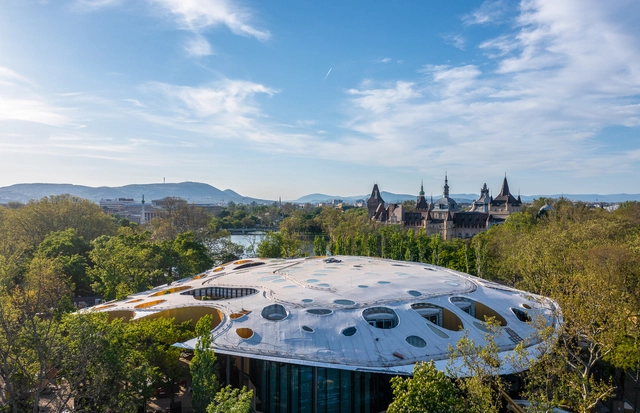
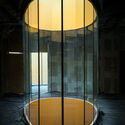
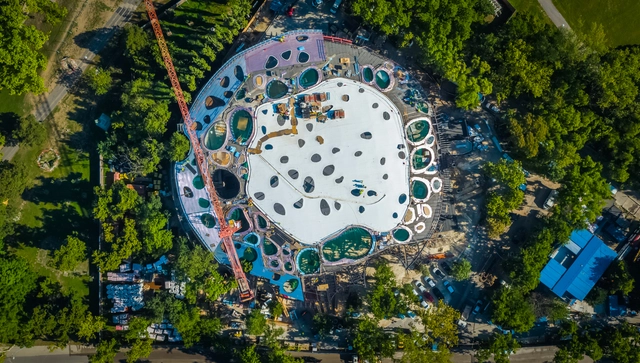
The House of Hungarian Music is taking shape within Budapest's City Park. With the structure and the design's distinctive roof completed, construction work is underway for the interior of the music hall. Nestled within the park's trees, the project designed by Sou Fujimoto features an extensive, horizontally uninterrupted glass volume topped by a perforated roof which allows natural light to penetrate all levels of the building.
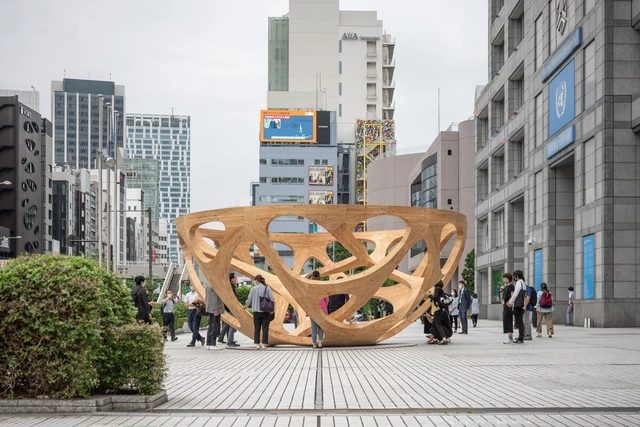
Accompanying the ongoing Olympics, Pavilion Tokyo 2021 invited Japanese architects and artists, including Kazuyo Sejima, Sou Fujimoto, Junya Ishigami and Yayoi Kusama, to envision nine temporary structures to be placed in various locations around the National Stadium designed by Kengo Kuma. The initiative showcases experimental interventions within the urban landscape that illustrate a playful take on public space. Also participating in the project are Terunobu Fujimori, Akihisa Hirata, Teppei Fujiwara, as well as artists Makoto Aida and Daito Manabe + Rhizomatiks.
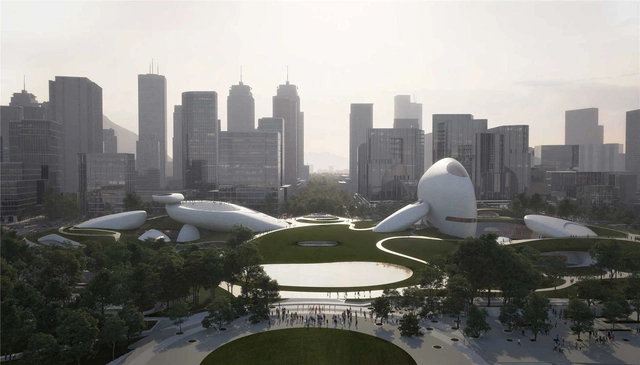
Sou Fujimoto Architects have revealed the winning design of the New City Center Landmark, a monumental floating tower on the bay of the Qianhaiwan district in Shenzhen. The proposed tower is 268m high, and consists of 99 individual tower-like elements connected a strong horizontal plane in the upper part, gradually vanishing as they descend. It is both one tower and a collection of towers all at once, symbolizing the future of societies in an age of diversity.
Shenzhen Bay Culture Park. Image Courtesy of Proloog
Shenzhen, as the modern metropolis in southeastern China that links Hong Kong to China’s mainland, has undergone rapid real estate development and intensive construction bidding in recent years.
“Shenzhen Ten Cultural Facilities of New Era” serves as a significant international design competition that has attracted much attention and investment from many high-level active architects worldwide.
Courtesy of Sou Fujimoto Architects & Donghua Chen Studio
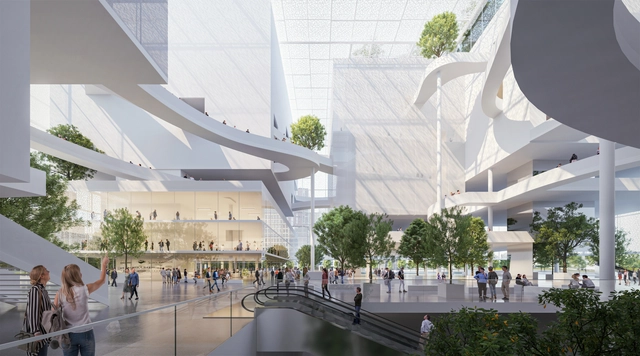
Japanese studio Sou Fujimoto Architects alongside Chinese office Donghua Chen Studio have designed a large scale exhibition complex in the heart of Futian District. The Shenzhen Reform and Opening-up Exhibition Hall adopts the city's characteristics as a contemporary entrepreneurial hub, welcoming innovative international businesses in a garden-inspired structure wrapped with white perforated facades. The design proposal was the winning entry of an international competition in Futian, and will be a part of the Shenzhen Ten Cultural Facilities of New Era promoted by the Municipal Government, once completed.
Sou Fujimoto. Image Courtesy of Sou Fujimoto Architects
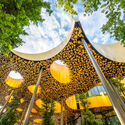
After MAD’s Wormhole Library, the city of Haikou revealed a pavilion by Sou Fujimoto Architects. Scheduled for the end of spring, the ribbon-like white pavilion with an accessible roof will be one of the first public waterfront interventions to be completed in the spring of 2021. Shaping the future of Haikou city and Hainan Free Trade Port, the master plan of 16 permanent destinations re-imagines the future of coastal living.
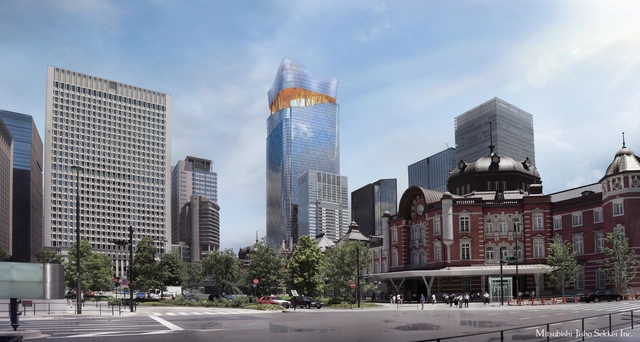
Sou Fujimoto Architects has unveiled its design for the top part of the tallest skyscraper in Japan“Torch Tower” in Tokyo, collaborating mainly with Mitsubishi Jisho Sekkei, Inc. Standing tall at 390m, the highrise building planned to be ready by 2028, takes on a large plaza at around 300m, generating a space for people.
Courtesy of Oyler Wu Collaborative and Ren Lai Architects
Oyler Wu Collaborative and Taiwanese partner Ren Lai Architects have won a competition to re-envision the KaohsiungMuseum of Fine Arts in Taiwan. Selected among finalists including Asif Khan with C.M.Chao Architects, Sou Fujimoto Architects with WSAA Design Team, and Liao Architects and Associates, the winning project proposes a newly renovated exterior that seeks to reconnect the building with its evolving context.
The House of Hungarian Music, part of the Liget Budapest Project, has won the World's Best Use of Music in Property Development at the Music Cities Awards. Also selected as one of the top three Best European Development category, the intervention, designed by Sou Fujimoto is under construction on the former site of the demolished Hungexpo office buildings in Budapest, Hungary. Scheduled to open in 2021, the structure of the building is complete, and the iconic roof is taking shape, as well as the monumental glass walls, the largest of their kind in Europe.
The current global situation forces us to do all kinds of adjustments and we are seeing this as an opportunity to go out of our comfort zone and try something new. We are going online! This allows us to invite architects from different parts of the world and make it possible for you to get to know them from the “AnA perspective”, no matter where you are located. The first round of events will take place before mid-July. Join us!
Another year, another successful ArchDaily Building of the Year Awards! With more than 95,000 votes gathered over the past 20 days, the results of the 2020 edition are in! Once more, the award has proved to be the largest architecture prize centered around people’s opinion. Crowdsourced, the most relevant projects of the year were both nominated and selected by our readers.
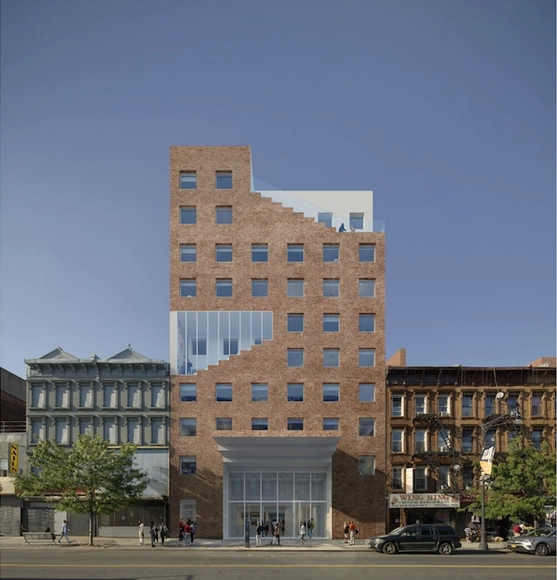
The Collective, a global network of co-living that creates private spaces with communal facilities has announced its recent partnership with Sou Fujimoto Architects in New York City. Located in 1215 Fulton Street, in Bedford-Stuyvesant, Brooklyn, the building will start welcoming its first tenants in 2022.
Phillips Exeter Academy Library by Louis I. Kahn (1972). Published in Manual of Section by Paul Lewis, Marc Tsurumaki, and David J. Lewis published by Princeton Architectural Press (2016). Image Courtesy of LTL Architects
For Paul Lewis, Marc Tsurumaki and David J. Lewis, the section “is often understood as a reductive drawing type, produced at the end of the design process to depict structural and material conditions in service of the construction contract.” A definition that will be familiar to most of those who have studied or worked in architecture at some point. We often think primarily of the plan, for it allows us to embrace the programmatic expectations of a project and provide a summary of the various functions required. In the modern age, digital modelling software programs offer ever more possibilities when it comes to creating complex three dimensional objects, making the section even more of an afterthought.
With theirManual of Section(2016), the three founding partners of LTL architects engage with section as an essential tool of architectural design, and let’s admit it, this reading might change your mind on the topic. For the co-authors, “thinking and designing through section requires the building of a discourse about section, recognizing it as a site of intervention.” Perhaps, indeed, we need to understand the capabilities of section drawings both to use them more efficiently and to enjoy doing so.
Hokkaido-born Sou Fujimoto’s breakout masterpiece, the playful and cloud-like 2013 Serpentine Pavilion says a lot about who Fujimoto is and how he thinks about architecture. But even more so do the 100-plus sometimes painstakingly refined, sometimes roughly executed exploratory models that dot the minimalist gallery space of Japan House Los Angeles. This, his retrospective show, Futures of the Future, neatly reflects on Fujimoto’s career, which began when he opened his own Tokyo-and-Paris-based firm in 2000.
Sou Fujimoto, Nicolas Laisné and Dimitri Roussel will be building a new gateway to the city of Rosny-sous-Bois in Grand Paris. Their project, Village Vertical, has been chosen as the winning proposal for the "Inventons la Métropole du Grand Paris" competition. The team includes landscape and urban designers from Atelier Georges and urban developers from La Compagnie de Phalsbourg and REI Habitat.
Architecture meets the outdoors in Sou Fujimoto's L’arbre Blanc housing tower, under construction in Montpeller, France. Image Courtesy of SFA+NLA+OXO+RSI
The destruction wrought upon Ishinomaki by the 2011 Great East Japan Earthquake and Tsunami damaged the city’s civic hall and cultural center beyond repair. To rebuild, Ishinomaki City wanted to create a landmark combining these two facilities into a new complex—one that would be like a city unto itself, serving the community.
In 2016, design proposals were screened in a process that included public presentations, with many locals participating. In the end, Sou Fujimoto, a leader among the next generation of Japan’s architects, was selected for his innovative design.
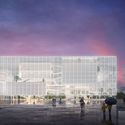
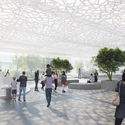
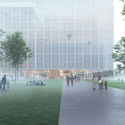
Sou Fujimoto Architects has been selected as the winner of a competition to design the new HSG Learning Center at the University of St. Gallen in Switzerland.
Chosen from a shortlist of 8 teams, Sou Fujimoto Architects’ proposal “Open Grid – Choices of Tomorrow” received the highest marks across the following criteria: architecture and urban planning, innovation in concept execution, functionality, sustainability and economic efficiency. According to the competition jury, the project was notable for its “highly developed didactic concept, compatibility with the district, architectural ambition and affordability.”