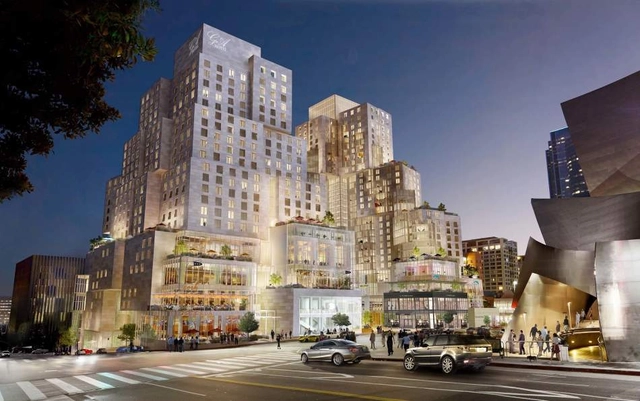
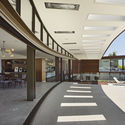
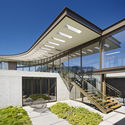
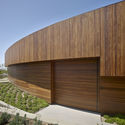
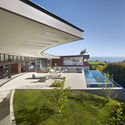
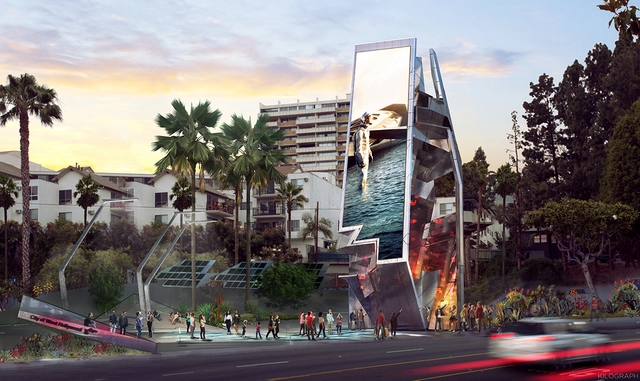
Next LA - Honor: West Hollywood Belltower / Tom Wiscombe Architecture, Inc. courtesy of AIA LA
The American Institute of Architects Los Angeles (AIA|LA) just announced the winners of their 2017 Design Awards honoring Los Angeles based architects and architecture. The ceremony took place Monday, October 30th, at the Broad Stage in Santa Monica, recognizing each of the winners.
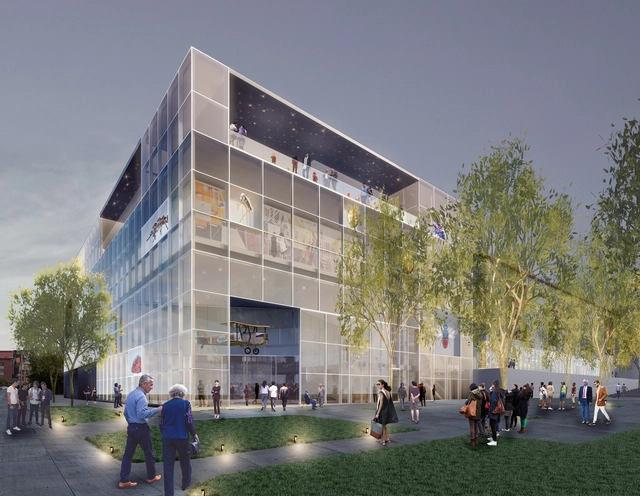
Natural History Museum West Wing at Night (view from southwest): From the exterior, passers-by can view the museum’s new public facilities, including a flexible theater and an interdisciplinary education center for urban nature, culture, and history. A rooftop restaurant offers panoramic vistas of the Los Angeles basin that include the Downtown skyline, San Gabriel Mountains, Baldwin Hills and the Santa Monica Mountains.. Image Courtesy of Natural History Museum of Los Angeles County
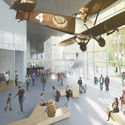
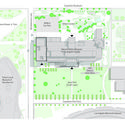
The Natural History Museum of Los Angeles County (NHM) has released concept designs for the new NHM West/South Project – a scheme designed by LA firm Frederick Fisher and Partners (FF&P) in the first step towards a 10-year revitalization of the NHM as Exposition Park’s historic hub. The extensions would focus on the west and south sides of the museum, supporting new uses and reimagining the programs and spaces of its famous Ice Age fossil site at the La Brea Tar Pits and Museum in Hancock Park.
Two large-scale US cultural projects have, this week, announced major updates relating to the renovation of existing buildings – and both involve, to a greater and lesser extent, American business magnate, media mogul, and philanthropist David Geffen.
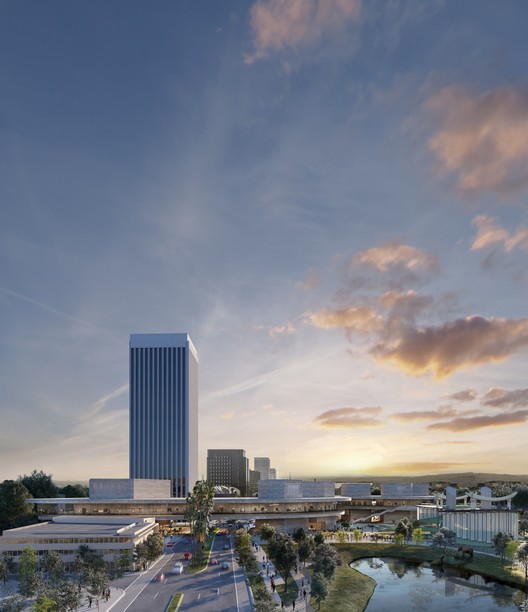
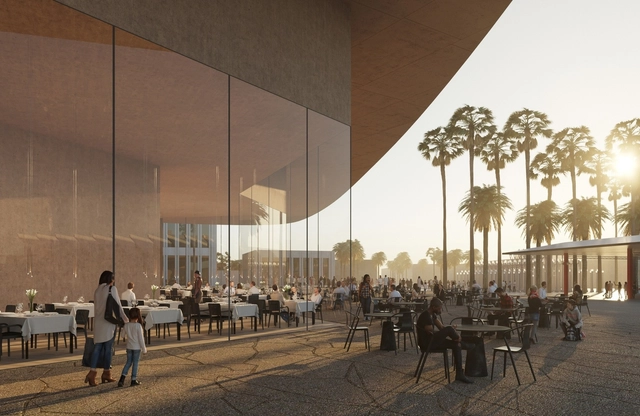
New renderings have been revealed of the Renzo Piano Building Workshop-designed Academy of Motion Pictures as the project races toward its 2019 completion date. Located along LA’s Miracle Mile, the museum is striving to become “the world’s premier institution dedicated to the art and science of movies.”
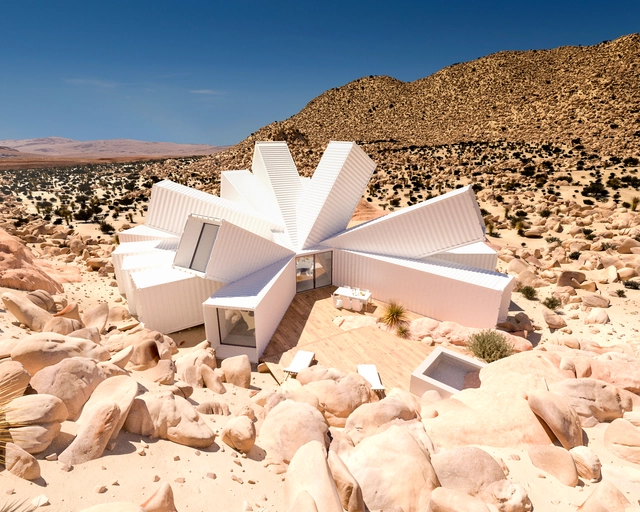
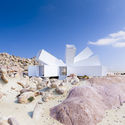
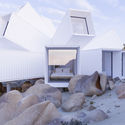
Blossoming from the rugged terrain of the California desert, Whitaker Studio’sJoshua Tree Residence is taking shipping container architecture to the next level. Set to begin construction in 2018, the home is laid out in a starburst of containers, each oriented to maximize views, provide abundant natural light or to create privacy dependent on their location and use.
Los Angeles’ beloved downtown icon Angel’s Flight has reopened for the first time in four years after undergoing extensive renovations to improve the safety and longevity of the attraction. Sometimes referred to as the “world’s shortest railroad,” the hillside structure is actually a funicular system – both cars share a single cable and are propelled forward in part with the potential energy afforded from the counterweight of the opposing car.
Already having tackled electric vehicles, space flight, and high-speed vacuum tubes, benevolent mad scientist Elon Musk’s latest foray into transportation infrastructure is ready to get off the ground, or rather, under it.
The tech mogul’s newest startup, the Boring Company, focuses on designing a subterranean network of tunnels beneath the streets of Los Angeles that could shuttle pedestrians and vehicles on electric sleds connected to a system of rails at speeds of up to 125 mph.
Now, the company has announced approval by the LA County city of Hawthorne to construct a 1.6-mile-long tunnel that will allow the technology to be tested in-full for the first time.
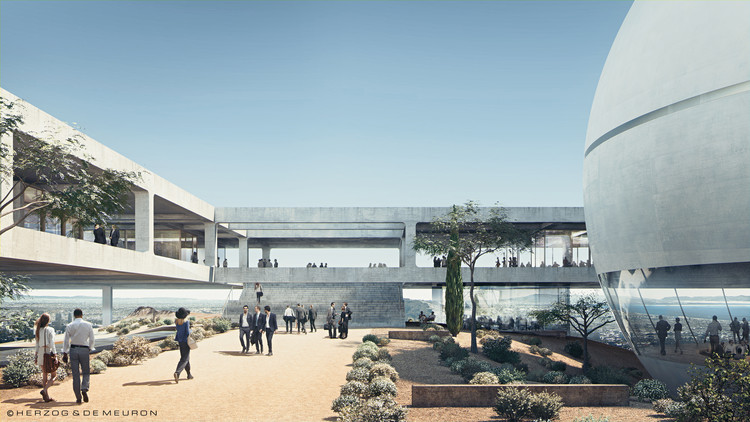
Herzog & de Meuron, in collaboration with Michel Desvigne Paysagiste, Inessa Hansch and executive architect Gensler, have revealed designs for a new “Scholars’ Campus” for global think tank the Berggruen Institute to be located in the Santa Monica Mountains overlooking the city of Los Angeles.
Inspired by the designs of traditional monasteries and hilltop villages, the scheme is rooted in the restoration and appreciation of the landscape. Along with the series of structures containing the Institue’s residence, meeting and study spaces, over 90% of the 447-acre site will be preserved as natural open space.
Downtown Los Angeles’ skyscraper boom continues – this time straying south to the intersection of South Olive and 11th Street, where developer Crescent Heights has submitted plans for a new 70-story residential tower housing 794 apartment units. Designed by ODA, 1045 Olive is planned to top out at a height of 770 feet, which would make it Los Angeles’ tallest residential building and 4th tallest overall.
Unique to the structure (and fitting for Los Angeles) would be the massive amount of space dedicated to parking: 13.5 total floors would be dedicated to parking spots, including an above ground 8-story core that would be wrapped in apartments to visually conceal the cars within.
In 2017, many of the world's cities have become potpourri time capsules of architecture. We live in an eclectic era in which a 19th-century industrial loft, post-war townhouse, and brand new high rise condominium are all comparably desirable properties. This increasingly varied urban landscape—and the appetite for variety of the people who live there—makes it more difficult than ever for new architecture to grab the public's attention.
To combat this, architects often attempt to produce an "iconic" work: a building whose design is so so striking that it attracts even a layperson's focus. Sometimes this ambition pays off as timeless, and sometimes it irreversibly pock-marks the skyline. What follows is a collection of attention grabbing structures. Will they be remembered as eccentric landmarks or glaring eyesores? You decide.
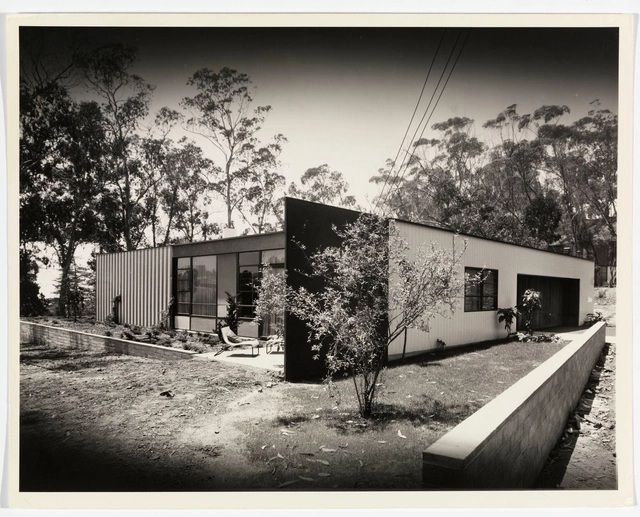
Nestled in the verdant seaside hills of the Pacific Palisades in southern California, the Entenza House is the ninth of the famous Case Study Houses built between 1945 and 1962. With a vast, open-plan living room that connects to the backyard through floor-to-ceiling glass sliding doors, the house brings its natural surroundings into a metal Modernist box, allowing the two to coexist as one harmonious space.
Like its peers in the Case Study Program, the house was designed not only to serve as a comfortable and functional residence, but to showcase how modular steel construction could be used to create low-cost housing for a society still recovering from the the Second World War. The man responsible for initiating the program was John Entenza, Editor of the magazine Arts and Architecture. The result was a series of minimalist homes that employed steel frames and open plans to reflect the more casual and independent way of life that had arisen in the automotive age.[1]



























.jpg?1502913677&format=webp&width=640&height=580)