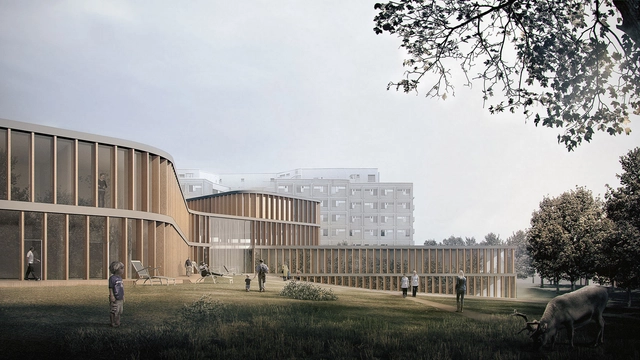
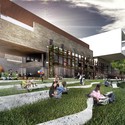
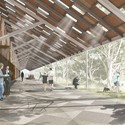
The built atmosphere in which we live has a profound impact on our mood and well-being. For those with mental health issues, this fact is particularly important to understand. This raises the question: can architects successfully design a space that has an overall positive influence on the healing process? What integrated elements of the building, in particular, aid in the process while fighting the prejudice and stigma of mental health issues?
Vista do átrio. Image Cortesia de Safdie Architects
The first Brazilian project by Safdie Architects has broken ground in Sao Paolo's Morumbi neighborhood on November 6. Developed in partnership with Perkins+Will, The Albert Einstein Education and Research Center is part of the Albert Einstein hospital complex.
The new center, named Campus Cecilia and Abram Szajman, will be one of the most advanced institutions in Latin America for medical studies. It will feature innovations in learning methods and technologies, as well as flexible research laboratories capable of adapting to the advancement of hospital techniques.
This article was originally published on August 15, 2016. To read the stories behind other celebrated architecture projects, visit our AD Classics section.
Le Corbusier made an indelible mark on Modernist architecture when he declared “une maison est une machine-à-habiter” (“a house is a machine for living”). His belief that architecture should be as efficient as machinery resulted in such proposals such as the Plan Voisin, a proposal to transform the Second Empire boulevards of Paris into a series of cruciform skyscrapers rising from a grid of freeways and open parks.[1] Not all of Le Corbusier’s concepts, however, were geared toward such radical urban transformation. His 1965 proposal for a hospital in Venice, Italy, was notable in its attempt at seeking aesthetic harmony with its unique surroundings: an attempt not to eradicate history, but to translate it.
A floor plan is an interesting way to represent and approach the functional program of hospitals and health centers, where the complexity of the system implies the need for specific studies of the distribution and spatial organization for proper health care.
From our published projects, we have found numerous solutions and possibilities for health centers and hospitals depending on the site's specific needs.
Below, we have selected 50 on-site floor plan examples that can help you better understand how architects design hospitals and health care centers.
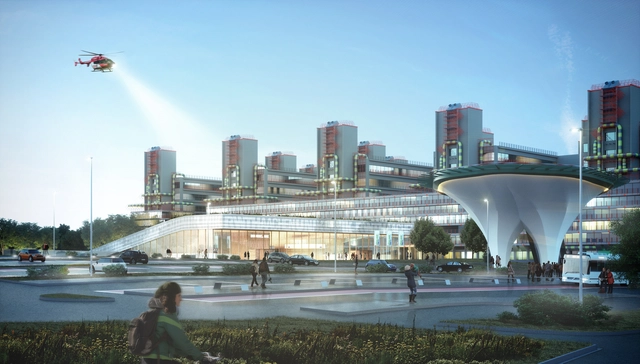
The Renzo Piano Building Workshop (RPBW) has presented their preliminary design approaches for three hospitals in Greece. Part of a €200 million ($240 million) healthcare initiative launched by the Greek government, RPBW will produce designs for a General Hospital of Kromotini, a Children’s Hospital in Thessaloniki, and the Evangelismos Hospital in Athens which will also form part of the University’s Faculty of Nursing.
The three schemes are united by a “people-centric” approach, with each project seeking to integrate into their natural environments with an emphasis on natural light. The projects will follow the design ethos of the Stavros Niarchos Foundational Cultural Center by RPBW, completed in 2016.
The extension is viewed as an urgent project to address overcrowding in the vital facility, with the demands of 20,000 annual patients resulting in hot, overcrowded communal spaces, and children sharing beds in wards. The Foundation described Manuel Herz as the “unanimous choice” with an approach showing “a mix of visual flair, practical understanding, and profound humanitarianism.”
https://www.archdaily.com/895766/manuel-herz-to-design-curvilinear-expansion-of-rural-senegal-hospitalNiall Patrick Walsh
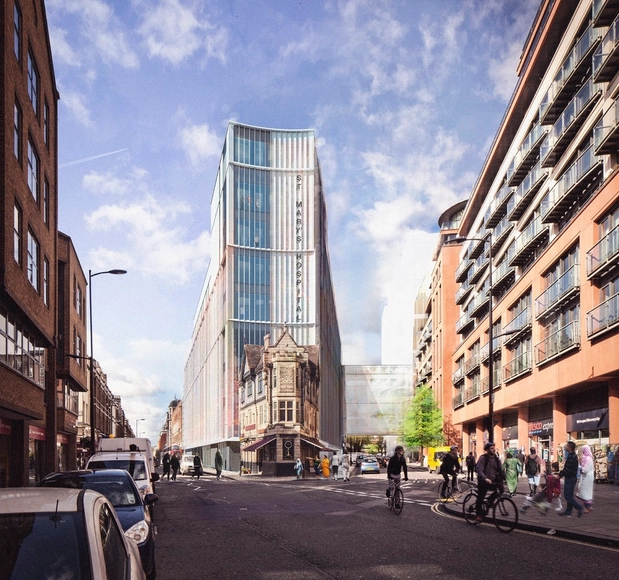
The Westminster City Council has granted planning permission for the New Outpatients Building at St Mary’s Hospital in Paddington, London. Designed by Feilden Clegg Bradley Studios, the 8-story building will consolidate outpatient services currently spread across 40 different locations into one comprehensive care center, increasing comfortability and ease-of-use for both patients and employees.
The award is given in four categories: Category A: Built, Less than $25 million in construction cost; Category B: Built, More than $25 million in construction cost; Category C: Unbuilt, Must be commissioned for compensation by a client with the authority and intention to build (No projects were selected in this category this year); and Category D: Innovations in Planning and Design Research, Built and Unbuilt.
Foster + Partners has announced the groundbreaking of a new $1.5 billion hospital for the University of Pennsylvania’s West Philadelphia Penn Medicine campus. Working in a multi-firm collaboration called PennFirst (with healthcare design firm HDR, engineers BR+A and construction management teams from L.F. Driscoll and Balfour Beatty), the architects have designed a 16-story facility known as “The Pavilion” to house 500 private patient rooms, 47 operating rooms and a total of 1.5 million square feet of healthcare space.
The competition called for the expansion of an existing listed 1970's hospital. Image Courtesy of HENN + C.F. Møller Architects
HENN and C.F. Møller Architects, of Berlin and Aarhus respectively, have jointly won an international competition to extend the iconic University Hospital RWTH Aachen in Germany. The winning entry, chosen amongst twelve others, responds to RWTH Aachen's existing listed 1970’s hospital with a partially-underground extension embedded in the landscape, seeking to minimize visual impact whilst creating lush green parkland for patients, staff, and the public.
With cracked paint, overgrown vines, rust, and decay, abandoned buildings have carved out a photographic genre that plays to our complex fascination with the perverse remnants of our past. While intellectual interest in ruins has been recorded for centuries, the popularity and controversy of contemporary "ruin porn" can be traced back to somewhere around 2009, when photographer James Griffioen’s feral houses series sparked a conversation about the potential harm in the aesthetic appropriation of urban collapse.
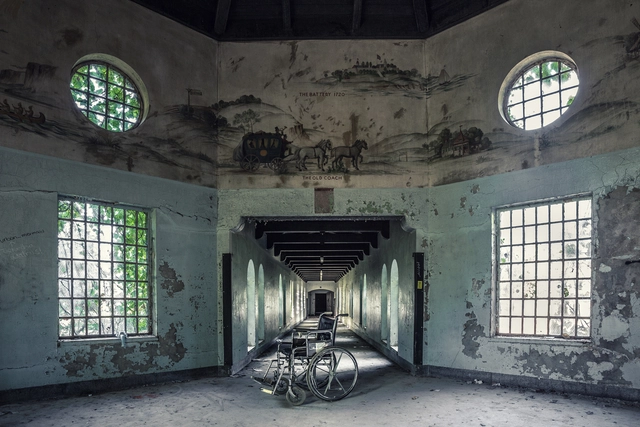
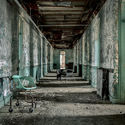
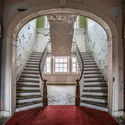
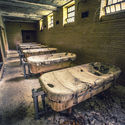
A favorite subject within this field is the American insane asylum, whose tragic remains carry echoes of the unsavory history of mental illness treatment in the United States. These state-funded asylums were intensely overcrowded and often housed patients in nightmarish conditions in the 20th century. Beginning in 1955, with the introduction of the antipsychotic drug Thorazine, these institutions were closed in large numbers, never to be reopened [1]. Now, these closed but un-demolished asylums that dot the country are the subject of "ruin porn" that neglects an equally important piece of the buildings’ narrative: the beginning. In his recent photobook Abandoned Asylums, Photographer Matt Van der Velde depicts this earlier period of asylum architecture, when the institutions were built in the belief that the built environment has the power to cure.
The American Institute of Architects (AIA) has selected seven recipients of the 2016 AIA National Healthcare Design Awards, given to the year’s best projects in healthcare building design and healthcare design-oriented research. Projects were selected for displaying “conceptual strengths that solve aesthetic, civic, urban, and social concerns as well as the requisite functional and sustainability concerns of a hospital.”
The award is given in four categories: Category A: Built, Less than $25 million in construction cost; Category B: Built, More than $25 million in construction cost; Category C: Unbuilt, Must be commissioned for compensation by a client with the authority and intention to build (No projects were selected in this category this year); and Category D: Innovations in Planning and Design Research, Built and Unbuilt.
Enter the unique realm of the "beautifully disturbing" with Project Senium, a new short film exploring the aging interiors of an abandoned mental hospital. Named for the Latin word for 'decay', the atmospheric film documents the asylum in breathtaking depth and detail, elevating material often dubbed "ruin porn" to a level of cinematic beauty.
Finnish firm Verstas Architects has been awarded first place in a competition for the expansion of Finland's Lapland central hospital for their design of a functional complex of "healing architecture." Responding to the challenge of Finland's aging population and changes in municipal funding, the winning proposal reflects the "hospital of tomorrow," creating a flexible and functional space in conversation with its urban surrounds.
Designing and building an 831,000 square foot hospital in 30 months is no easy feat. In fact, the Denver Saint Joseph Hospital project, owned by SCL Health Systems, is actually one of the fastest hospital builds ever completed in the US. Innovative methods of design, construction and collaboration among project partners throughout all phases of the project — from planning to construction — were critical for the team to open the hospital doors on time.
“The document management was tough—a million square feet of anything is going to generate a lot of documentation,” said Dale Clingner, an associate with Davis Partnership Architects, who partnered with H+L Architecture and ZGF Architects on the project, which was built by Mortenson Construction. To avoid the type of document management confusion that could slow progress, all project partners established a tacitly agreed-upon BIM execution plan and decided to incorporate digital design review in live collaborative sessions to successfully meet the condensed timeline on or under budget.
https://www.archdaily.com/614169/how-digital-design-review-enabled-one-of-the-fastest-us-hospital-buildsSponsored Post
Danish firm C.F. Møller has won first place in a competition to design an extension and renovation of Vendsyssel Hospital in Hjørring, Denmark. This winning proposal will add 14,000 square meters to the existing structure, incorporating a new treatment center, a ward for mothers and children, and a rooftop children’s playground. The new facilities are arranged around large courtyards, and make use of large windows to display the path of travel through the hospital. This helps make navigating through the large building as easy as possible.