First envisioned back in 2003, the enormous crystalline glass structure stands nearly complete on top a historic warehouse on the edge of the River Elbe. Rising costs, delayed schedules and legal issues with the contractor, has plagued this magnificent concert hall with controversy. However, according a report in the German news magazine Der Spiegel, contractor Hochtief has initiated a new deal to ensure the completion of the concert hall.
A revised contract, which is expect to adjust the architect’s fee’s to €94 million (€17 million over the original project cost), has projected Elbphilharmonie will be completed within the next four years. The news is bittersweet, as the architectural community and the residents of Hamburg have been waiting years for this highly anticipated concert hall to be complete, yet they cringe at the news of an overblown €575 million price tag.
Just recently, the City of Aberdeen announced a £300m city-wide plan of improving roads, schools and cultural buildings, with only £20m allotted for the city center, which will be pedestrianized but not much else. Thus, confirming the "final nail in the coffin" for DS+R's ambitious web of lush gardens and cultural landmarks.
Non-profit art organization FIGMENT asked the question “What would an art pavilion made out of recycled materials and based around the idea of "The City of Dreams" look like to you?" STUDIOKCA decided that it looks like an earthly cloud made of recycled water bottles; "A place to dream, in the 'city of dreams'."
This competition-winning cumulus, entitled 'Head In The Clouds' is campaigning to be the central pavilion at FIGMENT’s free art festival on Governor’s island in NYC this summer. The cloudy-centerpiece will contain a stage for events and provide a place for the 200,000 festival-goers to dream and contemplate the changing light.
More info on 'Head In the Clouds' after the break...
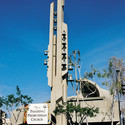
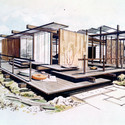
The Getty Trust is partnering with Pacific Standard Time to present 11 individual exhibitions throughout LA's museums that will explore the history and heritage of the city's modern architecture and its influential designers. As musician, photographer and architectural blogger Moby boasts that "LA has the most diverse architecture of any city on the planet". Pacific Standard Time Presents: Modern Architecture in LA will explore this diversity that covers post World War II architecture through today through specific points of view ranging in architectural style, influence and decade. The exhibitions, which will run from April through July 2013, are a follow-up to last year's Pacific Standard Time: Art in LA, 1945-1980. The focus of the exhibitions will range in scale and cover the monumental and everyday architectural moments that make LA unique. Exhibitions will present iconic modernist homes and cultural landmarks as well as coffee shops, car washes, and the freeways in addition to the un-built architectural fantasies of modernism and post-modernism.
Late last month the AIA released a report indicating that nonresidential construction is projected to increase by approximately 5% this year. While the recovery of both residential and nonresidential construction markets continues to grow slowly, the indication that it is steadily increasing marks a sense of security or stability that owners are beginning to identify in the economy. In the commercial / industrial sectors, hotels are seeing the largest projected growth at 15.7%, with retail and office buildings hovering between a 7 to 8% growth rate. In the institutional sector, construction growth is projected to be highest in health care facilities, which is expected to rise by 4.4%, while public safety spending is expected to decline in 2013.
With much awaited anticipation, Steven Holl‘s Sliced Porosity Block in Chengdu, China has just been completed. Forming giant public plazas with a mix of various functions, the group of five towers is intended to be seen as more of a public area despite its towering design as already witnessed in the site. Its sun sliced geometry results from required minimum daylight exposures to the surrounding urban fabric prescribed by code and calculated by the precise geometry of sun angles. The large public space framed by the block is formed into three valleys inspired by a poem of Du Fu (713-770). In some of the porous openings chunks of different buildings are inserted.
We have already brought you images of the project as it was under way, but the latest images from Hufton + Crow truly capture this inviting public realm in the heart of this metropolis like no one else!
Check out all the latest images of Steven Holl’s Sliced Porosity Block after the break.
The American Institute of Architects (AIA) has selected the 2013 recipients of the Institute Honor Awards, the profession’s highest recognition of works that exemplify excellence in architecture, interior architecture and urban design. Selected from over 700 total submissions, 28 recipients located throughout the world will be honored at the AIA 2013 National Convention and Design Exposition in Denver.
Top honors in architecture were awarded to the following:
The American Institute of Architects (AIA) today announced a five-point legislative agenda for the 113th Congress, targeting job creation for small businesses as a top priority. The agenda is the product of months of collaboration and dialogue with AIA members and leaders. More than 3,400 AIA members offered their views about what policies the AIA should advance through the annual Call for Issues last fall.
According to Mickey Jacob, FAIA, 2013 AIA President, the AIA’s agenda “reflects the interests of our members, which not so coincidentally reflects the priorities of the American people. These five priorities for the next two years have the creation of jobs as their centerpiece while also seeking to shore up our aging infrastructure, make our communities more resilient and assure we invest in the next generation of architects.”
As the Atlantic Cities best describes, “Leave it to Japan to turn one of the dirtiest and noisiest processes of the urban lifecycle – the demolition of highrises – into a neat, quiet and almost cute affair.”
Japanese construction company Taisei Corporation has discovered a new, more efficient way to disassemble, rather than demolish, a tall building over 100 meters. The process, known as Taisei’s Ecological Reproduction System or Tecorep, begins by transforming the structure’s top floors into an enclosed “cap”, which is then supported by temporary columns and powerful jacks. As demolition workers begin to disassemble the building from within, they use interior cranes to lower materials. After dismantling an entire floor, the jacks quietly lower the “cap” and the process is repeated.
“It’s kind of like having a disassembly factory on top of the building and putting a big hat there, and then the building shrinks,” says one Taisei engineer, according to this report in the Japan Times.
Learn about the advantages of this process after the break.
The American Institute of Architects (AIA) and the National Institute of Building Sciences (NIBS) have developed the Building Research Information Knowledgebase (BRIK), an interactive portal offering free online access to peer-reviewed research projects and case studies in all facets of the built environment, from pre-design through occupancy and reuse.
“By providing a portal to comprehensive research and data, this initiative is intended to help better educate the entire real estate marketplace on how design strategies and innovations can have a profound impact on building performance,” said AIA Chief Executive Officer, Robert Ivy, FAIA. “The BRIK offering is an entry-way to show quantifiable proof of evidence-based design approaches.”
Assemblage has succeeded against a prestigious shortlist – which included Zaha Hadid Architects, Capita Symonds, Fevre Gaucher and ADPI – in an international competition for the new Iraqi parliament complex in Baghdad. The $1Bn USD project challenged contestants to design a new, large scale complex amidst the remnants of a partially built super mosque planned by Saddam Hussein (photos of the existing site here).
The London-based practice will be awarded $250,000 USD and asked to produce a master plan for the surrounding city, as well as additional government buildings, a new hotel and public parks. The anonymous jury plans to exhibit the submitted projects, along with the judging committee’s decision. However, a date has yet to be announced.
Continue after the break for more images and the architects’ description.
When plans for the High Line were first revealed it made quite an impression on the design community. The converted elevated rail line, long abandoned by New York City, was threatened by demolition until a group of activists fought for its revival and helped transform it into one of the most renowned public spaces in Manhattan. Now Queens, a borough with its own abandoned infrastructure is on its way to redeveloping the land for its own version of the High Line, to be known as the Queensway Cultural Gateway.
In late December, the Trust for Public Land announced that New York Governor Andrew Cuomo has awarded a $467,000 grant to the organization to begin a feasibility study on the 3.5 mile Long Island rail line. Early proposals reveal a new pedestrian and bike path, public green space and a cultural gateway that will celebrate Queens’ diversity in art, sculpture and food, serving the 250,000 residents that live in the neighborhoods along the route, which include Rego Park, Forest Hills, Richmond Hill, Ozone Park and Forest Park.
It seems the rumors were true. The Venice Biennale’s board has just confirmed that Rem Koolhaas will be the Director for the next Venice Architecture Biennale in 2014 (to take place June 7th to November 23rd).
Ada Louise Huxtable (1921-2013), known as “the dean of American architectural criticism”, has passed away at the age of 91 at Memorial Sloan-Kettering Cancer Center in Manhattan. Winner of the first Pulitzer Prize for Criticism, Huxtable began her legendary career when she was appointed as The New York Times’ first architecture critic in 1963. Her sharp mind and straightforward critiques paved the way for contemporary architectural journalism and called for public attention to the significance of architecture.
In response an outrage that broke out amongst Democrats and Republicans, after House Speaker John Boehner failed to vote for Sandy relief before the end of the Congressional session two days ago, the House of Representatives have approved a $9.7 billion relief measure to aid flood victims of Hurricane Sandy. This is good news, as the Federal Emergency Management Agency’s (FEMA) recently warned that it would soon run out of funding if no measures were taken. Senate approval is likely to come later in the day and a second congressional vote is scheduled to take place on January 15 for a larger $51 billion request.
Understanding the importance of issuing this federal support, AIA President Mickey Jacob has offer Congress three key objects for helping these communities recover.
Read AIA President Jacob’s letter to congress and his three objectives after the break…
The American Institute of Architects (AIA) today issued the following statement in reaction to the House and Senate votes approving the “Fiscal Cliff” deal negotiated by Congressional leaders earlier this week. The statement should be attributed to AIA President Mickey Jacob, FAIA:
“On the plus side, the agreement prevents a tax increase on millions of Americans and small businesses. It also extends several business tax incentives that help create jobs and promote design and construction, including for schools and energy efficient homes.”
On the advice of English Heritage, architecture minister Ed Vaizey has listed Norman Foster’s first major public building: the 1977 Sainsbury Centre at the University of East Anglia, Norwich, in the United Kingdom. According to BDOnline, the popular public art museum, which houses the collection of Lord and Lady Sainsbury, was granted grade II* protection for its innovative engineering, fine design, historic association, flexibility and group value. Its revolutionary design features an innovative, prefabricated modular structure that is cleverly designed to allow for subsequent extension.
Vaizey described: “Norman Foster’s design for the Sainsbury Centre is recognized around the world as a high point of the British ‘high-tech’ movement and, by any standards, a modern classic.”
Construction has exploded along the High Line ever since it opened: condos hover over the rehabilitated track and look out onto the Hudson, while the new location of the Whitney Museum is making headway on the southern end of the park as Google moves into its NYC headquarters to a building just a few short blows away. Now, the historic Chelsea Market may be looking at a facelift following approval from the New York City Council for increasing density in the building by developers, Jamestown Properties. The proposed vertical extension, which has made a brief appearance on a few architecture blogs, will provide the additional in demand office and retail space in the Chelsea neighborhood.