The 2011 Serpentine Gallery Pavilion by Pritzker laureate Peter Zumthor was unveiled today. A design that ‘aims to help its audience take the time to relax, to observe and then, perhaps, start to talk again – maybe not’, the materials are significant in aiding the design which emphasizes the role the senses and emotions play in our experience of architecture.
Zumthor added that ‘the concept for this year’s Pavilion is the hortus conclusus, a contemplative room, a garden within a garden. The planted garden enclosed by this dark structure was conceived by the influential Dutch designer Piet Oudolf.
The building acts as a stage, a backdrop for the interior garden of flowers and light. Through blackness and shadow one enters the building from the lawn and begins the transition into the central garden, a place abstracted from the world of noise and traffic and the smells of London – an interior space within which to sit, to walk, to observe the flowers. This experience will be intense and memorable, as will the materials themselves – full of memory and time.’
The Academy of Art University, the nation’s largest private accredited art and design university, continues to grow their Landscape Architecture program. Earlier this year the University announced the addition of the School of Landscape Architecture with an accredited Associate’s (AA) and Bachelor’s (BFA) degree programs as well as continuing art education courses. Now the Academy of Art will additionally launch both a 3-year and 4-year MFA degree program. For more information about the new MFA program click here.
“You’re not going to find any of Ai Weiwei’s work being shown in Beijing”, said each Beijing gallery representative. That’s because the artist and agent provocateur has been detained for 80 days now was released today, from what the government is saying was based on “economic charges”. The name “Ai Weiwei” has joined a long list of sensitive words in this country, and associating yourself with the artist has become tantamount to asking for trouble. Just ask the Chinese curator who was questioned by authorities after putting Ai Weiwei’s name under a blank wall in Beijing’s Incident Art Festival.
While Beijing’s lively art scene might currently be scrubbed clean of Ai Weiwei’s work, there’s one thing that’s a little difficult to “harmonize” away, as it’s known here. In 1999, Ai Weiwei began moving into the world of architecture, establishing his own architecture studio called FAKE design four years later. So Ai Weiwei’s artistic vision continues to stand in the form of buildings across the nation’s capital. The most concentrated of these is the artist district of Caochangdi, a few kilometres north of the more commercial art district called 798. It’s also the location of the artist’s studio and where he headed straight to after his release.
More after the break.
https://www.archdaily.com/145818/ai-weiwei-is-free-at-last-plus-photos-of-his-architecture-work-in-beijingMonica Tan
Back in February we shared with you that part of President Barack Obama’s State of the Union address focused on highlighting future plans for making American businesses more energy efficient. The Better Buildings Initiative (BBI) that the President proposed would invest in innovative clean energy technologies, aiming to increase energy efficiency in commercial by 20 percent in the next ten years.
Several hundred guests joined Daniel Libeskind in a ceremony last Friday as he laid the foundation stone of the Kö-Bogen building along with Dusseldorf’s Lord Mayor Dirk Elbers, investor Kurt Zech of Zech Group, and project developer Stefan H. Muehling. The stainless steel foundation stone, designed by Libeskind, will be visibly integrated into the facade of the building.
The new 432,300 sqf mixed use building is scheduled for completion in 2013 will house both office and retail space in downtown Dusseldorf. The design of Kö-Bogen intends to naturally blend landscape into the building space through geometry, permeated cuts in the facade, the green courtyards, and green roof system. All of these elements are ‘part of a new environment that bridges urban space with park space’.
Last week the Internet and architecture blogs went crazy after Steve Jobs presented the new Apple Campus to the city of Cupertino, California.
Rumors about Foster + Partners (an office with a high expertise on work environments) working with Apple on this new campus appeared on December last year on a Spanish newspaper, but there was never an official confirmation (or denial). But given that the actual project fits with the information we received from an anonymous tipster last December, it seems it could be right:
“I recently got a tour of Norman Foster’s office in London and saw some images of the Apple Campus design. I believe the main building will be a large donut shaped building with all the offices and labs surrounding a large garden. It was a very pure form which connects to some of the recent Apple stores, but I was surprised that it didn’t really scream Apple to me. Of course it could have been a very preliminary design that wasn’t fully resolved yet. Anyway, I just thought I would pass on some info.”
During Steve Job’s presentation to the city of Cupertino we could see this round building, and Jobs outlined several facts on how this new campus for 12,000 people will improve the 98-acre site, such as taking parking underground to reduce the footprint, increasing landscaping from 20% to 80%, and planting more trees (3,700 now, 6,000 in the future). It even includes its own natural gas based energy generation plant (as seen on the drawings) with the electrical grid as backup.
“It’s a pretty amazing building. It’s a little like a spaceship landed. It’s got this gorgeous courtyard in the middle… It’s a circle. It’s curved all the way around. If you build things, this is not the cheapest way to build something. There is not a straight piece of glass in this building. It’s all curved. We’ve used our experience making retail buildings all over the world now, and we know how to make the biggest pieces of glass in the world for architectural use. And, we want to make the glass specifically for this building here. We can make it curve all the way around the building… It’s pretty cool.”
We reached Steve Jobs over the past weekend to get more details about the project and he said that he wasn´t interested in presenting the project on ArchDaily at this time, possibly because the project still needs to be approved by the city. We hope to bring you more details later on, so you can have an informed opinion.
More images from the presentation after the break.
We have been covering the fluctuating Architecture Billing Index for several months, anxious to see steady improvement in our economy and our profession’s field. In the month of April, a survey was included in the Billings Index and the AIA recently released the findings. As John Schneidawind reported, almost two-thirds of the surveyed architects reported at least one stalled project due to lack of financing, despite record low interest rates.
Back in 2009 when Norway’s Kunt Hamsun Center was unveiled, the faceted volume topped with an a-typical vertical grass roof gained international attention for its reinterpretation of Nordic aesthetics complimented by Holl’s fascination with interior light quality. This year, Holl + Oslo-based LY Arkitekter, have been awarded the prestigious 2011 Byggeskikkprisen for their collaboration on the project; rising above over 90 submitted buildings. The prize, which is granted by the Norwegian government for outstanding architecture, was presented by Local Government and Regional Development Minister Liv Signe at the Norwegian Design and Architecture Center in Oslo. “The Hamsun Center is a piece of original architecture that is deeply moving on many levels and meets all of its functions in exceptionally exciting and unique ways,” said the jury. “It both provokes and delights through its strong, clear and non-traditional form, and it finds its natural place in the dramatic skyline of the northern landscape.”
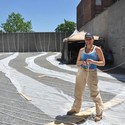
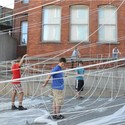
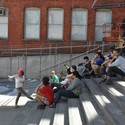
The community based winning design for the 2011 Young Architects Program at the P.S.1, “Holding Pattern” by Interboro Partners, shared photographs of the installations canopy raising which took place last Thursday at MoMA. The New York firm, formed by Tobias Armborst, Daniel D’Oca, and Georgeen Theodore, were able to creatively accomplish the design within the Young Architects Program’s budget and program requirements, stretching the funds to essentially serve two purposes; as the materials will be recycled, donating the objects such as ping pong tables, benches, and flood lights, to the community at the end of the installation. ”Holding Pattern” will welcome visitors beginning June 19th.
New Yorkers can’t get enough of James Corner Field Operations with Diller Scofidio + Renfro‘s High Line as millions meandered along the refurbished rail tracks enjoying spectacular views of the skyline. And yet, the opening of the High Line in 2009 offered a mere preview of the project’s total grandeur as parts two and three of the 1.45 mile project were still to come. Today, the second phase of the High Line has opened to the public – a section which stretches from West 20th up to West 28th Street. This segment includes a hovering frame that will display people’s silhouettes against the evening sky, an elevated pathway which brings visitors to the level of the trees’ canopy, and a Great Lawn which will be perfect for sun-bathing and a summer time picnic.
After the break you can find a great set of photos from Iwan Baan, via the High Line Facebook Page, and some more information about the project.
2010 Pritzker Prize winning SANAA has released renderings to convert La Samaritaine department store in Paris into a mixed-use development. Commissioned by LVMH (client/developer) the architectural concept for the project expresses above all the ambition to restore the La Samaritaine, recognizing the significance of the building and the role the restoration will play in the revitalization of the neighborhood as a whole. The project is schedule to begin July of next year.
Last May, we shared NYU’s expansion plan, NYU 2031: NYU in NYC – a 20 year developmental framework to help the campus provide adequate facilities for its growing student body. Yet, as we reported, the conceptual plan was met with much resistance as residents of the Village claim that the plans will diminish the character of the area. Only time will tell whether NYU will successfully expand into the Village, however, in the meantime, as The Journal reported, NYU is putting more attention on its expansion to Brooklyn and Manhattan’s East Side. The university has just leased 120,000 sqf in Brooklyn (a move that has increased the existing Polytechnic Institute of NYU by 20%); plus, NYU has chosen Kohn Pederson Fox to design a 170,000-square-foot campus between 24th Street and 34th Street which will be home to a new bio-engineering program and provide more space for the dental school, as well as the relocation of the nursing school from Washington Square. NYU’s vision for a presence on Governors Island is still in the works as the university is looking to develop one million square feet for academic and residential use. We will keep you updated as we hear more about the plan.
This was the third time we attended the event (after 2009 in Buenos Aires and 2010 in New York) and it was a special evening, not only because of the renowned architects attending the event, but also for the presenting speech by President Barack Obama. Obama, a friend of the Pritzker family, delivered a short but interesting speech to Souto de Moura and the architects. Obama’s interest in architecture goes way back as we’ve heard him state that he thought he could be an architect, but as he said at the speech “I expected to be more creative than I turned out, so I had to go into politics instead”.
It’s worth mentioning that Obama referred to the Pritzker Prize as the Nobel of architecture, a common comparison that puts the importance of this recognition in context.
After several mentions to architecture, his hometown Chicago, Mies (his campaign HQ was in a Mies building), Louis Sullivan, Frank Lloyd Wright, and Jefferson’s Monticello, he mentioned that architecture is about “creating buildings and spaces that inspire us, that help us do our jobs, that bring us together, and that become, at their best, works of art that we can move through and live in. And in the end, that’s why architecture can be considered the most democratic of art forms“.
About Souto de Moura’s work he mentioned that it was “effortless and beautiful”, and he highlighted the fact that the Braga Stadium was a democratic building, as he not only served the audience but people on the outside.
After Obama and Lord Palumbo (chairman of the Pritzker jury) Eduardo Souto de Moura accepted his recognition, and said something very interesting that made me understand contemporary Portuguese architecture. He developed his work during the 1974 revolution in Portugal, after which the country required to give housing to millions of people. At that time post modernism was starting strong in the country, but that wasn´t the way to do housing (with columns and arches), which led to a late modernism that we see on his works, which in my opinion became a legacy to the new generation of Portuguese architects. More photos after the break:
DesignByMany is a challenge based design technology community sponsored by HP and ArchDaily. Users post challenges to the community along with their design source files. The community can then post responses with their own source files to solve the challenge. They can also comment on the challenge and interact with other designers throughout the process.
As designers we not only need to think about how we can originate buildings, we need to think about how we can use existing structures to accommodate new types of building programs. This challenge is to design a pedestrian bridge between to two existing buildings.
It strives, with the help of the curatorial endeavours of artists and projects that can contribute a different layer to the ever more monopolized artistic scene.
The third issue is “Dubai Graphic and Visual Encyclopedia”, Dubai Manifesto 3/3. Adapted for the latest electronic devices (Ipad, Kindle, etc), Brusselssprout can be downloaded quarterly in ePub and PDF format from the magazine’s official website.
More information on this third issue and some images after the break.
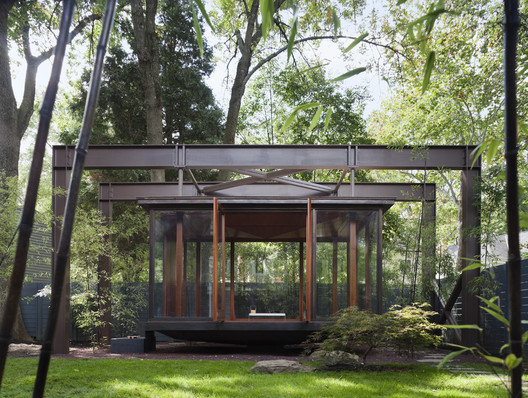
The eight winners of the 2011 Small Project Awards were recently announced by the AIA. In its eighth year the program focuses on highlighting good design at any scale. The jurors for this year included: Deborah Pierce, Obie G. Bowman, Randy Brown, Lance Hosey, and Wendy Evans Joseph.
Steven Holl Architects were approved last week by the board of visitors’ finance committee to design a $19.3 million gallery at Virginia Commonwealth University (VCU) in Richmond, Virginia.
An existing surface parking lot on the east side of VCU’s campus will be transformed into the 32,000 sqf arts institute. This will provide an opportunity to create a distinctive entrance into the campus from Broad and Belvidere streets. The program for the new gallery includes space for traveling exhibits and student exhibits, archival study area, offices, and an auditorium.