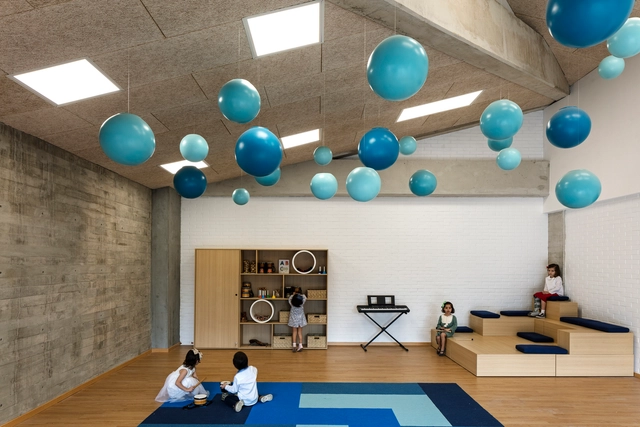
The Reggio Emilia Approach was created in the post-WWII period at the initiative of widowed mothers and under the coordination of journalist and educator Loris Malaguzzi. In a time of postwar urban reconstruction, the group's primary concern was the formation of new schools, where they wanted to create a peaceful, welcoming, and cheerful environment, with a domestic atmosphere where children could stay while their mothers worked. Understanding the children's interests and providing a suitable environment for exploration and experimentation is one of the focal points of this pedagogy. The creation of a safe and stimulating environment is so fundamental that, in much literature, it appears as a third teacher.
Manufacturers: Hansgrohe, Art Steel, Cia de Iluminação, Clatt, Concresteel, +7Deca, Eurocentro, Microcimento Do Brasil, Portinari, Pratikline, Tecnics, Viroc-7
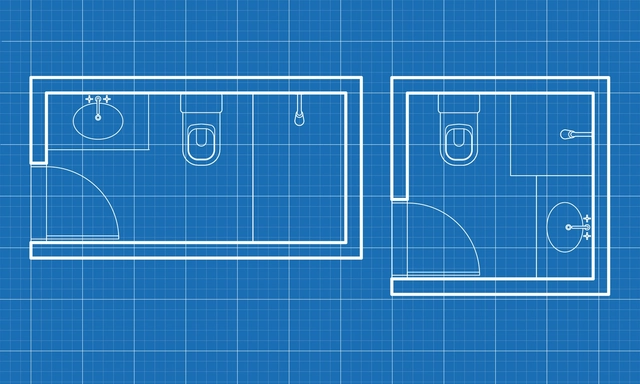
Having access to a bathroom is, above all, a factor of dignity. As basic as this fact may seem, the WHO (World Health Organization) estimates that 2 billion people worldwide do not have access to basic sanitation facilities, such as bathrooms or latrines. Such inadequate sanitation causes 432,000 deaths annually, mainly from diarrhea, in addition to being an aggravating factor for several neglected tropical diseases including intestinal worms, schistosomiasis, and trachoma. In 2010, the UN (United Nations) labeled sanitation a basic right, alongside access to drinking water.
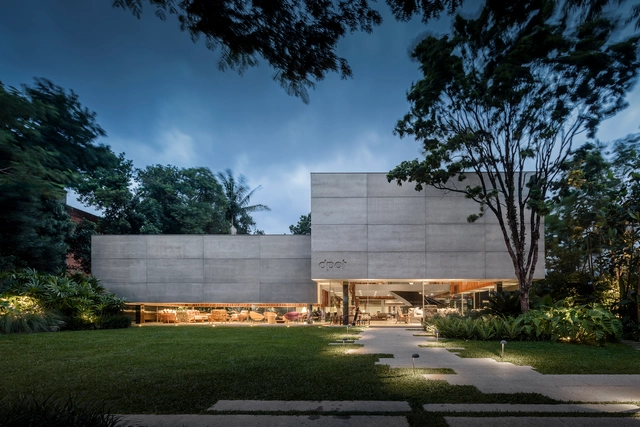
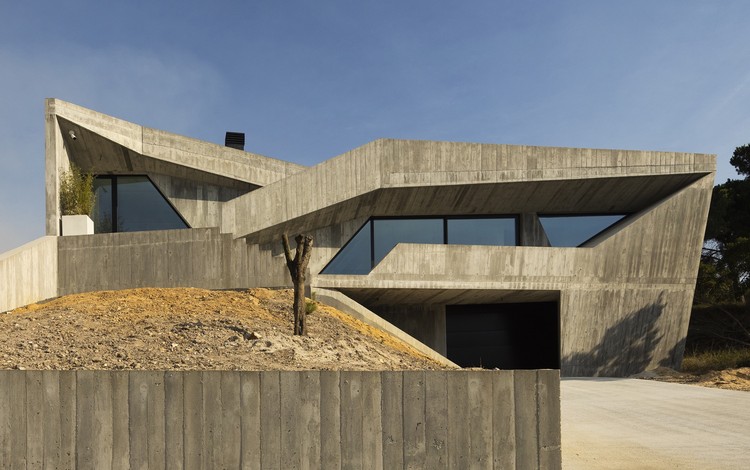
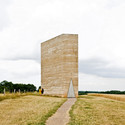
Peter Zumthor, in one of his most emblematic works, gives concrete an almost sacred dimension. The work in question is the small Bruder Klaus Field Chapel, located in a small village in Germany, a construction that is both robust and sensitive. Built with white cement, which was mixed with stones and sand from the region, the chapel is composed of 24 layers of concrete that were poured day after day by local labor, and compressed in an unusual way. The building's flat and smooth exterior contrasts with its interior, which was initially made of inclined wooden logs forming a triangular void. To remove these internal forms, the logs were set on fire in a controlled process, reducing them to ash and creating a carbonized interior that varied between black and gray and retained the texture of the negatives of the logs. The result is a masterpiece of architecture, a space for reflection and transformation, in which the same material appears in diametrically opposing ways.
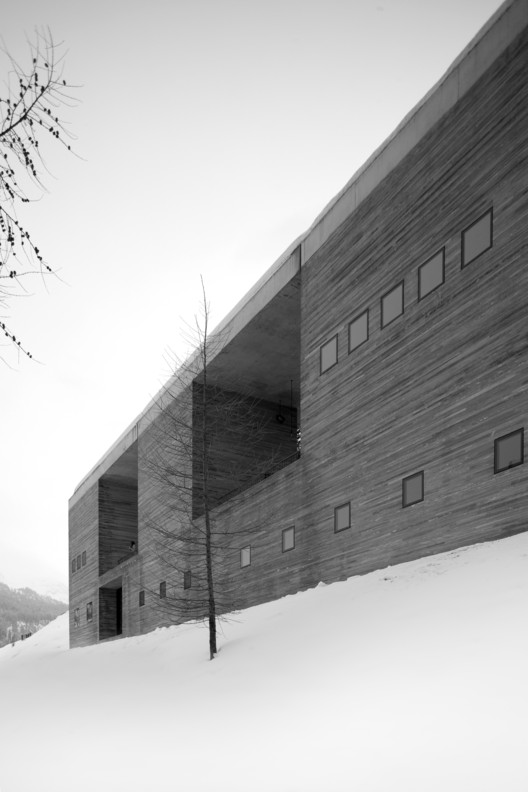
Known for his sensuous materiality and attention to place, 2009 Pritzker LaureatePeter Zumthor (born April 26, 1943) is one the most revered architects of the 21st century. Shooting to fame on the back of The Therme Vals and Kunsthaus Bregenz, completed just a year apart in 1996 and 1997, his work privileges the experiential qualities of individual buildings over the technological, cultural and theoretical focus often favored by his contemporaries.
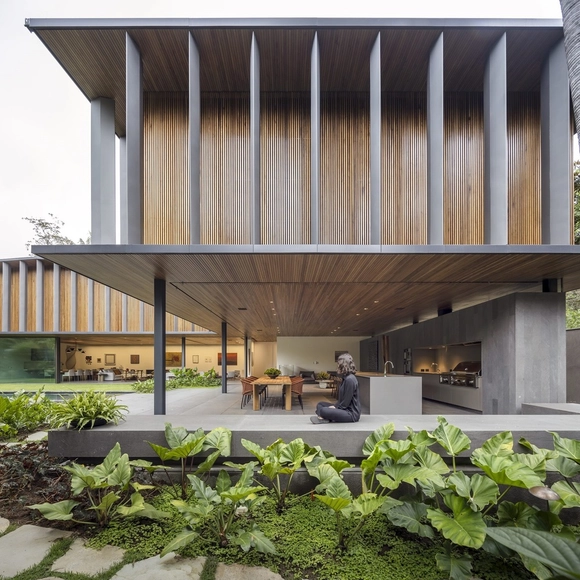
Nothing is more rational than using the wind, a natural, free, renewable and healthy resource, to improve the thermal comfort of our projects. The awareness of the finiteness of the resources and the demand for the reduction in the energy consumption has removed air-conditioning systems as the protagonist of any project. Architects and engineers are turning to this more passive system to improve thermal comfort. It is evident that there are extreme climates in which there is no escape, or else the use of artificial systems, but in a large part of the terrestrial surface it is possible to provide a pleasant flow of air through the environments by means of passive systems, especially if the actions are considered during the project stage.
This is a highly complex theme, but we have approached some of the concepts exemplifying them with built projects. A series of ventilation systems can help in the projects: natural cross ventilation, natural induced ventilation, chimney effect and evaporative cooling, which combined with the correct use of constructive elements allows improvement in thermal comfort and decrease in energy consumption.
In times of quarantine, architects and designers are settling into a new remote working environment. In this process of implementing platforms and workflows to work from home, the risk of social isolation remains real, even for companies used to this environment, such as ArchDaily. As David Basulto, CEO of ArchDaily, wrote last week, the quarantine implies not just working online, but "staying connected and support each other."


.jpg?1594149242&format=webp&width=230&height=230&crop=true)


_copiar.jpg?1526480173&format=webp&width=230&height=230&crop=true)
.jpg?1526480088&format=webp&width=230&height=230&crop=true)
_copiar.jpg?1526480197&format=webp&width=230&height=230&crop=true)
_copiar.jpg?1526480161&format=webp&width=230&height=230&crop=true)



.jpg?1593664464&format=webp&width=640&height=580)

.jpg?1593664852&format=webp&width=230&height=230&crop=true)
.jpg?1593664477&format=webp&width=230&height=230&crop=true)
.jpg?1593665178&format=webp&width=230&height=230&crop=true)
.jpg?1593664464)
.jpg?1465011155&format=webp&width=640&height=580)
.jpg?1465010900&format=webp&width=230&height=230&crop=true)
.jpg?1465010808&format=webp&width=230&height=230&crop=true)
.jpg?1465010844&format=webp&width=230&height=230&crop=true)
.jpg?1465010776&format=webp&width=230&height=230&crop=true)
.jpg?1465011155)




.jpg?1591893896)
.jpg?1591894104&format=webp&width=230&height=230&crop=true)
.jpg?1591894053&format=webp&width=230&height=230&crop=true)
.jpg?1591894024&format=webp&width=230&height=230&crop=true)
_.jpg?1591894012&format=webp&width=230&height=230&crop=true)











.jpg?1515030902)
_Fernando_Guerra_006.jpg?1585858178&format=webp&width=640&height=580)
_Takuji_Shimmura_24.jpg?1585855053&format=webp&width=230&height=230&crop=true)
_Takuji_Shimmura_26.jpg?1585855190&format=webp&width=230&height=230&crop=true)
_Takuji_Shimmura_22.jpg?1585854824&format=webp&width=230&height=230&crop=true)
_Takuji_Shimmura_18.jpg?1585854638&format=webp&width=230&height=230&crop=true)
_Fernando_Guerra_006.jpg?1585858178)