-
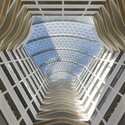
Architects: Feilden Clegg Bradley Studios
- Area: 5596 m²
- Year: 2022
-
Manufacturers: KEIM
-
Professionals: AKTII, Croft Building and Conservation, E3 Consulting Engineers, LT Studio, Gleeds, +1





Architecture remains in constant tension with natural forces. Designed around gravity, climate, and time, buildings are always part of larger systems. Throughout the world, designers have tried to mitigate natural forces by constructing hybrid spaces and structures, artificial areas where nature meets the manmade. Embodying this relationship, canals reflect a desire to direct nature and its flows. Today, these fluid spaces are opening up to new programs, projects that explore modern life and urban vitality.
We spoke with Beat Guhl, CEO of Sky-Frame, during the Swiss Bau fair – one of the largest events in the materials industry. Sky-Frame produces frameless sliding window systems; vital components to achieve an effective and efficient transparency in architectural projects. The company is constantly pushing for technical innovation and works closely with architects to help achieve fluid spatial concepts.


Between March of 2013 and December of 2014, Simon Henley of London-based practice Henley Halebrown wrote a regular column for ArchDaily titled “London Calling,” covering architectural topics of note in the UK's capital. Now, Henley is returning to his column – but in the wake of 2016's shock political developments, his column is re-branding. Thus, here he presents the first of his column “Beyond London” – a look at architectural topics around the UK. Here, Henley presents his opinion on those political developments, and the role architects should play as the UK embarks on a new period in its history.
Post-Brexit, British architects need to think hard about the profession’s London-centric position. There has been a policy of inclusion of non-London architects on panels, their work in magazines and on awards shortlists, but this is not enough. It was quite clear on June 24th when the London design community awoke to the realization that Britain will leave the European Union, that a “Remain”-minded bubble had formed within the capital. The same may be true of the other large cities around the country which voted largely in favour of “Remain.”

_JoChambers-Cropped-764x500.jpg?1428504204)
A total of sixteen projects have been shortlisted for RIBA South West 2015 Awards, featuring buildings by Glenn Howells Architects, Feilden Clegg Bradley Studios, AHR, and Stonewood Design. All shortlisted buildings will now be assessed by a regional jury. Regional winners will then be considered for a RIBA National Award in recognition of their architectural excellence, the results of which will place some projects in the running for the 2015 RIBA Stirling Prize.
See the complete list of shortlisted projects after the break.
AlanWilliams.jpg?1426489201)
A total of 15 projects have been shortlisted for RIBA North West 2015 Awards, featuring buildings by John McAslan + Partners, Feilden Clegg Bradley Studios, MUMA and Carmody Groake. All shortlisted buildings will now be assessed by a regional jury. Regional winners will then be considered for a RIBA National Award in recognition of their architectural excellence, the results of which will place some projects in the running for the 2015 RIBA Stirling Prize. The 2014 RIBA Stirling Prize was won by Haworth Tompkins for the Everyman Theatre in Liverpool, a project which was shortlisted by this branch of the RIBA. Feilden Clegg Bradley Studios' Manchester School of Art also made it to the national finals.
See the complete list of shortlisted projects after the break.

Mies. UK recently spoke to Roger Stephenson OBE, Managing Partner at Manchester based stephenson:ISA Studio, about his award winning practice's approach to "using craft in a contemporary way". The office most recently completed an addition to Chetham's School of Music, winning the 2013 RIBA Regional Building of the Year Award, RIBA National Award, and the RIBA Regional Award. This project is the latest in a long list of innovative buildings that are part of a "rigorously coherent, contextually progressive architecture" that has made the practice one of best known regionalist design offices in the UK.
Read the interview in full, and watch a three minute tour of Chetham's School of Music, after the break.

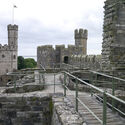
The 2013 RIBA Stirling Prize has been won by Witherford Watson Mann for Astley Castle (Nuneaton, Warwickshire). The winner was just announced at a ceremony at London's Central Saint Martins, a building designed by last year's winner Stanton Williams. Astley Castle was also voted as BBC readers' favourite earlier this week. Jury-member Stephen Hodder stated that "engaging with the building was such a surprise for [the jury]," and described it as an "unassuming" building with great "rigour."






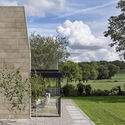

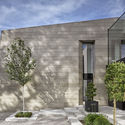


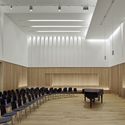
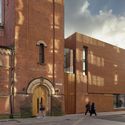




.jpg?1390765597)
.jpg?1390765552 "© Daniel Hopkinson")
.jpg?1390765557 "© Daniel Hopkinson")
.jpg?1390765580 "© Daniel Hopkinson")
.jpg?1390765597)