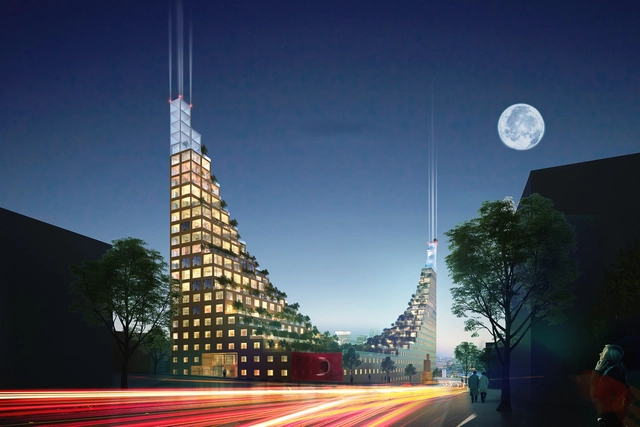
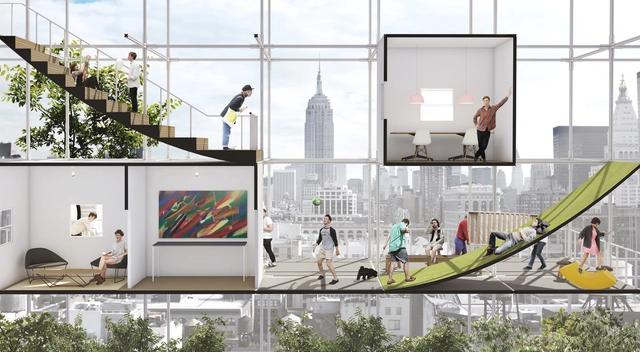
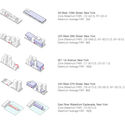
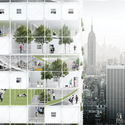
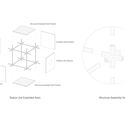
Beomki Lee and Chang Kyu Lee of Atelier L have unveiled their speculative project, Instant City: Living Air-Right, which proposes that affordable housing and public programs be built in the air rights of existing buildings in New York City.
As a response to the lack of home ownership in the city, the project aims to provide living space, as well as to foster community in an overlooked space.
One general trend in today's Information Age involves the absolute transmutation of downtime into productivity or engagement of any kind, however meaningless. We hear it all the time: we have lost our ability to be still. However, as a team at Ennead Lab has observed, some of the same technologies that are causing this shift in routine also have the potential to open new, empty pockets of time in our daily lives, and affect the built spaces with which we interact.
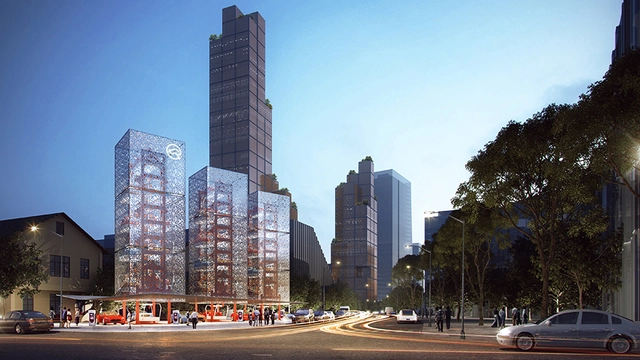
Tasked with designing an electric car charging station for a development in Shanghai, Ennead realized that the five hours required to fill up a single standard charge necessitate a place for customers to wait. In an article on Metropolis Magazine, they show that the promise of transportation-less people to stick around in one place for such a period of time opens up a host of possibilities for what could fill the latency period; the Shanghai project, however, focuses on the opportunity to create a civic space. The team has imagined the modern "gas station" as a vertical charging tower that calls upon the functionality of urban parking elevators in the 20th century, this time clad in reflective silver to serve as a beacon for customers in search of a charge. Rather than standalone charge-park towers, the projects are integrated into a system that encourages patrons to walk to neighboring zones to eat, shop, and socialize while they wait.
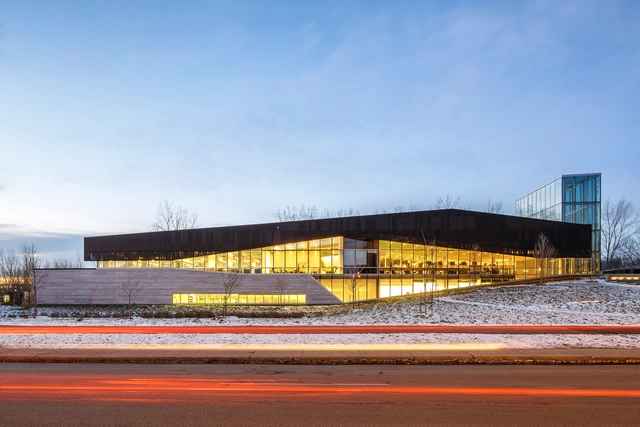
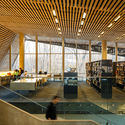
"The library offers a variety of beautifully lit and welcoming spaces throughout, maximizing daylight and views and the use of natural elements, such as wood, to create an environment that contributes to health and wellbeing,” said the jury. “Their approach to high-performance building through whole systems design and strategy has resulted in an impressive achievement.”
Hyperloop One has revealed the results of the second round of the Hyperloop Global Challenge, which is seeking proposals for future routes for their vacuum-powered transportation system. The semifinalists include 11 different routes connecting various major American cities. Check them out below.
A total of 85 buildings from the British capital have been shortlisted for the 2017 RIBALondonAwards, including projects from Wilkinson Eyre, AHMM, Allies and Morrison, Herzog & de Meuron, and Rogers Stirk Harbour. All 85 buildings will now be visited and carefully assessed by one of four regional juries, before the regional winners are selected in June of this year. Winning projects will continue on to compete for the RIBA Stirling Prize - the UK's highest honor for architecture.
See a complete list of shortlisted buildings after the break.
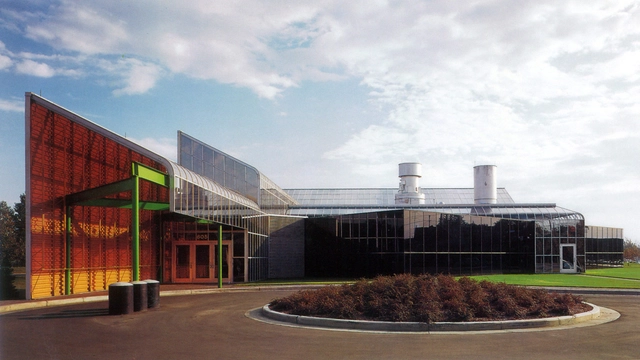
If I had to guess, I would say that it has been forty years since Columbus, Indiana, was the hot topic of cocktail conversations at design-related get-togethers in New York City. In those days, it was the supercharged patronage of industrialist J. Irwin Miller and his relationships with designers like Eero Saarinen and Alexander Girard that spurred a wave of innovative and provocative architecture in the small Midwestern town. Columbus, with a population of 45,000, has a Robert Venturi fire station, a John Johansen school, a park by Michael Van Valkenburgh, and several buildings by Eliel and Eero Saarinen, including the younger’s iconic Miller House.
“I could not be more excited to realize our first European project in my hometown. Designed not just as a series of buildings but as an exploration of the spaces between the buildings, Die Macherei is an innovative design for a new way of working and interacting, integrating social activity and behaviors to promote a sense of community,” expressed Matthias Holwich, principal at HWKN.
With the 2017 Salone del Mobile now behind us, photographer Laurian Ghinitoiu has shared a collection of photographs from Milan Design Week. From housing prototypes to immersive "digital installations", the annual design show—which is often touted to be the fourth largest of any kind in the world—this year brought together a wide range of practitioners and design companies. In Milan, unusual collaborations are the order of the day.
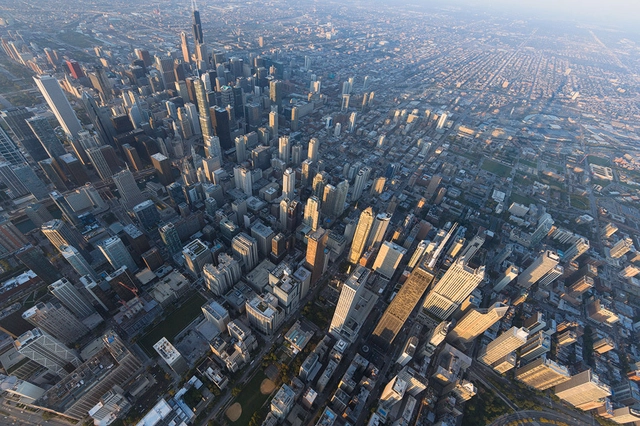
The Chicago Architecture Biennial has announced partnerships with six Chicago museums and institutions that will serve as “community anchor” sites during the event’s run from September 16, 2017–January 7, 2018. This selection of sites will play host to events, exhibitions and other programming surrounding the festival, in hopes of encouraging Biennial attendees to explore other parts of the city and experience a few of Chicago’s historic museums.
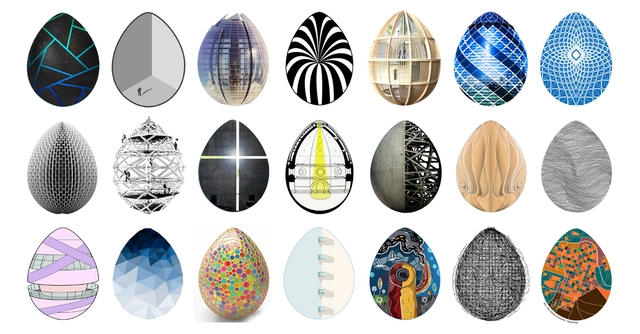
Year after year we are never disappointed by the witty, creative, and inspiring designs of ArchDaily readers from across the globe. From over 700 submissions, here are the most egg-celent!
https://www.archdaily.com/869135/easter-eggs-for-architects-and-architecture-loversAD Editorial Team
The American Institute of Architects (AIA) has named the fourteen projects selected as recipients of the 2017 Housing Awards. Now in its 17th year, the AIA’s Housing Awards program was established to recognize "the best in housing design and promote the importance of good housing as a necessity of life." Projects are awarded in four categories: One/Two Family Custom Housing, One/Two Family Production Housing, Multifamily Housing and Special Housing.
When I joined BIG–Bjarke Ingels Group in 2008, we had one office, one partner, and 45 employees. Eight years later we have 12 partners and more than 400 employees in Copenhagen, New York, and London. As we continue to expand our reach, projects, and staff I have awarded myself the luxury of looking back and distilling what has made a difference so far. These are my top eight lessons for having secured the successful growth of BIG over the past eight years.
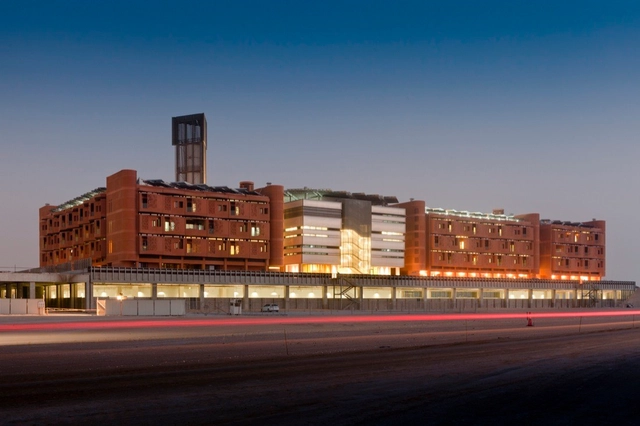
Masdar Institure. Image Courtesy of Foster + Partners
The Norman Foster Foundation has announced plans for its new Madrid-based headquarters to be opened in June this year, whose inauguration will be marked by the first session of the global forum Future is Now, addressing future social, economic and design concerns architecture will face. With the intersection of art, technology, and design, the Foundation facilitates multifaceted thinking and discourse among architects and designers. The opening of its new headquarters is a vital step in “establishing a world-class archive and inaugurating an international program of research, education, and interdisciplinary projects.”
According to the Foundation, “the decision to establish the Foundation as an independent entity, separate from the architectural practice of Foster + Partners, grew out of the perceived need for a permanent physical space that could house the Archive and study center, receive students and graduates, and present programs and projects."
https://www.archdaily.com/868821/norman-foster-foundations-madrid-headquarters-to-inaugurate-with-global-forum-in-juneOsman Bari
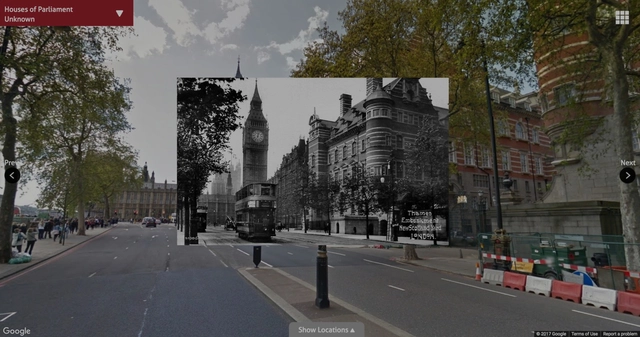
Houses of Parliament – Then and Now. Image Courtesy of Expedia
Go on a virtual stroll through century-old London, with this new interactive map produced by Expedia. Named “Historic London,” the app takes you through 14 notable sites throughout the British capital, from Buckingham Palace to a view of St. Paul’s Cathedral from Fleet Street. Archival images of the sites from the late 1800s and early 1900s are overlayed onto the streetview of today, so you can easily compare what has and hasn’t changed over the last 100 years.
Telluride Arts has announced the three finalist firms that will compete for the adaptive reuse and transformation of the historic Telluride Transfer Warehouse in the arts district of Telluride, Colorado. Selected from an initial list of 30 firms from across the country, Gluckman-Tang, LTL and NADAAA were chosen as finalists based on “their sensitivity to the Telluride Arts and Telluride Historic Landmark Districts, their experience with historic restoration, and their previous design experience with public spaces for the arts.”
The three firms will now develop conceptual designs for the building, with the vision of “[creating] an architectural and cultural landmark in the heart of Telluride that provides contemporary, public art space that deepens and expands the cultural life of Telluride.”
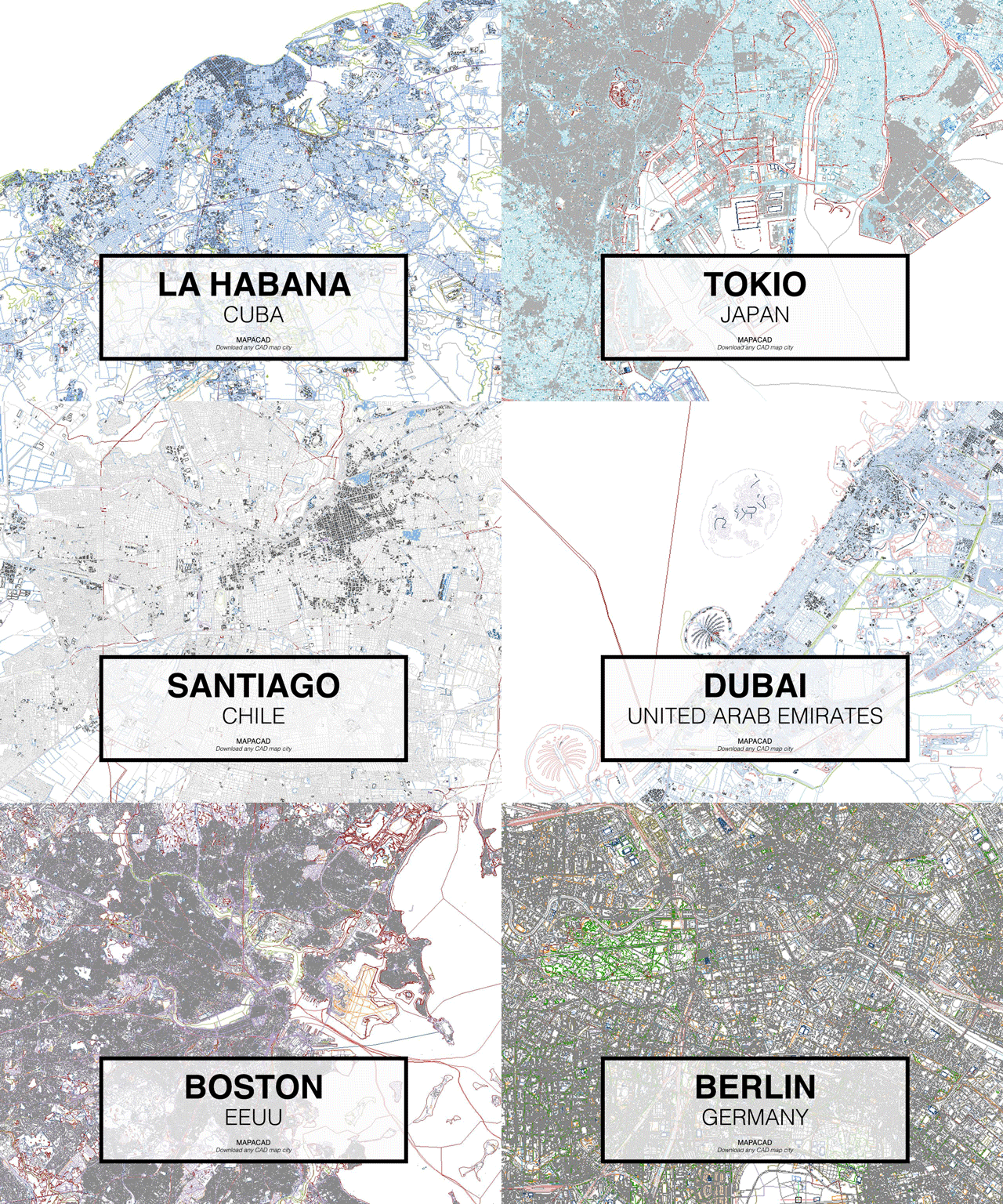
Mapacad is a website that offers downloads of .dwgs of dozens of cities. With 200 metropolises in their database, the founders have shared a set of their most-downloaded cities.
The files contain closed polyline layers for buildings, streets, highways, city limits, and geographical data--all ready for use in CAD programs like Autocad, Rhino, BricsCad and SketchUp.
Drawing on a touchscreen or trackpad can be a huge pain – but when you’re on the go, sometimes that may be your only option to quickly convey an image. To the rescue, Google has unveiled its latest AI experiment, AutoDraw, which uses machine learning to pair your wobbly doodle with a corresponding artist-drawn image – like autocorrect for sketching.
https://www.archdaily.com/869005/googles-new-autodraw-feature-will-complete-your-drawings-for-youAD Editorial Team
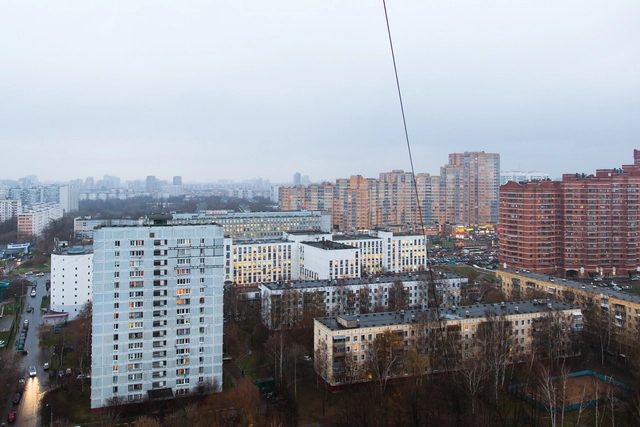
The Moscow government has just launched the biggest demolition program in the city’s history. Its goal is to get rid of 8,000 5-story residential buildings constructed in the Soviet era—it is probably the biggest program of erasure of modernist architectural heritage in world history. The main assumptions of the plan, as well as the press comments following it, show that we have forgotten what modernism was about, and what the real values of this architecture are.
A few years ago I published an essay titled Belyayevo Forever, dedicated to the preservation of generic modernist architecture. I focused on Moscow’s microrayons—vast, state-funded housing estates built in the Soviet era. In the essay, I explained the spatial and cultural values these prefabricated landscapes had. I also speculated about how one would go about preserving architecture that completely lacks uniqueness. The essay ended with a provocative statement: we should put Belyayevo—the most generic of all Soviet estates—on the UNESCO heritage list.
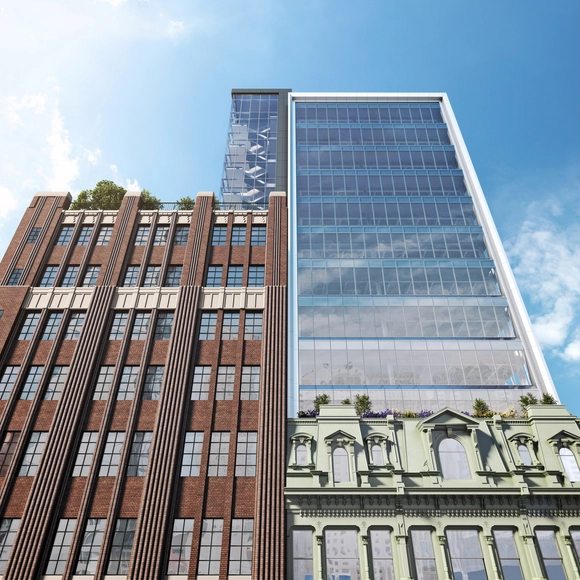
Plans have been announced by Tishman Speyer for "The Wheeler", a glassy new addition above downtown Brooklyn’s iconic Macy’s store on Fulton Street. The design is a collaboration between Shimoda Design Group and Perkins Eastman, and incorporates 10 stories of dynamic office and mixed-use space that will sit atop the existing department store.
Paying homage to the renowned 19th century Brooklyn developer Andrew Wheeler, the new offices will come complete with 16 foot ceiling heights, an acre of combined outdoor terrace gardens and decks, an amenity floor, and 360,000 square feet of rentable space, all while capturing the surrounding views of Lower Manhattan, the Brooklyn Bridge, the Statue of Liberty and New York harbour from its vantage point above the existing architecture.
A new housing complex in the form of 500 terraced units has been proposed by London practice Architects of Invention for the city of Birmingham, in response to its growing multicultural population. Drawing inspiration from the ancient Hanging Gardens of Babylon, Garden Hill’s formal composition is that of two staggered 25-storey towers, with private and communal gardens on each level of terraces.
With the project's swooping mass, the residences aim to offer panoramic views of Birmingham, given its central location in the Digbeth area, a 10-minute walk from the city center. Additionally, the staggered towers capture ample daylighting over the course of the day, with the south end benefitting from the morning sun and the north end in the evening.
Architectural projects are only as successful as an architecture firm’s ability to work together. Experience means nothing if projects aren’t rooted in creative collaboration.
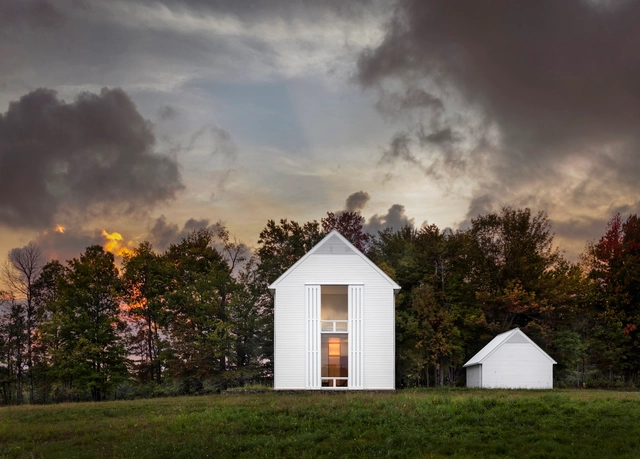
For more than 30 years, residential architects Stuart Cohen and Julie Hacker have produced a series of exquisitely designed and crafted homes in Chicago’s northern suburbs. Although known for their distinctly different personalities, this husband and wife duo has effectively created an environment where clients can be heard and understood. They know how to design together from start to finish, and that’s what makes their project results so remarkable.
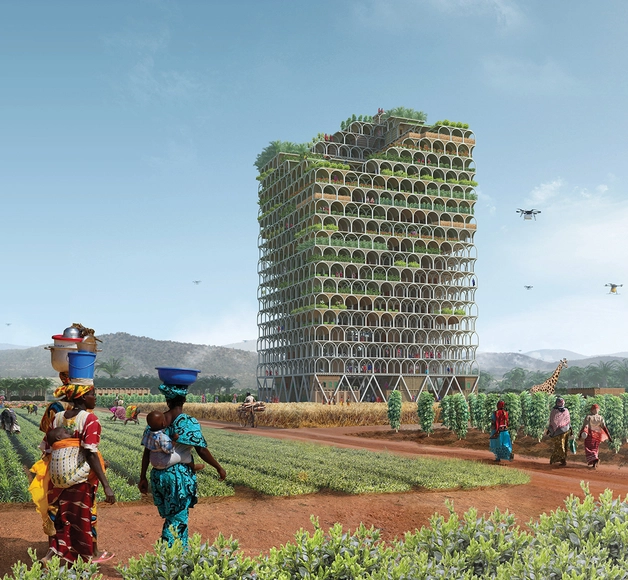
First Place: Mashambas Skyscraper / Pawel Lipiński, Mateusz Frankowski. Image Courtesy of eVolo
eVolo Magazine has announced the winners of its 2017 Skyscraper Competition. Now in its 12th year, the annual award was established to recognize “visionary ideas for building [high-rise] projects that through [the] novel use of technology, materials, programs, aesthetics, and spatial organizations, challenge the way we understand vertical architecture and its relationship with the natural and built environments.”
This year, 3 winners and 22 honorable mentions were selected from a pool of 444 entries. Among this year’s winners are a modular educational center and marketplace for sub-Saharan Africa, a vertical stack of factory and recreational space, villages embedded in mountains and even a skyscraper built within a giant sequoia.
Now, a new pool at Houston’s Market Square Tower is upping the ante even further with a transparent plexiglass wading pool that projects out 10 feet past the end of the building – and 500 feet above the busy street below.
https://www.archdaily.com/868968/this-glass-bottomed-sky-pool-is-suspended-500-feet-from-the-groundAD Editorial Team













.jpg?1492020579&format=webp&width=640&height=580)
.jpg?1492020513 "SO-IL. Image © Laurian Ghinitoiu")
.jpg?1492020331 "COS × Studio Swine. Image © Laurian Ghinitoiu")
.jpg?1492020534 "SO-IL. Image © Laurian Ghinitoiu")
.jpg?1492020424 "DS+R. Image © Laurian Ghinitoiu")
.jpg?1492020579)