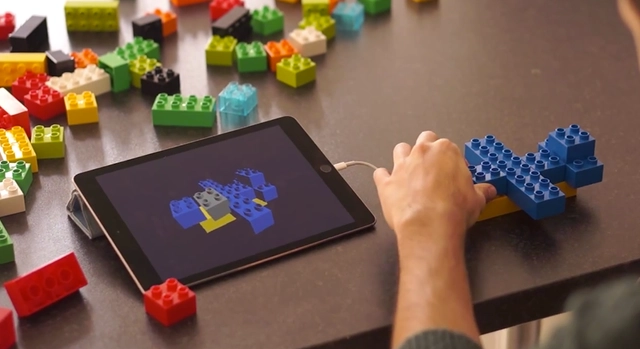
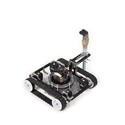
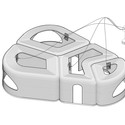
Imagine forgoing time-intensive 3D modeling programs to instead create 3D printable models by playfully stacking sensored LEGO bricks. This reality isn’t far from fruition, as the London-based studio Gravity has released plans for an augmented reality app that uses location-mapping and gyroscopic sensors to generate digital (and scalable) models of your creation in realtime. The program, “Lego X” uses an algorithm to intuitively smooth out edges and join corners, allowing for easy modifying and seamless 3D printing.
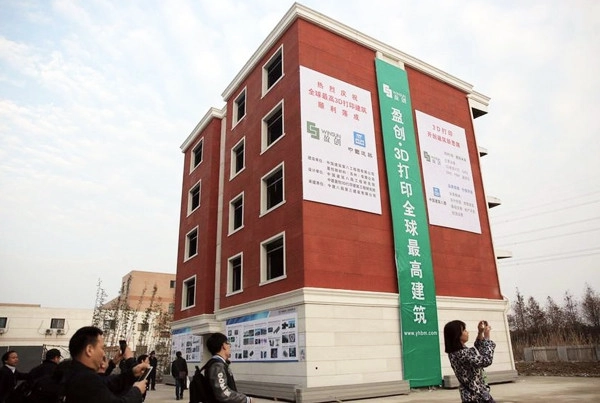
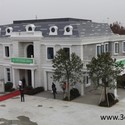
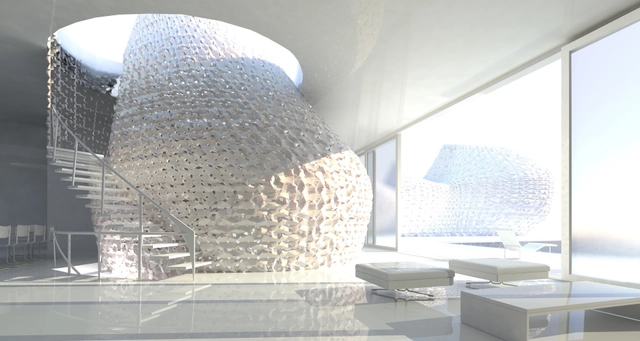
Once again, Chinese company WinSun Decoration Design Engineering Co has expanded the capabilities of 3D printing. After constructing ten houses in under twenty-four hours last year, now they are back with both the world's tallest 3D printed building - a five-story apartment block - and a 1,100 square meter mansion with internal and external decoration to boot.
On display in Suzhou Industrial Park in Jiangsu province, the two buildings represent new frontiers for 3D printed construction, finally demonstrating its potential for creating more traditional building typologies and therefore its suitability for use by mainstream developers.
At their Windows 10 Event today in Redmond, Washington, Microsoft unveiled features for its forthcoming operating system that it feels could revolutionize computing, particularly for people who want to design, make or fix something in the real world: holographics. The company revealed both the Windows Holographic features that will be built into Windows 10 and HoloLens, an in-house designed headset that will be capable of placing holographic elements into the world around you - think of it as a combination of the flat augmented reality overlay in Google Glass, and the immersive yet virtual-only presentation of Oculus Rift.
The video trailer above shows the far-reaching implications for a variety of designers, both professional and amateur (including a nod to the architecture profession at the 50-second mark), with TechCrunch explaining how the technology "offers a way for architects to survey and present their designs alongside clients even when separated by great distances."
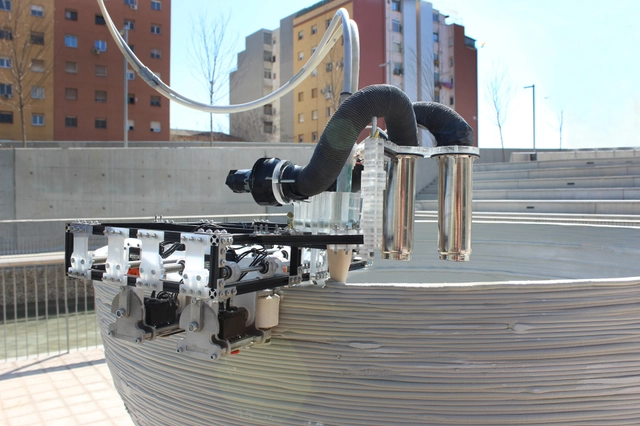
Global construction company Skanska is teaming up with Foster + Partners and the engineers at Loughborough University (LU) to create the world’s first commercial 3D concrete printing robot. The company has signed an agreement with LU, who has been working on the project since 2007, to partake in an 18-month initiative with a consortium of partners focused on developing a robot capable of printing complex structural components with concrete.
A video about LU's research on 3D concrete printing and Foster + Partner's involvement, after the break.
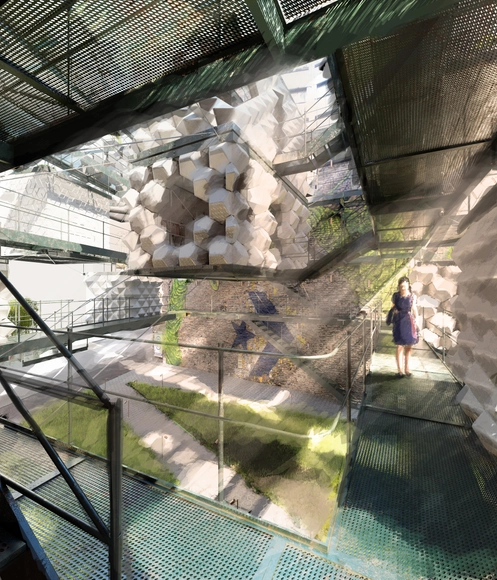
3D printing technology is quickly emerging as a technology that could be applied at the scale of the built environment. But could we use 3D printed materials to create engaging urban spaces that are constantly changing? Creative communications agency, The Neighbourhood, has imagined speculative architecture based on 3D printed materials.
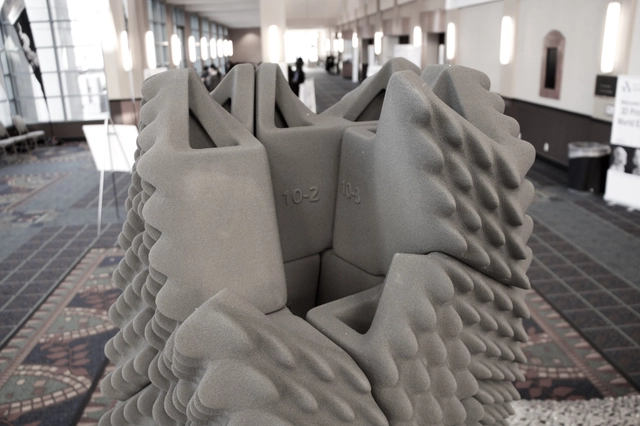
A team of California-based designers have invented an earthquake-proof column built of 3D printed sand, assembled without bricks and mortar to withstand the harshest seismic activity. The 'Quake Column' is comprised of a pre-determined formation of stackable hollow bricks which combine to create a twisting structure, optimized for intense vibrations in zones of earthquake activity. Created by design firm Emerging Objects, the column's sand-based composition is one of many in a series of experimental structures devised by the team using new materials for 3D Printing, including salt, nylon, and chocolate. The column can be easily assembled and disassembled for use in temporary and permanent structures, and was designed purposefully with a simple assembly procedure for novice builders.
Find out how the Quake Column works after the break
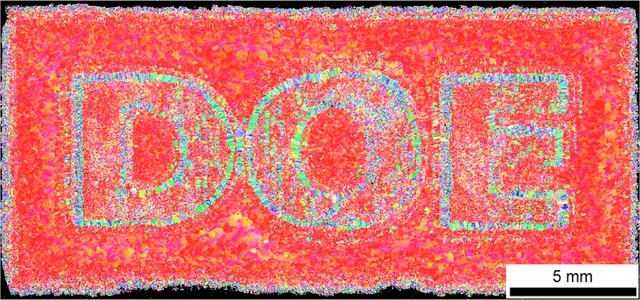
This electron backscatter diffraction image shows variations in crystallographic orientation in a nickel-based component, achieved by controlling the 3-D printing process at the microscale. Image Courtesy of ORNL
3D printing technology continues to advance, developing new applications which are particularly promising for the world of architecture. Now, researchers at the Department of Energy’s Oak Ridge National Laboratory (ORNL) have demonstrated a new manufacturing process that can create 3D printed metal components with an unprecedented degree of precision. For architecture, this could mean greater control over the customization of the smallest components in buildings, as well as more carefully engineered properties of the larger ones.
The new technique involves an additive process in which successive layers of material are laid down with computer control and fused to create an object of almost any shape. As technology has progressed, printers have been able to progressively increase their resolution, enabling the creation of smaller parts with smoother surfaces. ORNL has developed a process that precisely manages the solidification of metal parts in each layer on a microscopic scale. This enables them to better control local material properties, which can have a profound impact on the strength, weight, and function of 3D printed metal components.
Read on to learn more about how this manufacturing process could shape the future of 3D printing.
Many groups are working on innovative 3D Printing technologies, such as Emerging Objects' designs for a 3D printed house made from locally harvested salt. Image Courtesy of Emerging Objects
Autodesk has announced a new program which aims to invest up to $100 million in 3D printing companies over the next several years. The Spark Investment Fund will invest in innovative entrepreneurs, startups and researchers in the 3D printing field who "push the boundaries of 3D printing technology and accelerate the new industrial revolution."
The investment fund has been developed alongside Autodesk's recently released Spark software, a free and open 3D printing platform which connects a wide range of 3D printing hardware and design software, and can work with any material. The company hopes to encourage the 3D printing community to build upon and improve this software.
The 5AXISMAKER is a desktop 5-axis multi-fabrication CNC machine that hopes to expand the possibilities of digital fabrication by making it cheap and more versatile. Should the project receive backing on Kickstarter before the 27th October 2014, the possibility of 5-axis milling will become an affordable reality for manufacturing complex design prototypes. The product in development "provides a large cutting volume for it’s size, therefore producing "generously sized objects." Developed by graduates of London's Architectural Association, they hope to "shake the manufacturing world with new ways of fabricating using industrial robots right at your desk."
Behrokh Khoshnevis of the University of Southern California has won Grand Prize in the NASA Tech Briefs magazine’s “Create the Future” contest for his entry, "Robotic Building Construction by Contour Crafting.” The revolutionary construction method was awarded for being a “major innovation” that could potentially 3D print entire neighborhoods in half the time and at 30 percent less cost than traditional building methods.
Though some have visions of using Contour Crafting (CC) to sculpt the moon's first settlements, Khoshnevis primary desire is combat the world's housing shortage by using the automated construction method to rapidly deploy housing in impoverished and disaster areas.
More information and an interview with Khoshnevis on CNN, after the break.
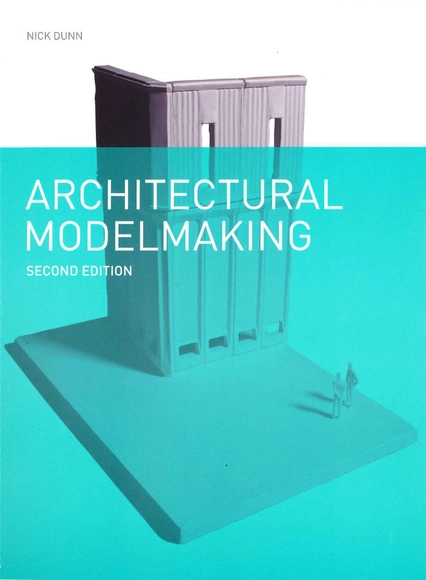
Why do we make models? From sketch maquettes and detail tests to diagrammatic and presentation models, the discipline of physically crafting ideas to scale is fundamental to the architect's design process. For architect and educator Nick Dunn, architectural models ultimately "enable the designer to investigate, revise and further refine ideas in increasing detail until such a point that the project's design is sufficiently consolidated to be constructed." In Dunn's second edition of his practical guide and homage to the architectural model, the significance and versatility of this medium is expertly visualised and analysed in a collection of images, explanations, and case studies.
The architects of Emerging Objectshave devised a scheme for a 3D printed house made from locally harvested salt and concrete. Known as the “3D Printed House 1.0,” the case study residence was commissioned by the Jin Hai Lake Resort Beijing. It integrates traditional construction methods with renewable 3D printed materials, manufactured by Emerging Objects, to build a house that is sustainable, structurally sound and beautiful.
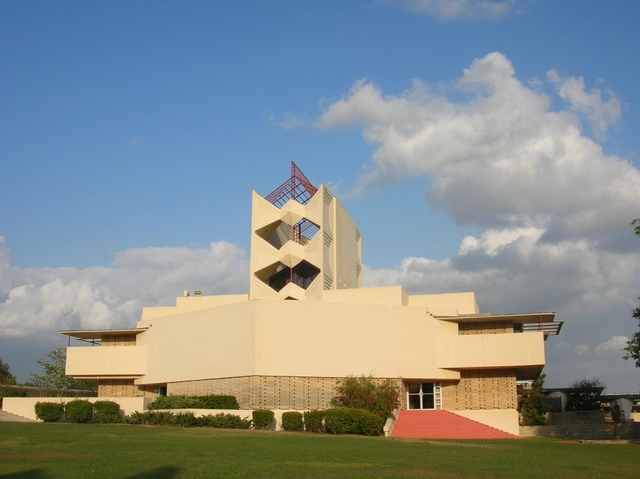
Among the vast coverage of 3D printing in the media, the technology is frequently cited as the 'future' of production, focusing on its ability to bring new things into existence quickly and cheaply. But does 3D printing have to be all about the future? As this article originally printed by Metropolis Magazine as "3D Printing Saves a Frank Lloyd Wright Treasure" attests, 3D printing also has something to offer to the past; specifically, to a deteriorating Frank Lloyd Wright building whose 'textile block' was simply too complex to restore through any other modern techniques. Read on after the break to find out how this high-tech rescue mission is being achieved.
Chinese company WinSun Decoration Design Engineering has constructed a set of ten single story, 3D-printed homes which it produced in under 24 hours. The homes, printed in prefabricated panels which fit together on site, were created using WinSun's custom-built 3D printer which measures 10 meters by 6.6 meters, and took the company twelve years to develop.
Formed with a cement-based mixture containing construction waste and glass fiber, each of the houses cost just $5,000 to build. Read on after the break for more on the development.
Biomimicry is quickly emerging as one of the next architectural frontiers. New manufacturing processes such as 3D printing, coupled with the drive to make buildings more environmentally sustainable, have led to a wave of projects that are derived from natural phenomena or even constructed with biological materials. A recent example of this trend is “Hy-Fi,” this summer’s MoMA PS1 design that is constructed of organic and compostable eco-bricks. Other projects such as MIT Media Lab’s Silk Pavilion have taken biological innovation a step further by actually using a biometric construction processes - around 6,500 silkworms wove the Silk Pavilion's membrane. “Animal Printheads,” as Geoff Manaugh calls them in his article "Architecture-By-Bee and Other Animal Printheads," have already proven to be a viable part of the manufacturing process in art, and perhaps in the future, the built environment as well. But what happens when humans engineer animals to 3D print other materials?
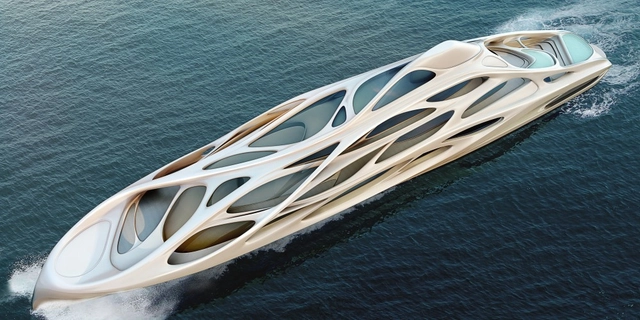
On a purely aesthetic level, 3D printing holds great potential for buildings – all the possibilities of sculpted concrete without the bulky and expensive formwork. Taken to an extreme, it could someday make Hadid-like forms so cheap to execute that they become mundane (even for a non-architect) -- maybe even causing the profession to re-evaluate what qualifies as high design.
However, the more important advantage of 3D printing, what could spur its acceptance as a viable means of construction, is its supposed sustainability. Among its oft-cited advantages are a use of “green” materials and a reduction in construction waste. However, is 3D Printing really as sustainable as its defenders contend?
The skyline of San Francisco is in the process of significant transformation. Projects such as OMA's 550-foot residential tower, as well as developments in the pipeline from Foster + Partners and Studio Gang, are sure to change the city dramatically - thankfully, the 3D printed model in this video is there to show exactly how. The 6x6 foot model shows 115 blocks of downtown San Francisco as it will appear in 2017, and was created by visualization company Steelblue and Autodesk. Claimed to be the largest 3D printed model of a city in the world, it can show much more than just how San Francisco's downtown will look: overlaid projections can show the status of each building, projected traffic patterns and more. Furthermore, each block is individually replaceable to keep the model up to date. Watch the video, and find out more about the model through this article from SFGate.