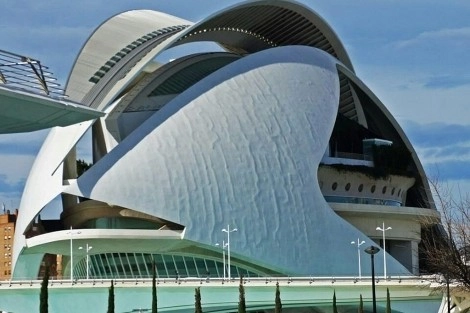
Will the peeling shell of Santiago Calatrava’s Palau de les Arts in Valencia be saved by an innovative, new paint? Calatrava's $455.6 million project, which surpassed its budget four times over, has sprouted many defects over the years, but none more damning than its peeling facade - a defect that spurred the city of Valencia to sue Calatrava's office. However, Spanish paint manufacturer Graphenano has proposed an innovative solution: Graphenstone, a mixture of limestone powder and the allotrope graphene, which should just prevent further deterioration. Whether the solution could also relieve some courtroom tension, remains to be seen. Read more on Inhabitat and The Architect's Newspaper.
The American Institute of Architects (AIA) has selected the recipients of the 2014 Institute Honors for Collaborative Achievement. The award, to be presented at the 2014 AIA National Convention and Design Exposition in Chicago, recognizes and encourages distinguished achievements of allied professionals, clients, organizations, architect teams, knowledge communities, and others who have had a beneficial influence on or advanced the architectural profession. Among this year’s winners include the ACE Mentor Program, the National Building Museum, the AIA New York’s “Post-Sandy Initiative,” and computer-aided design pioneer Rick Smith. You can learn more about the awardees here.
Construction has begun on KWK Promes’ lakeside hotel in Poland. Inspired by traditional mountain homes that found refuge from flooding on a neighboring hilltop, the building’s low profile burrows into the ground at its entrance while opening up to the Czorsztyn waters as topography descends. Similar to the regions typical layout, two massive gable roofs, which appear as two separate structures, are designed to house the elevated sleeping quarters.
As New York begins to thaw after record breaking winter conditions, city dwellers are forced to be on high alert for falling ice. Streets surrounding the 1,776-foot One World Trade Center have been closed following reports of ice shearing from its surface. Some blame the more energy efficient buildings for the deadly occurrence, believing that because the newer structures are able to hold in more heat their exteriors remain colder which aids the formation of ice. Materials and building form can help prevent this phenomena. You can learn more here.
The School of Visual Arts MFA Design Criticism invites you to join them for a two-week intensive to research and write about design. Participants will be introduced to a range of techniques for constructing compelling narratives about images, objects,and spaces. You will experiment with different research methods, writing formats, and complete several projects across media, including a collaboratively produced publication.
Last night, another pamphlet launched its sixth issue, DEFAULT!, at New York's Printer Matter, Inc. With contributions from CODA'sCaroline O'Donnell (winner of the 2013 MoMA PS1 Young Architects Program), critic Sylvia Lavin, Urtzi Grau and Cristina Goberna (of Fake Industries) and others, this installment tackles the presupposition that "design inherently denies the default, and that the default is by definition un-designed." Copies of DEFAULT! are available through their website. More information after the break.
The American Institute of Architects (AIA) has selected James L. Abell, FAIA, Carole J. Olshavsky, FAIA, and Robert G. Shibley, FAIA, as recipients for the 2014 Thomas Jefferson Award for Public Architecture. The award recognizes excellence in architectural advocacy and achievement in three categories: Private-sector architects who have established a portfolio of accomplishment in the design of architecturally distinguished public facilities (category 1); public-sector architects who manage or produce quality design within their agencies (category 2); and public officials or other individuals who by their role of advocacy have furthered the public's awareness and/or appreciation of design excellence (category 3). Learn more about the recipients, after the break.
What unites contemporary design? What is the through line that connects designers between continents and across decades? This spring, The MA program in Design Studies at Parsons The New School for Design presents a two-day symposium that will bring together a rare interdisciplinary group of professionals and academics to explore narratives surrounding the field of design, and attempt to answer these questions. The conference, Narratives and Design Studies: A Task of Translation, will be held March 7 – 8.
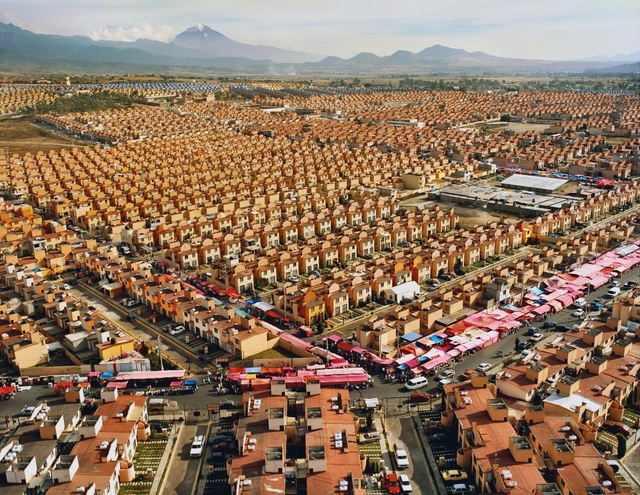
Livia Corona (b. Mexico, 1975; based in New York) / From the series: "Two Million Homes for Mexico / 47,547 Homes for Mexico Ixtapaluca, 2007 / Archival Chromogenic Print / 30 x 40 inches / Courtesy of the artist and Galeria Agustina Ferreyra, San Juan, Puerto Rico
Beyond the Supersquare brings together a select group of contemporary artists whose insightful work addresses the remnants of the Modern Movement in Latin America and the Caribbean. While the exhibition will address how Modernism defined a number of decisive aspects related to contemporary architecture, urbanism, and art in Latin America, this exhibition will also examine the larger political and social underpinnings of these cultural and environmental developments.
Although Arizona developer Novawest was determined to build BIG’s 420-foot observation tower in downtown Phoenix before the 2015 Super Bowl, failed negotiations has left them without a site. Once planned for the interior courtyard of the Arizona Science Center, the privately-funded project is now being considered for an undisclosed downtown site with completion rescheduled for 2016. Considering the project has received a considerable amount of support from city officials, it seems inevitable that the BIG pin will eventually be built despite harsh criticism from nearby residents. Modifications for the new site will be minimal. You can review the design here.
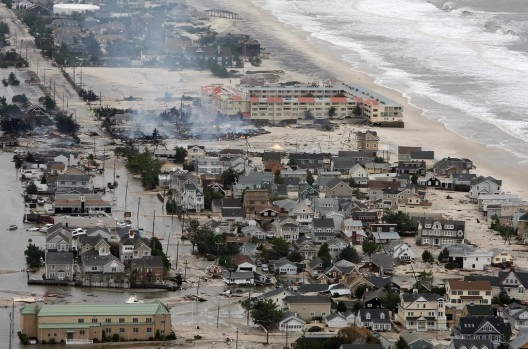
Between Hurricane Sandy in the USA and ongoing storms and floods damaging large areas of Britain, the issues of flood prevention and coastal defense are now a top priority for planners on both sides of the Atlantic. This article in the Guardian asks whether it might be time to give in to the sea and rethink our affinity for coastal living; and this one on Architecture Boston asks to what extent society should be expected to foot the bill for those in high-risk areas, and wonders how, legally, the state could encourage people to live elsewhere.
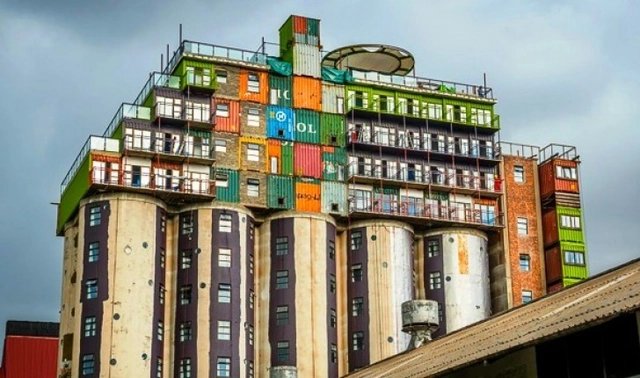
Courtesy of Citiq Property Developers, via Inhabitat
Inhabitat has just featured an unlikely new student housing project in Johannesburg: Mill Junction, a student complex that consists of two former grain silos topped with shipping containers. According to its developers, Citiq Property Developers, the energy and money-saving project re-directs money towards communal facilities, proving popular with students. As a result, Mill Junction, the second shipping-container housing project built by the Developers, may be the second of many more. More info at Inhabitat.
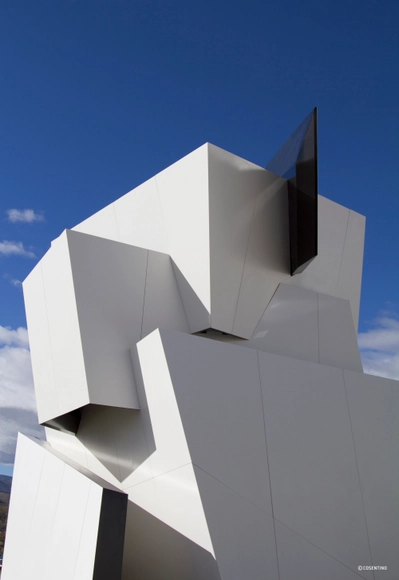
Beyond the Wall / Daniel Libeskind for Cosentino Group
Daniel Libeskind has unveiled a permanent sculpture at the Cosentino Group world headquarters in Almeria: “Beyond the Wall.” Inspired by the “infinite possibilities of the spiral,” the installation is intended to exhibit how the company’s ultra-compact, innovative surfacing material, Dekton® can be used to clad contemporary facades.
“This is not a traditional spiral with a unique center and axis, but a contemporary spiral that opens multiple paths in many different directions,” describes Cosentino in a press release. “In short, a polycentric spiral energy is projected to a dramatic peak.”
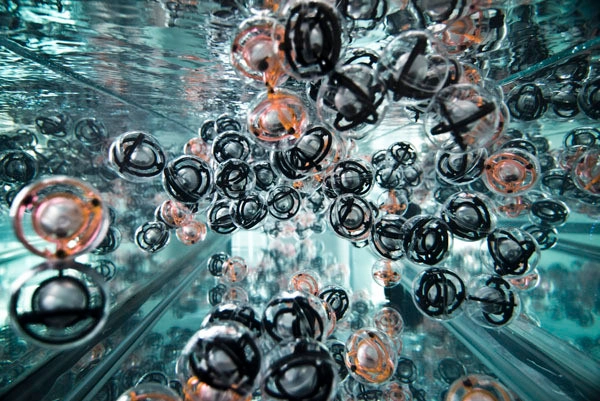
Fluid Crystallization, a project by Skylar Tibbits which informed his investigation of 4D printing. Image Courtesy of The Self-Assembly Lab, MIT
Spectrum Magazine, an annual publication by MIT to highlight the work of a cross-section of their professors and alumni, has recently released its 2014 edition. This year, the focus is on cities, with a great selection of architecture, planning and technology based contributions. You can download a pdf of the magazine here - or read on after the break for links to some articles of note.
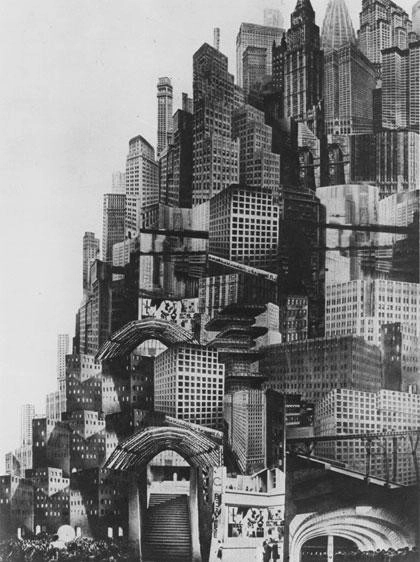
A still from "Metropolis", perhaps the archetypal futuristic city film. Image
From 1927's Metropolis to 2002's Minority Report, this article on the Guardian Cities explores film's futuristic cities - utopias, dystopias, and those somewhere in-between - and asks: which of these cities would be safest? Most suited to under-30s? The best to live in? You can find out by reading the article here.