Award-winning architect, writer, and professor David Heymann has just released his first work of fiction: My Beautiful City Austin. Composed of seven humorous tales, the stories document the misadventures of a young architect in Austin and his accidental involvement in the slow decimation of his city’s charms. Unable to deter his clients from their poor choices, the well-intentioned designer finds himself complicit. Using fiction, Heymann paints a sharply dynamic picture of the architectural consequences of Austin’s rapid growth and “rediscovered allure.” Check out the book, here.
In an article for The Guardian, Maryam Omidi explores Moscow's Door19, a place where "Damien Hirst and David LaChapelle artworks adorn the raw concrete walls," "flair bartenders serve up gem-coloured cocktails," and "a rotation of Michelin-starred chefs flown in from around the world curate new menus each week." It is indicative, she argues, of what Kuba Snopek (a lecturer at the Strelka Institute) describes as "hipster Stalinism" - a surge of redevelopment in certain parts of Moscow that cater to the 'oligarchs', wealthy creatives and Muscovite 'hipsters'. At Door19, for example, apartments sell for between $15,000 and $20,000 per square metre.
Architect Steven Bingler and architectural journalist Martin C. Pedersen fear that architecture is loosing its credibility. In their recent op-ed on the New York Times, the pair claims that our profession’s biggest challenge is regaining public trust by reconnecting architecture with its users. Referencing his mother’s aversion to a student-built affordable housing project that he considered a “bold statement of design,” Bingler believes the key to salvaging the profession is for architects to stop dismissing and start listening to the general public’s take on architecture.
American Museum of Natural History. Image Courtesy of Wikipedia
Chicago’s Studio Gang Architects have been selected to design a new Center for Science, Education and Innovation for the American Museum of Natural History in New York. Named after its largest donor, the $325 million Gilder Center will include 218,000-square-feet of existing and new space. It is slated to open on Columbus Avenue at 79th Street on the west side of the Museum campus, in conjunction with its 150th anniversary in 2019–2020.
Vacation just got a little bit sweeter with these Gingerbread BNBs. Looking for a luxurious getaway? The Gingerbread Modern Home is a gorgeous estate, made from gluten-free gingerbread and featuring a frosted stucco exterior and mid-century taffy furniture (but please don’t eat the artwork). The house is part of a fundraiser for New-York charity Robin Hood to provide shelter to homeless families in New York during the holiday season.
Edward Mazria, AIA, founder of Architecture 2030, has been selected to receive the 2015 Edward C. Kemper Award. The American Institute of Architects (AIA) chose Mazria for “catalyzing the architecture community to address climate change through the design of decarbonized, sustainable and resilient built environments.”
The Royal Institute of British Architects (RIBA) have today announced a call for entries to the 2015 RIBA Awards programme. The prestigious awards are designed to celebrate the best architecture projects that have been opened within the past two years. Projects of all sizes and budgets from across the UK (excluding those in Scotland) are eligible to be entered to the RIBA Regional Awards. Scottish projects can be entered into the RIAS Awards. Those that are successful in the regional rounds are made eligible to be considered for the RIBA Stirling Prize, one of the most coveted awards in the architectural world.
Courtesy of School of Architecture, Tsinghua University
This Sunday, December 14, ArchDaily founders David Assael and David Basulto will speaking at the day-long Tsinghua Thinking Architecture Forum in Beijing on the subject of architectural media. The event, Dissemination and Intervention: The Contemporary Role of Architectural Media, will bring together 15 of architecture's most influential editors from around the world to join in on the conversation. The forum is being organized by the World Architecture Magazine and School of Architecture, Tsinghua University. You can review the day's complete itinerary and full list of speakers, after the break.
Young architects and designers are invited to submit work to the annual Architectural League Prize Competition. Projects of all types, either theoretical or real, and executed in any medium, are welcome. Established in 1981 to recognize visionary work by young practitioners, the Architectural League Prize is an annual competition, lecture series, and exhibition organized by The Architectural League and its Young Architects + Designers Committee.
Stephen Hodder, the current President of the Royal Institute of British Architects (RIBA), has spoken out about a "U-turn" following the proposal of March 19th (passed under past President Angela Brady) condemning the Israeli Association of United Architects (IAUA) for its failure to "resist projects on illegally-occupied land" in the West Bank and Gaza. According to BDOnline, the RIBA has "been forced to abandon its policy [...] after an internal report said it should never have been put to a vote in the first place."
This highly controversial episode, which has overshadowed Hodder's presidency, has also garnered criticism both in the UK and as far afield as the USA. Architects such as Richard Meier and Daniel Libeskind have stated that the RIBA’s actions have been "short-sighted and appear to be an attempt to simplify a very complex issue." In the UK, Paul Finch writing in the AJ asked whether there would "be a rush to suspend the Russians because of what is happening in Ukraine? Were the Chinese suspended when they were destroying much of their magnificent built heritage, or invading Tibet?" "Certainly not", he concluded.
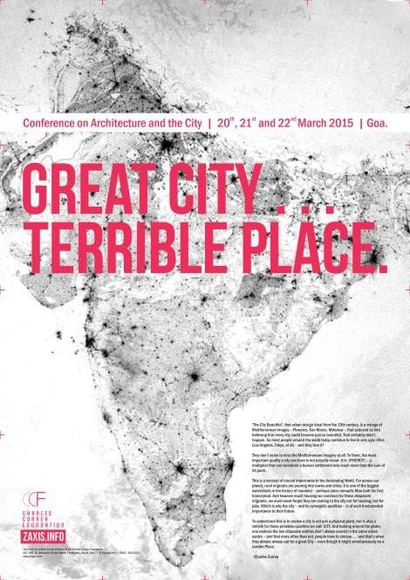
Curated by the Charles Correa Foundation, the Z Axis is an annual conference bringing together pioneers, thought leaders, influencers, professionals, and students in the fields of architecture and urban design to create an intellectual community focused on issues related to the context of India and the developing world. Fifteen speakers will gather from across the globe to explore the theme of Great City…Terrible Place, including Charles Correa, David Adjaye, Alfredo Brillembourg of Urban Think Tank, Spain's "guerrilla architect"Santiago Cirugeda, Simone Sfriso of Studio TAM Associati and more.
Jose Ahedo, Blanca Pyrenees, Education Center (Els Hostalets de Tost, Spain, 2013). Image Courtesy of Wheelwright Prize
The Harvard Graduate School of Design (GSD) is pleased to announce the third edition of the Wheelwright Prize, an open international competition that awards $100,000 to a talented early-career architect to support travel-based research. The 2015 Wheelwright Prize will begin accepting applications online on January 5; the deadline for submissions is January 30. This annual prize is dedicated to fostering new forms of architectural research informed by cross-cultural engagement.
Applications have opened for the Australian Institute of Architects’ 2015 Droga Architect in Residence program. The Droga residency, one of only a few architectural residencies worldwide, offers successful applicants the opportunity to engage with the Australian architecture community over a 12 week period. Submissions are invited from practitioners based outside Australia for residencies available between June and December 2015.
Speaking to The Guardian, David Chipperfield has stated that he regards the hold of private investment over new architecture in London as an "absolutely terrible" means of building a city. He argues that Berlin - where he spends considerable amounts of time and runs a large office - "is a much more reflective society than ours" because the UK has sunk into "a success-based culture."
[In Berlin] there is still an idea of the public realm. We have given that up in London. We have declared the public realm dead; the question is how to get stuff out of the private sector. We are unbelievably sophisticated at that.
With 1,715 entries submitted, the Guggenheim Helsinki Competition has become the most popular architectural competition in history. Only six proposals have made it through to the final round, however we believe there is something to be learned from the hundreds of proposals that didn't make the cut. Therefore, if you participated in the Guggenheim Helsinki Competition and would like ArchDaily’s team of architects and editors to review your proposal for publication, we ask you to submit your proposal here (under "Submit an event, competition, award, news") by Wednesday, December 10. All proposals submitted after this deadline will not be considered. Take a look after the break for the required format for submitting project materials.
Are you currently enrolled in a NAAB-accredited architecture program or other degree-granting institution? You may qualify for the 2015 WIA (Women in Architecture) Fund's Emerging Professional Inspiration Award, now open to all US-based and international applicants. Working to inspire emerging professionals, one woman at a time, the WIA Fund will award one national and one international professional with a cash grant to help further their career. Depending on the quality and quantity of entries, other awards may also be given. Entries will be shortlisted and winners will be selected by both a committee and the public via the WIA Fund Facebook page. Submissions are due January 10, 2015. For more details, visit their page, here.
Santiago Calatrava’s head-turning World Trade Center Transportation Hub has assumed its full form, nearly a decade after its design was revealed. In light of this, the New York Times has taken a critical look at just how the winged station’s budget soared. “Its colossal avian presence may yet guarantee the hub a place in the pantheon of civic design in New York. But it cannot escape another, more ignominious distinction as one of the most expensive and most delayed train stations ever built.” The complete report, here.