Although ancient buildings carry compelling architectural presence, demolition or radical change is often their fate. While some architects prefer to introduce thoroughly new structures, others choose to honor the works of historic architects, who built the basis and foundations of structures that helped shape up cities today.
For the refurbishment of Paris’ Hotel Fouquet Barrière, located one block facing Avenue des Champs Elysées, Edouard François was selected to renovate the entire property, including offices, spa services, façade, and courtyards. François’ design strategy was rather unambiguous, using only two keywords as reference: “COPY-EDIT”; a reinterpretation of the “old” through contemporary technologies and modified material.
In episode #59 of our series on architectural figures, we invited architect and historian Renato Anelli, who is also a board member of the Bardi Institute, and architect, professor, historian, and architectural critic Ana Luiza Nobre to discuss the life and work of Lina Bo Bardi—the Italian architect who deeply absorbed Brazilian roots and translated them into her highly original architecture. Trained at Rome's traditional school of architecture, Lina went far beyond the conventional scope of the profession, also working as an illustrator, editor, designer, and set designer.
"Domestic Workspaces" by Silvia Garcia Camps brings together 46 international architecture offices through collage, revealing the intimate, domestic, and shared qualities of workspaces through the everyday objects within them. Explore a selection of these illustrations, along with her thoughts, below.
Videos
Screenshot from Simón Vélez's interview in "El Espectador"
In an interview with El Espectador, Colombian architect Simón Vélez opens a debate on the state of the discipline, prompting us to question the role of the architect in both economics and politics.
Last week, we announced the 15 finalists for the 2019 Obra do Ano, an award celebrating the best of Lusophone architecture by inviting our readers to vote for their favorite projects built in Portuguese-speaking countries. Today, we reveal the winners of ODA19.
This year, three Brazilian projects received the most votes. In addition to showcasing architectural diversity, they exemplify the public impact that architecture should deliver. Meet the three winners below!
Last week, we announced the 15 finalists for the 2019 Building of the Year Award, which since 2008 has celebrated the best built architecture in Latin America and Spain, inviting our readers to select their favorite completed projects. Today, the time has come to announce the winners of ODA19.
We are pleased to present three architectural works from Peru, Chile, and Ecuador, where the winners not only showcase the architectural diversity of the region but also serve as examples of the public impact that architecture should deliver. Meet the three winners!
Louisiana Channel has released a video interview conducted with world-renowned architect Daniel Libeskind, where he advises young architects to follow their dreams, take risks, and expose themselves to the possibilities of short term sacrifice for long term gain. Reflecting on the pace of change, Libeskind says “the world is always changing, but not very slowly. It changes just suddenly. It doesn’t change by evolution, it changes suddenly. If a young architect realizes this, it is a big help. It took me a while to realize that.”
https://www.archdaily.com/915734/watch-daniel-libeskinds-advice-for-young-architectsNiall Patrick Walsh
When you start to consider implementing the BIM (Building Information Modeling) methodology, whether as an independent professional or as a construction firm, it's necessary to take into account three key aspects: the technology, the process, and the people who bring it all together. In this article, we will address the key points in every one of these three aspects in order to give you insight into how to best start using BIM.
Courtesy of Workshop Architects, Cooper Carry, OLIN, and Gilbane
Today in the United States, buildings account for nearly 40% of carbon emissions (EESI) and 78% of electricity usage. The most sustainability-focused firms run energy simulations for less than 50% of their projects (10% for a typical firm) and only doing so late in the process when design changes are limited and insufficient to combat red flags found in the performance report (AIA 2030 report). We can make building performance widespread once we help the entire community discuss the subject in terms of investment and return. Especially during a project pursuit, since having the buy in from the whole team helps ensure the key project metrics are met. Owners are seeking out teams who are using actual metrics and data driven processes that affect their bottom line. This new approach to practice is what makes the younger teams’ standout and will benefit both the climate and the bottom-line. Here are 5 ways to talk about building performance in your project pursuits:
Educational Landscape is a data visualization project featuring an interactive interface based on a dot-density map that represents the population aged 25 or older, classified by educational attainment.
ArchDaily is working with the "Eyes of the City" curatorial team, to publish a series of articles by international architects, designers, writers and thinkers who will discuss the ways in which new technologies - and Artificial Intelligence in particular - might impact architecture and urban life. After the publication of the curatorial statement by Carlo Ratti, Politecnico di Torino and SCUT, we are hosting a text by Chinese architect Yung Ho Chang, curator of the first edition of Shenzhen Biennale in 2005. The open call for proposals for the “Eyes of the City” will run from April 1st to May 31st: www.eyesofthecity.net
https://www.archdaily.com/915461/we-are-looking-back-yung-ho-changs-response-to-curatorial-statement-at-shenzhen-biennial-2019Yung Ho Chang
The Bachelor of Architecture (B. ARCH) at the American University in Dubai was inaugurated in the fall of 2009 and much like Dubai, is young, dynamic, and has achieved considerable milestones over a short period of which NAAB accreditation is at the top. The architecture department along with the Interior Design and the Visual communication departments make up the School of Architecture, Art, and Design (SAAD), which is the only school outside of the USA to have obtained the three primary accreditations (NAAB, CIDA, and NASAD). These accreditations reflect high education standards and quality assurance of SAAD’s programs.
https://www.archdaily.com/914527/the-american-university-in-dubai-celebrates-the-work-of-students-at-the-yearly-architecture-senior-showcaseSponsored Post
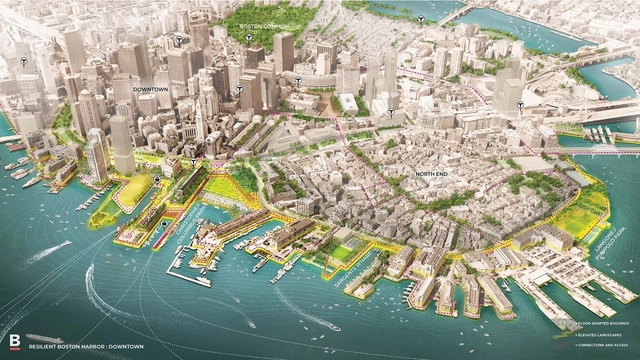
As the world recognizes Earth Day 2019, the public discourse is increasingly dominated by citizen action across the world manifesting a widespread fear and frustration at a perceived lack of action by governments and officials to confront the issue forthrightly. From the Extinction Rebellion protests that have gripped London, to school student strikes across 125 countries, global cities are increasingly finding themselves on the front line of a battle to limit the effects of global warming.
https://www.archdaily.com/915510/how-three-major-us-cities-are-preparing-for-climate-changeNiall Patrick Walsh
Last year I was invited to teach design studio for the first time by Tsinghua University in Beijing, home to the top architecture school in China and one of the strongest in the world, according to the latest international ratings. There, I met husband-and-wife teaching practitioners Qing Fei and Frank Fu. As soon as I witnessed their unorthodox way of teaching by challenging students with rigorous questioning, I wanted to interview them. Their innovative approach did not fit my impression of how architecture is tackled in China. Fei and Fu are Tsinghua graduates; they moved to America in the late 1980s where they studied, worked, and researched both art and architecture for almost two decades.
Now that it's time for the Easter Holidays, kids (and young-at-heart adults) will be busy searching for colorful eggs hidden here and there. As for you architecture lovers, illustrator Chanel Dehond took egg hunts to the next level and found a way to make the activity a bit more relatable.
Take a look at Dehond's eggceptional collection of illustrations, inspired by some of your favorite structures from all over the world.
The daily routine of psychologist and CAPS* (Psychosocial Care Center) coordinator Antoniella Santos Vieira centers on listening and walking: during the day, she listens to the stories of people experiencing homelessness, those struggling with alcohol and drug abuse, among other challenges. It is this challenging territory – half urban, half rural – that she traverses, showing that the center offers a range of services – such as yoga and pilates – in addition to psychological support.
If you come to think of it, the urban development of the world's largest cities is like playing a game of Tetris; No matter how condensed or crowded, for architects, there is always room for more. However, this act of 'structural stacking' often creates unique architectural compositions.
As a follow-up to his first photo-series, Singaporean photographer and visual artist Kevin Siyuan put together 'Corridors of Diversity', a short montage of communal corridors and HDB (Housing and Development Board) block facades, featuring the dynamic designs and forms of Singapore's densely built environment.



_5738.jpg?1556027783&format=webp&width=640&height=580)
_5498.jpg?1556027648 "© Laurian Ghinitoiu")
_5957.jpg?1556027812 "© Laurian Ghinitoiu")
_5926.jpg?1556027680 "© Laurian Ghinitoiu")
_7973.jpg?1556027669 "© Laurian Ghinitoiu")
_5738.jpg?1556027783)
.jpg?1555714480&format=webp&width=640&height=580)






.jpg?1555740229&format=webp&width=640&height=580)


.jpg?1555740229)
