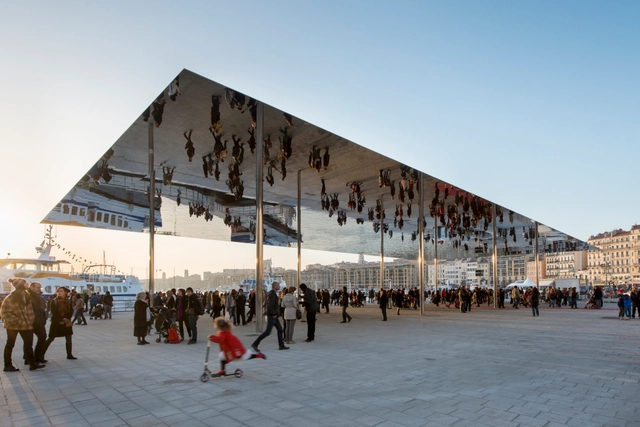
Saturday in Marseille, France, pedestrians and city officials joined Foster + Partners to celebrate the completion of the Vieux Port Pavilion at the mouth of Marseille’s World Heritage-listed harbor. Minimal, yet effective, this “discreet” intervention provides a new sheltered events space on the eastern edge of the port. With six slender pillars supporting its razor-thin profile, the polished 46 by 22 meter stainless steel canopy amplifies and reflects the surrounding movement, creating a spectacle that encourages pedestrians to linger.
More on Foster’s Vieux Port Pavilion after the break...
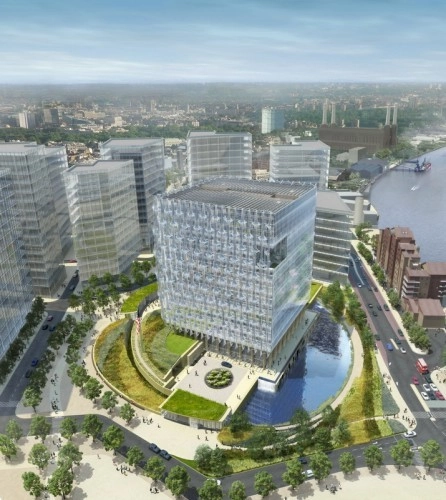
US Embassy in London / KieranTimberlake Architects
"The works of our artists, architects, and preservationists provide us with another language of diplomacy. A transcendent language that allows us to convey values that are at once uniquely American yet speak to all of humanity. Increasingly in this world, art and architecture help us maintain our sense of openness and liberation." -- Former Secretary of State Hillary Rodham Clinton, April 12, 2010
An embassy is much more than a building or a work of architecture; it functions as a symbolic representation of countries' relationships to one another. It represents the universal language of diplomacy - "communicating values and ideals, extending well beyond any moment in time". An embassy has the difficult task of representing two diametrically opposed concepts: security and openness. The former typically overpowers the latter in importance, which is most probably why when we think of foreign embassies, it conjures up images of stately monolithic buildings surrounded by tall fences and menacing guards or "bunkers, bland cubes, lifeless compounds", according to Tanya Ballard Brown of NPR's All Things Considered.
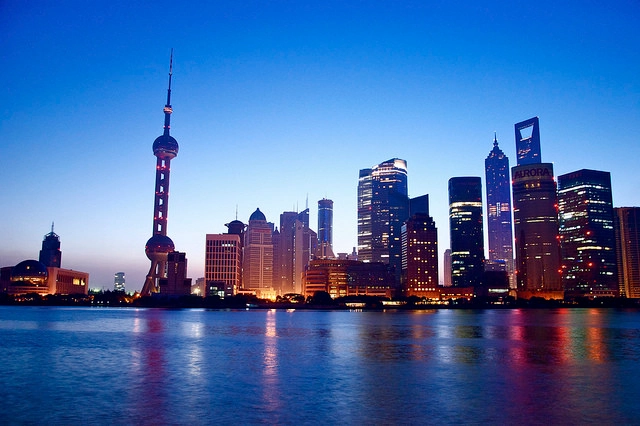
Shanghai Skyline. Image Flickr User CC Gaëtan Bruneteau. Used under Creative Commons
This article, by Austin Williams, originally appeared in The Asian Age as "India, China: Talk of the Town." Williams is the co-author of Lure of the City: From Slums to Suburbs and director of the Future Cities Project. He teaches architecture and urban studies at XJTL University in Suzhou, China. Email him at futurecitiesproject@gmail.com
As an architect living in Suzhou, just outside Shanghai, I have become blasé about the skyline being transformed before my very eyes. The classic view of Shanghai’s towering waterfront may not represent great architecture, but it’s impressive all the same… and constantly improving. In most cities across China it is the same story: high-speed construction activity, modernisation, transformation and skyscrapers everywhere. There is a palpable sense of opportunity pending — what the émigrés to America must have felt when arriving in New York 100 years ago.
While many Western commentators point to the failures (the accidents, the pollution and the corruption) with an unremitting Schadenfreude, China marches on. Where else can you watch a modern city grow and change in real time? Where else, indeed?
Read more of Austin Williams' account of the different kinds of urban development happening in China and India, after the break...
BIQ - the world's first algae powered building - is set to be completed in Germany later this month. Built for the International Building Exhibition (IBA) in Hamburg, this zero-carbon apartment complex will sport a bright green facade-cum-algae farm, while its interior proposes a radical new theory on how we will live in the near future.
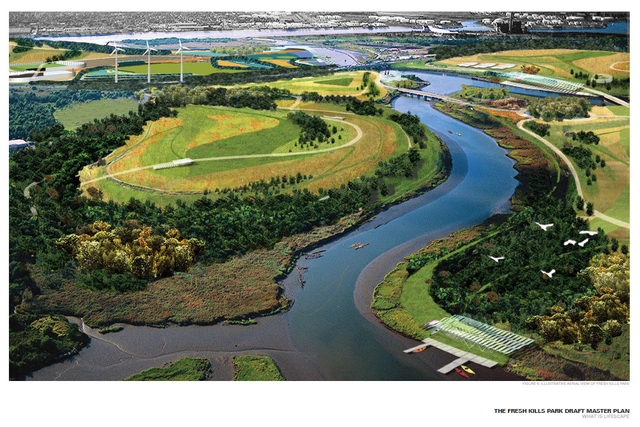
Courtesy of Department of Parks and Recreation - Draft Master Plan
Every natural disaster has an "aftershock" in which we realize the fragility of our planet and the vulnerability of what we have built and created. We realize the threat to our lifestyles and the flaws in our design choices. The response to Hurricane Sandy in October 2012 was no different than the response to every other hurricane, earthquake, tornado , tsunami or monsoon that has wrought devastation in different parts of the world. We recognize our impact on the climate and promise to address how our development has caused severe disruptions in the planet's self-regulating processes. We acknowledge how outdated our systems of design have become in light of these damaging weather patterns and promise to change the way we design cities, coastlines and parks. We gradually learn from our mistakes and attempt to redress them with smarter choices for more sustainable and resilient design. Most importantly, we realize that we must learn from how natural processes self-regulate and apply these conditions to the way in which we design and build our urban spaces.
Since Hurricane Sandy, early considerations of environmentalists, planners and designers have entered the colloquiol vocabulary of politicians in addressing the issues of the United States' North Atlantic Coast. There are many issues that need to be tackled in regards to environmental development and urban design. One of the most prominent forces of Hurricane Sandy was the storm surge that pushed an enormous amount of ocean salt water far inland, flooding whole neighborhoods in New Jersey, submerging most of Manhattan's southern half, destroying coastal homes along Long Island, and the Rockaways and sweeping away parts of Staten Island. Yet, despite the tremendous damage, there was a lot that we learned from the areas that resisted the hurricane's forces and within those areas are the applications that we must address for the rehabilitation and future development of these vulnerable conditions. Ironically, one of the answers lies within Fresh Kills - Staten Island's out-of-commission landfill - the largest landfill in the United States until it was shutdown in 2001. Find out how after the break.
Fresh Kills Landfill was opened in 1947 along the western coast of Staten Island as a temporary solution for New York City's waste just in time to accommodate an exponential rise in consumption in the post-World War II United States. Three years later, and the landfill continued to operate until it became the principal landfill for New York City, collecting the solid waste from all five boroughs in the "age of disposability". It is no wonder then, that the temporary solution swiftly became a 50-year one.
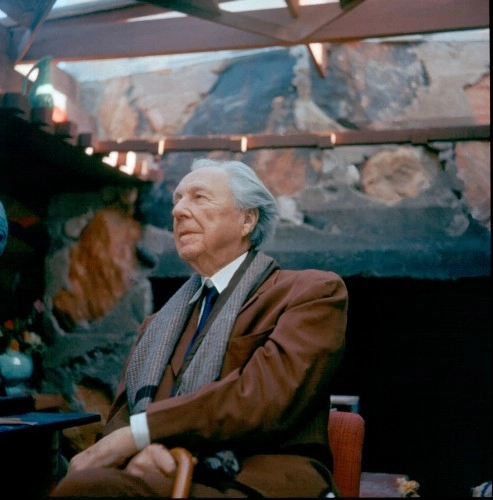
Frank Lloyd Wright by JOHN AMARANTIDES, 1955. ”The Frank Lloyd Wright Foundation Archives (The Museum of Modern Art | Avery Architectural & Fine Arts Library, Columbia University, New York)”
If you only know Frank Lloyd Wright for his classic works - Fallingwater and the Guggenheim among them - and not for his bristly personality, then you're in for a treat.
WNYC has just released a candid interview they recorded with Wright in 1957, two years before his death, in his Plaza Hotel apartment (where he’d moved to oversee construction of the Guggenheim, which he'd been working on for 14 years). The conversation covers a wide range of topics - from Wright's quirky personal views on American culture to the significance of architecture for mankind. Some gems from the interview include:
On the Guggenheim and its critics: “You’re going to be awakened to the beauty of that thing [a picture, a painting] from a new point of view. And it’s going to be so enlivening and refreshing, that it will make some of these painters quite ashamed of the protest that they issued against it.”
Dessen Hillman is currently a graduate student at MIT, pursuing his SMArchS degree in Architecture and Urbanism. He is interested in investigating the role of architecture in various urban settings through the scope of architecture design.
Since the modernist movement in architecture (early 1900s), building design has been majorly focused on expressing itself as a unique entity, becoming more of an art than architecture. Buildings are now formally expressive more than ever. After pondering the differences between the two, I have, for now, come to a conclusion on one fundamental difference:
Art is a form of self-expression with absolutely no responsibility to anyone or anything. Architecture can be a piece of art, but it must be responsible to people and its context.
Read on to find out how changing the way we snap images coud change the way we evaluate architecture, after the break...
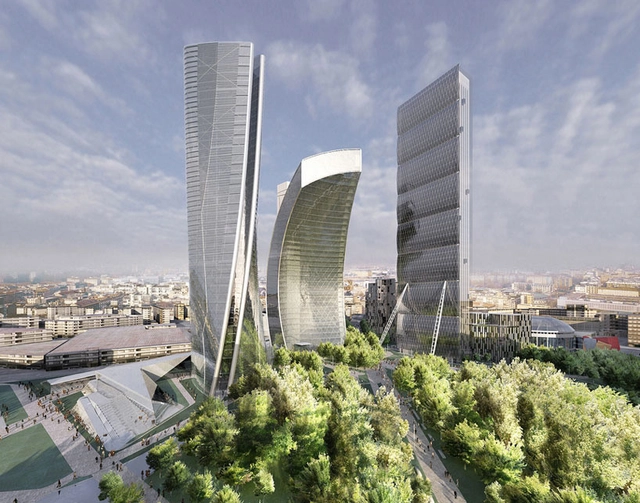
CityLife Milano is an ambitious commercial and residential development on Milan's historic former trade fair grounds: the Fiera Milano. On the surface, over half of CityLife Milano will be covered with upwards of 168,000 square meters of landscaped parkland dedicated to pedestrians and bicycles. This lush, pedestrianized space will be centered around a grand new piazza -'piazza delle tre torri' - shaped by a trio of towers and surrounded by a cluster of residences, all designed by three world-renowned architects. As previously mentioned, Arata Isozaki and Andrea Maffei has contributed the Isozaki Tower, which is planned to become the tallest skyscraper in Italy at 202 meters and built alongside the curved, 150 meter Libeskind Tower. To complete the triad, Zaha Hadid has designed a twisting, glazed tower, which will rise 170 meters into the skyline.
More on the Hadid Tower and surrounding development after the break...
The following article was featured on Fulcrum #67 "The End of Critique" and includes texts by Oliver "Olly" Wainwright (Architecture critic at The Guardian) and me, David Basulto (Founder and Editor in Chief of ArchDaily). Thanks to Jack Self for the invitation and for his thorough editing.
Towards a new architecture
Since the early 1900s, modern architecture has undergone incremental development, where each new iteration has been informed by previous findings and solutions designed by other architects. This process started at a very slow pace, when a young Le Corbusier went east and published his findings and observations in Vers une Architecture.
The book became very influential among his contemporaries, who, based on his observations, produced their own iterations, second, third and forth waves, very quickly. These architects then started to unite. CIAM is an instance of where this early knowledge was shared, replicated, and published, therefore advancing at a faster pace.
Since then, architectural knowledge pursued a steady curve of advancement, accelerated by architectural publications that made this knowledge available to different parts of the world. Ultimately, the Internet arrived, making the exchange rate of information so fast that new iterations of modern architecture are today accelerating this curve in unprecedented ways.
Let’s dump the word “zoning,” as in zoning ordinances that govern how land is developed and how buildings often are designed. Land-use regulation is still needed, but zoning increasingly has become a conceptually inappropriate term, an obsolete characterization of how we plan and shape growth. - Roger K. Lewis
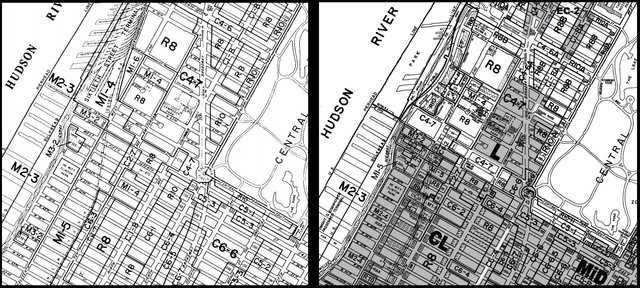
Zoning, just over a century old concept, is already becoming an outdated system by which the government regulates development and growth. Exceptions and loopholes within current zoning legislation prove that city planning is pushing a zoning transformation to reflect the goals and needs of city building today and in the future. To determine how zoning and land use need to change we must first assess the intentions of future city building. Planners and architects, legislators and community activists have already begun establishing guidelines and ordinances that approach the goals of sustainability and liveability. The AIA has established Local Leaders: Healthier Communities through Design and has made a commitment to the Decade of Design: Global Solutions Challenge. NYC has come up with Active Design Guidelines: Promoting Physical Activity and Health in Design and its Zone Green initiative in regards to updating its zoning resolution. Philadelphia has augmented its zoning to include urban farms and community gardens. It is safe to assume that many other cities will follow this precedent.
"Take Five: A Titan of Architectrual Criticism has Died, but Architects are Best Prepared to Carry on the Conversation" was originally published in AIArchitect.
In a stirring call-to-action written for AIArchitect,Robert Ivy, FAIA and AIA EVP/Chief Executive Officer, reflects on the state of architecture criticism today. He recognizes thatthe late, great Ada Louise Huxtable was unquestionably the best critic of our time. However, the time of the singular architectural voice has passed; in the 21st century, and with the rise of the Internet, we have all become architectural critics - architects, informed citizens, and, often most vociferously, not so informed citizens. In this world of critical noise, Ivy proposes that the architect must step up to take on the role of architecture critic... and advocate.
Read Ivy's stirring article in full, after the break...
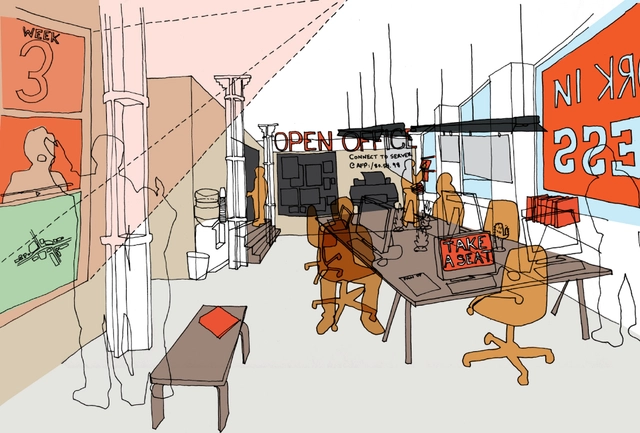
The Architecture Foundation has recently launched a month-long initiative named The Open Office. The scheme, which is described as “part 'Citizens Urban Advice Bureau', and part functioning practice” is the brainchild of London-based practice We Made That and will take place in the offices of The Architecture Foundation in Southwark, London until 22nd March. Operating on a walk-in basis, and displaying all work openly, The Open Office aims to engage and educate local communities on issues of architecture, urbanism and planning.
Read more about The Open Office scheme after the break.
Currently in the California State Polytechnic University, Pomona, Interim Design Center parking lot, students are constructing a 30 foot experimental structure that expands on the notion of housing astronauts in space. Funded by the National Aeronautics and Space Administration (NASA), the year-long research and experimentation project challenges students to design a vertical habitat capable of housing four astronauts in space for a period of 60 days. Not only is this an extreme case of micro-living, but to design a living quarters with no orientation, where walls, floors and ceilings are non-existent, is unworldly.
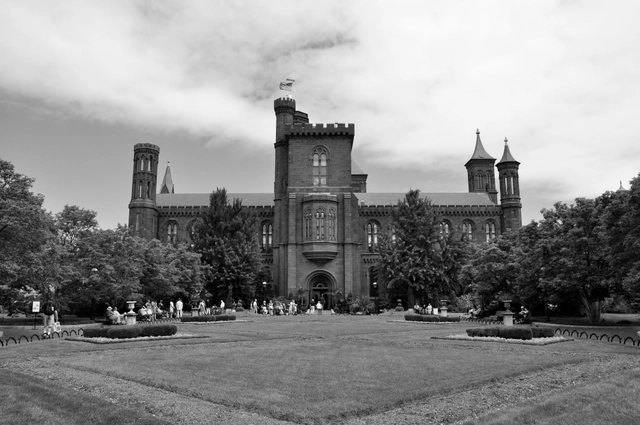
The Smithsonian Institution has commissioned the innovative practice of Bjarke Ingles to reimagine the heart of its antiquated Washington D.C. campus. The Danish architect has agreed to an eight- to 12- month, $2.4 million contract to draft the first phase of a master plan that seeks to dissolve the notable impediments and discontinuous pathways that plagues the area.
American Institute of Architects (AIA) and Massachusetts Institute of Technology’s (MIT) Center for Advanced Urbanism have announced a research collaboration to support AIA efforts through the Clinton Global Initiative (CGI), Decade of Design, a measure focused on improving the health of urban communities. As the global population continues to shift toward urban environments, urban conditions of the past century have become too outdated to address the increase in population and pollution. In order to advance the state of city liveability, professionals in the design and planning fields must reconsider how urban environments need to be designed to work optimally in regards to social, economic and health challenges. MIT's collaboration with the profession-based organization of the AIA allows the research of the school to reach the professional world for application and development.
One thing Google has become known for is their spectacular work environments. From playful employee lounges to environmentally sensitive design, the multifaceted internet giant has successfully transformed hundreds of existing spaces from around the globe into casual work environments that spawn innovation, optimizes efficiency, and boasts employee satisfaction. Much like many other California-based corporations, Google has been toying with the idea of building their own office space from scratch. Well, this dream will soon be realized, as the company has teamed up with Seattle-based NBBJ to expand their current, 65-building “Googleplex” in Mountain View, California, by adding a 1.1-million-square-foot complex known as “Bay View” on a neighboring 42-acre site.
Enthusiasm for water and energy data collection for commercial and residential buildings has been growing strong across the U.S. in major cities such as Austin, New York, Washington D.C. and San Francisco. It's no surprise to learn that Earth-friendly Seattle is ahead of the game when it comes to tracking its buildings; reports show that the city is receiving data for a whopping 87% of its commercial and multi-residential buildings over 50,000 square feet, which totals to 1,160 individual properties covering over 200 million square feet of the city.
Last year, Google founder Sergey Brin demoed Google Glass a new technology from the big G that puts an augmented reality display in front of your eye. The device is scheduled for early release to developers and creatives (in order to get feedback before the $1,500 product finds its way to the general public) in just a few weeks, but it has already been highly acclaimed by the media (including Best Inventions of the Year 2012 by Time).




.jpg?1361892672)