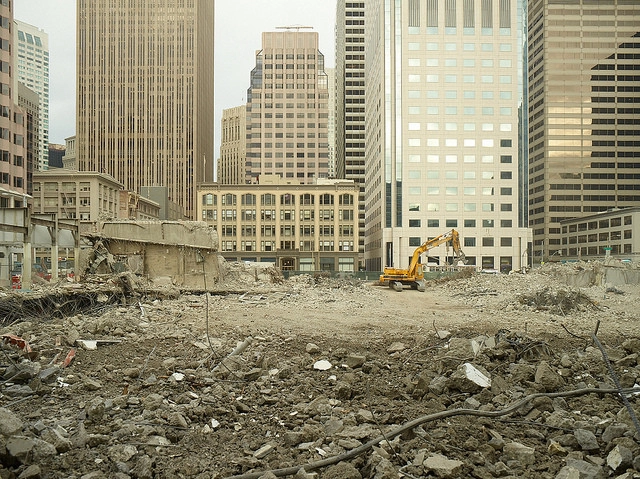
Could OMA's design of the Kunstahl Gallery be largely to blame for the art heist that occurred there this past Tuesday?
That's exactly what the Gallery's security expert, Ton Cremers, has suggested to Dutch newspaper De Volkskrant (as reported by Dezeen) in his attempt to explain how the thieves made off with millions of dollars worth of Picassos, Monets, and more.
More about the Kunsthal (including plans) and why it's supposedly "awful to protect," after the break...
From October 22-26, Cannon Design will host a prominent and diverse group of speakers to present at the Chicago firm’s 11th Annual EnvironmentalAwareness Week.
Indeed, largely because of their gargantuan energy requirements and high-tech secrets, Data Centers have been shrouded in mystery since their beginnings. This is particularly true in Google’s case. When Andrew Blum, author of Tubes: A Journey to the Center of the Internet, visited Google’s Data Center in The Dalles, Oregon, he said it was like “ a prison,” and couldn’t even get past the cafeteria. Nary a peek has been seen of a Google Data Center.
Until now, that is. Google just launched a new website,Where the Internet Lives, which features never-before-seen images of eight of Google’s 9 data centers, the places the “physical internet” calls home.
Check out the images of these never-before-seen Data Centers, after the break…
Now in it’s sixth year, the Royal Institute of British Architects’ (RIBA) 2012 Lubetkin Prize has been awarded to Wilkinson Eyre Architects for their Guangzhou International Finance Centre in China. This annual award is presented to the “best new building outside the European Union”.
RIBA President and judge, Angela Brady commented: “With exceptional vision and skill, Wilkinson Eyre Architects have given their clients and the city of Guangzhou an outstanding new 103 storey landmark. The tower’s diamond shaped structure, exposed throughout the offices, atrium and hotel, looks simple but is the hugely complex key to the success of this building. It not only allows the dramatic tapering atrium and raked floors but brings environmental benefits by using 20% less steel than similar buildings. Guangzhou International Finance Centre is a worthy winner of this important prize.”
The Municipal Art Society of New York is preparing for their third annual Summit which will feature nearly 100 talks pertaining to architecture and urbanism. Beginning October 18th, the two day event at Jazz at Lincoln Center’s Frederick P. Rose Hall will bring together elected officials, designers and innovators to share their thoughts on how New York can maintain its global-leadership position while remaining a livable environment for all its inhabitants.
Intervention in Human Rights has, until now, had very few models in the architecture profession. There are the non-profit organizations and NGO’s. They often focus on structures and spaces that have been decimated by natural disasters or military conflict. Then there is the Forensic Architecture approach which seeks to document exactly what people have undergone in those circumstances. Most architecture activists, however, fall into the first category, focusing on building or re-building.
While these models are very useful, they contain some inherent problems. One is that many of these organizations have predetermined agendas that dictate their intervention. Part of this is driven by the funding cycle: donors are not always inspired by the thought of funding a pig farm, but the idea of a new school designed by a famous architect makes an attractive selling point for new and continuing donors. Too often, however, that results in projects that are disconnected from the actual needs of local populations. Unneeded buildings are a waste of resources, time, money, and labor.
Continue reading the school profile after the break
Well, as any architect knows, first estimates are never accurate. Broad Sustainable Building (BSB), the design firm behind Sky City, soon to be the world's tallest skyscraper,has professed that the building will now be built at the positively glacial pace of 210 days (7 months instead of 3).
As we explained last time, Sky City will shoot up to its 838-meter (2,750-ft/220-story) height thanks to its pre-fabricated assembly (up to 95% of the materials will be assembled in modular form before on-site construction even begins). BSB also claims that it will be sustainable and earthquake proof.
According to a fascinating Wired interview with BSB's founder and Chairman, Zhang Yue (check it out), the foundation is scheduled to be laid in November and should be complete by March 2013.
Read on after the break for more of Sky City's impressive record-breaking stats and sustainability chops...
Maison L, the dramatic addition that transformed an 18th century orangery into an innovative contemporary house on the outskirts of Paris, has been awarded the Royal Institute of British Architects’ (RIBA) 2012 Manser Medal for best newly designed private house. The major restoration and extension was designed by christian pottgiesser architecturespossibles (CPAP), a well-published practiced based in Paris whose portfolio ranges from small private homes to large scale urban design. The French home was selected over four other impressive residences, seen here on the 2012 Manser Medal shortlist.
Just a short time since its public opening celebration, Farshid Moussavi’sMuseum of Contemporary Artis already a dynamic hub of activity for the city of Cleveland. A three-day festival in early October welcomed museum members, out-of-town guests and the general public with a series of art installations, music and entertainment, to showcase the city’s newest icon. Moussavi joined in the festivities and was honored for her sleek faceted form at the museum’s three-tiered party. Although we have been following the progress of the project since its conceptual phases, we have yet to see what the mysterious black cube has to offer in terms of interior gallery spaces and public gathering zones… until now! Check out a great series of interior photos plus beautiful exterior photos by photographers Dean Kaufman and Duane Prokop to compliment our set from the summer time.
To celebrate the start of a seven-month land use review process, Cornell has released preliminary renderings of the first academic building planned for Cornell Tech – the new world-class technology and entrepreneurship campus in New York City that was masterplanned by Skidmore, Owings and Merrill (SOM).
The modern campus strives to rethink academic workspace, prioritize environmental performance, and exploit the unique urban condition of Roosevelt Island. In May, Pritzker Prize laureate Thom Mayne, founder of Morphosis, was appointed as architect of the first landmark building, which will set the stage for the carbon positive campus.
Japanese modernist Fumihiko Maki has been chosen to design a cultural and university complex on a 67-acre Kings Cross development in London. As reported by the Evening Standard, the 84-year-old, Pritzker Prize-winning architect will design two buildings for the Aga Khan Development Network – an organization who leads the world’s 15 million Ismaili Muslims.
The two projects are among five, totaling a half million square feet, that are being commissioned by the Network at Kings Cross. It is unsaid of who will design the other three buildings. However, preliminary designs studies are under way and formal appointments will be announced shortly.
It wasn’t hard for us to get sucked into the slightly addictive world of Pinterest… and we are not complaining. For architects, Pinterest has created an online community of endless inspiration that allows you to easily share your ideas with the world.
This past week we surpassed 10,000 followers on Pinterest! In celebration, we have complied a list of a few of our most popular pins. Let’s start with the stunning aerial of the Dubai Marina, seen above. This mesmerizing image has been repined well over 300 times! For more, check out the official ArchDaily Pinterest and continue after the break for a selection of our top pins. Happy pinning!
RIBA President Angela Brady has awarded Stanton Williams the 2012 RIBA Stirling Prize for their Sainsbury Laboratory. The Stirling Prize – the UK’s most prestigious architecture award – is presented annually to the “building that has made the greatest contribution to the evolution of architecture in the past year”. Sainsbury Laboratory was selected over five other shortlisted candidates, including the London Olympic Stadium which was awarded the “People Choice” in Observers’ Stirling Prize online poll.
Beautifully integrated within the University of Cambridge’s Botanic Garden, the Sainsbury Laboratory provides world-leading scientists engaging in plant science research a working environment of the highest quality that is capable of continuously adapting to the ever-evolving needs of the scientific world. Despite high energy demands, the buildings has achieved a BREEAM excellent rating with the aid of 1,000 square meters of photovoltaic panels and extensive natural lighting.
Learn more with our comprehensive overview of the Stirling Prize-winning project, here on ArchDaily.
The critically acclaimed documentary Unfinished Spaces will premiere on PBS today at 10pm (ET). The film reveals the turbulent past of Fidel Castro’s Cuba and tells the story of his utopian dream to construct the Cuban National Arts Schools.
Beginning on October 16th, 2012, Galeries Lafayette in Paris, France, will be celebrating the 100 year anniversary of the Dome designed by architect Ferdinand Chanut and glass artist Jacques Gruber in 1912. 100 years under the Dome will be held at the flagship store of the boulevard Haussmann, a true Parisian symbol. In addition, the gallery will launch an exhibition called 1912-2012. Chronicles of a Creative Itinerary by architect Rem Koolhaas and his studio OMA, along with a collaboration called Chrysalide between visual artist Yann Kersalé and Djuric Tardio – Architectes.
Join us after the break for more stunning images for the anticipated celebration.
OMA has shared with us their proposal for the new National Art Museum of China (NAMOC) in Beijing. The Rotterdam-based practice is one of the all-star contenders competing to design the 1.3 million square feet NAMOC that will be built next to the Herzog & de Meuron-designed Bird’s Nest. Even though rumors are flying about a potential winner, the jury won’t announce the final results of the competition until November.
Given the epic proportions of the NAMOC, OMA has chosen to treat the massive structure as a small city by integrating a variety of city-like districts throughout. The proposal includes a range of experiences in both “classical, orthogonal” museum spaces as well as contemporary, open-plan areas. Continue after the break to learn more.
Well, according to the UK’s Architects Registration Board (ARB) he isn’t.
Last week, BDOnline received an email from the ARB asking them to refrain from calling Renzo Piano and Daniel Libeskind an architect, since “they are not registered with the ARB they are not entitled to be described as such”.
The statement said: “BD referred to two eminent individuals as architects – neither of whom are on the UK register. This is one of a number of peripheral areas, and architects often contact us when they are concerned about the use of the title ‘architect’ in the press although no breach of the legislation in fact occurs.”
For the 13th Venice Biennale, Norman Foster was invited to create two exhibitions. On the one hand, there’s Central Pavilion, “Hong Kong and Shanghai Bank HQ”, specifically commissioned by David Chipperfield, which presents how a public space, created by physically lifting a tower to make a space at its base, has been used by people over time.
On the other hand, we find“Gateway.” Located at the beginning of the Arsenale, it is one of the first spaces the public encounters at the Biennale. In this installation, viewers are presented with an intense dose of images and words, representing different types of buildings and spaces, criss-crossed with the names of the architects, designers and planners that have influenced our built environment over the years.
We had the chance to interview Norman Foster, who tells us more about “Gateway” in this video. Full interview coming tomorrow!
Not all is well with the global economy. Eurozone is in crisis, and East Asian market is stalling, and North America (read: the US) is see-sawing until after the election. Of course, this is not news to people in the architecture profession, where many firms are just beginning to recover from the last four years of belt-tightening lay-offs and restructuring.
Here in the United States the unemployment rate, though varying state-to-state, is still painfully high nationally at 7.8%. In California it was 10.6% back in August. Compressing further down to Los Angeles where I am, it’s 10%. According to a report from Georgetown’s Center on Education and the Workforce the unemployment rate for recent architecture graduates was 13.9%, the highest among other fields.
This exhibition, curated by London-based Sergison Bates Architects, explores the common spaces between the public city and the private room. It considers six recent social housing projects in six cities: Amsterdam, Barcelona, Geneva, Paris, Trondheim and Winterthur. The work, by six different practices, reveals an interconnected culture of thought and practice, a common ground of influence and affinities that extends back to past practitioners and typological precedent.
Cinematographer Tomas Koolhaas, son of notorious Rem Koolhaas, has shared with us his latest clips from the feature length documentary film, REM. Set to debut in 2013, the motion picture breaks away from conventional approach to filming architecture and exposes the raw, human experience of Dutch architect’s most famous projects. As Tomas describes, REM gives the audience “a rare insight into the reality of the hidden internal life of the buildings”.
ArchDaily had the chance to discuss the film with Tomas. Continue after the break for the complete interview and another small preview of the film!