Perot Museum of Nature and Science designed by the 2013 Gold Medal Award Winner: Thom Mayne of Morphosis
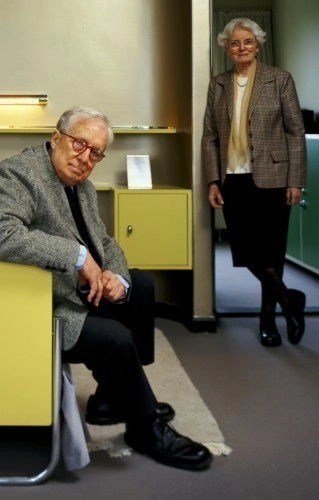
In the wake of Pritzker’s refusal to retroactively acknowledge Denise Scott Brown’s role in Robert Venturi’s 1991 Pritzker Prize, the American Institute of Architects (AIA) Board of Directors have voted to expand the prestigious Gold Medal award’s criteria to include either an individual or two individuals working together in a collaborative partnership. In order to be considered, partners must have created a singular body of distinguished architectural work.
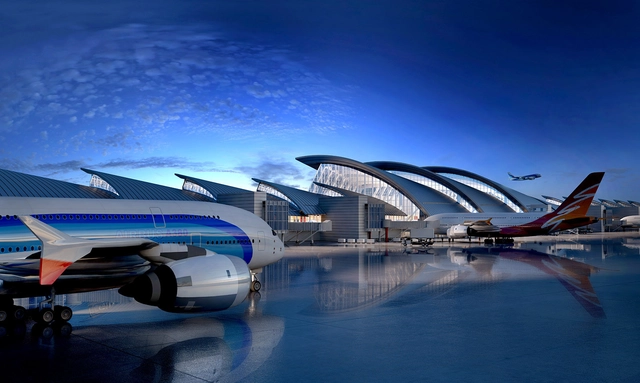
Phase 1 of the new Tom Bradley International Terminal at LAX, the largest public works project in the history of Los Angeles, has been completed. The new airport, designed by Fentress Architects to be a LEED-certified landmark for the city, will feature a flowing, ocean-inspired roofline, a three-story,150,000-square-foot Great Hall, and one of the most advanced multimedia Integrated Environmental Media Systems (IEMS) in the world. The $1.5 billion project has been funded solely from LAX’s operating revenues, without public funds.
Thousands have flocked to the Mile High City in Colorado to attend the American Institute of Architects (AIA) 2013 National Convention. The three-day event was enthusiastically kickstarted this morning by AIA president Mickey Jacobs who honored Tod Williams Billie Tsien Architects with the 2013 Architecture Firm Award; highlighted this year's theme of leadership; and featured words of advice from TOMS founder and chief shoe giver, Blake Mycoskie.
Learn TOMS Founder Mycoskie’s top advice for architects after the break.
In the 20th century, it was going to be the site of the world's tallest skyscraper, but it became the world's largest hotel. In 2006, the hotel was replaced with a fence, the largest advertising space in all of Europe, enclosing acres of undeveloped, highly valuable land. In 2014, it will become Moscow's first - and most important - park in over 50 years.
Videos
Courtesy of Reiser + Umemoto, RUR Architecture PC
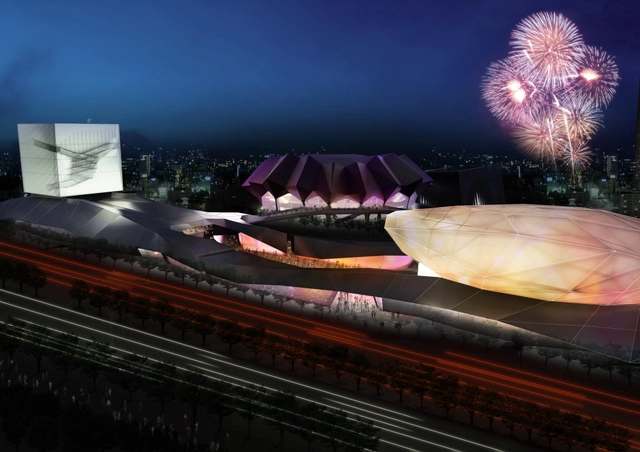
Reiser + Umemoto, RUR Architecture PC's Taipei Pop Music Center breaks ground today at the center’s site on the edge of Taipei, Taiwan. Challenging the limitations of traditional performances spaces, the center consists of several mixed-use spaces woven together into a dynamic, multi-purpose venue that reflects and supports the evolving culture of pop music. Three monumental elements—the Main Hall, Hall of Fame, and Industry Shell—symbolize the principal uses and attractions of the complex, making it a powerful representation of Taiwan’s pop music industry worldwide.
More on the new Taipei Pop Music Center after the break…
In a recent interview, Spiegelspeaks candidly with three architects who have one thing in common: projects in Germany plagued by severe delays and spiralling costs. Christoph Ingenhoven is head of Ingenhoven Architects, designers of train station Stuttgart 21. Meinhard von Gerkan of Gerkan, Marg and Partners is responsible for the Berlin Brandenburg International Airport, and finally Pierre de Meuron represents Herzog & de Meuron, designers of Hamburg's Elbphilharmonie.
These projects are well known in Germany as much for their designs as for their construction costs, and Spiegel is not shy about getting to the bottom of these controversies. Of course, the architects themselves have their own ideas about the bad press (namely that they're being unjustly blamed). Meinhard von Gerkan, for example, says:
"It's a big mistake to voluntarily serve as a figurehead, because then everyone knows whom to target. We are these figureheads, not the clients and not the construction companies. And we are liable for everything."
More of these gems from the architects, after the break....
Featuring fantastic quotes from SHoP Architects, Diller Scofidio + Renfro, Tod Williams Billie Tsien, & WORKac, Justin Davidson's latest in New York Magazine gets behind the scenes of the working architectural relationship, in all its "beauty & complexity." According to Davidson, these husband-wife teams are serving to upset ”two enduring fallacies: that men build as women help, and that the noblest kind of architect is a Napoleon of the blueprint, dispatching orders for others to carry out.”
Following the first negative downturn in ten months (what AIA Chief Economist, Kermit Baker, Phd, is hoping was just a "blip"), May's Architecture Billing Index (ABI) has bounced back from a score of 48.6 to 52.9. Any score above 50 indicates an increase in billings (aka an expansion in demand for architects' services).
Baker notes that "there is [still] a resounding sense of uncertainty in the marketplace from clients to investors and an overall lack of confidence in the general economy – that is continuing to act as a governor on the business development engine for architecture firms.” However, the scores, which revealed the most growth in the Northeast as well as in the multi-family residential and institutional sectors, are good signs for the design and construction industries.
More results of this month's ABI, after the break...
Amid fears that an initial proposal for a DePaul University stadium wouldn’t adequately fit in its residential context, The Metropolitan Pier and Exposition Authority (MPEA) seeks architects without experience in sports design to propose alternative designs. The MPEA hopes to draw top architects to the project, who, with their fresh-eyed approach, will then collaborate with specialized stadium designers later in the process. A similar approach to solicit proposals for a revamp of Navy Pier was used in 2011.
The Chinese government is pushing forward with a plan that will move 250 million Chinese people from rural communities into newly constructed towns and cities over the next 12 years. The government has been bulldozing ancient villages, temples and open-air theaters as well as paving over farmland to make way for mega-cities that will raise the number of city-dwellers in China to nearly the total urban population of the US.
To find out how and why this is happening, keep reading.
Halley VI, Copyright A.Dubber, British Antarctic Survey
In order to illustrate the ingeniuity and innovation of contemporaray architecture, the British Council and curated by the Arts Catalyst, Ice Lab: New Architecture and Science in Antarctica has declared an open call for an international touring exhibition that will feature architecture of Antarctica. With one of the most extreme and desolate environments on the planet, the facilities must be laboratories and residences for scientists working in this distant terrain. The exhibition will feature five designs for Antarctica research stations: British Antarctic Survey's Halley VI by Hugh Broughton Architects; Princess Elisabeth Antarctic by International Polar Foundation; Bharati Research Station by bof Architekten / IMS; Jang Bogo Korea by Space Group; and the Iceberg Living Station by MAP Architects.
A preliminary document reveals that, if passed, The Law of Professional Services (LSP) will modify labor regulations in order to allow engineers, or really any one "competent" in construction, to take on the work of architects:
“Exclusivity is eliminated. Architects or engineers with competency in construction will be able to design and direct projects, including residential, cultural, academic or religious buildings. [...] If a professional is competent enough to execute one building’s construction, it is understood that he/she will also be capable of executing other kinds of buildings, regardless of its intended use.”
Unsurprisingly, Spanish architects have risen up against the law, mobilizing both physical protests as well as social media campaigns. Even Pritzker-Prize winner Rafael Moneo has offered his opinion on the matter...Hear what Moneo has to say, after the break...
+ Pool, the ambitious project to float a public swimming pool in New York's East River, has recently launched a Kickstarter campaign to fund "Tile by Tile," what will be the largest crowdfunded civic project to date. Those who back the pool will be rewarded by having their name engraved on one of the pool's 70,000 tiles.
+ Pool will filter the river water to give users a clean, safe yet natural environment to swim in and provide space for all types of "swimmers, bathers and hanger-outers" in each of its four sections. The current campaign's primary aim is to fund an in-situ floating test lab which will, for the first time, prove the feasibility of filtering river water by testing various potential filtration systems.
Read more about the + Pool and the growing trend towards crowdfunding after the break...
Over the last few months, OMA and BIG have been vying for the opportunity to redevelop the 52-acre site home to the convention center in the heart of Miami Beach. With two award-winning, international firms at the center of the showdown, the media frenzy has been intense and the public’s imagination activated. It only remains to be seen if the results, which promise to be visionary, surpass expectation. With so much on the line, we decided to sit down with both OMA and BIG and discuss how their proposals differ.
The Department of State’s Overseas Buildings Operations (OBO) has shortlisted six design teams for the new U.S. Embassy in Beirut, Lebanon. The project is part of OBO’s Excellence in Diplomatic Facilities initiative in which seeks to provide safe and functional facilities that represent the best in American architecture.
open concept, double loft by 3six0 Architecture in Rhode Island
According to the AIA, The American Institute of Architects, the American housing market is at its strongest growth level since 2005. As the once struggling residential market continues to improve, the size of homes is also growing in both high-end and custom homes as well as in additions to existing homes. Data from the AIA Home Design Trends Survey reveals that preferences for accessible spaces in homes - such as open-space layouts and single-floor design - is also on the rise.
To see the survey's findings and to learn more about today's housing market, read on.
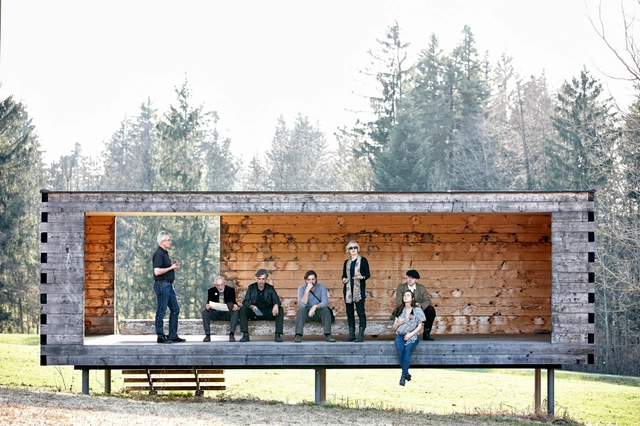
BUS:STOP Krumbach is a recently initiated project in the Bregenzerwald region of Austria that will bring together seven well-known architecture offices from around the world, pair them up with seven local architects and allow the pairs to work together on the design of seven new bus shelters in the town of Krumbach. A true collaboration between tradition and innovation, national and international, BUS:STOP hopes to create a series of small and functional buildings with their own unique characters that tell not only the story of these architects, but also of this special region.
For the list of participating offices and to learn more about BUS:STOP, read on.
Lord Palumbo, the Chair of The Pritzker Architecture Prize, has responded that this would be impossible due to the way that Pritzker Juries deliberate: "Pritzker juries, over time, are made up of different individuals, each of whom does his or her best to find the most highly qualified candidate. A later jury cannot re-open, or second guess the work of an earlier jury, and none has ever done so."
The letter goes on to suggest that Ms. Scott Brown is, however, still eligible for a Pritzker of her own; it also thanks Assouline-Lichten and James for "calling directly to our attention a more general problem, namely that of assuring women a fair and equal place within the profession. [...] one particular role that the Pritzker Jury must fulfill, in this respect, is that of keeping in mind the fact that certain recommendations or discussions relating to architectural creation are often a reflection of particular times or places, which may reflect cultural biases that underplay a woman’s role in the creative process. Where this occurs, we must, and we do, take such matters into account."
Rendering of the proposed Apple Store in Union Square
This past May, Apple filed plans to close its existing flagship retail store at 1 Stockton Street in San Francisco and move it three blocks north to one of the city's most popular spots: Union Square. This plan was met with enthusiasm from city officials until they realized that Apple and the store's architects at Foster + Partners were disregarding a beloved bronze folk art fountain by San Francisco sculptor Ruth Asawa that currently occupies the site. Many have also criticized the store's design for being a characterless box of metal and glass that contributes nothing unique to the local landscape, raising awareness of a commercial architecture defined more and more by trademark and less and less by its surroundings.
More on Apple's proposal in San Francisco and the problems of trademarked design after the break.
Courtesy of Kevin Roche John Dinkeloo and Associates
Kevin Roche, the Pritzker-winning architect known for his innovative and sometimes unusual designs, turns 91 today. His firm Kevin Roche John Dinkeloo and Associates was once described by critic C. Ray Smith as "the most aesthetically daring and innovative American firm of architects now working".
The Royal Institute of British Architects (RIBA) has unveiled the 2013 RIBA National Award winners, a shortlist of 52 exemplars in design excellence from the UK and EU that will compete for the prestigious RIBA Stirling Prize. This year’s award winners were selected from practices of all sizes and projects of all scales, ranging from a beautifully-crafted chapel in the back garden of an Edinburgh townhouse to the innovative yellow-roofed Ferrari Museum in Italy. Notably, one third of the UK winners are exceptionally designed education buildings.
The 43 UK buildings that have won an RIBA National Award are:
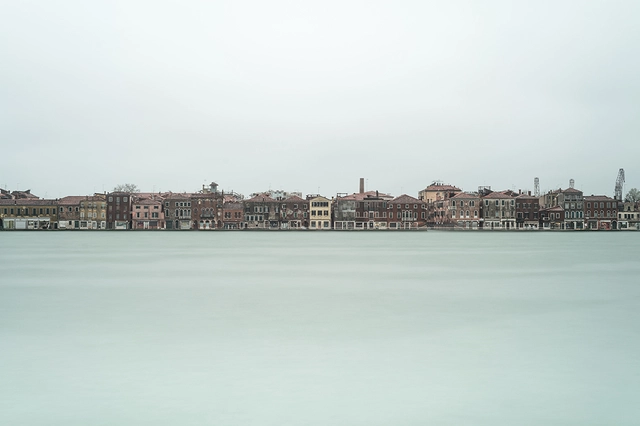
Architecture and Place Winner: Venice 2 / David Kirkland
Winners of the Architect’s Eye 2013 Competition have been announced! In an effort to encourage photography by architects, the biennial competition asked entrants to submit photography in two categories: Architecture and Place focusing on the aesthetics of a building and how it shapes the location and Architecture and People focusing on the interaction of people in relation to architecture.
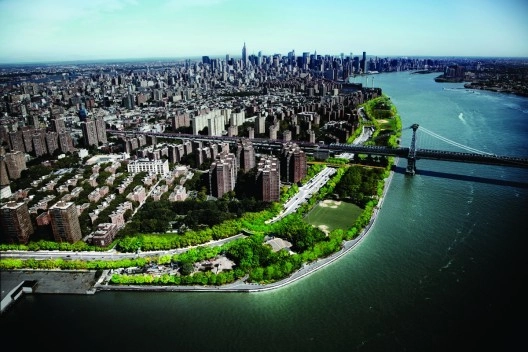
East River Blueway Plan proposed by WXY Studios provides a natural waterfront along the existing and vulnerable FDR in NYC's Lower East Side
Immediately after Hurricane Sandy hit the North American Eastern seaboard last October, NYC embarked on a debate on the ways in which the city could be protected from future storms that climate scientists predict will escalate in frequency. Engineers, architects, scientists from myriad disciplines came up with proposals, inspired by international solutions, to apply to this particular application. We were presented ideas of sea walls, floating barrier islands, reefs and wetlands. Diverse in scope, the ideas have gone through the ringer of feasibility. Should we build to defend or build to adapt?
On Tuesday, NYC Mayor Bloomberg announced a plan that includes $20 billion worth of both: a proposal of removable flood walls, levees, gates and other defenses that would be implemented with adaptive measures such as marshes and extensive flood-proofing of homes and hospitals. We have learned over the years that resilience must come with a measure of adaptability if we are to acknowledge that climatic and environmental conditions will continue to challenge the way in which our cities are currently being developed.
What does this plan entail and what can we imagine for the future of NYC? Find out after the break.