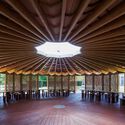
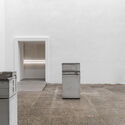
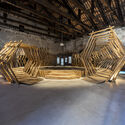
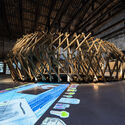
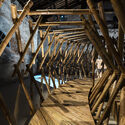
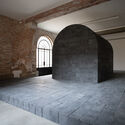
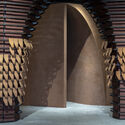
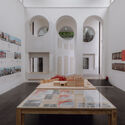
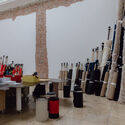
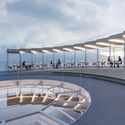
Néstor Montenegro, Enorme Studio y Smart and Green Design diseñarán el Pabellón de España en Expo Osaka 2025. Image Cortesía de Acción Cultural Española (AC/E)
The architecture and design practices Néstor Montenegro (EXTUDIO), Enorme Studio, and Smart and Green Design will be in charge of carrying out the designs of the Spanish Pavilion at Expo Osaka 2025. This comes after being selected in the public competition organized by the Spanish Cultural Action (AC / E), the institution responsible for representing the country in Universal and International Expositions.
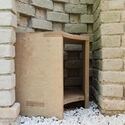
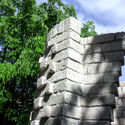
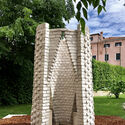
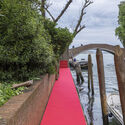
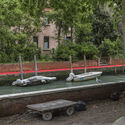
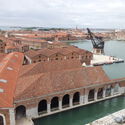
Urban Radicals presented a temporary pavilion “A Brick for Venice” as part of the European Cultural Center’s “Time Space Existence program during the same time as the 2023 Venice Architecture Biennale. The entirety of the brick pavilion was made with mud from the city’s canals. Furthermore, “A Brick for Venice” is the first proof of concept for the team’s novel waste-based construction product.
Developed by GXN for the 2023 UIA World Congress of Architects in Copenhagen, The (P)RECAST Pavilion explores the possibility of reusing precast concrete elements from existing buildings to promote circularity and reduced carbon emissions in the construction industry. The pavilion showcases salvaged concrete elements alongside 200-year-old timber beams, highlighting their aesthetic and structural value. Following the same motivation but through a different approach, MEE Studio has developed The Regenerative Cabin. Located in Copenhagen, the structure explores the applied use of regenerative biogenic materials to reduce the carbon emissions associated with the building materials.
At the 18th International Architecture Exhibition of La Biennale di Venezia, the Pavilion of Slovenia set out to explore the theme of ecology and the paradoxical ways in which architecture relates to it. Instead of understanding it strictly through energy-efficient adaptations like heat pumps or recovery ventilation, the exhibition titled +/- 1 °C: In Search of a Well-Tempered Architecture aims to address the theme holistically. The Pavilion curators Jure Grohar, Eva Gusel, Maša Mertelj, Anja Vidic, Matic Vrabič, together with fifty European architects and creatives, researched and analyzed vernacular buildings from Europe to gain insight into the living example of intuitive adaptations.
The architecture of Studio Muoto is one that encompasses endless definitions of what architecture should be, but most importantly, of what architecture can become. The scope of work of the Paris-based practice founded in 2003 by Gilles Delalex and Yves Moreau includes projects in the fields of architecture, exhibition design, urban planning, teaching, and research. All of this has led to an architecture of minimal structures that age gracefully, an architecture that evolves and adapts with time, and that is sustainable economically and environmentally.
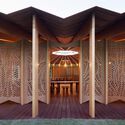
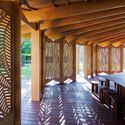
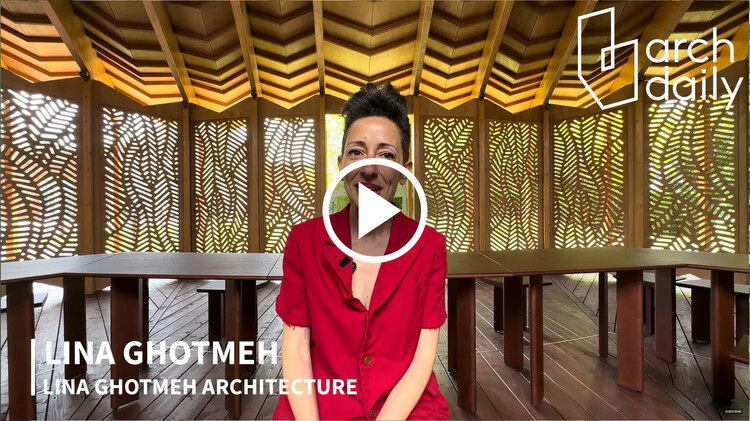
While visiting this year’s Serpentine Pavilion, the ArchDaily team has a chance to sit down with French-Lebanese architect Lina Ghotmeh, the designer behind the temporary structure built in the Kensington Gardens in London. The conversation touched upon Ghotmeh’s motivations and concepts that prompted this pavilion titled À table, conceived as an invitation to sit down together at a table, to enjoy sharing food and engaging in open dialogues. Delving into her Lebanese roots, the architect also expands on her methodology and the desire to create space for conversation and decision-making while encouraging conviviality among people of different backgrounds and experiences. The ArchDaily team also talked to Hans Ulrich Obrist, artistic director at the Serpentine Galleries, about the pavilion as a platform for architecture and the arts.
The Unfolding Pavilion is a recurring exhibition and editorial project by Daniel Tudor Munteanu and Davide Tommaso Ferrando that aims to highlight previously inaccessible but architecturally significant spaces. Now in its fourth edition, the exhibition is dedicated to the Giardini della Biennale, the Venetian garden that became the main location for one of the most important architecture exhibitions worldwide, the Venice Biennale. Through a series of site-specific interventions and photographs by Laurian Ghinițoiu, the Unfolding Pavilion #OPENGIARDINI set out to explore the paradoxical state of this public space that is not publicly accessible.
The National Pavilion of Israel presents “Cloud-to-ground,” an immersive installation exploring the nature of modern communication networks at the 18th International Architecture Exhibition of La Biennale di Venezia. The exhibition, curated by Arch. Oren Eldar, Arch. Edith Kofsky, and Hadas Maor, aims to initiate a multifaceted discussion regarding the physical aspects of virtual networks: the data centers and telephone exchanges commonly referred to as “black boxes.” The chosen theme is relevant for Israel due to its strategic location set at the intersection of continents and cultures. The pavilion in the Giardini will remain open for visitors until November 26, 2023.
At the 18th International Architecture Exhibition of La Biennale di Venezia, The PhilippinesPavilion presents an exhibition that investigates the ecology and social implication of the Tripa de Gallina estuary in Manila. The body of water, once a mechanism for flood mitigation, has now become congested and polluted, affecting the lives of the nearby communities. The Pavilion aims to present the initiative that set out to gather and investigate the guts of the estuary and to work with the residents to find adequate and sustainable architectural solutions. Titled “Tripa de Gallina: Guts of Estuary,” the exhibition in Venice is co-curated by Architect Choie Funk and Sam Domingo and presents the work of the Architecture Collective, represented by Bien Alvarez, Matthew Gan, Ar. Lyle La Madrid, Noel Narciso and Arnold Rañada.
Taking a broader perspective on architecture, the exhibition shifts its focus towards the discipline rather than just the profession. It’s not “about building buildings per se”, explains the curator to ArchDaily. Instead, it seeks to question our conventional understanding of architecture, and with that, architectural exhibitions. The 2023 Biennale is a laboratory in every sense of the word, a global platform of experimentation, and a space to explore new ideas in the absence of spaces that allow us to do so. "It borrows its structure and format from art exhibitions, but it differs from art in critical ways which often go unnoticed", states Lesley Lokko in her initial statement.
Czech Republic Pavilion at the Universal World EXPO 2025 in Osaka, Japan. Image Courtesy of Apropos Architects - Renders by ZAN Studio
Apropos Architects has won the competition to design the Czech Republic Pavilion at the Universal World EXPO 2025 in Osaka, Japan. The architecture of the intervention prioritizes movement as a crucial component of preserving physical health.
The pavilion's content demands a creative connection with spiritual and cultural ideals while openly urging visitors to engage in physical activity. It focuses on the concept that the movement of the body and the soul can shape a place, with a dynamic ascending spiral designed as a metaphor for the ideal life path. As visitors actively move within the pavilion, the cultural content materializes, culminating in a journey that generates lasting inner energy.
The National Pavilion of the Czech Republic presents the exhibition “The Office for a Non-Precarious Future” at the 18th International Architecture Exhibition of La Biennale di Venezia. The exhibition investigates current pressing issues faced by the architectural profession and especially by young practitioners by asking the initial question: ”How can architects design a better world if they themselves work in a toxic working system?.” The pavilion is commissioned by Helena Huber-Doudová and will present the works of exhibitors Eliška Havla Pomyjová, David Neuhäusl, and Jan Netušil. As the Czech ad Slovak Pavilion at the Giardini della Biennale is under reconstruction, the Czech Republic will exceptionally use the Arsenale in the Artiglierie section as its exhibition space. The Czech and Slovak Pavilion in Giardini will serve only as a digital hub to complement the main presentation.
Courtesy of the South African Pavilion at Biennale Architettura 2023
For the 18th International Architecture Exhibition – La Biennale di Venezia, the South African Pavilion explores the architectural representation of social structures through an exhibition titled “The Structure of a People.” Prior to the exhibition, the pavilion curators, Mr. Stephen Steyn, Dr. Emmanuel Nkambule, and Dr. Sechaba Maape, conducted a national architecture competition titled “Political Animals,” aimed at gathering artifacts crafted by lecturers and architecture students to represent the structures of their schools or universities. The resulting models and miniature architectures, produced by ModelArt, will be exhibited within Zone III, Political Animals, as part of the South African Pavilion.
The Naomi Milgrom Foundation has revealed the design of its tenth MPavilion, designed by Pritzker Prize-winner Tadao Ando, set to open during Australian summer, on November 16, 2023. Reflecting the architect’s architectural approach, the design unveiled the “use of striking geometric interventions in nature and […] concrete.” Once ready, the intervention will become the architect’s first commission in Australia. Created as a new gathering place situated within Melbourne's cultural and botanical garden precinct, MPavilion 10 responds directly to the park's surroundings by emphasizing spatial purity and utilizing the geometric shapes of circles and squares.
For the 18th International Architecture Exhibition – La Biennale di Venezia, the Pavilion of Ukraine presents an exhibition titled “Before the Future,” focusing on the paradox of “building a future from a collapsing present.” The intervention reimagines two spaces, one in Arsenale and one in Giardini, to evoke protective structures that have become emblematic of feelings of safety while under threat for Ukrainian society. The curatorial team, composed of Iryna Miroshnykova and Oleksii Petrov, of the Kyiv-based architectural office ФОРМА, and Borys Filonenko, independent curator, art critic, and lecturer, set out to work with specialists from numerous fields to further explore the theme “Laboratory of the Future.”
The Kingdom of Bahrain announced its participation at the 18th International Architecture Exhibition of La Biennale di Venezia with a pavilion exhibition titled “Sweating Assets.” Curated by architects Latifa Alkhayat and Maryam Aljomairi, the exhibition highlights the relationship between the extreme heat and humidity that characterizes Bahrain and the inherent need for comfort. The curators aim to show how the necessary cooling infrastructure can be maximized through adaptive means and resource management while reducing its negative impact on the environment.