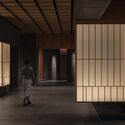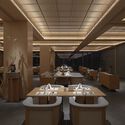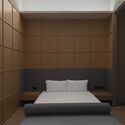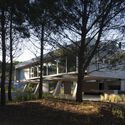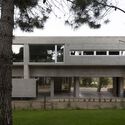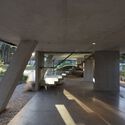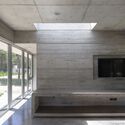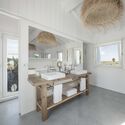
The Wright / Andre Kikoski

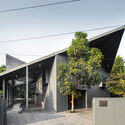
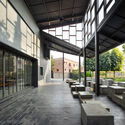
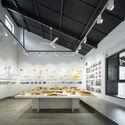
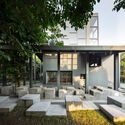
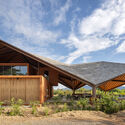
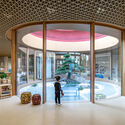
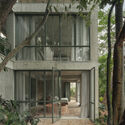
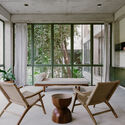
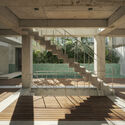
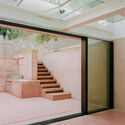
Andre Kikoski has designed a new restaurant, The Wright, for the Guggenheim Museum in New York that transforms Wright’s familiar geometries into a new dining experience. “It was both an incredible honor and an exhilarating challenge to work within Wright’s iconic building,” says Kikoski. “Every time we visit, we see a new subtlety in it that deepens our appreciation of its sophistication. We sought to create a work that is both contemporary and complementary.”
More about the restaurant after the break.
St. Albans School / Skidmore, Owings & Merrill

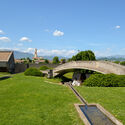
In 2006, with its centennial approaching, St. Albans School, a private boys’ school founded in 1909, decided to embark upon its first new construction project in nearly 30 years. The institution hired Skidmore, Owings & Merrill (SOM) to complete a 25,000-square-foot expansion and 30,00-square-foot of renovations to provide a student center, new classrooms, faculty offices, library and auditorium. The school, which had developed slowly over the years and did not follow a rational plan, also hoped that the architects could create a cohesive linkage between four of its existing buildings.
Treehouse / RPA

Architects: RPA
Location: Nichols Canyon, Los Angeles, CA, USA
Project Area: 16 sqm
Project Year: 2009
Photographs: Eric Staudenmaier
RCA Sackler Building / Haworth Tompkins

Architects: Haworth Tompkins Limited
Location: London, England
Project Team: Graham Haworth, Chris Fellner, Roger Watts and David Lyndon
Client: The Royal College of Art
Main Contractor: LIFE Build Solutions Limited
Structural Engineer: Price and Myers LLP
Quantity Surveyor: Gardiner & Theobald
M&E Consultant & Lighting: Max Fordham Consulting Engineers
Project Area: 1,280 sqm
Budget: £2,963,138
Project Year: 2008-2009
Photographs: Philip Vile, Helene Binet, Katsuhisa Kida Foteca
Zagreb Pavilion by njiric + arhitekti for sale on eBay
Designed for the “44th Zagreb Salon”, an architecture show in Croatia, the pavilion designed by njiric + arhitekti (featured on ArchDaily) is currently on sale on eBay.
The Pavilion is approximately 24ft across and 38ft high, and is built using steel framing, with acrylic sidings and interior and aluminum siding. Inside is the dome is placeholder for video projection equipment so this can be used for multimedia exhibitions. The starting bid is US$ 100.000 and there’s a little less than a month to bid.
To bid or find more information, click here.
Bosque Esmeralda / ROW Studio

With a shopping center already under construction, ROW Studiowas asked to design the facade for the center in Zona Esmeralda, in Mexico City. The clients asked for an interesting, and almost contradictory mix of requirements: the façade must be both dynamic and eye-catching, while still blending into the surrounding forest line.
More images and more about the facade after the break.
Atoms are the new bits, and its relation with architecture

Last weekend I had the chance to spend the afternoon with a group of entrepreneurs and Chris Anderson, editor for Wired magazine and author of The Long Tail and Free, two books that define the new economies of the Internet (highly recommended if you haven´t read them yet, specially Free)
Chris did a little speech on his new research, which immediately made sense to me from an architect’s point of view. At this point, it is more than clear that the bit revolution turned our world in 360º, and thanks to the connected world it seems that the technology development curve is more steep than ever. And now, many rules of the online world are being adopted by the physical world, and according to Anderson “atoms are the new bits”.
First, it was the media revolution. Information became democratic, collaborative, the tools became free, and everyone is part of it. But how do we take this to the World (World 2.0?)? Actually… it´s happening and very close to our profession:
AD Interviews: Paint and Architectural History, Natasha Loeblich

Architectural paint analyst Natasha Loeblich traces the histories of structures from such as the Revolutionary War-era buildings at Colonial Williamsburg, by studying what’s on their walls. I spoke to her about her work and the field.
Reconstruction of Kremlin Concert Hall / OTASH studio
Architects: OTASH studio
Location: Kremlin, Moscow, Russia
Authors: Dejan Otasevic, Ivo Otasevic, Uros Otasevic (designer)
Project architectural team: Slobodan Damjanovic, Pavle Bogdanovic
Associates: Nenad Peranovic, Marija Simsic, Dragana Mijatovic
Design Year: 2007
Project Year: 2008-2009
Photographs: OTASH studio
Trop de Bleu / Olivier Bourgeois, In Progress Architecture
Architect: Olivier Bourgeois
Location: Magdalen Islands, Qc, Canada
Visual Artist: Annie Landry
Carpenters: Gaston Bourgeois, Cyrice Boudreau
Fiberglass specialists: Les Entreprises Leo Leblanc & fils
Main partner: Arrimage
Project year: 2009
Photographs: Serge Boudreau, Olivier Bourgeois
Russia Pavilion for Shanghai World Expo 2010
Russia will decorate its pavilion for the 2010 World Expo like a fairy-tale world, showing a comfortable city as seen through children’s eyes. The country unveiled its pavilion design which will be on a 6,000-square-meter plot and feature 12 white towers inspired by traditional Russian women’s costume.
The 20-meter towers, in white, red and gold, will duplicate the ancient Ural towns dating back 3,000 years ago, but given a modern touch with their irregular shapes. They demonstrate the diversity of both ancient and modern cities, said Vladimir Strashko, Russia’s commission general for the Expo.
A 15-meter-tall central building will link the towers. More images after the break.
de Albatros / HVDN

Architects: HVDN
Location: Amsterdam, The Netherlands
Design Team: Albert Herder, Vincent Van der Klei, Jean-Marc Saurer
Project Team: Albert Herder, Jean-Marc Saurer, Rodger Van Leeuwen
Structural Engineering: Jean-Marc Saurer
Client: Van Der Waal, Vlaardingen
Project Year: 2006
Budget: € 18.100.000
Photographs: John Lewis Marshall & Luuk Kramer
CO2 Cube / Bonanno + Cornubert
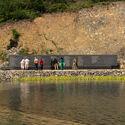
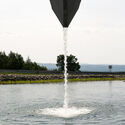
As the trend of “going green” takes over society, concerns about carbon emission is constantly growing, making both architects and those not in the profession aware of the implications of their actions. With their new installation, Alfio Bonanno and Christophe Cornubert have made a 27 foot cube of an actual ton of CO2. Dubbed the “CO2 Cube”, the piece is a representation of the amount of carbon dioxide emitted each month by the average person in an industrialized country, or in the case of the United States, every two weeks. The piece will create a strong visual impact on those passing by the Saint Jørgen Lake in front of the Copenhagen Planetarium.
More images and more about the cube after the break.
Urban Mediaspace / SHL

Libraries are something that has been revolving my head ever since I read some writings by Kahn on the Exeter Academy Library. Part of my graduate studies focused on how this typology has evolved during this last few years, moving between the silent sanctuary of books we find at Exeter and new public spaces like OMA’s Seattle Library.
As the publishing/reading platforms are changing at an unprecedented speed (Web 2.0, eReaders and the Kindle, an upcoming “Hulu for Magazines”), physical libraries have the challenge to be a place for research, gathering, socializing… being built today, to house activities in the future that we don´t even know yet.

A good example is the ongoing “Urban Mediaspace”, a project by danish practice Schmidt / Hammer / Lassen Architects which will be completed by 2014. The project is part of a large scale urban renewal project to regenerate the docks area in Aarhus, Denmark.
A big covered public space offers the flexibility needed for this kind of program, enclosed by a transparent skin that connects the outside public space with the new interior public space.
Project description and more images after the break. Thanks to Trine from SHL for sharing this project with us:
Villa Vals / SeARCH & CMA

Architects: SeARCH & CMA
Location: Vals, Switzerland
Design: Bjarne Mastenbroek & Christian Müller
Interior design cardboard bedroom: Studio JVM, Jeroen van Mechelen
Interior design excluding cardboard bedroom: Bjarne Mastenbroek
Interior advises: Christian Müller, Monica Ketting & Thomas Eyck
Contractor main structure: Kurt Schnyder Bauunternehmung, Vals, CH
Structural engineering: Alex Kilchmann, Schluein, CH
Glass façade engineering and construction: Walch GmbH, Ludesch, AT
Carpenter, interior finishing: A. Gartmann AG, Vals, CH
Cardboard interior: Nedcam shaping technology, Apeldoorn, NL
Cupboards, step chest: van hier tot Tokio’, Japanese Antiques
Electrical installations: Comet GmbH, Vals, CH
Plumbing & Water installations: Oscar Caduff, Vals, CH
Mechanical Ventilation & heating regeneration: Lippuner EMT AG, Grabs, CH
Avalanche protection: Geobrugg AG, Romanshorn, CH
Fire places and stoves: Maurus Cathomas, Ilanz, CH
Project Year: 2009
Photographs: Iwan Baan
Hometta’s Gingerbread House
This year, Hometta’s celebrating by offering all their friends and members free downloadable plans for the hippest gingerbread house on the block. This DIY house is a small-scale version of the Draft House by Hometta’s own, award-winning HouMinn Practice.
Free plans and detailed instructions on how to build your very own modern gingerbread house are available here.
To learn more about Hometta, click here.
House in Hamadera / Coo Planning
Kiyoshi Nakao of Coo Planning designed an apartment for four in Osaka Prefecture Sakai City. The cilents expressed the need for booksheleves to fit their expansive book collection. Quite different from a traditional house interior, this building is clad in wood from floor to ceiling to try and provide a “warm, lofty feeling.”
More images after the break.
Church(ita) / Supersudaka
Architects: Supersudaka / Juan Pablo Corvalán & Gabriel Vergara
Location: Villa la Paz, Talca, Chile
Collaborators: Pablo Sepúlveda, Jaime Pavez
Mosaic: Simón Fuentes / Simbiotika
Engineers: Cesar Moreira / Sigma Ingenieros
Project Area: 200 sqm
Budget: US $64,700
Project Year: 2006–2009
Photographs: Supersudaka
Camp Twin Lakes treehouse / Lord, Aeck & Sargent

Architects: Lord, Aeck & Sargent (Atlanta office)
Location: Rutledge, Georgia, USA
Client: Camp Twin Lakes
Creative director: Cynthia Gentry, founder of Atlanta Taskforce on Play (Atlanta)
Structural Engineer: Penta Engineering Group, Inc. (Atlanta office)
General Contractor: Merit Construction Co. (Atlanta)
Landscape Architect for treehouse green roof: Decatur Roofing (Norcross Georgia)
Arborist: Arborguard Tree Specialists (Atlanta)
Photovoltaic system designer: One World Sustainable (Colbert, Georgia)
Totem pole-inspired sculptures lining nature trail to treehouse: Savannah College of Art and Design, Sculpture Department (Atlanta campus)
Project Area: 1,200 square feet of enclosed space surrounded by a 600-square-foot covered deck
Project year: 2007
Construction year: 2009
Photographs: Jonathan Hillyer Photography, Inc.