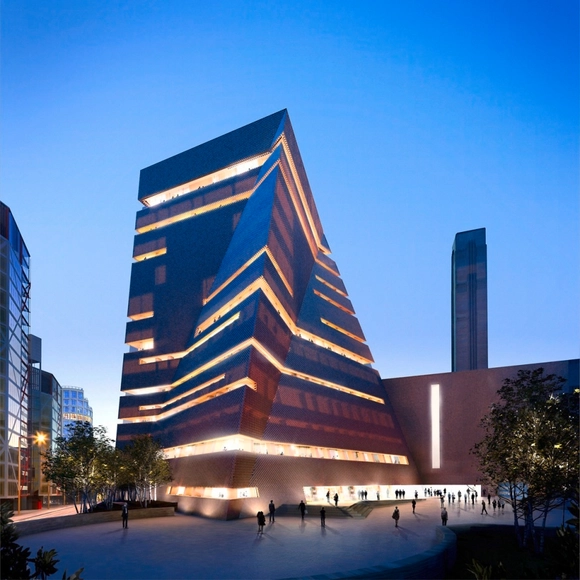
Earlier this week Sir Nicholas Serota, director of the Tate Modern, announced that Herzog & de Meuron's extension will officially open on Friday 17th June 2016. The gallery, which originally opened in 2000 housed within a former power station in London's Bankside, dramatically transformed the UK's relationship with modern and contemporary art. Since then, the Tate Modern has become a bastion of trend-setting and high-profile exhibitions, and has grown to be one of London's most visited cultural venues.
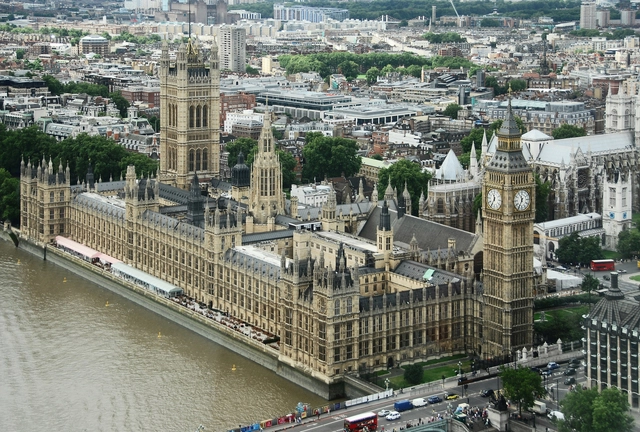
Empathetic historicism and romanticising older buildings has become an ever-common sentiment in modern Britain. In an article for the British daily The Telegraph, Stephen Bayley tackles this trend by questioning whether Victorian-era architecture is actually all worth saving? Victorian architecture, so called because it was implemented under the reign of Queen Victoria, was stylistically preoccupied by Gothic Revival — an attempt by architects and commissioners to impose a 'pure', chivalrous unifying aesthetic designed to instill a sense of civic importance and reaffirm a social hierarchy. Yet "their architecture," according to Bayley, "has an inclination to ugliness that defies explanation by the shifting tides of tastes."
London-based British practice Jonathan Tuckey Design (JTD) have created a series of residential interiors for the 'Gasholder Triplets' in London's formerly industrial King's Cross district. 145 individual apartments have been designed inside these mid-nineteenth century structures, within which Wilkinson Eyre Architects have created the "architectural insertions" (the buildings themselves).
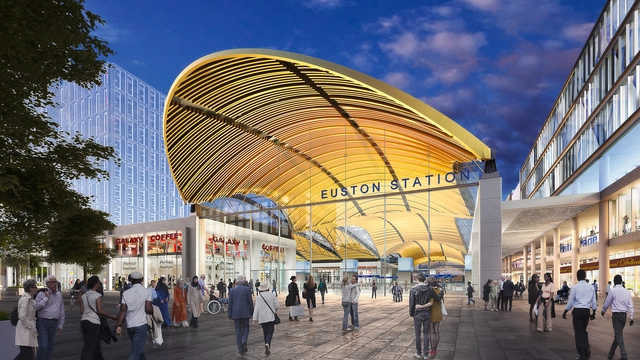
Grimshaw Architects, in collaboration with Arup, have revealed renderings for their proposed 25,000 square metre High Speed Two (HS2) railway terminal at Euston Station, in north London. They have developed an "incremental staged design" that will allow for the construction of the new high speed station while maintaining all existing services. Fronted by a 38 metre glazed façade, the new entrances will transform the internal circulation spaces into a "light and airy destination with shops, restaurants, and cafés."
According to the Architects' Journal Jonathan Woolf, "the much-respected architect and academic" born and based in London, has died aged 54. His practice, Jonathan Woolf Architects, was established in 1990 and has completed more than thirty-five projects in Europe and Africa. Woolf was also a prolific educator, having taught at the British universities of Bath, Kingston (from which he received an honorary doctorate earlier this year), the Scott Sutherland School of Architecture, and the Architectural Association.
The Royal Institute of British Architect (RIBA)'s Future Trends Survey results for July 2015 present a note of caution for architecture practices with a fall in both workload and staffing forecasts. However, optimism remains as staffing levels are higher than a year ago. Despite June’s record-high forecast, July 2015 saw a downturn in the RIBA Future Trends Workload Index from +44 to +22. Even so, practices reported an overall increase in workload at an annual rate of 8%, and staffing levels 6% higher than in 2014.
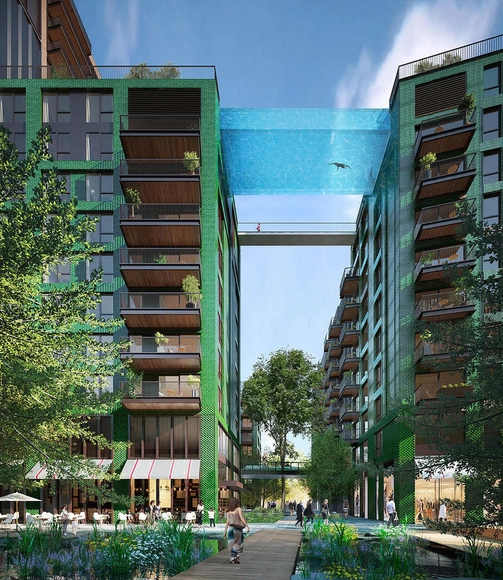
A twenty five metre long, ten storey high suspended swimming pool—dubbed the 'Sky Pool'—has been planned for the second phase of a new high-end residential development in the London district of Nine Elms, next to the new Embassy of the United States. The pool is part of two buildings, designed by London-based practice HAL and part of a complex of 2000 homes developed Ireland's Ballymore Group. The water will be held in suspension by just twenty centimetres of "structure free" transparent glass, and will connect two housing blocks together. Alongside a rooftop bar, orangery and spa, a second connection between the two is also planned in the form of a footbridge.
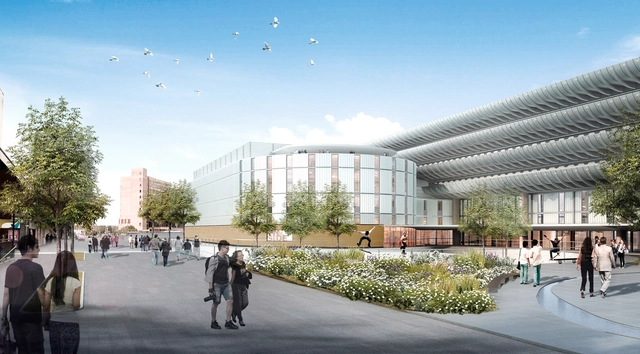
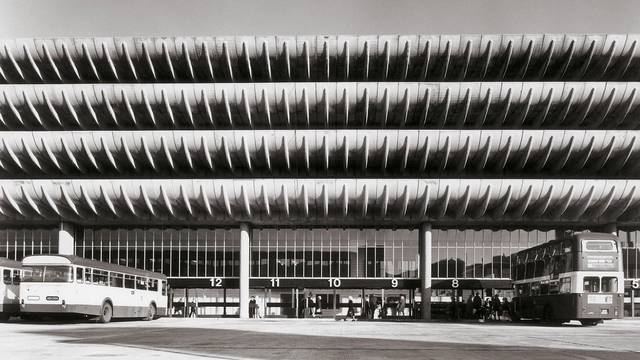
In 2013, following a number of campaigns, a 1969 Brutalist icon in the northern British city of Preston was listed. The future of this bus terminal—one of the largest in the UK and the biggest in Europe when it originally opened—was, until last month, a matter of considerable speculation and debate. This week the results of an international open-call competition for proposals transforming into a new youth centre were revealed, selecting the proposal of New York based practice John Puttick Associates as 'the best of the lot.' The 'lot', however, left something to be desired.
In a recent article for The Observer, Rowan Moore discusses what he describes as the "quiet revolution in British housing." In compiling a list of practices and collectives from the recent past and present, he has created a compendium of people and organisations who he believes are creating exemplary dwellings in the UK. Noting that the British housing stock is not necessarily in the best shape (a symptom of the 1970s), Moore ultimately offers an optimistic message tinged with words of caution.
In the latest episode of 99% Invisible, Hard to Love a Brute, Roman Mars and Avery Trufelman take a look at the potted history of the "hulking concrete brutes" of post-war Europe, centring on the UK, and the US east coast. Exploring Ernö Goldfinger's Balfron and Trellick towers, while making a pitstop in Boston, MA, this twenty minute podcast examines why people "love to hate" Brutalism and why, "as harsh as it looks, concrete is an utterly optimistic building material."
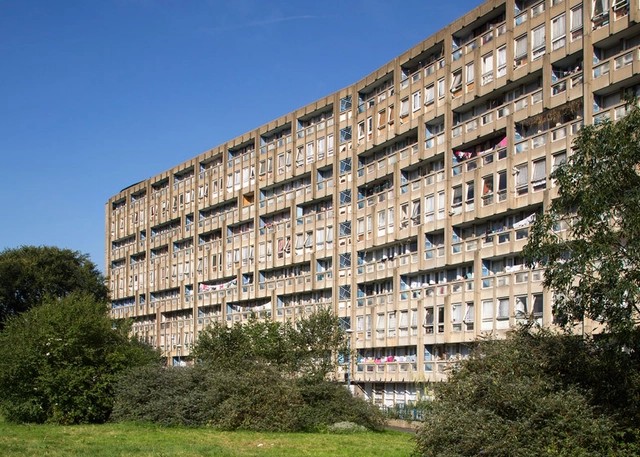
In spite of this, it has now been announced that the UK Heritage Minister, Tracey Crouch, "is minded to approve the Certificate of Immunity for Robin Hood Gardens" meaning that the decision not to list the residential complex in Tower Hamlets will be upheld, giving a"legal guarantee that the building or buildings named in the certificate will not be considered for listing for five years." This will be the second certificate of this type to have been issued for this complex. According to Historic England, "a period of 28 days [beginning on the 4th August 2015] is now allowed for review before the certificate is issued."
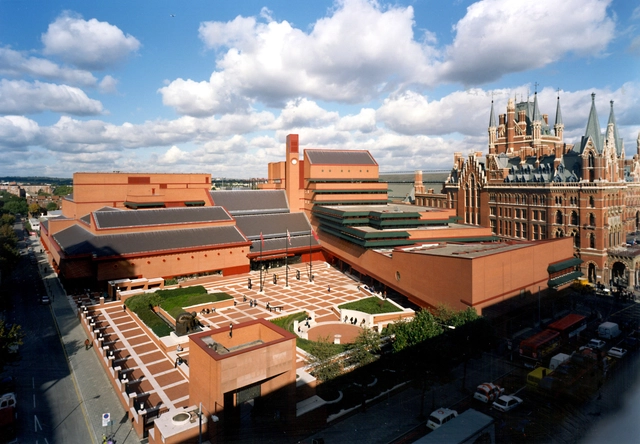
The British Library in London's St. Pancras is often hailed as the only major public building to be built in Great Britain in the twentieth century. "No other project, since the building of St. Paul’s Cathedral over 400 years ago, took so long to construct or was surrounded by so much controversy." Begun in 1962, completed in 1997, and opened to the public in 1998, the Brutalist building is a world-class a repository of artistic, scholarly and literary treasures. It has now, along with seven other post-war libraries, been given Grade I Listed status for "its soaring and stimulating spaces" which, according to Historic England, have become "much-loved and well-used by scholars and members of the public alike."
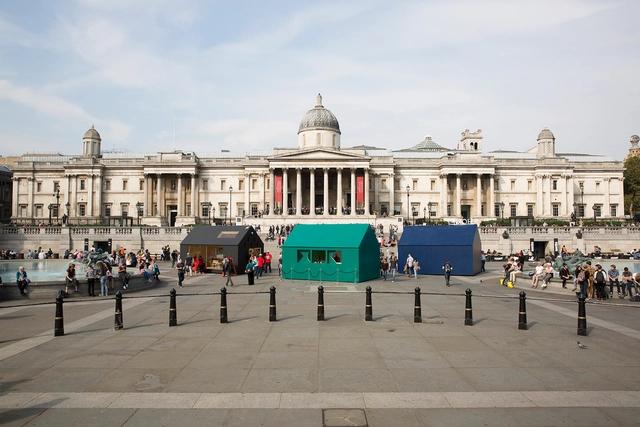
Trafalgar Square (2014 LDF). Image Courtesy of London Design Festival
The 2015 London Design Festival, an annual event held to celebrate and promote London as "the design capital of the world," will run this year between the 19th and 27th September. As a platform for some of the capital's major trade shows, the city-wide event aims to showcase exhibitors from across the world at a series of 'Design Destinations' — places at which established and emerging designers, manufacturers and brands can present their products and innovations.
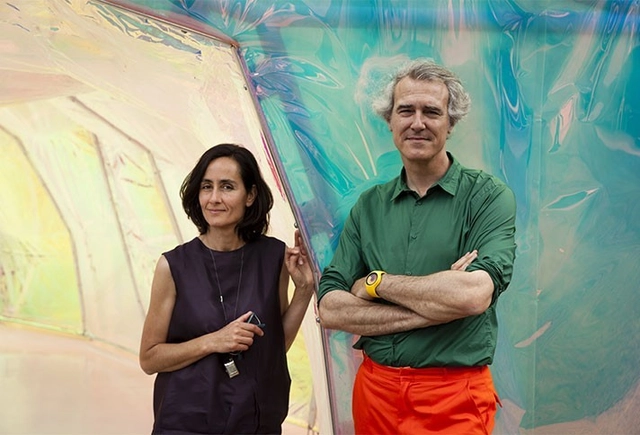
Last month, as part of their Park Nights event series, COS assembled Spanish architects José Selgas and Lucía Cano (SelgasCano) at their new pavilion for the Serpentine Gallery in London's Hyde Park to discuss the concepts behind their design and the history of the Pavilion Commission with Serpentine directors Julia Peyton-Jones and Hans Ulrich Obrist. They were joined by Chilean architect Smiljan Radić, designer of the 2014 pavilion, and Japanese architect Sou Fujimoto, designer of 2013's, in an hour long conversation moderated by Sarah Ichioka.
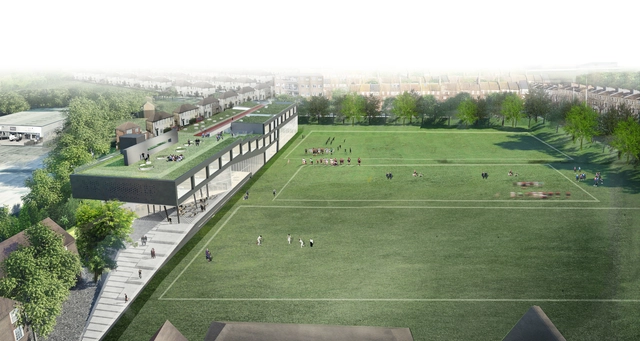
OMA has been selected to design a new building for Brighton College that will host its sport and science departments. Their design combines the two departments into one linear building that runs along the edge of the playing field.
The sport facilities are housed on the same level as the field, while the science department stretches over the top “like a skeletal bridge.” Views between the two departments are offered on the inside creating “lively and animated circulation throughout the new building.” The façade is inspired by the terrace housing that runs opposite the building.
The Royal Institute of British Architects (RIBA)’s Future Trends Survey for June 2015 shows "an all-time high," with the workload index ascending to +44 compared to +37 last month. All nations and regions within the United Kingdom returned positive balance figures, with practices in the Midlands and East Anglia responding most confidently about workloads in the next quarter. Following a slight fall last month, the private housing sector workload forecast increased to +39 (from +34), while the public sector saw a modest increase back into positive figures. Workload forecast balance figures have remained extremely high. The survey reports that large-sized practices continue to be the most optimistic about growth, while small and medium-sized practices "remain in strongly positive territory."



_Nick_Kane_6.jpg?1439884712&format=webp&width=640&height=580)