After generously donating an archive of over 6000 drawings and 150 projects, architect Charles Correa sat down with RIBA President Angela Brady to discuss his life and work as one of “India’s greatest architects.” The short interview touches on a wide range of topics, from the inspiration behind some of his greatest projects to advice for future architecture students.
“The thing about architecture is that you cannot teach it. You can learn it, but you cannot teach it. And a good school is a school which makes you passionate about architecture and that teaches you how to ask questions. [...] If you know how to ask the right questions, you will develop your own philosophy and your own visual vocabulary.”
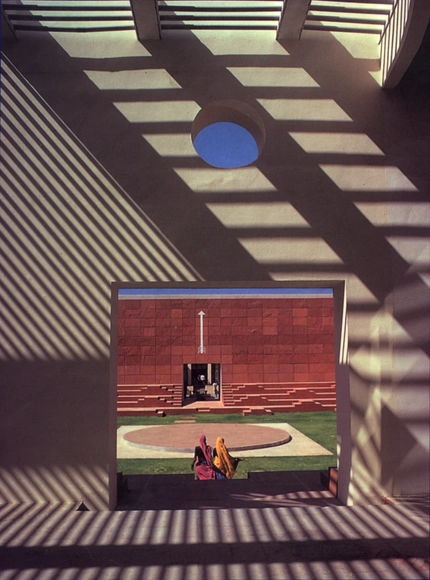
The Royal Institute of British Architects (RIBA) presents the first major UK exhibition showcasing the work of renowned Indian architect Charles Correa(born in 1930). Rooted both in modernism and the rich traditions of people, place and climate, Correa has played a pivotal role in the creation of an architecture and urbanism for post-war India. He has designed some of the most outstanding buildings in India and has received many of the world’s most important architecture awards including the RIBA Royal Gold Medal (1984), Aga Khan Award for Architecture (1988) and Japan’s Praemium Imperiale (1994), and is still working today.
According to the survey, large firms such as Foster + Partners make up just 3% of practices, but employ 40% of architects. Image courtesy of Foster + Partners
A recent survey by the RIBA of over 2,100 UK practices revealed there is now a widening gap between 'massive' and 'micro' practices, with a 'squeezed middle' in between, as reported by BD.
This was the first mandatory survey of its members conducted by the RIBA, and gives a glimpse, for the first time, into the workings of every chartered UK practice. The RIBA's executive director of membership and profession Richard Brindley described the findings as a "tale of two professions operating in different universes". The polarized profession is most damaging to the practices in the middle; those of 10-50 employees which are large enough to have costly overheads, but not large enough to absorb them.
Large practices, employing 50 people or more, include just 3% of practices, but, thanks to their size, include 40% of registered architects. At the other extreme are practices of 10 employees or less, who account for 53% of practices despite employing a meager 10% of architects. The survey found that the majority of practices employs fewer than six people.
Read on for more results and analysis of the survey
In preparation for a ministerial review of housing standards by the UK government, the RIBA has launched their "Without Space + Light" campaign aimed at advocating minimum requirements for total space and natural lighting in order to improve quality in new built homes.
The campaign, supported by a survey titled "Housing Standards and Satisfaction: What the Public Wants", aims to combat the recent trend towards 'shoe-box homes', highlighting the dissatisfaction among owners of new homes when it comes to living standards and the fact that new homes are an average of 10% smaller than they used to be.
Not only are the space standards in UK homes poor compared to past housing, they also lag behind standards set by other European countries: in Ireland, new homes are on average 15% larger, in the Netherlands they are 53% larger, and most strikingly in Denmark they are a full 80% larger.
It’s a rarity that the architecture community is presented a chance to indulge in a Peter Zumthor lecture. Often referred to a architecture’s reclusive “man of mystery”, the Swiss legend has produced a handful of projects so eloquently designed that they have captured the attention of the world. In honor of his mastery, RIBA awarded Zumthor with the institute’s prestigious Royal Gold Medal in February. In this video, he gives the 2013 Royal Gold Medal Lecture at the RIBA, focused on the theme of Presence in Architecture.
The findings of the recent BD employment survey in the UK, revealing that 22% of British architects are unemployed, certainly makes for unpleasant reading, but it is important to look beyond the upsetting numbers to figure out what they mean.
Much more than a simple number showing the rate of UK unemployment, a closer look at the results highlights problems, exposes trends, and dispels myths - from the assumed truth that London is an employment "oasis" to the supposed strength the profession has shown in this economic crisis.
Read more analysis of the survey results, after the break...
Following the conclusion of David Chipperfield’s 2012 Venice Biennale, the British Pavilion has brought its investigations back to the UK to expand upon ten exceptional research projects that illustrate how architecture has shaped the culture and economy of countries around the world.
Should Amsterdam-style floating homes be built in London’s Docklands? Could the UK learn from Brazil’s successful identikit school-building program? Could Belfast be redeveloped by following a Berlin model? These are just some of the fascinating questions that will be addressed in a series of lectures, debates and events hosted by the Royal Institute of British Architects (RIBA) in collaboration with the British Council and the Architectural Association.
Mark your calendars for the following special events, which will run from February 26 through April 27, 2013.
RIBACompetitions recently announced their two-stage design ideas competition for the Great Fen Visitor Centre in Cambridgeshire. Great Fen is an internationally acclaimed vision, one of sweeping scale and ambition. Over the next 50-100 years, more than 3,000ha of largely arable land will be transformed into a mosaic of habitat: open water, lakes, ponds and ditches; reedbed; fen, bog and marsh; wet grassland; dry grassland; woodland and scrub. The competition seeks to to create around and between a restored fenland landscape which provides a living landscape for wildlife and people. Registrations will close on December 19. The deadline for Stage 1 design submissions is 2pm on January 10. To register, and for more information, please visit here.
Now in it’s sixth year, the Royal Institute of British Architects’ (RIBA) 2012 Lubetkin Prize has been awarded to Wilkinson Eyre Architects for their Guangzhou International Finance Centre in China. This annual award is presented to the “best new building outside the European Union”.
RIBA President and judge, Angela Brady commented: “With exceptional vision and skill, Wilkinson Eyre Architects have given their clients and the city of Guangzhou an outstanding new 103 storey landmark. The tower’s diamond shaped structure, exposed throughout the offices, atrium and hotel, looks simple but is the hugely complex key to the success of this building. It not only allows the dramatic tapering atrium and raked floors but brings environmental benefits by using 20% less steel than similar buildings. Guangzhou International Finance Centre is a worthy winner of this important prize.”
Maison L, the dramatic addition that transformed an 18th century orangery into an innovative contemporary house on the outskirts of Paris, has been awarded the Royal Institute of British Architects’ (RIBA) 2012 Manser Medal for best newly designed private house. The major restoration and extension was designed by christian pottgiesser architecturespossibles (CPAP), a well-published practiced based in Paris whose portfolio ranges from small private homes to large scale urban design. The French home was selected over four other impressive residences, seen here on the 2012 Manser Medal shortlist.
Today, the Royal Institute of British Architects (RIBA) honored Swiss architect Peter Zumthor for his significant influence on the advancement of architecture by naming him the recipient of the 2013 Royal Gold Medal.
It all started in Switzerland, in 1979, when Zumthor founded his “small yet powerful and uncompromising practice”. Since, he has built a prestigious, international reputation for creating “highly atmospheric spaces through the mastery of light and choice of materials”. From his small rural chapels to the Thermal Baths at Vals, the Zumthor experience ignites the senses, with “every detail reinforcing the essence of the building and its surroundings.”
RIBA President Angela Brady, stated: “Peter Zumthor’s work renews the link with a tradition of modern architecture that emphasizes place, community and material practice. His writings dwell upon the experience of designing, building and inhabitation while his buildings are engaged in a rich dialogue with architectural history. I will be delighted to present him with the Royal Gold Medal.”
The Royal Institute of British Architects (RIBA) has announced the 2012 shortlist for the UK’s pre-eminent private housing design award, the Manser Medal. These five houses, chosen from winners of RIBA Awards and RIBA regional awards, are competing for the UK’s “best new house”.
The 2012 Manser Medal shortlist includes:
The Dune House in Thorpeness, Suffolk / Jarmund Vigsnaes Architects & Mole Architects
Private house in Gloucestershire / Found Associates
Private house in East Sussex / Duggan Morris Architects
Two Passive Solar Gain Houses, Porthadown, Cornwall / Simon Conder Associates
Maison L, Ile de France / Christian Pottgiesser – Architecture Possibles
The winner will be announced at the RIBA Stirling Prize dinner October 13, 2012 in Manchester. This year’s judges include Michael Manser CBE, architect; Lady Jill Ritblat; and Tony Chapman, Hon FRIBA, RIBA Head of Awards.
The City of York Council recently launched a competition seeking nationally and internationally renowned architects to submit their design proposals which clearly demonstrate potential future uses for York’s historic Guildhall and riverside complex. Registered architects are invited to develop their ideas for the Guildhall, the associated office accommodation, river frontage and boat yard, as part of an ‘Open Ideas’ competition, run by The Royal Institute of British Architects (RIBA). Entries will be sought from architects putting forward innovative ideas on how the potential of the Guildhall site and riverside could be maximized for the benefit of the city and its residents. The competition submission deadline is November 6th and the results will be announced early December. For more information, please visit here.
As the world turns its eyes to London in 2012, Design Stories examines the architecture and engineering behind the 2012 sporting venues. It provides a unique Olympic experience – a place where people can explore and view drawings, images, videos and amazingly detailed models of London’s key new sporting venues.
The 2012 RIBA Award winners have been announced! Since 1966, RIBA has set the standard for architectural excellence across the UK with the RIBAAwards. As bdonline points out, this year RIBA has halved the number of projects who have received awards in an attempt to harden the competition. Shortlisted from 739 entries, the 59 winners chosen from the UK and EU will now be considered for the 2012 RIBA Stirling Prize – the UK’s most prestigious architecture prize whose 2011 winner was the Evelyn Grace Academy by Zaha Hadid Architects.
RIBA president Angela Brady said: “The judges were delighted to see so many well considered, crafted and innovative projects, and the use of beautiful materials; these projects are truly exciting and inspiring.”
Taking place June 19th at 7pm at RIBA in London is the Do Architects Help? event which will examine the role that the UK built environment industry plays in overseas development. This London Festival of Architecture discussion, sponsored by Dunbar & Boardman, and put on by Article 25, emphasizes that in a world that is becoming increasingly urban and populous, architects and other built environment professionals are well placed to use their specialist knowledge and skills to influence development policy and help communities better prepare for and recover from disasters. Despite this their expertise is largely lacking for mainstream international development practice. For more information on the event, please visit here.
RIBA Competitions recently announced the launch of a new Invited Design Competition on behalf of King’s College London. Expressions of Interest are sought from architects or architectural practices for the redevelopment of the Quadrangle and its associated buildings at the College’s historic Strand Campus in London WC2. This £20 million project to design and redevelop the Quad site will provide an additional 3,700 square meters of teaching space and student facilities. King’s is committed to appointing an architect based on their ability to bring innovative thinking to a significant historical site in order to revitalize a learning community. The deadline for receipt of Expressions of Interest is June 1. More information on the competition after the break.
The 2012 RIBANorman Foster Travelling Scholarship has been awarded to Thomas Aquilina of Edinburgh School of Architecture and Landscape Architecture, part of the University of Edinburgh. He will be granted £6,000 to develop his proposal, ‘Material Economies: recycling practices in informal settlements along African longitude 30ºE’ , which takes the scholarship’s theme of resources and addresses recycling in informal African settlements. More information on the award after the break.