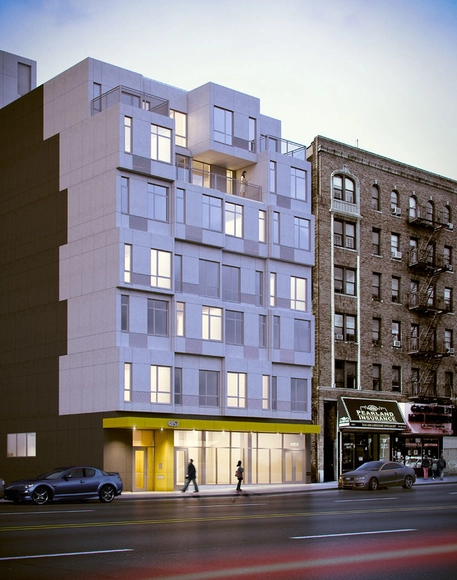
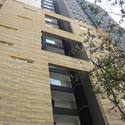
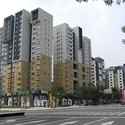
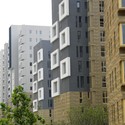
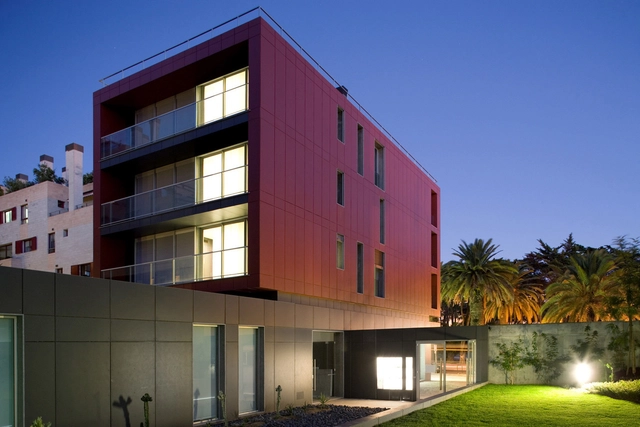
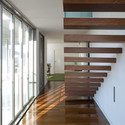
Prefabrication has long been heralded as a possible way to infill New York's vacant sites, however it is only in recent years that it has become a solid practical solution rather than an experimental concept. Riding the crest of the wave of new prefabricated housing is GLUCK+ (formerly Peter Gluck & Partners), in collaboration with developers Jeffrey Brown and Kimberly Frank. Together they have began construction on one of New York's first prefabricated steel and concrete residential buildings.
Read more about this and New York's recent wave of prefabricated buildings after the break...
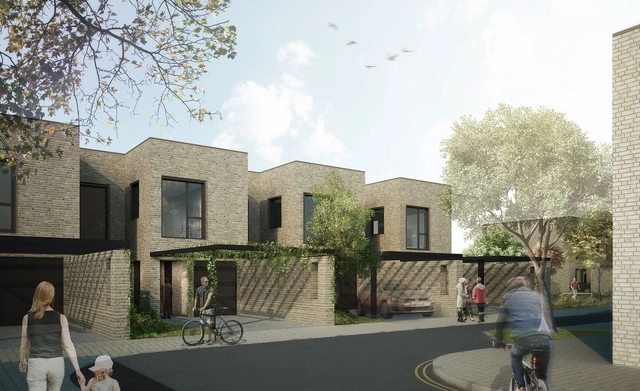
Long Lane, a key section of the Great Kneighton development on the southern fringe of Cambridge, has recently received planning approval, which will provide 273 homes over 5.4 hectares. Designed by C.F. Møller their contemporary masterplan retains historic features from the existing site, while providing homes that are functional, flexible and sustainable. Working in collaboration for developer Homes by Skanska and PRP, the customer-focused scheme provides a tenure-blind mix of private and affordable housing. More images and architects' description after the break.
Designed by Architetto Matteo Ascani (AMA), the main driving force behind the their Cambonian Sustainable Housing project was to somehow recreate the sensation of living in a typical Cambodian house, where people have to maintain their own traditions, but in healthy and safe living conditions. Combined with a type of spatial experience that allows flexibility and the simple method of construction, this environmentally conscious design is able to respond to the needs of this society. More images and architects’ description after the break.
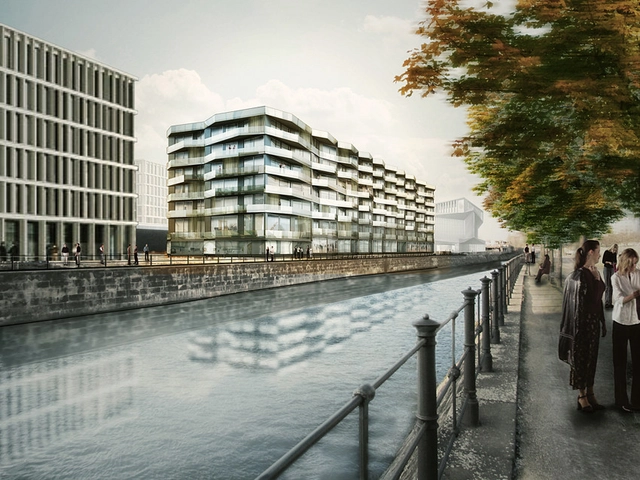
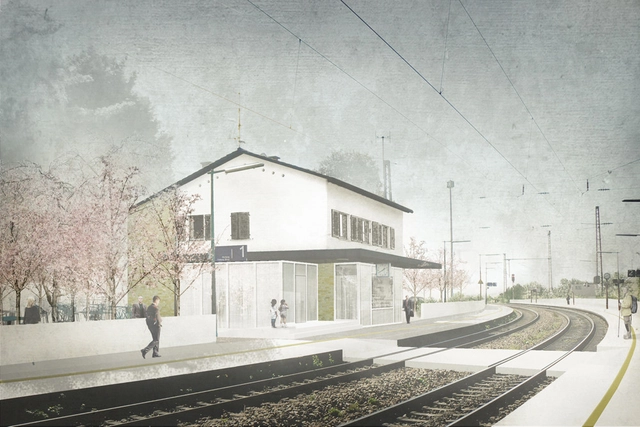
Léon Wohlhage Wernik Architekten was recently announced as the first prize winner for their proposal in the Living on Kunstcampus competition. Situated in the heart of Berlin, on the estate of the Hamburger Bahnhof, a new quarter will be created there, including the dominant urban planning element called the “Kunstkubus”. A lengthy building with a faceted surface gives the residential area its own urban planning presence. All apartments radiate spaciousness, and can be freely partitioned and enter into a relationship with the city through large loggias, or so-called “green rooms”. More images and architects' description after the break.
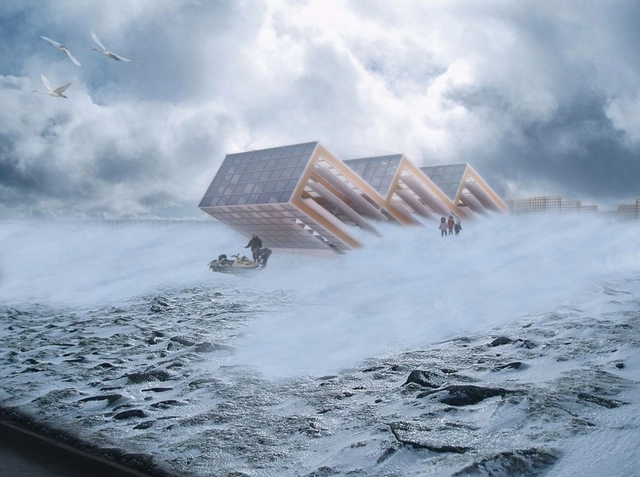
With shelters and settlements in northern Canada currently undergoing a housing crisis due to decadent construction and energy costs, the corresponding ramifications on overcrowding and deprivation have resulted. What the Drift House aims to do is hybridize the intelligence of tradition and technology of both housing systems to offer direction on future constructions in the Arctic. Designed by Neeraj Bhatia of The Open Workshop, this housing prototype for northern climates proposes a series of snow fences that passively utilize snowdrift to form a new dwelling type by calibrating the snow fences with differential mesh openings and height. More images and architect's description after the break.
Videos
Courtesy of WXY Architecture + Urban Design
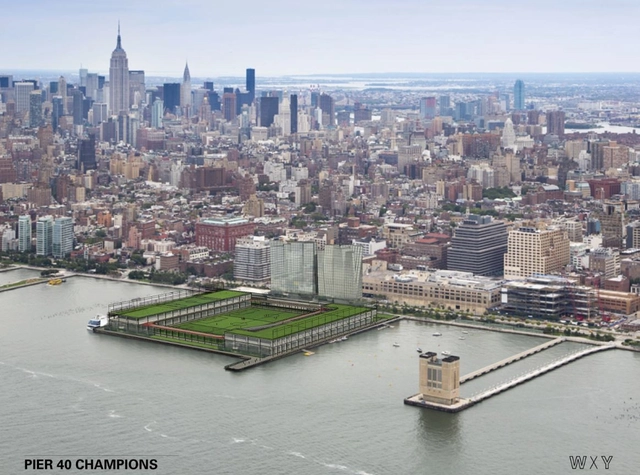
In an effort to saving the crumbling 15-acre Pier 40 on Manhattan’s Lower West Side waterfront, seven downtown youth sports groups have released a concept plan prepared by WXY Architecture + Urban Designto open up 40% more space for more fields and park space on the pier, mainly by creating a new development site for two new, 22-story residential buildings in an area along West Street directly in front of the pier. The development approach would open the existing 800-foot-long pier shed building that encloses the park fields to improve connections and access between the Hudson River, the pier, and the park. The result knits together leisure and recreation amenities with a premier waterfront destination. More images and architects' description after the break.
Studio BANG shared with us their winning proposal for the IBA Basel competition to design a settlement for commuters in Rheinweiler, Germany. With a strong focus on the last part of the commuters daily way back home, this new settlement is composed of 3 different row-housing units with 28 of them forming a structure that is slightly denser than the surrounding single-family house units. Thus, lower building costs and a closer community is enabled. More images and architects' description after the break.
Toyo Ito was commissioned for this building by his older sister after her husband sadly lost his battle with cancer in the 1970s. Having lived for a number of years in a high-rise apartment, she and her two young daughters wished to move to a site which had more connection to the ground; as luck would have it, the site next to Ito's own house was being sold at the time.
Studio Seilern Architects shared with us their recently commissioned design for a 31 hectare waterfront masterplan for Duval Properties Ltd in Abuja, Nigeria. Situated on Jabi Lake, the project aims to create a new destination for the city; a place to live, work, shop, be entertained and above all, to enjoy. With the loose arrangement of these building clusters, this results in the possibility of a flexible plan that generates multiple aspect residential units. More images and architects’ description after the break.
Despite NYC's recent bout with nature, Mayor Bloomberg is undeterred from developing housing along NYC's long stretch of waterfront, taking into account that proper measures are taken for storm and flooding mitigation. The latest in large scale developments comes to Hunter's Point South in the neighborhood of Long Island City in Queens. The first of such a scale since the 1970s development of Co-Op City in the Bronx, plans will include two phases of design and construction. The first phase, designed by SHoP Architects with Ismael Leyva Architects will bring two residential towers with 925 permanently affordable apartments, 17,000 square feet of retail space, infrastructural installations, a five-acre waterfront park, and a 1,100-seat school.
Join us after the break for more on this large scale development in Long Island City.