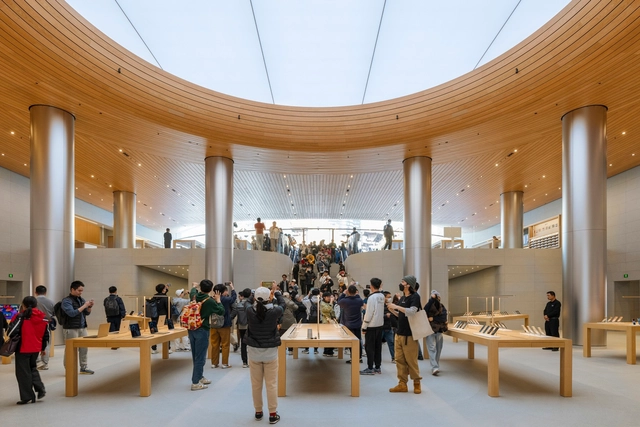
To differentiate themselves in competitive markets, the world's favorite retailers are tapping into retail design to cultivate communities of brand enthusiasts. Since traditional marketing methods no longer engage customers, physical spaces offer an avenue for more immersive and personalized experiences that match their values and lifestyles. Evolving customer preferences have led to the creation of authentic retail experiences that serve now as areas of recreation and entertainment. Designing outlets that encourage engagement, exploration, and a sense of belonging enables brands to foster loyal followings.
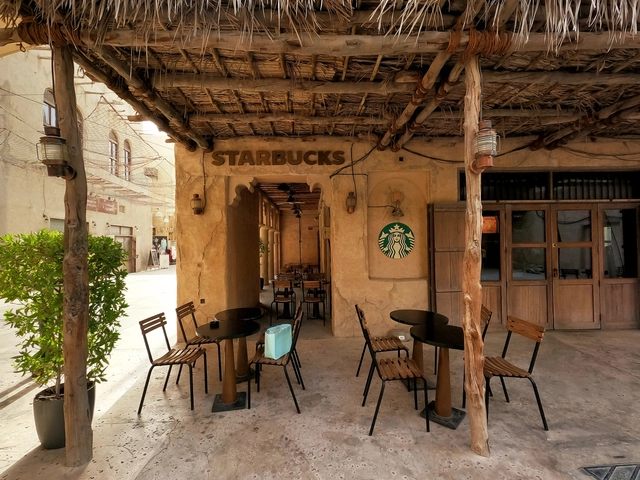
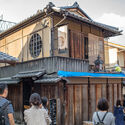
Two years ago, Starbucks' branch in Al Seef, Dubai captivated the internet with its contextual design. Located in the oldest part of Dubai, the renowned coffee outlet boasts a thatched roof, mud-like exterior finishes, traditional screens, and wooden furniture, all of which retain the picturesque charm of the landscape. The design not only garnered immense attention on social media but also attracted curious customers to the store. Effortlessly blending in with its regional context, the Al Seef branch has become an integral part of the locality. The store is one of Starbucks' many efforts at regionalizing its international outlets to create authentic connections with customers. In an era where consumers crave meaningful connections, regionalism in retail design emerges as a powerful design strategy.
When one steps into a Starbucks, they almost instantly know they are in the famed coffeehouse, and not at a McDonald's. Apart from the uniformed staff and a giant sign at the door, there are countless other factors that make a Starbucks look like a Starbucks. Textures, materials, shapes, colors, layouts, furniture, and lighting all contribute to the experience of being in a branded environment. These elements are replicated globally to create an identifiable image. As economic patterns change, brands are looking at extending their identities into spatial experiences in order to better engage with their customers in their daily lives.
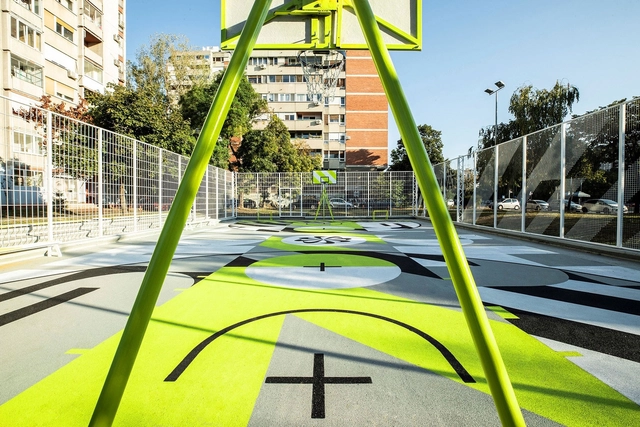
Creative agency Accept & Proceed has designed a new basketball court for Nike using 20,000 recycled sneakers in New Belgrade, Serbia. Inspired by the ‘Move to Zero’ ethos, the design features the court, children’s playground, bleacher benches, chain link fence, outdoor gym, collection bins, in-store campaign presence and restoration of existing elements. The renewal aims to re-energize the local neighborhood while providing a space for play and for sport among kids and adults alike.
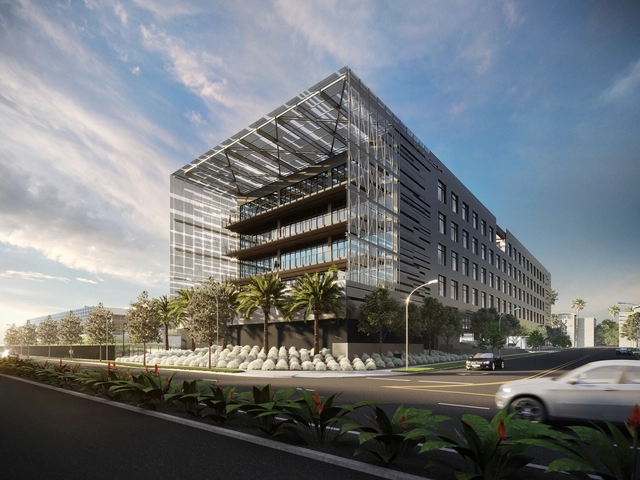
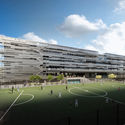
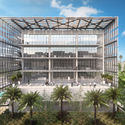
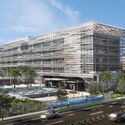
SPF:architects has topped out construction on WE3 at Water’s Edge, a six-story creative office building in Playa Vista. The 183,000 square foot structure along Silicon Beach encompasses four floors of open creative workspace, with upper floors of the structure wrapped in a “floating” perforated aluminum skin.
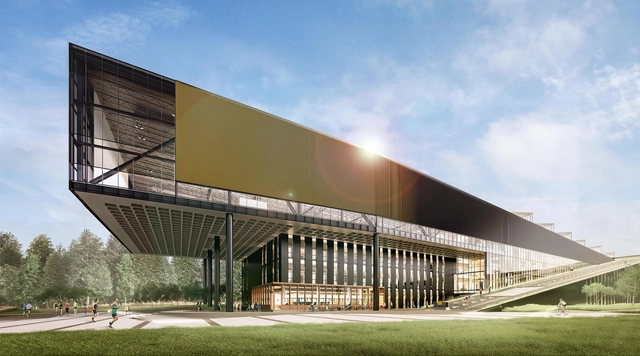
Nike has announced that the latest building in its World Headquarters (WHQ) campus expansion will be named after LeBron James. The new building is designed by Olson Kundig and will be home to Nike’s Beaverton-based Advanced Innovation team. The project will include a state-of-the-art Sport Research Lab and explore the future of sports science.
Courtesy Nicholas Calcott, via Metropolis Magazine
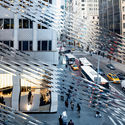
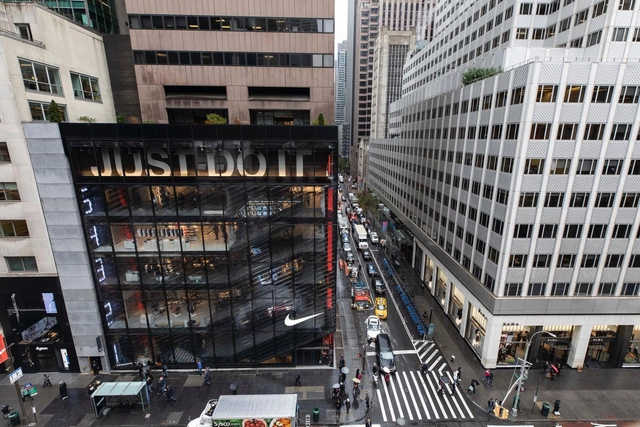
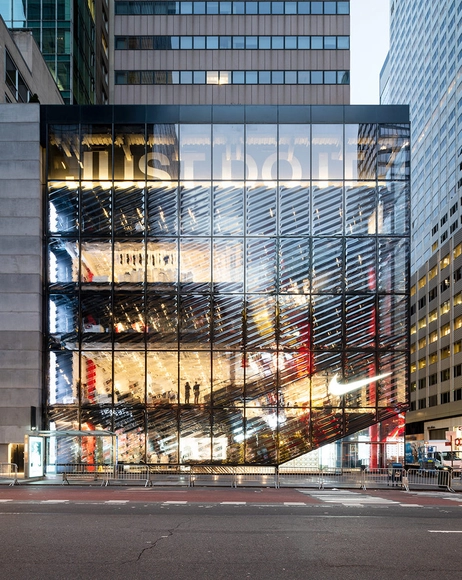
Nike's New York flagship store, primely located on Fifth Avenue, is perhaps the closest thing to a temple in the digital age. At a massive 68,000 square feet, it commands attention and symbolically dwarfs even its skyscraper surroundings. The exterior facade features a grid of undulating glass that casts glimmering shadows both inside and out. Inside, a tractor-beam type installation hangs from the ceiling, giving the space-age flavor. There's no set ritual or tradition like in the temples of old, but sneakerheads might certainly feel they've found their heaven on earth.
Nike House of Innovation 000 continues the athletic brand’s redefinition. As a company that prides itself on the innovative design of its foot and athletic wear, Nike has chosen to design its retail locations to reflect a new generation in sports performance. The House of Innovation maintains a foundation in flexible design, allowing the retailer to provide its patron with an immersive brand experience.
The store concept is described as “one floor, one world.” Each floor, inspired by the sounds and movement of New York, highlights different collections within the Nike brand. The retail program of each floor gets more specific as the levels increase. The 68,000 square-foot, six-level destination is the second Nike House of Innovation. The first was opened in Shanghai last month. These stores are the first of a new generation of sport retail experiences for Nike, numbered sequentially around the globe.
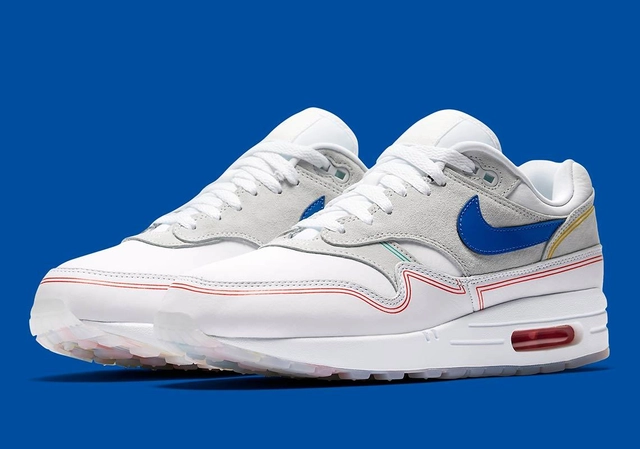
Nike has announced that it will release a special edition of its Air Max 1 range, inspired by the iconic Centre Georges Pompidou in Paris. The special edition pays tribute to the Richard Rogers and Renzo Piano-designed structure, which is credited by designer Tinker Hatfield as the inspiration behind his original Air Max 1 range.
Two upcoming editions of the Air Max 1 will honor the building, with colored tubes appearing along the seams and lines of the fabric, as well as the sole. A large P logo on the translucent sole offers a further tribute to the controversial structure, opened in 1977.
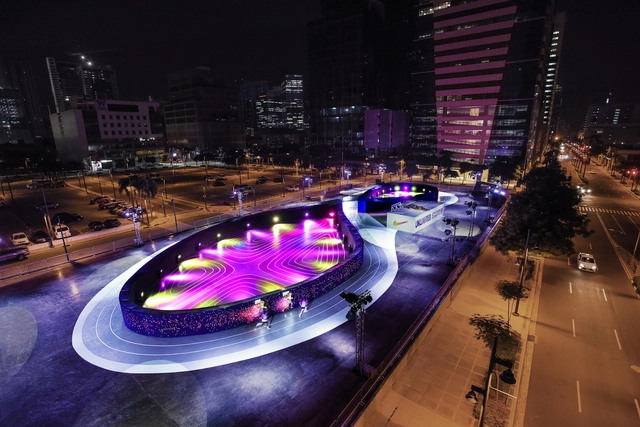
NIKE has created a new experimental lab for running aficionados: the world’s first full-sized LEDracing track. Built as a pop-up in Manila, Philippines, the "Unlimited Stadium" coincided with the launch of their new LunarEpic running shoe. The 200m long figure-8 course follows the imprint of the running shoe, scaled up to a 100ft long footprint lighting up the heart of Manila.
Nike Air Box / Kosmos Architects. Image Courtesy of Nike
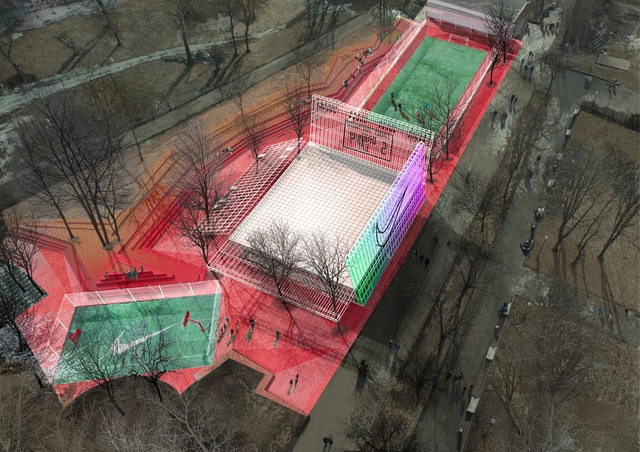
Global sportswear brand Nike, in collaboration with urban planning consultants Strelka KB, has announced the winners of the competition to design a new Nike sports facility in Gorky Park, located at the heart of Moscow. The competition asked five of Russia’s leading young architecture studios – KOSMOS Architects, Rhizome, Novoe, Crosby Studios and Xора – to envision a “unique architectural object” that seamless integrates into the surrounding park environment, creating a landmark hub for sport and physical activity for Russia.
At the Rio 2016 Olympics, Studio GTM Cenografia developed a temporary installation for Nike. The space, inspired by containers and industrial sheds, occupies a total area of 600 square meters and was built in a metallic structure and wrapped in galvanized trapezoidal tiles. The cube used in the project is an installation from Brazilian artist and designer Muti Randolph, one of the pioneers of digital illustration in Brazil.
Our friends from ArchDaily Brasil talked with the architect Daltro Mendonça (GTM Cenografia) to find out more details on material choices and the execution of the project.
https://www.archdaily.com/799270/gtm-cenografia-uses-shipping-containers-in-rio-olympic-pop-up-store-for-nikeArchDaily Team
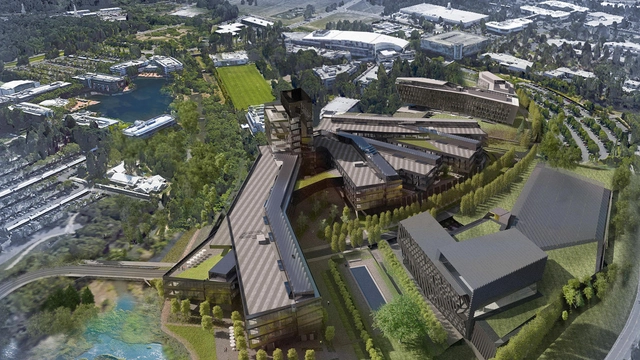
Nike has unveiled plans to expand their World Headquarters, located near Beaverton, Oregon. Their campus first opened in 1990 and has undergone three waves of construction, doubling its size. Now, Nike will expand the facility again, adding 3.2 million square feet of office, mixed-use and parking facilities.