Thanks to the increasing popularity of massive open online courses -- or MOOCs as they’re commonly referred to -- learning has never been easier (or more convenient). Sites like Coursera and edX offer free classes online from accredited and well-known universities across the globe, including Harvard, MIT and the University of Hong Kong. While some classes are more structured and include a set lesson plan, homework assignments, quizzes and the option to receive a certificate at the end, others can be set at your own pace and approached more independently.
Following our wildly popular article on Four Ways to Learn About Architecture for Free, we’ve compiled a list of upcoming online classes related to architecture, engineering, urbanism and design. So whether you’re looking to embark on a new topic or dive deeper into an already familiar subject, take a look at these free online courses after the break.
Architect and MIT Lecturer Cristina Parreño has created this new prototype for a self-supporting glass facade, entitled "The Wall." The design is the first in Parreño's "Tectonics of Transparency," a series of planned prototypes that will "explore the relationship between formal design, spatial perception, structural efficiency and systems of fabrication."
More details about Parreño's prototype after the break
The Courtowers (currently under construction). Image Courtesy of Hashim Sarkis Studios
Hashim Sarkis - a prominent scholar of architecture and urbanism, a practicing architect whose works have been built in the United States and the Middle East, and a leading expert on design in the Middle East - has been named the new dean of MIT’s School of Architecture and Planning (SA+P), effective in January. Sarkis is currently the Aga Khan Professor of Landscape Architecture and Urbanism in Muslim Societies at Harvard University’s Graduate School of Design (GSD). He has been on the Harvard faculty since 1998, and has been a full professor since 2002.
“The energy and forward-looking attitude I have encountered at one of the oldest schools of architecture and planning in the country makes it feel like the youngest,” Sarkis says. Read the complete press release here.
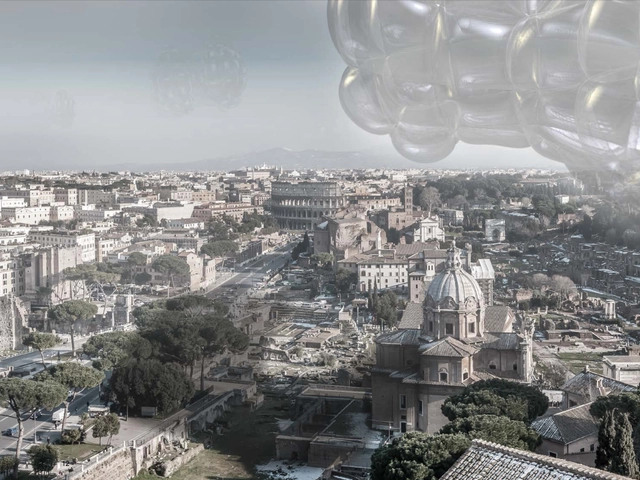
Imagine luminaires that could fly and visualise new buildings or individually guide you through space. What would happen if you could even interact with these flying pixels? These concepts could be realised in the near future as the first prototypes and experiments are being introduced. Software-driven LED pixels combined with drone swarm technology provide extraordinary possibilities for inducing new forms of spatial experience. These luminous pixel clouds emerge as digital patterns, but at the same time they emanate a romantic quality with their unique star formations twinkling in the night sky. The first projects have shared a playful note, but laboratories such as MIT's SENSEable City Lab, ARES Lab and Ars Electronica Futurelab have shown an intriguing future in urban design for guidance systems or envisioning real estate developments, as advances in battery technology and wireless control have opened new perspectives for a life with smart flying pixels.
From November 19-22 in Aarhus, the Media Architecture Biennale 2014 held in will feature the world premier of "Mapping the Senseable City," an exhibition of the now ten-year-old MIT Senseable Cities Lab's collected works. The following essay was written by Matthew Claudel, a researcher at the Senseable Cities Lab, In response to this collection, exploring what the future holds for media architecture, and imploring it to explore ideas beyond "TV screens for living in."
The Actuated Cathedral
Media architecture is emphatically ambiguous. The phrase has been pasted wholesale onto a dizzying array of projects and products. But beyond imprecision, media architecture is vexed by an inherent tension: media are networked, immediate, dynamic communication systems that reach people broadly, while architecture is sited, singular, and persistent in time. Reconciling the two evokes clumsy associations with Times Square, screens, integrated LEDs, paparazzi, or more generally things that flicker.
Buildings, regrettably, don't last forever. Until recently, the only way to increase a building's lifespan was ongoing maintenance, which can be expensive, time-consuming and in the case of infrastructure such as bridges or roads, inconvenient. Beyond that, periodic replacement of the entire structure was an option, however this is clearly not a sustainable solution, especially considering the amount of CO2-releasing concrete used in modern construction.
But in the 21st century, another alternative is emerging. This article on CityLab uncovers three self-healing materials that could significantly extend the lifespan of a construction, including Erik Schlangen's asphalt that re-sets itself with a dose of induction heating, concrete developed at TU Delft (and elsewhere) that patches up cracks with the help of its living bacterial aggregate, and a recent discovery by MIT scientists that some metals have self-healing properties.
Read the article in full here, or carry on after the break for our own coverage of Erik Schlangen and TU Delft's work in self-healing materials.
Project example from MIT OpenCourseWare's Geometric Disciplines and Architecture Skills: Reciprocal Methodologies by Isabel Collado and Ignacio Peydro. Image Courtesy of Luisel Zayas-San-Miguel
Learning doesn't necessarily need to be formal – or expensive for that matter. Thanks to the Internet and some generous benefactors, you can further your education for free from the comfort of your own home. Top schools such as MIT and Harvard University are affiliated with free online learning resources, allowing people from all over the globe to connect and audit courses at their own pace. In some cases, these services even provide self-educators with proof for having completed courses. Keep reading after the break to check out our round-up of four free online learning resources.
The following six "miracle" materials could be headed straight into your home, office, car and more. Dina Spector at Business Insider recently rounded up the six most promising materials. As of now, their potential applications have just scratched the surface, but the possibilities are endless. Presented by AD Materials.
Scientists are constantly on the look out for lighter, stronger, and more energy-efficient materials. Here's a glance at some materials that will change the way we build things in the future.
https://www.archdaily.com/508576/six-miracle-materials-that-will-change-their-industriesDina Spector, Business Insider
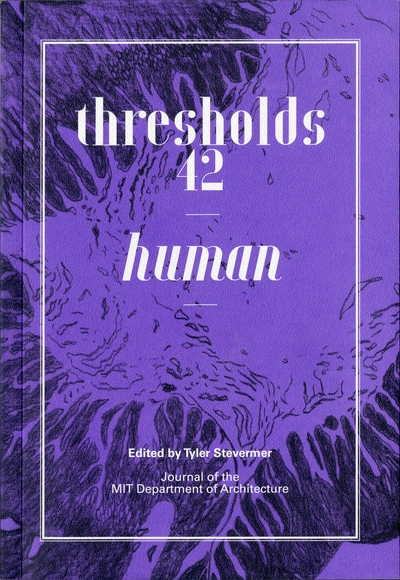
In time with the release of the 42nd issue, Human, Thresholds Journal — MIT’s peer-reviewed journal of art, architecture and culture — has launched a new website. The new ThresholdsJournal.com has been redesigned with more content, spanning the past two decades of the journal’s publication. Other features include online purchasing of past issues, enhanced search capabilities for past contributors, and social media interactivity. The new website will feature news on upcoming issues and related events, submission calls, as well as the broad range of voices that Thresholds has featured since 1992.
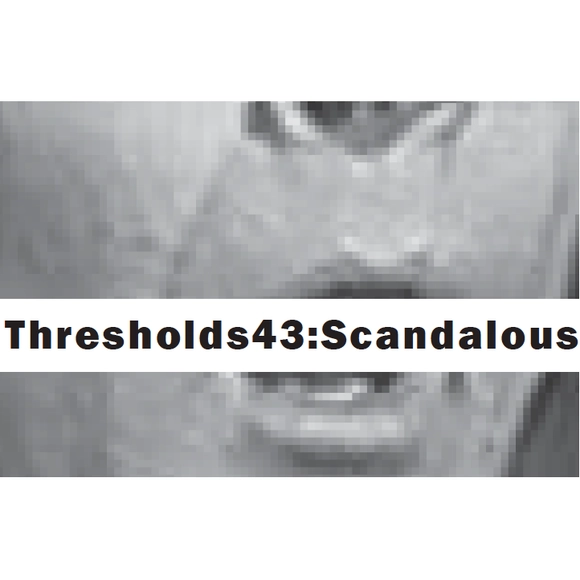
Gasp! What provokes this reflex that leaves one short of breath? More than just a sudden turn of events, for discourse to move from gossip to scandal there have to be stakes. Reputations, profits, and history-by-the-winners are on the line.
Fluid Crystallization, a project by Skylar Tibbits which informed his investigation of 4D printing. Image Courtesy of The Self-Assembly Lab, MIT
Spectrum Magazine, an annual publication by MIT to highlight the work of a cross-section of their professors and alumni, has recently released its 2014 edition. This year, the focus is on cities, with a great selection of architecture, planning and technology based contributions. You can download a pdf of the magazine here - or read on after the break for links to some articles of note.
As part of their coverage of the Global Agenda Council on Design and Innovation, Grasp Magazine interviewed Joi Ito, director of MIT's Media Lab. He voices his opinion that current strategies for masterplanning do not work, as designers struggle to reliably "predict and cause a future to occur" (a better approach is to enable and empower innovation on a grass-roots level); that designers need to find the right balance between intuition and data; and that new technologies should not just improve existing systems, but preferably overhaul them entirely. You can read the full article here.
The American Institute of Architects (AIA) and MIT’s Center for Advanced Urbanism has produced a new report examining urban health in eight of the USA’s largest cities, which has been translated into a collection of meaningful findings for architects, designers, and urban planners. With more than half of the world’s population living in urban areas - a statistic which is projected to grow to 70% by 2050 - the report hinges around the theory that “massive urbanization can negatively affect human and environmental health in unique ways” and that, in many cases, these affects can be addressed by architects and designers by the way we create within and build upon our cities.
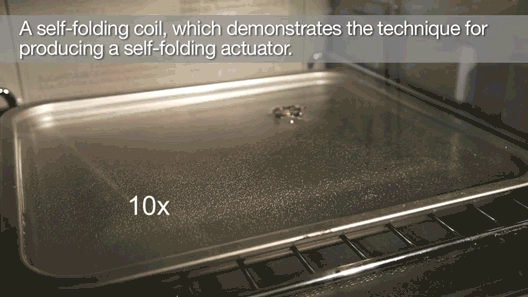
While most of us are grappling with the idea of 3D printing, Skylar Tibbits - computational architect and lecturer at MIT - is spearheading projects towards a fourth dimension. Transformation, Tibbit claims, is an uncharted capability that enables objects - straight off the printing bed - to assemble themselves, changing from one form to another. "Think: robots with no wires or motors." Tibbits exhibits how a single strand - embedded with predetermined properties - can fold from a line to a three dimensional structure. "I invite you to join us in reinventing how things come together."
https://www.archdaily.com/437587/3d-printing-moves-into-the-fourth-dimensionJose Luis Gabriel Cruz
Picture this: self-assembling blocks that, when given a task, have the ability to reorganize themselves into new geometries.
This is precisely what research scientist, John Romanishin, at MIT's Computer Science and Artificial Intelligence Laboratory (CSAIL) has long envisioned for a near future — robotic modules known as M-Blocks. Romanishin has teamed with his professor, Daniela Rus, and colleague, postdoc Kyle Gilpin, to prototype robotic cubes with no external moving parts, able to climb over, around and even leap onto each other.
Till now, robots have depended on arms or attachments to move themselves. "We wanted a simpler approach," says Romanishin, that uses fewer moving parts. Inside each M-Block is a flywheel that spins at 20,000 revolutions per minute, creating enough angular momentum when it brakes that the blocks assemble themselves in new configurations. On each face and edge of the cubes are magnets, naturally connecting the cubes when spurred by the flywheel.
Learn more after the break...
https://www.archdaily.com/435250/mit-researchers-propose-self-assembling-robots-as-future-of-constructionJose Luis Gabriel Cruz
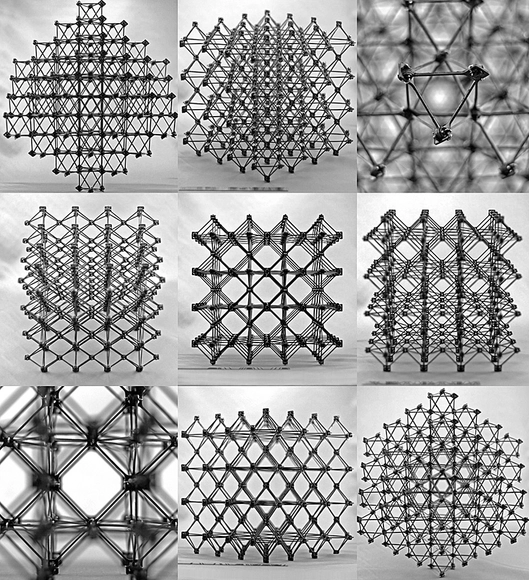
MIT researchers have developed a lightweight, interlocking composite component which can be snapped together to create airplanes, spacecraft and even larger structures. Likened to chain mail but based on a newly-developed geometry, the parts form a structure that is 10 times stiffer for a given weight than existing ultralight materials. The structure allows much less material to carry a given load and could revolutionize all moving vehicles, reducing their weight and the costs of construction while allowing greater design flexibility. To find out how it happens, read the full description here.
Text description provided by the architects. MIT’s Self-Assembly Lab has exhibited the Fluid Crystallization project as part of the 2013 Architectural League Prize Exhibition at the Parson’s Gallery in New York. The Fluid Crystallization installation - a collaboration between MIT Self-Assembly Lab director Skylar Tibbits and The Molecular Graphics Lab director Arthur Olson - investigates hierarchical and non-deterministic self-assembly with large numbers of parts in a fluid medium.



.jpg?1417009867&format=webp&width=640&height=580)
.jpg?1417009941 "© John Horner")
.jpg?1417009867 "© John Horner")
.jpg?1417009859 "© Jane Messinger")
.jpg?1417009978 "© John Horner")
.jpg?1417009867)