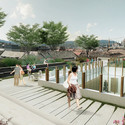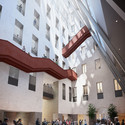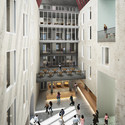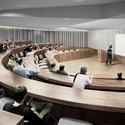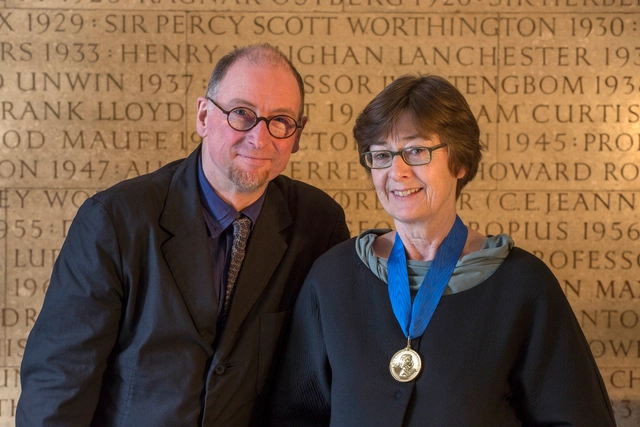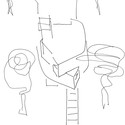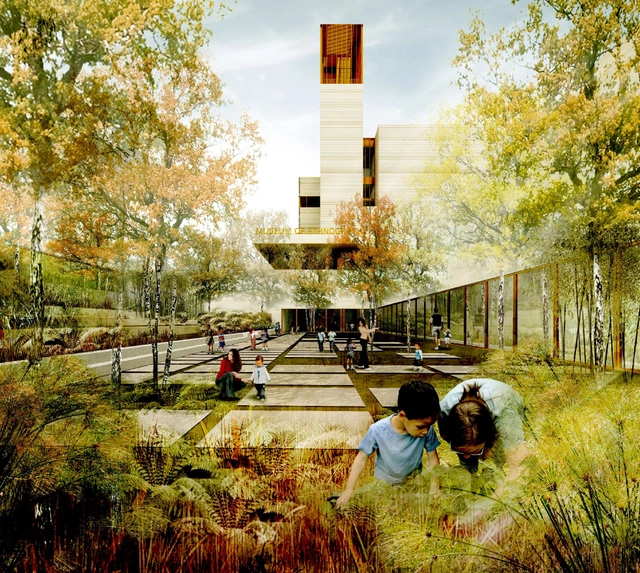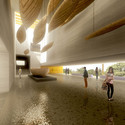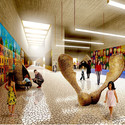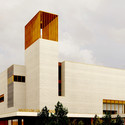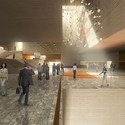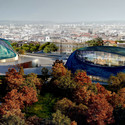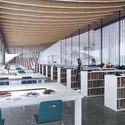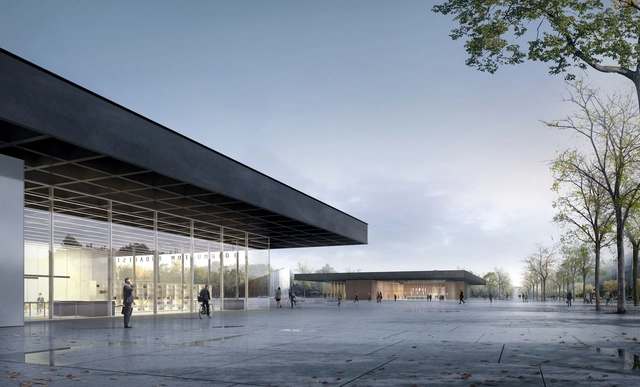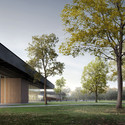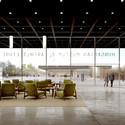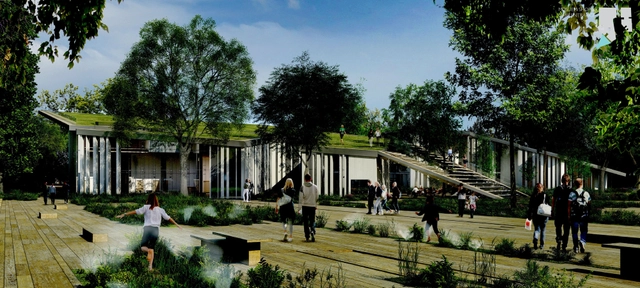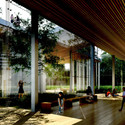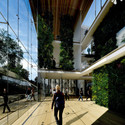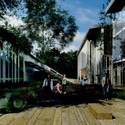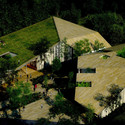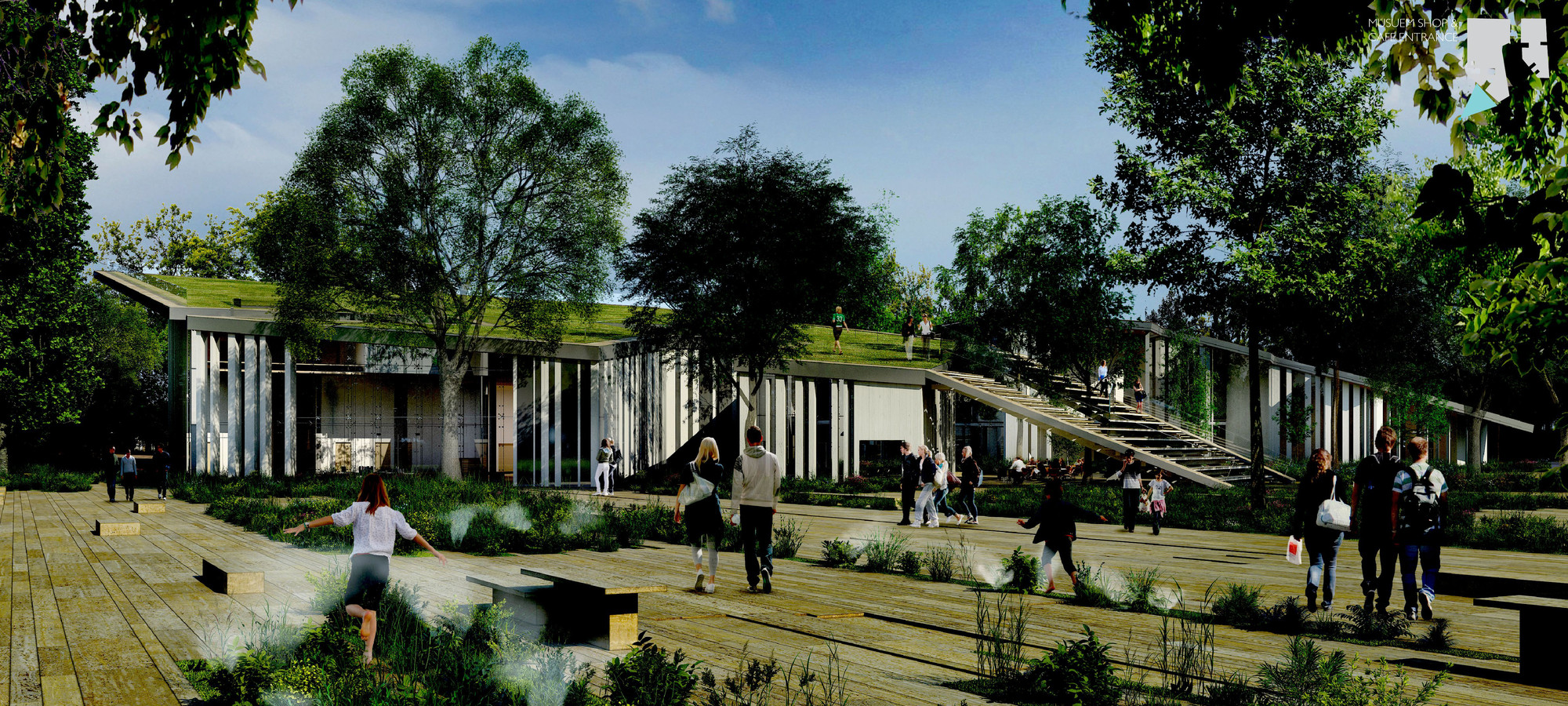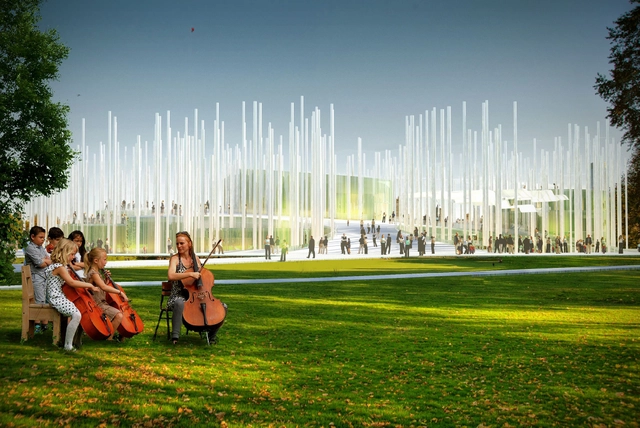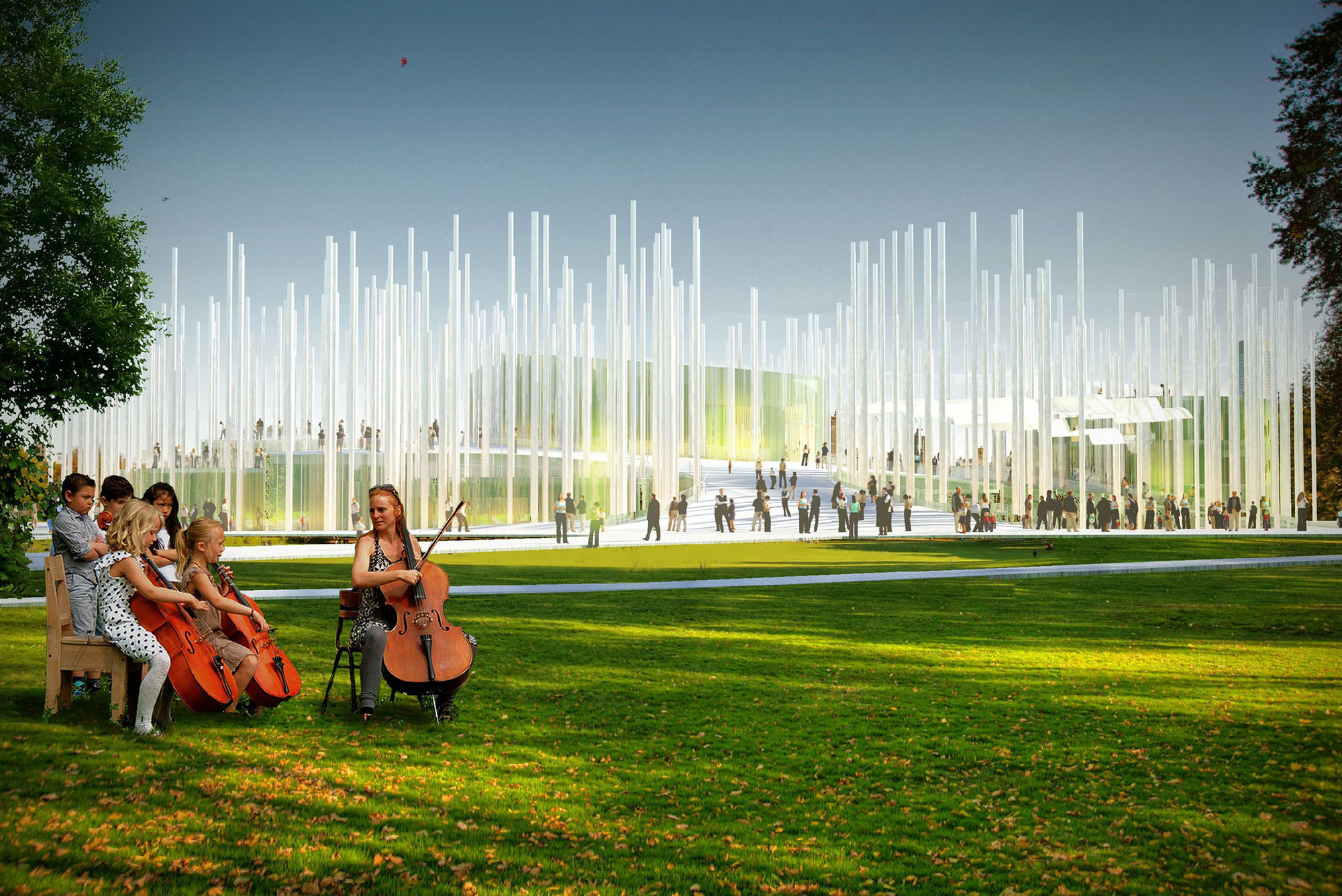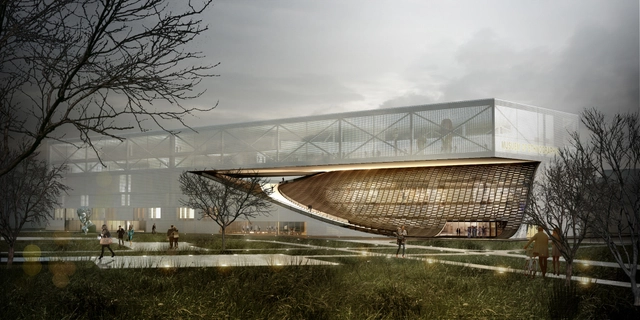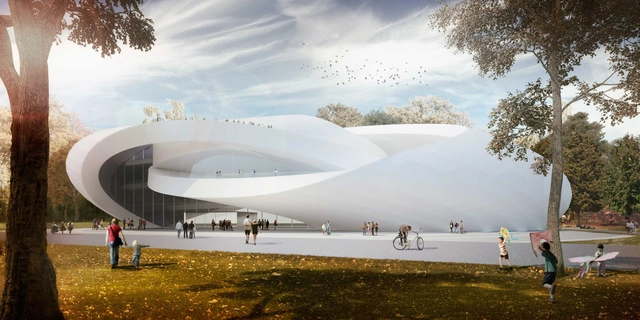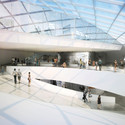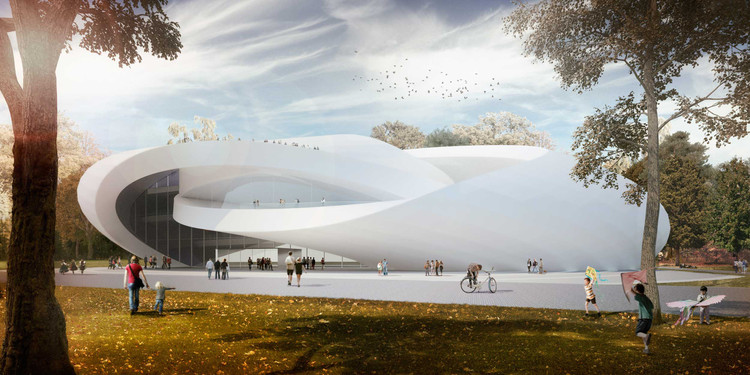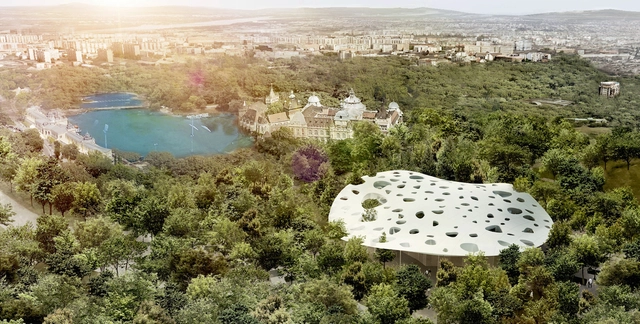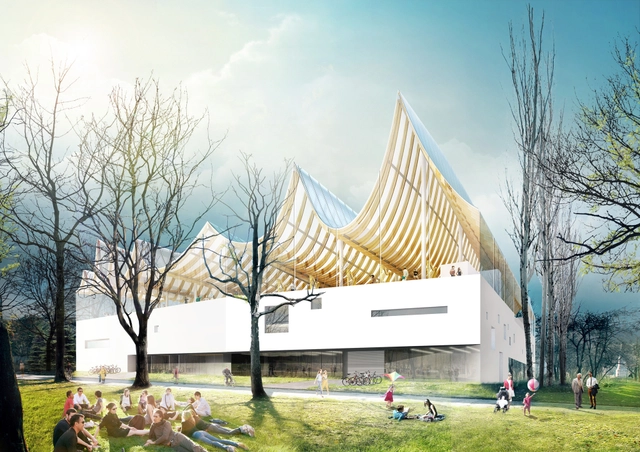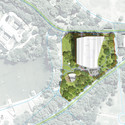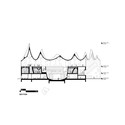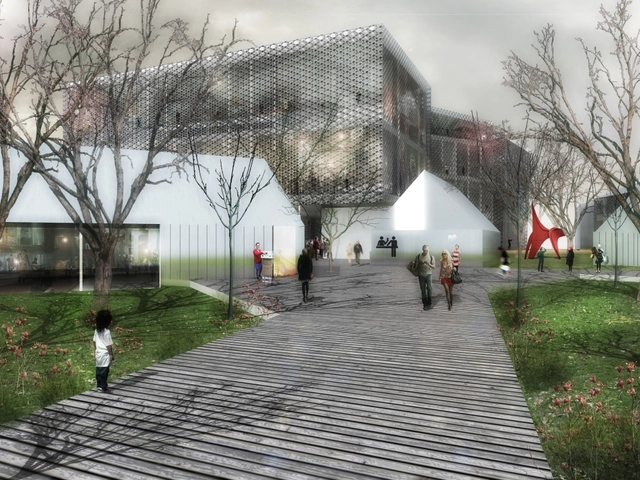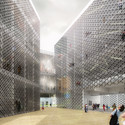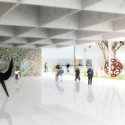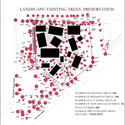
The Liget Budapest Competition has recently announced its winners, and Kengo Kuma and Associates has taken home honorable mention for their House of Hungarian Music design. Conceived as a house in the woods, the proposal seeks to embed itself in the landscape, having a low impact on the natural environment while becoming a focal point of Budapest’s urban environment.
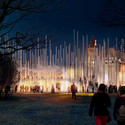
The Liget Budapest Architecture Competition has recently announced the winners for Budapest’s new Hungarian House of Music museum design. Coming in second place is architecture firm ARCVS Projektni biro. Their proposal takes the form of an 8-pointed star-shaped dome, held up by a veritable forest of columns. This uncommon shape provides numerous places, both indoors and out, for education, leisure, and exhibition, establishing itself as a prominent destination for the people of Budapest. Learn more, after the break.
A few days ago, the winning design for the new Liget Budapest Museum of Ethnography was revealed. BFarchitecture, awarded second place, has just released their design proposal, which weaves the city and park of Városliget together by flowing the public along the Dózsa György út through the procession of the building.
Courtesy of Andrea Vattovani Architecture, Segnoprogetto
This past spring, the Liget Budapest competition was launched in the interest of finding new designs for planned cultural buildings in the Hungarian capital. One of these, the House of Hungarian Music, is to be a museum as well as a performance space set in Budapest City Park. Over 170 entries were submitted for the building, and of those, Andrea Vattovani Architecture’s proposal has taken third place. This gently curving and folding sculpture of a building aims to present the history of Hungarian music in an engaging setting, while creating an iconic landmark for the city of Budapest. Learn more, after the break.
Sou Fujimoto Architects has been announced as one of three practices chosen to design buildings for the Liget Budapest project, one of Europe’s largest museum developments. Selected through an anonymous competition process, the Japanese firm will realize an undulating House of Hungarian Music that was “inspired by sound waves.” Its distinctive perforated “smart roof” will float on top an airy glass-walled interior illuminated by the canopy’s lightwells.
An international jury behind Budapest’s new National Gallery has launched a second and invited competition for a select few of the industry’s best after the first, open competition lead to “disappointing” results. Jean Nouvel, David Chipperfield, Mecanoo, Nieto Sobejano, Renzo Piano, SANAA and Snøhetta have been asked to submit proposals for a 5-building museum complex on the edge of Városliget, one of the city’s main parks. It will house the new National Gallery, the Ludwig Museum, an ethnography museum, architecture museum and photography museum.
The competition, known as the Liget Project, is being directed by jury members Wim Pijbes, the director of the Rijksmuseum, and Henri Loyrette, former director of the Louvre in Paris.
Fundamentalhas shared with us their vision for the House of Hungarian Music, as part of the Liget Budapest Competition. Inspired by the Neo-Baroque and Neo-Gothic spires of the park’s monuments which surrounding it, the modest house features a folded, white canopy rooftop which illuminates its surroundings and provides natural light deep into its interiors.
As part of the Liget Budapest Competition, SCStudio has shared their entry for the House of Hungarian Music. A transformation of an existing city park, the project is conceived as a sequence of cultural programs - an “urban archipelago” - connected by a “naturalistic promenade” of pathways and landscape within a preserved forested area.
Featuring around 220 events spread out over 10 days, Budapest Design Week kicks off its 11th year on October 3rd. With exhibitions, workshops, lectures and a range of other events spread across all design disciplines, the program will suit all tastes - however, perhaps the highlight for architects will be the presence of Benedetta Tagliabue, Principle of EMBT, who will give a lecture on "Blending and Experimentation" on October 8th.
Read on after the break for more on Budapest Design Week.
Italian design firm IaN+ has put forth their vision for a pair of museums along the Dòzsa Gyorgy Boulevard in Budapest, Hungary for the Liget Budapest International Competition. Connected by a central foyer, the two exhibition spaces will be based on a common grid of structural concrete walls whose cells will form galleries. One of these museums will be devoted to photography, the other to architecture, and each building, while similar in appearance, is designed to best accommodate the work they will display.
Ziya İmren Architects have proposed a "symphonic architectural poem dedicated to Franz Liszt and Béla Viktor János Bartók" as part of the Liget Budapest International Design Competition launched earlier this year. The architects' approach is based on the pioneering compositional methods of Franz Liszt and Bela Bartok. The design proposal brings "thematic inspiration to the fore by restructuring the classical system of a symphonic work into the form of poetry as a gesamtkunstwerk (a 'total work of art')."
Official Danish LEGO constructors have teamed up with locals in Budapest, Hungary to build the world’s tallest LEGO tower. Rising 34.76 meters (114 feet) in front of the St. Stephen’s Basilica, the towering spire was officially registered with the Guinness book of World Records for breaking the US’ previous record of 34.43 meters on May 25th. The structure was made of 450,000 colorful bricks and appropriately topped with an oversized, Hungarian-built Rubik's Cube.