Amsterdam, the capital of Netherlands is said to be a city with heart. The polycentric city of Amsterdam has its heart and soul lying in its ring of canals and bridges that bind the concentric and infinite loop that the city is. The city is popularly called the ‘Venice of North’, for its more than one hundred kilometers of canals, around 90 islands and about 1500 bridges.
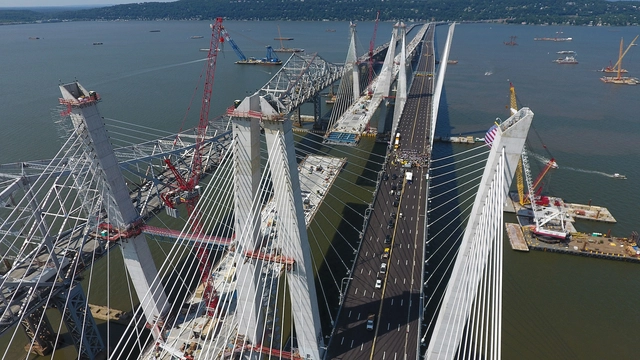
The bridge today (Aug 24). Image Courtesy of New York Governor's Office
The long-awaited replacement for New York City’s longest bridge, the Tappan Zee, is set to open to the public on Friday, announced Governor Andrew Cuomo. After four years of construction, the first of the $4 billion dollar project’s twin two-span cable-stayed structures will welcome automobile as well as pedestrian and bicycle traffic for the first time.
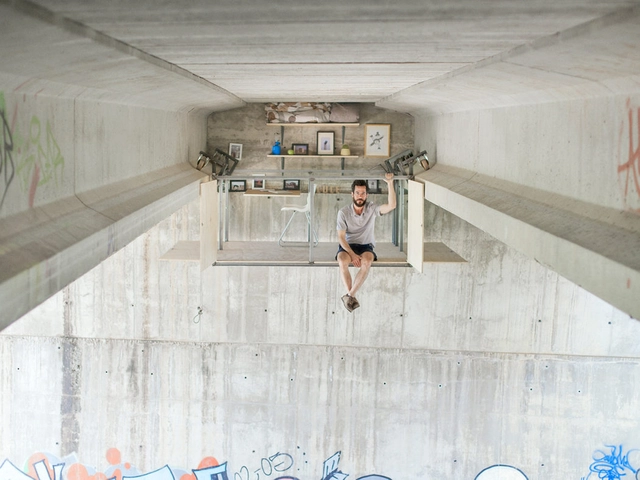
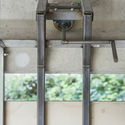
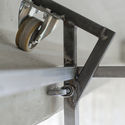
As urban environments become denser, more expensive and, on occasion, less desirable, creative minds are creating novel ways to escape the hustle, bustle, and tumult of the city. Fernando Abellanas, a designer based in Valencia, has gone to new extremes in his search for solitude. Positioned beneath a traffic bridge somewhere in the Spanish city, a hidden studio comprises a shelf, a chair, and a small desk – all anchored to the concrete undercarriage of the bridge by means of rails and rollers. Movable, the "room" becomes both impenetrable and isolated by the turn of a hand crank.
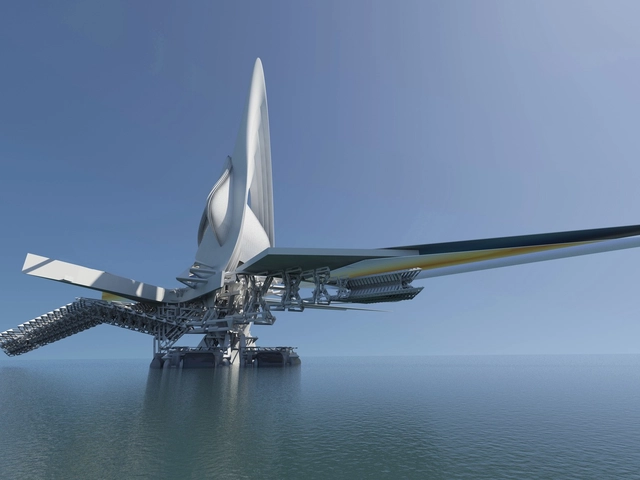
Dr. Margot Krasojević, known for creating impossibly futuristic architecture has unveiled her latest project: a bridge that can sail across the water. Dubbed the “Revolving Sail Bridge” - the experimental project was commissioned by the Ordos government in the Kanbashi District of Inner Mongolia (China) to be built across the Wulamulum River. Featuring a main floating section topped with a carbon-fibre triple sail, the flexible structure is capable of sailing anywhere across the river to relocate itself.
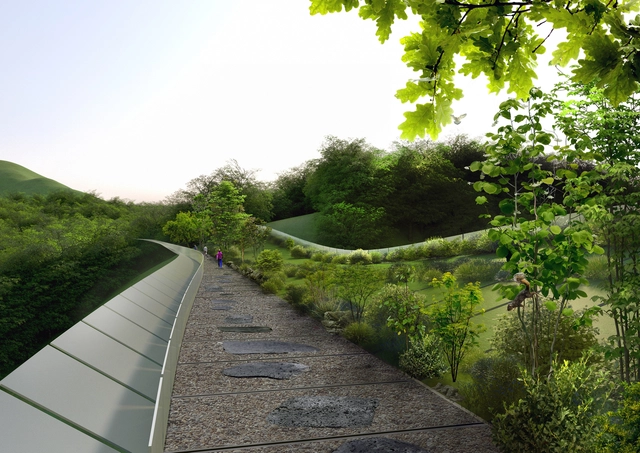
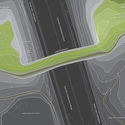
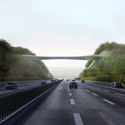
In response to the Yangjaegogae Eco Bridge Design Competition commissioned by the Seoul Metropolitan Government, SLOPEWALK is a mountain-inspired bridge designed by a Lithuanian team, KILD, proposing a structure evoking the “pictorial passage through the southern slopes of the two discontinued mountain peaks of Mt. Umyeon and Maljukgeori Parks.” Seeing a current infrastructural void, the project aims to unite the two neighboring mountain parks over the Gyeongbu Expressway, as a continuation of the sloped landscape.
The Seoul Metropolitan Government is promoting the Yangjaegogae Eco Bridge Design Competition which connects green areas that were disconnected for the Gyeongbu Expressway. The Yangjaegogae Eco Bridge Competition aims to connect green axis, as a part of the Ring of Green Phase of the 2030 Seoul Park and Green Basic Plan, also targets the preservation of wild animals and plants by obscuring animal’s roaming routes and improving citizens’ convenience by connecting with the Seoul Trails. After an evaluation of the entries, the results will be posted on the website, “Let’s Design Seoul” during this coming June and the winner will have the right of design.
The architectural competition for Kulbroen (the Coal Bridge) is on and teams can now apply for the pre qualification. Please note that the material is in Danish, so if foreign teams want to sign up it would be a good idea to find someone here that master the language.
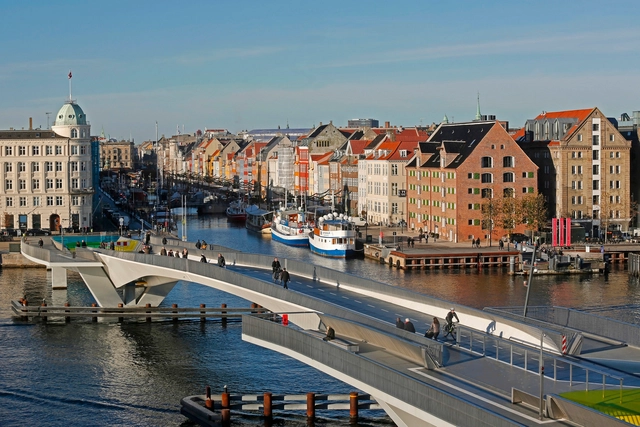
It's no secret that Copenhagen continues to invest massively in bicycle infrastructure like no other city on the planet. The network is already comprehensive and effective but the City continues to add important links, especially over the harbor and the canals. One of the more recent additions is the Inner Harbor Bridge—Inderhavnsbroen in Danish—that spans Copenhagen Harbor at a key, strategic and iconic point. It links the city center at the end of the postcard picture perfect Nyhavn with the Christianshavn neighborhood and the southern neighborhoods beyond. It is one of a series of 17 new bridges or underpasses for bicycle traffic that have been added to the City's transport network in the past few years.
The Inner Harbour Bridge was riddled with problems and was extremely delayed, as you can read here. Now, however, it's been open since July 2016. Let me be clear: I'm thrilled that we have a new, modern link over the harbor to accommodate bicycle traffic and pedestrians. I am over the moon that the number of cyclists crossing daily exceeds all projected numbers. The City estimated that between 3,000–7,000 cyclists would use the bridge but the latest numbers are 16,000. It's a massive success. But sometimes you can see the forest for the trees. I'm sorry, but Inderhavnsbro is a stupid, stupid bridge.
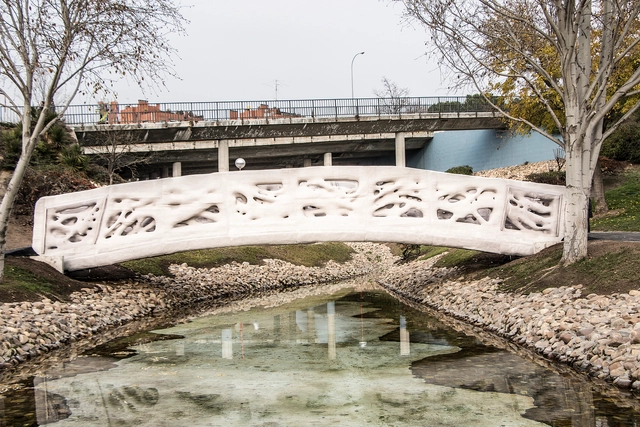
The first 3D printed pedestrian bridge in the world opened to the public on December 14 in Madrid. Led by the Institute of Advanced Architecture of Catalonia (IAAC) in a process that took a year and a half from its conception, the structure crosses a stream in Castilla-La Mancha Park in Alcobendas, Madrid.
Although similar initiatives have already been announced in the Netherlands, this is the first to have finished construction. The structure is printed in micro-reinforced concrete, and measures 12 meters in length and 1.75 meters wide.
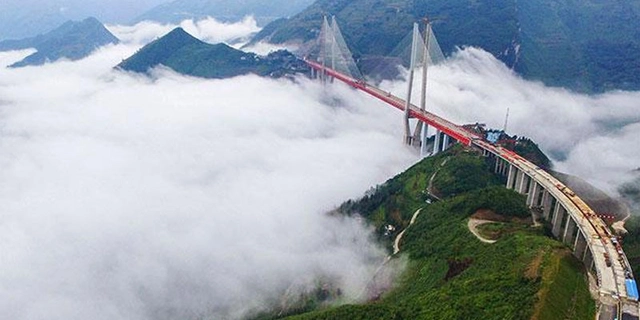
Today China inaugurated the world's highest bridge, opening the new crossing to traffic after the structure was completed in September, reports China Central Television (CCTV). Crossing the Nizhu river canyon at 565 meters above water level the Beipanjiang bridge spans 1,341 meters to connect the provinces of Yunnan and Guizhou in the Southwest of the country. The 4-lane bridge is part of a network of new highways around Yunnan and Guizhou that allow access across rugged terrain that was previously largely inaccessible.
Warsaw has just announced a competition to prepare an architectural conceptual design of a bridge for pedestrians and cyclists, which will connect both shores of the Vistula by the Karowa street.
“This will be our showcase and first passage of the kind for pedestrians and cyclists over the Vistula. Over the last years, we have done a lot to bring it closer to the locals – we have built lanes and boulevards, beaches and cafés. A new bridge, in accordance with the Warsaw Mobility Policy, will substantially improve the quality of life for cyclists and pedestrians,” says Hanna Gronkiewicz-Waltz, Mayor of the City of Warsaw.
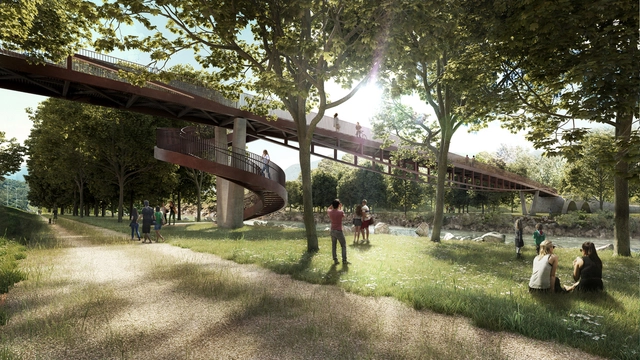
The team of AZPML + DFN has won a competition for the design of the Passerella Ex-Torretta, a new bridge spanning the Ticino River in Bellinzona, Switzerland. The bridge will connect two existing medieval structures, the Torretta tower to the west of the river and medieval arcades on the eastern bank, and will provide a gradual 6% slope to allow for pedestrian and bicycle access.
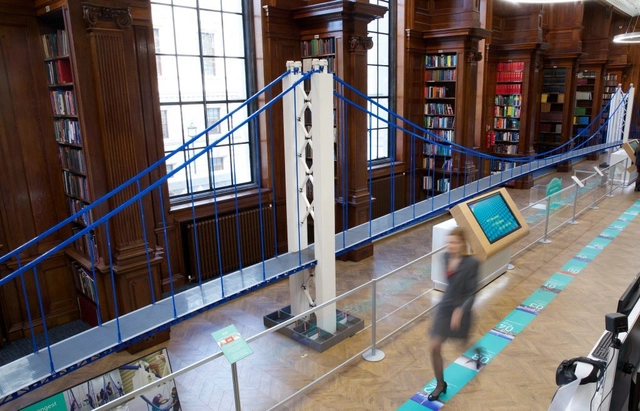
It’s a project out of every architect’s childhood fantasy: a 100 foot (31 meter) long suspension bridge, constructed completely out of LEGO.
Envisioned as part of the ongoing BridgeEngineering exhibition at London’s Institute of Civil Engineers (ICE), the massive bridge utilized over 250,000 individual LEGO bricks in shattering the World Record for the longest LEGO suspension bridge. Stretching further than the length of three London City Buses end-to-end, the bridge weighs in at over 1,600 lbs (75 kg).
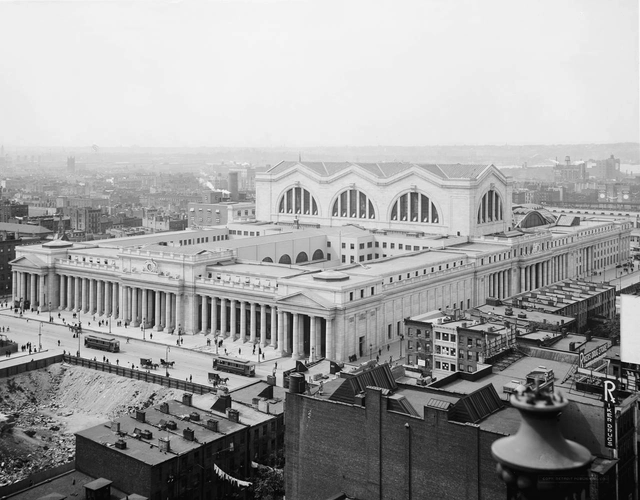
Courtesy of Detroit Publishing co. via US Library of Congress (Public Domain)
Architecture inherently appears to be at odds with our mobile world – while one is static, the other is in constant motion. That said, architecture has had, and continues to have, a significant role in facilitating the rapid growth and evolution of transportation: cars require bridges, ships require docks, and airplanes require airports.
In creating structures to support our transit infrastructure, architects and engineers have sought more than functionality alone. The architecture of motion creates monuments – to governmental power, human achievement, or the very spirit of movement itself. AD Classics are ArchDaily's continually updated collection of longer-form building studies of the world's most significant architectural projects. Here we've assembled seven projects which stand as enduring symbols of a civilization perpetually on the move.
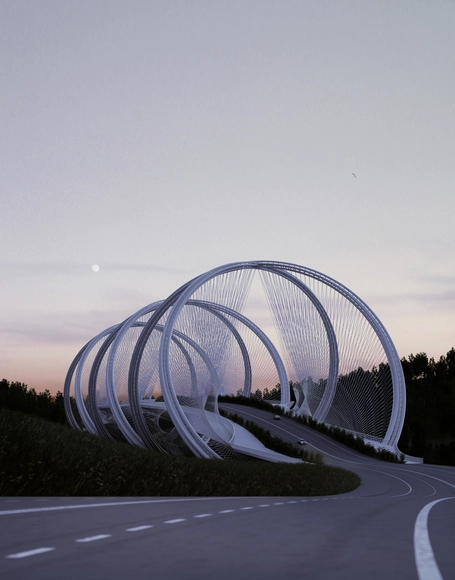
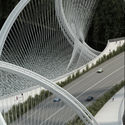
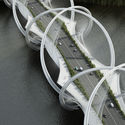
Penda has designed a prestressed double-helix bridge spanning China’s Gui River that will become an integral part of the infrastructure system for the 2022 Winter Olympics in Beijing. The San Shan Bridge, which translates to 3 Mountains Bridge, draws inspiration from the interlacing of five rings in the Olympic Symbol to create a form evocative of the area’s mountainous landscape.
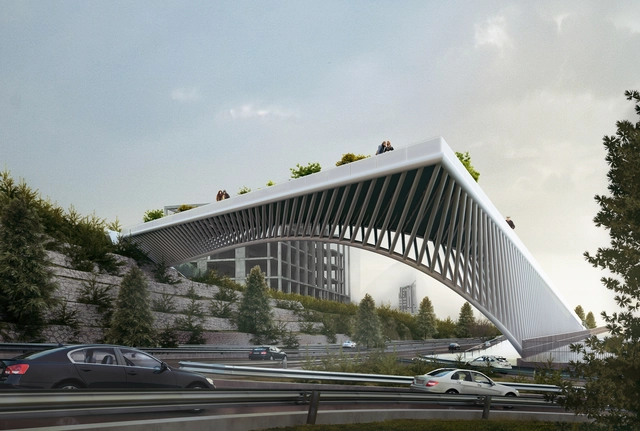
3rd Skin Architects has released the plans for the Haghani Pedestrian Bridge, which will connect the residential zone of Mirdamad, Tehran, to Abbas Abad over the Haghani Highway in Iran.
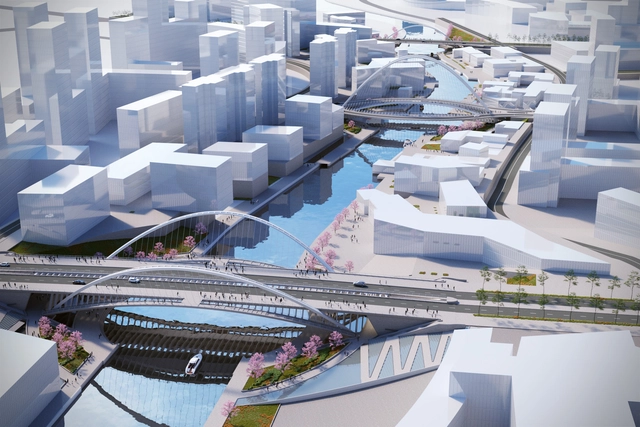
Santiago Calatrava has been commissioned to design a trio of bridges in the Chinese city of Huashan, east of Wuhan. The three steelbridges - Xihu, Xianbi and Lincong - will span 1.5 kilometers of the city's new Yangtze River canal, providing access to pedestrians, cyclists and vehicles.
“Architecture is one of the art forms best able to improve and revitalize cities both artistically and functionally,” said Calatrava. “The Huashan project is a clear example of how an urban element, key to the successful growth of the city, can at the same time improve the quality of life for its citizens, thanks to an integration of all three bridges and the creation of boulevards on the banks of the canal.”