Update: We've added links to help you find these books for purchase and, in 5 of 8 cases, tracked down a way you can read them online for free!
Quality over quantity, so the saying goes. With so many concepts floating around the architectural profession, it can be difficult to keep up with all the ideas which you're expected to know. But in architecture and elsewhere, the most memorable ideas are often the ones that can be condensed textually: “form follows function,” “less is more,” “less is a bore.” Though slightly longer than three words, the following lists a selection of texts that don’t take too long to read, but impart long-lasting lessons, offering you the opportunity to fill gaps in your knowledge quickly and efficiently. Covering everything from loos to Adolf Loos, the public to the domestic, and color to phenomenology, read on for eight texts to place on your reading list:
Videos
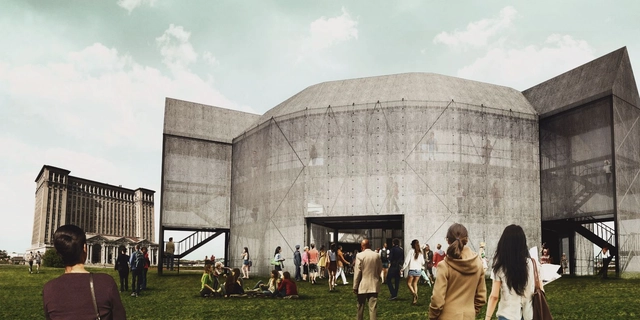
Globe by Michigan Station, Detroit. Image Courtesy of The Container Globe
All the world’s a stage – quite literally so, in the case of the Container Globe, a proposal to reconstruct a version of Shakespeare’s famous Globe Theatre with shipping containers. Staying true to the design of the original Globe Theatre in London, the Container Globe sees repurposed containers come together in a familiar form, but in steel rather than wood. Founder Angus Vail hopes this change in building component will give the Container Globe both a "punk rock" element and international mobility, making it as mobile as the shipping containers that make up its structure.
The Rockwell Group takes advantage of a cross-disciplinary approach, with a diverse array of projects ranging from large-scale buildings to product and set design. In this article by Shannon Sharpe, originally posted on Metropolis Magazine as "The Rockwell Way"we learn seven ways that the Rockwell Group has achieved creative success. Read the full article below to discover what drives this particular firm and how it could serve as an inspiration to anyone in the field of design.
How does the magic happen at Rockwell Group? “Pixie dust,” quips Marc Hacker, the firm’s in-house “Thinker.” All jokes aside, there is some truth here. From the animated Quan Yin statue in TAO Downtown to the shifting set of Kinky Boots, to the child-directed free play of the Imagination Playground, a distinct sense of magic imbues every one of these projects. All of them are driven not so much by a look, or even a sensibility, but by the endlessly curious creative process that shaped them. “I know this sounds trite, but it’s not about what’s true now,” says founder and president David Rockwell. “It’s about asking, ‘what if?’” What if an architect could be as experimental as a chef? What if the stage set became a character? What if your environment could transform with every step?
In the Rockwell Group world, asking “What if?”—also the title of a new book being released by Metropolis Books in December to commemorate the firm’s 30th anniversary—has led to an embrace of design at all scales. “On a given day, we could be working on an exhibition, a park, a master plan, an airport interior, a children’s hospital, and a night-club,” Rockwell says. “That confluence of things is probably what makes us most unique.” The process behind these projects —the Rockwell way—is really a set of permissions to roam and explore.
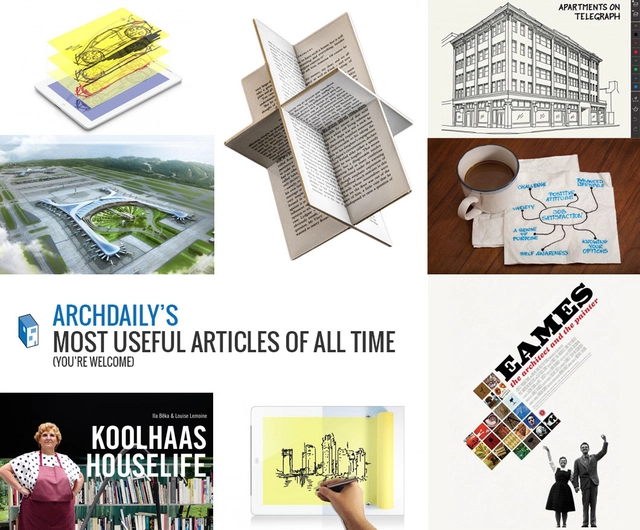
As summer draws to an end and we enter into the last quarter of 2014, we decided to round-up a selection of the most useful articles we've published over the past three years. Ranging from The 40 Architecture Documentaries to Watch in 2014 to The 10 Most Overlooked Women in Architectural History, we've also brought together app guides, career tips, and city guides. Alongside links to open-source CAD files and cut-out people, we've also featured book recommendations, study tips, and links to our complete coverage of some of the world's major architectural events and prizes. Delve into our collection and discover what our readers have found most useful!
San Francisco architect Chris Downey is changing how design is employed for people with disabilities and redefining how architects can approach accessible design. In this article by Lamar Anderson on Curbed, we learn about how Downey has developed his own design methods and utilizes his rare skillset to draw attention to what architects often miss when designing for the public.
Architect Chris Downey is standing next to a pile of Sheetrock, balancing a white cane in the air like a tightrope walker's pole. The week before, construction had begun on a new office for the Independent Living Resource Center of San Francisco, or ILRC, a nonprofit community center for people with disabilities. Downey holds the cane up to approximate for the center's executive director, Jessie Lorenz, how the reception desk will jut out at an angle from a concrete column. Lorenz takes a step, and a pile of pipes on the floor clatters. "I don't know what's over there," says Downey. Lorenz giggles. "I hope I didn't break anything," she says. Lorenz regains her footing and touches the cane. "That makes sense," she says. "It's almost like we're funneling people into this part."
https://www.archdaily.com/536298/how-a-san-francisco-architect-reframes-design-for-the-blindLamar Anderson
It's that time of year again! The time when we round-up what you, our dear readers, most enjoyed this year. The following ten articles - from fun lists (30 Architecture Docs to Watch in 2013) to thought-provoking looks into the state of the architecture profession (Are Renderings Bad for Architecture?) - caught your attentions and provoked some great comments. See them all - including our record-breaking #1 article - after the break.
It’s that time of year again: DesignIntelligence has released their 2014 rankings of the Best US Architecture Schools. Though many students and professionals are curious to know just who is number 1, we encourage you to forget the rankings and consider the survey’s invaluable insight on the current state of architecture and architectural education.
Hundreds of design educators and professionals participated in the 2014 survey to identify the profession’s biggest challenges, as well as just how design education is evolving to reflect those challenges and which schools are really producing students best equipped for the profession today.
Out of all the data, two Universities stood out.
Read more to find out which two Universities are best preparing students in 2014, after the break…
In 2013 alone some 1 million people have poured out of Syria to escape a civil conflict that has been raging for over two years. The total number of Syrian refugees is well over 2 million, an unprecedented number and a disturbing reality that has put the host countries under immense infrastructural strain.
Host countries at least have a protocol they can follow, however. UN Handbooks are consulted and used to inform an appropriate approach to camp planning issues. Land is negotiated for and a grid layout is set. The method, while general, is meticulous – adequate for an issue with an expiration date.
Or at least it would be if the issue were, in fact, temporary.
https://www.archdaily.com/435492/beyond-the-tent-why-refugee-camps-need-architects-now-more-than-everKatherine Allen
"It's not where you start in life, it's where you end up and all the places you went in between." - United States General Colin L. Powell
For the closing keynote speaker of the stimulating, three-day “Building Leaders” convention in Colorado, the American Institute of Architects (AIA) selected one of America’s most admired public figures to share wisdom and insight to becoming a great leader.
General Colin L. Powell, a first-generation American born from Jamaican immigrants in 1937, is the epitome of the American dream. Starting life in the South Bronx, Powell paved his way to becoming a highly respected, four-star general in the United States Army and the first African American to serve as Secretary of State. A natural storyteller, Powell effortlessly captivated the audience of architects with a series of experiences and lessons he had learned throughout his lifetime of service.
General Colin Powell’s top ten lessons of leadership after the break...
“When you build a beautiful building, people love it. And the most sustainable building in the world is the one that’s loved.” - Cameron Sinclair, Co-founder of Architecture for Humanity
Cameron Sinclair is a man who sustains his passion for helping improve the world, one project at a time, by tapping into the skilled enthusiasm of like-minded architects from all over the globe. Since co-founding of his non-profit organization with Kate Stohr in 1999, Sinclair and his interdisciplinary teams of citizen architects have provided shelter for more than two million people worldwide.
Under his leadership, Architecture for Humanity’s infectious mantra has inspired thousands to join its cause every year, allowing the organization to expand at an unbelievable rate and become the exemplar of public interest design. Considering this, it is no surprise that Sinclair was selected to be the keynote speaker on day two of the 2013 AIA National Convention.
As his speech continued the momentum of yesterday’s inaugural presentation, in which TOMS founder Blake Mycoskie shared his success story of “doing well by doing good,” Sinclair urged architects to hold close the true value of their profession.
Learn what Cameron Sinclair believes to be the true value of architects after the break.
Originally published on Intercon, Ohioan and Africa-based architect Charles Newman, LEED AP discusses the pitfalls of LEED in rural Africa. Newman, who is currently working for the International Rescue Committee in Bukavu, Democratic Republic of Congo, is dedicated to the integration of sustainability in communities worldwide. Learn more about his work and travels on his blog Afritekt.
While in a small southern town of the Democratic Republic of Congo in mid-2012, a colleague of mine approached me for some guidance on a large health proposal he was putting together. A portion of the grant would be earmarked for the construction of hundreds of clinics across the DR Congo, and he mentioned that the donor would be very interested in “green” building standards. Knowing that I was a LEED Accredited Professional, he began asking how we might be able to incorporate such building standards into the designs for the pending projects. I rattled off some general guidelines such as using local materials – recycled ones if available, incorporating existing infrastructure, natural ventilation, etc. He jotted down a few notes, then began to pry a little deeper. “What about the LEED point system? Could we incorporate that into our strategy?”
My response was frank: “No, not really. LEED doesn’t work here in rural Africa.”
Designed as an experiment on “the architectonics of music,” the basic geometry of the Daeyang Gallery and House was inspired by Istvan Anhalt’s 1967 Symphony of Modules - a uniquely transcribed sheet of music found in John Cage’s contemporary music compendium, Notations. Reminiscent of the “blocky and shard-like shapes” of Anhalt’s sketch, Holl’s design features three copper-clad pavilions punctured by a symphony of carefully placed, rectangular skylights that animate the interior with “bars of light”. As Kennicott describes, Holl uses music as a “powerful metaphor for the dynamic unfolding of experience” (captured in this film by Spirit of Space).
Read Kennicott’sMusic Holl: A Copper Clad Pavilion in its entirety here on Dwell. Continue after the break to compare Steven Holl's sketch above with Anhalt’s Symphony of Modules.
Global architecture underwent a seismic shift in the 20th Century. Governments, keen to mitigate the impoverishing effects of rapid urbanization and two world wars embarked on ambitious social housing programs, pairing with modernists who promised that design could be the solution to social inequality and poverty. Today, the problems inherent in these mid-century tower blocks are well documented and well known, and these modernist solutions to poverty are often seen as ill-conceived failures.
If the 20th century was all about designing to solve social problems, then the 21st century has been about the exact opposite – not designing to solve social problems. These days, it is much more common to see architects praising the social order and even aesthetic of illegal slums, which in many cases provide their residents with a stronger community and higher quality of life than did many formal social housing projects of the past. The task of architects (both today's and tomorrow's) is to develop this construction logic: to use design and, rather counter-intuitively, non-design to lift these urban residents out of their impoverished conditions.
More on the social potential of non-design after the break...
We live in the world of a sad separation that began some five hundred years ago when art and science split apart. Scientists and technicians live in their own world, focusing mostly on the “how” of things. Others live in the world of appearances, using these things but not really understanding how they function. Just before this split occurred, it was the ideal of the Renaissance to combine these two forms of knowledge. This is why the work of Leonardo da Vinci continues to fascinate us, and why the Renaissance remains an ideal.
So why did Santiago Calatrava, now one of the world’s elite architects, decide to return to school in 1975 for a civil engineering degree after asserting himself as a promising young architect?
Before we welcome the new year, lets take a look back at ArchDaily’s most popular articles of 2012. From inspiring projects to influential editorials, this top ten list illustrates some of the year’s most important moments. Review them all, after the break.
In the wake of Hurricane Sandy, as communities band together to clean up the devastation and utility companies work tirelessly to restore the infrastructure that keeps New York City running, planners and policy makers are debating the next steps to making the city as resilient to natural disaster as we once thought it was. We have at our hands a range of options to debate and design and the political leverage to make some of these solutions a reality. The question now is, which option or combination of options is most suitable for protecting New York City and its boroughs? Follow us after the break for more.
The outcome of the 2012 United States presidential election will have global economic implications. In the midst of one of the most severe global recessions in history, policymakers around the world are waiting to see which way the United States will go this coming November. Will it stay the course of potential recovery—as yet incomplete—set by President Barack Obama? Or will it veer to the right into the still vague and undefined policies of challenger Mitt Romney?
For architecture specifically there is much at stake in this, the most expensive presidential race in history, where two contrasting visions of government’s role in the economy are boiling over. The Democrats advocate a course of continued federal investment and regulation to steer the country through rough economic waters they say were created by eight years of Republican policies. The Republicans point the finger and say Obama’s policies have not succeeded. They prioritize bringing down the deficit, reducing the size of the federal government and less regulation. Both sets of policies claim to be the answer to get the economy growing again.
Regardless of who wins the chances that economic growth will magically spring back to pre-recession levels are slim to non-existent. But whose policies would be more likely to at least make the long climb out of the well more tolerable?
Vote in our Presidential Poll after the break
https://www.archdaily.com/285321/archdaily-u-s-election-poll-where-do-architects-standAD Editorial Team
Our friends at Design Observer’s Places Journal have shared with us two fascinating articles, written by architects Jonathan Massey and Brett Snyder, that explore the physical and virtual evolution of Occupy Wall Street (#OWS) as it transformed from the privately owned public space of Zuccotti Park into the bustling micro-city of Liberty Plaza sustained by online media.
To learn how OWS has influenced architecture and urbanism, Massey and Snyder asks the following questions: What’s the layout of this place? What are its rules, and who owns it? How does its design shape possibilities for individual and collective action?









.jpg?1474243524 "Globe in Waitangi Park, Wellington NZ. Image Courtesy of The Container Globe")






.jpg?1361402796)


