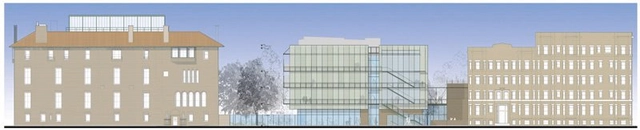
Opening in 2012, the $118 million steel, glass, and copper-clad expansion to Boston’s Isabella Stewart Gardner Museum by Renzo Piano Building Workshop will more than double the size of the current facility. Included in the project are a new entrance, music hall, gallery space, and other amenities for an institution that has remained largely unaltered since opening in 1903.
In today’s world “going green” has become a top priority in our society, and sustainable buildings and design are at the forefront of this green revolution. While many designers are focusing on passive and active energy systems, the reuse of recycled materials is beginning to stand out as an innovative, highly effective, and artistic expression of sustainable design. Reusing materials from existing on site and nearby site elements such as trees, structures, and paving is becoming a trend in the built environment, however more unorthodox materials such as soda cans and tires are being discovered as recyclable building materials. Materials and projects featured after the break.
The Internet is now the library of the past. Where the public library has historically served as the primary source of information gathering and dissemination, we now look to this new virtual, infinitely large library that can be accessed anywhere at any time as the Library of the present.
As a result, the primary roles of today’s physical libraries have shifted. Libraries of the past focused primarily on individualized information consumption. Communal aspects of interaction and information dissemination now represent the core mission of the library when information is more easily accessible. The silent grand beaux-arts reading rooms of New York or Boston have of the past been transformed into flexible communal “living rooms” in Seattle.
With nearly 23 million people, Shanghai is China’s biggest and most populous city. It is the financial and commercial capital of the country and a leading cultural center in Asia. Throughout the 1990′s and 2000′s the city underwent immense growth and redevelopment, thriving on international business. The futuristic and ambitious skyline of Pudong is the heart of Shanghai’s business district, and is growing swiftly with towering skyscrapers and an advanced urban environment. More pictures and information after the break.
Sustainability can be associated with wildly expensive technological advances. Which not coincidentally can immediately turn off clients.
So how do we define it? What does it mean, from a resource-conservation standpoint, as well as from a business one? For one viewpoint, we turn to Mark English, AIA. He has promoted sustainability efforts on several different levels for years. That means that not only does he incorporate sustainable strategies in his designs, he also helps other firms implement them in their work. He has been involved in programs including the California Solar Initiative, Green-point Rating, and he is also a Director on San Francisco’s AIA Board. He also edits two online publications including “Green Compliance Plus” where articles explore such topics as Passive Houses and the debate on Green Certification, and which also assists other professionals in meeting energy-efficient goals. Another publication, “The Architect’s Take,” presents news from an architectural standpoint. In fact one of those articles provided the basis for some of this author’s work.
Via mirage.studio.7 we ran into this list of fictional architects in movies. There are some classic ones, like Henry Fonda. Some new ones like Adam Sandler. And there’s even an actual architect who made it to The Simpsons.
Which one do you like the most? The least? Is there anyone missing in this list? Some actor/actress you would really like as an architect in a movie? Tell us what you think. Full list after the break.