Green Spine / UNStudio + Cox Architecture . Image Courtesy of UNStudio / Cox Architecture
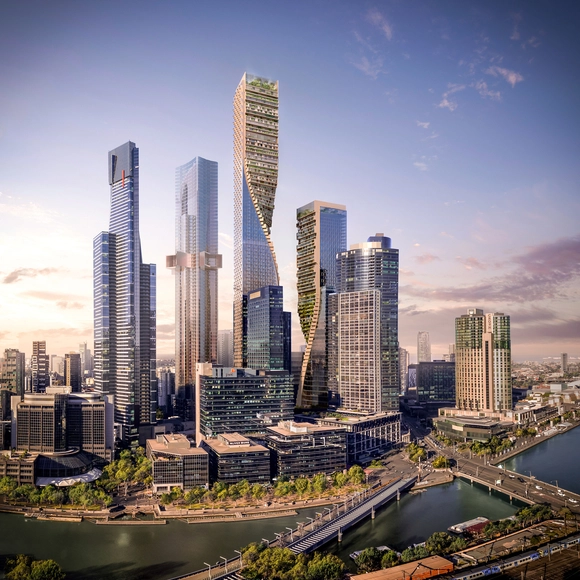
Australia loomed large in the news this week following the announcement for the continent's tallest tower in Melbourne. The competition, which was won by a joint bid from UNStudio and Cox Architecture, boasted designs from some of the world's best-known firms including MVRDV, OMA, MAD, and BIG.
https://www.archdaily.com/900424/this-week-in-architecture-australias-tallest-tower-and-questions-about-infrastructureKatherine Allen
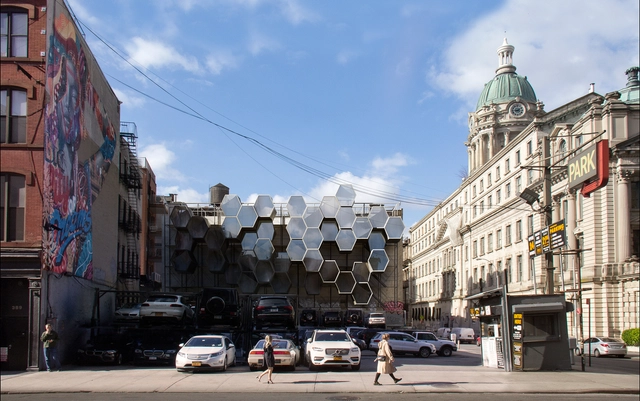
In the last global survey undertaken by the United Nations in 2005, there were an estimated 100 million people who were homeless around the world and 1.6 billion who lived without adequate housing. This number has escalated in recent years; unaffordable housing has become a global norm, making it increasingly difficult for the disadvantaged to seek out permanent, or even temporary shelter.
As housing becomes a means of accumulating wealth rather than fulfilling its fundamental goal of shelter, well-intentioned architects have attempted to solve the homelessness crisis through creative ideas and innovative design. But is architecture really the solution?
James Stirling (1926-1992) was a British architect who is considered by many as the premier architect of his generation and an innovator in postwar architecture. Some of his most famous projects include the Sackler Museum, No 1 Poultry, and the Neue Staatsgalerie. Through the influence of his teacher Colin Rowe, Stirling had a deep understanding of architectural history, yet never adopted a singular doctrine. His career began with designs that were more aligned with what would later be labeled as the high-tech style, but evolved into buildings that were a series of dynamic and often colorful arrangements. Stirling’s aesthetic tropes ultimately gave the final push that broke architecture free from the clutch of post-war European Modernism as he turned the Modernist canon of “form follows function” into a hyperbole by celebrating the expression of a building’s program with his over-the-top details. Stirling’s work is still largely influential, and the recursive wave of history has shown that the underlying implications of his oeuvre remains somewhere in all architectural practice of the present day.
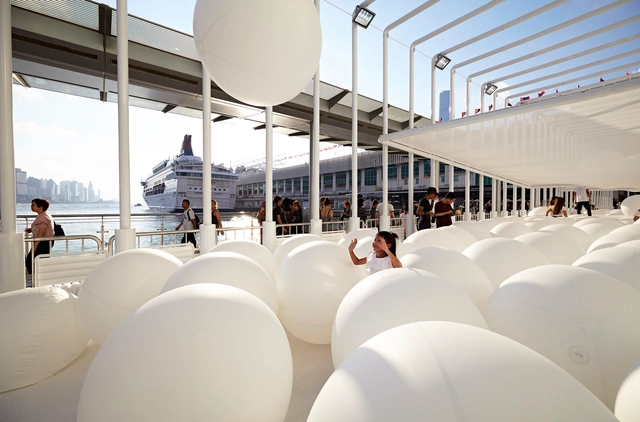
New York-based collaborative and design studio Snarkitecture have unveiled their newest interactive installation, bringing a surreal sense of play to Hong Kong’s waterfront. Titled “BOUNCE,” the installation features hundreds of 300% sized bouncing balls contained in a cage-like stadium, inviting the public to “create their own unique playing experiences.”
The program is spread across three locations, with the feature installation along the Harbour City waterfront, an indoor installation at the Ocean Center titled “Gallery by the Harbour,” and a children’s “Eyeball Maze” at the Ocean Terminal.
Upon its completion in 1966, Sewoon Sangga, designed by prominent South Korean architect Kim Swoo-geun, was a groundbreaking residential and commercial megastructure consisting of eight multistory buildings covering a full kilometer in the heart of Seoul. Like other futuristic projects of the decade, it was conceived as a self-contained city, complete with amenities that included a park, an atrium, and a pedestrian deck. But construction realities crippled Kim’s utopian vision, compromising those features. By the late 1970s, Sewoon Sangga had shed residents and anchor retail outlets to newer, shinier developments in the wealthy Gangnam district across the river. Between Sewoon’s central location and plunging rents, the building became a hub for light industry—as well as illicit activity.
This article was originally published by Jude Fulton on Medium under the title "Why Architects are Super Well-Suited for Startups". You can see the original post here.
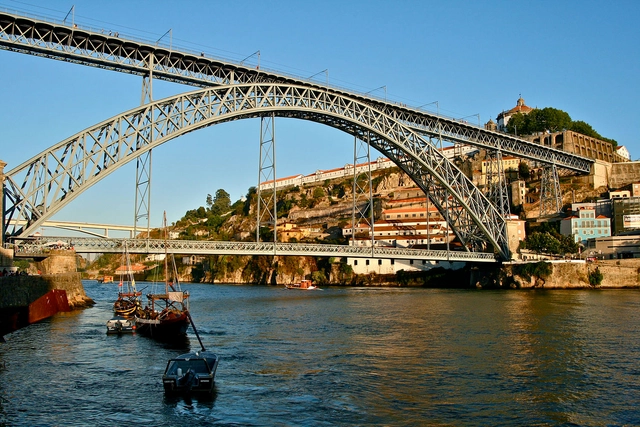
via Wikimedia. ImageDom Luis Bridge / Porto, Portugal
An unfortunate fact of the AEC (architecture, engineering, and construction) industry is that, between every stage of the process—from planning and design to construction and operations—critical data is lost.
The reality is, when you move data between phases of, say, the usable lifecycle of a bridge, you end up shuttling that data back and forth between software systems that recognize only their own data sets. The minute you translate that data, you reduce its richness and value. When a project stakeholder needs data from an earlier phase of the process, planners, designers, and engineers often have to manually re-create that information, resulting in unnecessary rework.
Like food and clothing, buildings are essential. Every building, even the most rudimentary, needs a design to be constructed. Architecture is as central to building as farming is to food, and in this era of rapidly advancing technological change farming may offer us valuable lessons.
At last census count there were 233,000 architects in the United States; the 113,000 who are currently licensed represent a 3% increase from last year. In addition there’s a record number of designers who qualify for licensure: more than 5,000 this year, almost the same number as graduates with professional degrees. There is now 1-architect-for-every-2,900 people in the US. A bumper crop, right?
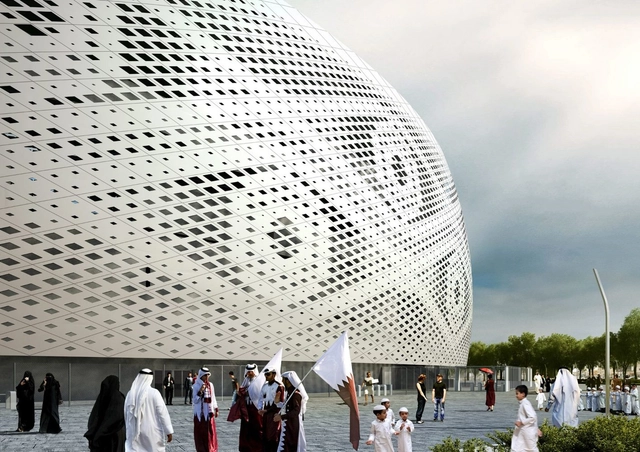
Al Thumama / Ibrahim Jaidah. Image Cortesía de Comité Supremo de Entrega y Legado
France took home the gold in this year's World Cup, however, in four years time, the world will turn its eyes to Qatar for another round of soccer mania. Preparations for the 2022 World Cup are already in full swing, with the construction and restoration of 8 stadiums that will host teams and fans from across the globe.
Get to know the 8 Qatar 2022 World Cup stadiums below.
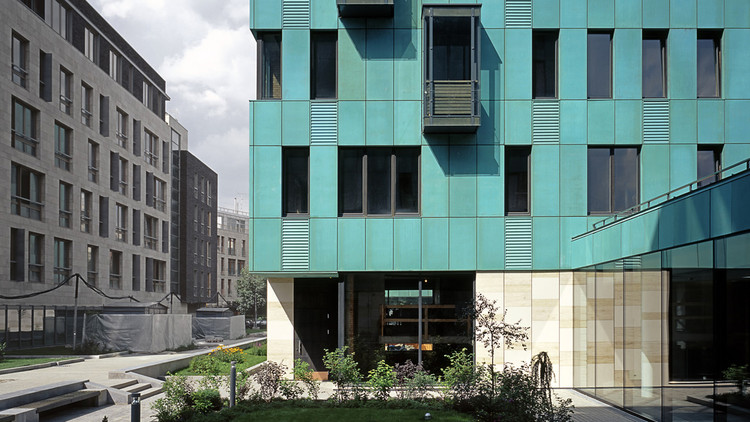
Sergey Skuratov, founder of Sergey Skuratov Architects, an award-winning Russian practice (2008 Architect of the Year), is known for his sleek and well-composed portfolio. Projects such as Copper House, Art House, and House on Mosfilmovskaya Street demonstrate his sensitivity to materiality and ability to retain his vision from concept to reality. Over the last two decades Skuratov has succeeded in producing a whole strata of world-class architecture in Moscow, far more than any other local practitioner. His projects, predominantly residential and office complexes, have remained attractive and versatile without ever veering into conservatism.
This article was originally published on Archipreneur by architect Chris Barnes who, with his wife Bonnie Robin, runs the practice Field Office Architecture.
There aren’t many architects I know who do not love to travel, and I’ve always felt the two things are intrinsically linked. Maybe it’s our constant quest for visual inspiration and new ideas, or perhaps our fascination for how people live their lives and how wildly that varies from border to border, and the impact that has on our physical environments.
Either way, in the age of Instagram and unavoidable envy at the seemingly constant stream of images of laptops by the beach, cocktail in hand my wife and business partner Bonnie Robin, and I were keen to try this thing called digital nomadism for ourselves.
Hungarian architects Paradigma Ariadné push the concepts of progression and growth to a literal spatial extreme in their proposal for a new sport complex for the MTK Football Academy. Drawing inspiration from the diagram of traditional European peasant houses, the design stretches into a kind of visual infinity, stacking all the rooms in the building along a single horizontal axis.
Los Angeles-based studio EC3 has revealed its design entry for a new 14.5-acre, cultural & sports center in Shenzhen’s growing Dalang neighborhood, hosted by the Shenzhen Longhua District Government and the Vanke Real Estate Co.