1. ArchDaily
  2. architectural classics

architectural classics: The Latest Architecture and News

Architecture Classics: Barcelona Pavilion / Mies Van der Rohe

Subscriber Access | 
Architecture Classics: Barcelona Pavilion / Mies Van der Rohe - Featured Image
© Flickr: user - gandolas. Used under Creative Commons

The German Pavilion was designed by Ludwig Mies van der Rohe in 1929 for the German representation at the International Exhibition in Barcelona held on Montjuic that same year. The Pavilion was conceived as a space of modest dimensions and refined materials. It was made of glass, steel, and four types of marble, intended to host the official reception led by King Alfonso XIII and German authorities. The uniqueness in the use of materials, which was always highlighted in his work, wasn't about their novelty but about the modernity they represented and their precise application in terms of geometry, the accuracy of their components, and the clarity of their assembly.
Architecture Classics: Julio Mario Santo Domingo Cultural Center / Bermúdez Arquitectos

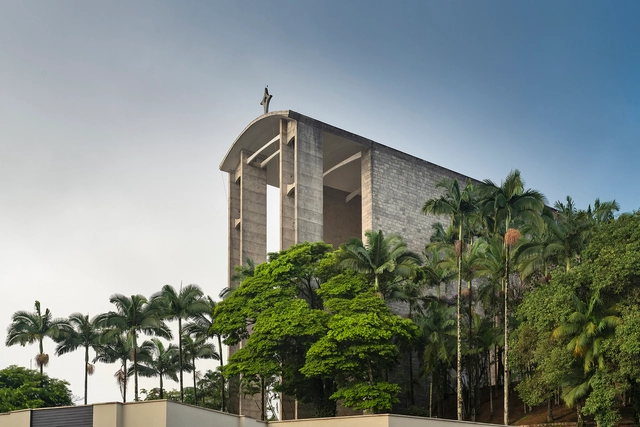
The intervention project includes the design of the Julio Mario Santo Domingo Cultural Center and Public Library, as well as the 6-hectare San José de Bavaria recreational park. With its completion, a new recreational and cultural hub was established for the Suba area and the city.

Architecture Classics: Biblioteca El Tintal / Bermúdez Arquitectos

El Tintal Library is the result of reusing a former disused waste transfer plant and transforming the 5-hectare site into a park along Avenida Ciudad de Cali with 6th Street. The rescued building from ruin was a 25-meter-wide by 72-meter-long industrial warehouse with a total area of 3,600 m², distributed over two floors of considerable height. Built with a sturdy concrete structure and large spans, it was adaptable to new use, enhancing its robust and industrial appearance.

AD Classics: Ortega Garden House / Luis Barragán

AD Classics: Ortega Garden House / Luis Barragán - Exterior Photography, Garden, FacadeAD Classics: Ortega Garden House / Luis Barragán - Interior Photography, Table, ChairAD Classics: Ortega Garden House / Luis Barragán - Interior Photography, TableAD Classics: Ortega Garden House / Luis Barragán - Interior PhotographyAD Classics: Ortega Garden House / Luis Barragán - More Images+ 39

Mexico City, Mexico

Architecture Classics: Torres del Parque / Rogelio Salmona

Subscriber Access | 
Architecture Classics: Torres del Parque / Rogelio Salmona - Offices
Flickr user: sbstnchïng. Used under Creative Commons

By Rogelio Salmona

The construction of Torres del Parque began in 1968 and was completed in 1970. Between 1964 and the start of the project, there was a period of uncertainty, doubts, and successive trials to find the right form for the project, not only from an architectural perspective but also from urban and landscape points of view.

The site, characterized by its overwhelming topography, the Plaza de Toros, the abandoned Parque de la Independencia (for over 15 years), and the magnificent panoramic view of the foothills, still untouched by the multitude of towers and dense buildings, invasions, and senseless occupations of the area, should not only be taken into account in the development of the project but, above all, be exalted through architecture that is implemented in such a correct and sensitive manner that it transforms and shapes the city. It should be the heartbeat of the place and a meeting point between reason, enchantment, and poetry. Between clarity and magic, an architecture that can be discovered, that doesn't impose itself, as it is more beautiful when discovered with surprise, like discovering nature. Ultimately, an architecture that integrates with the existing Plaza de Toros and allows transparency between the city and its foothills, reclaiming the steep street adjacent to Parque de la Independencia and transforming it into a pedestrian garden formed by stairways and ramps connected to the residential complex and the park.

Architecture Classics: Library and Auditorium at Jorge Tadeo Lozano University / Bermúdez Arquitectos

The project contemplates the development of a building and a square that aims to articulate and integrate the Jorge Tadeo Lozano University with the center of Bogotá, revitalizing and converting what was once a deteriorated residential and industrial suburb into an open and public campus. The building results from overlapping a volume of 47 meters in width and depth with another volume of 40 meters in width and depth, creating a covered perimeter walkway on the first floor that extends along the sidewalks of the surrounding streets. With a total height of 30 meters, the building consists of 4 large floors, with clear heights ranging from 3.4 to 6.1 meters.

Architecture and the God Problem

This article was originally published on Common Edge.

It has been about 200 years since the École des Beaux-Arts in Paris created an academic discipline—and thus the profession—of architecture. The central role of the architect as the defining agent of creation transcended the Master Builder, a role that defined those who designed buildings not as experts or celebrities but as stewards of building traditions.

The Story of Cora Kavanagh and her Emblematic Building in Buenos Aires

Perhaps without even looking for it, Cora Kavanagh would leave one of the most emblematic buildings of rationalist architecture in Argentina. Inaugurated in January 1936, with its almost 120 meters of height, the Kavanagh Building stands in front of the ravine of Plaza San Martín, located in the central neighborhood of Retiro in the Autonomous City of Buenos Aires.

"Cora Kavanagh and her Building" is the title of Marcelo Nougués' new book that gathers the entire story, revealing everything from her building and her travels to her art collection and the different houses she lived in during a period of almost 50 years. In collaboration with Díaz Ortiz Ediciones, this 572-page printed volume compiles texts, photographs, and documents from the author's collection and also showcases selected images and illustrations from extensive research. Discover a part of this story below.

Architecture Classics: Copan Building / Oscar Niemeyer

The Copan is a landmark in Sao Paulo. Even those who have never entered the building know its curves from afar. Amid the intense verticalization of the city center, the horizontal brise-soleils reinforce the building’s presence on the city’s horizon.

Architecture Classics: Gilardi House / Luis Barragán

Subscriber Access | 

Architecture Classics: Gilardi House / Luis Barragán - Image 1 of 4Architecture Classics: Gilardi House / Luis Barragán - Image 2 of 4Architecture Classics: Gilardi House / Luis Barragán - Image 3 of 4Architecture Classics: Gilardi House / Luis Barragán - Image 4 of 4Architecture Classics: Gilardi House / Luis Barragán - More Images+ 43

The great architect Luis Barragán, at 80 years of age, and after almost 10 years of inactivity, carried out his last work on a plot of land measuring 10x36 meters, between party walls in Mexico City. A work that reflects the influence of Mexican culture and painters Diego Rivera and Frida Kalho, where the most interesting thing, according to Barragán, was the challenge of the enormous jacaranda tree that had to be maintained, and the pool requested by the owner as part of the program.

The small pink house, which closes towards the street, reinforcing its interiority, is ordered on the longitudinal axis of the plot. Towards the back, the house is divided into two; the front volume, which contains the services and bedrooms, and the back, where the living room, dining room, and pool are located. These two volumes are joined by a corridor, forming a patio that surrounds the Jacaranda tree.

Architecture Classics: Casa-Estudio Luis Barragán / Luis Barragán

Subscriber Access | 

Built in 1948, this Mexican modern house, designed by Luis Barragán, is recognized for its international significance. The house-studio, inhabited by the architect himself until 1988, incorporates principles of the vernacular architecture of the region in its design, including the use of striking colors. Barragán has been one of the most influential Mexican architects, and his house is one of the most visited places in Mexico City.

The Houses of Alejo Martínez in Concordia: Building Argentine Modernity

Subscriber Access | 

Alejo Martínez, one of the main builders of Argentine modernity, turned the city of Concordia into a reference of the South American modernist movement. His extensive work on houses, such as Casa Péndola Díaz from 1925, Casa Marcone from 1928, or Casa Camaño from 1930, "changed the typology of the 'chorizo' house to compact housing, where straight volumes stand out, staggered from each other, and with terraces".

Architecture Classics: 500 Club / Oscar Niemeyer

Subscriber Access | 

The banker Orozimbo Roxo Loureiro created the 500 Club in the early 1950s. It followed the lines of the former 200 Club, founded by President Washington Luís to bring together influential politicians and businessmen away from the spotlight of capital cities. The initial idea of a social club did not prosper, and Orozimbo decided to develop a commercial and tourist enterprise in the area, which is well positioned between the two largest Brazilian cities.

Architecture Classics: 500 Club / Oscar Niemeyer - Image 1 of 4Architecture Classics: 500 Club / Oscar Niemeyer - Image 2 of 4Architecture Classics: 500 Club / Oscar Niemeyer - Image 3 of 4Architecture Classics: 500 Club / Oscar Niemeyer - Image 4 of 4Architecture Classics: 500 Club / Oscar Niemeyer - More Images+ 31

Architecture Classics: Aeronautics Technical Center / Oscar Niemeyer

Subscriber Access | 

Although little known, the Aeronautics Technical Center (CTA, current Department of Aerospace Science and Technology - DCTA) in São José dos Campos can be considered one of the largest and most relevant works by architect Oscar Niemeyer before Brasilia. It is his first project executed in São Paulo.

Architecture Classics: Aeronautics Technical Center / Oscar Niemeyer - Image 1 of 4Architecture Classics: Aeronautics Technical Center / Oscar Niemeyer - Image 2 of 4Architecture Classics: Aeronautics Technical Center / Oscar Niemeyer - Image 3 of 4Architecture Classics: Aeronautics Technical Center / Oscar Niemeyer - Image 4 of 4Architecture Classics: Aeronautics Technical Center / Oscar Niemeyer - More Images+ 40

Architecture Classics: Study House for Artists / Antonio Bonet + Horacio Vera Barros and Abel López Chas

The building on the corner of Suipacha and Paraguay Streets in the city of Buenos Aires, designed by the Spanish architect Antonio Bonet, established from its realization the basis to begin certain reflections on international modern architecture in the Argentinian context of the 1930s.

Architectural Classics: Mariano Moreno National Library / Clorindo Testa + Francisco Bullrich + Alicia Cazzaniga

In the central Recoleta neighborhood of Buenos Aires, in a large lot between Austria Street, Agüero Street, and Del Libertador Avenue, stands the current building of the Mariano Moreno National Library, designed by architects Clorindo Testa, Francisco Bullrich, and Alicia Cazzaniga.

Built on the basis of the project that won first prize in a national competition in 1961, and completed in the early 1990s, it has become a landmark of modern Argentine architecture and an example of the variant of 20th century expressionism known as "brutalism".