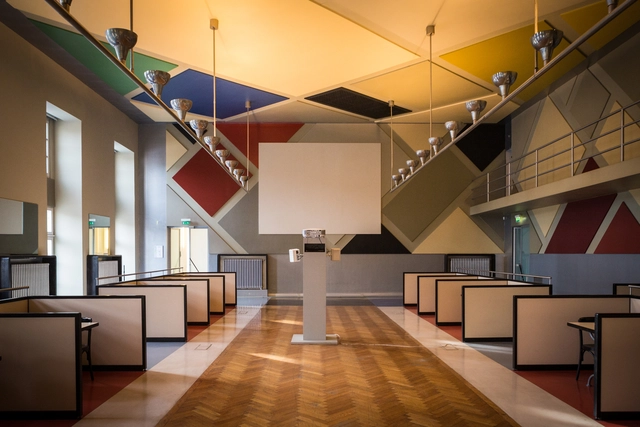
Concealed behind an 18th century Baroque façade in Strasbourg’s Place Kléber, the Café L’Aubette is a dazzlingly incongruous expression of the 1920s De Stijl movement. Designed by Theo van Doesburg, one of the movement’s founders and leading lights, the Aubette’s minimalist, geometric aesthetic was heavily influenced by the work of contemporary artists such as Piet Mondrian. In designing the café’s interiors, Van Doesburg sought to do more than simply place viewers before a painting; he wanted to envelop them in it.
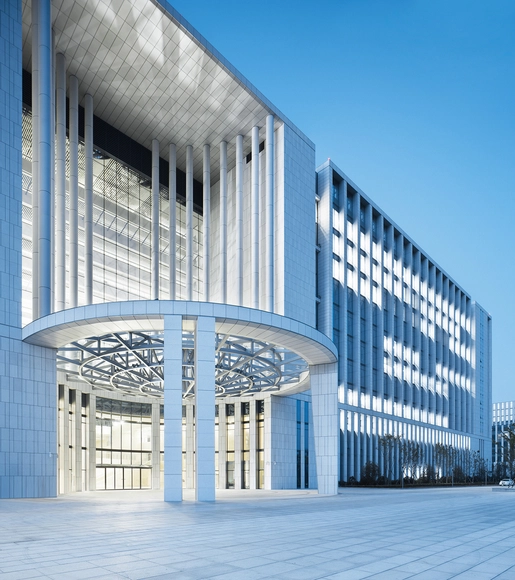
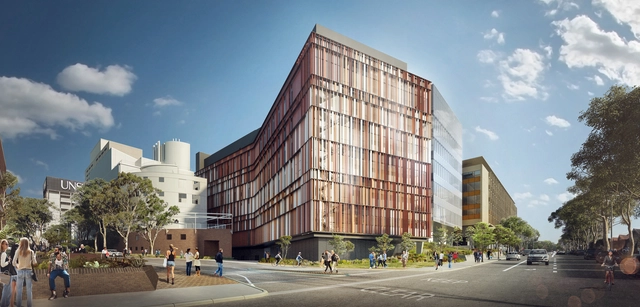
Woods Bagot has revealed designs for the new Biological Sciences building at the University of New South Wales (UNSW Australia). Currently under construction, the 21,000 square meter (226,000 square foot) building will provide world-class facilities for UNSW biomedical and environmental researchers and create a new northern gateway for the university’s upper campus.
In the design process, Woods Bagot explored a series of iterative responses aimed at dividing the eight-story structure into three distinct elements: the laboratory box, the workplace box, and the atrium. The building skin takes inspiration from natural elements, such as the movements of a butterfly and the colors of Australian rock landscapes, to produce a distinct aesthetic for the Biomedical Precinct, as well as reference the terra cotta heritage on the university grounds.
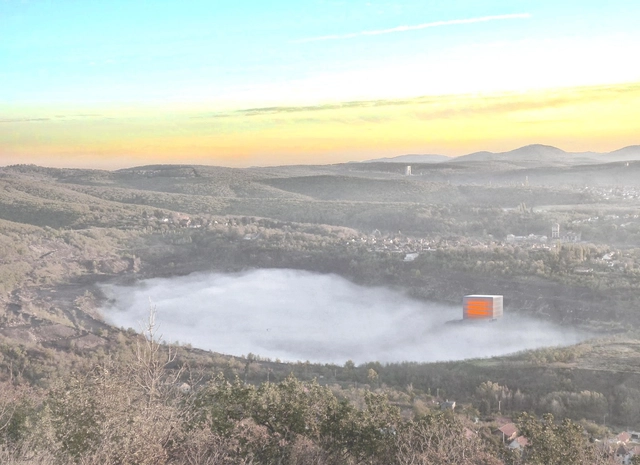
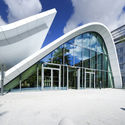
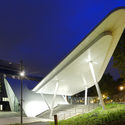
NARTARCHITECTS has released the plans for its Csontváry Museum in Pécs, Hungary, which will feature the work of Tivadar Csontváry Kosztka, a Hungarian painter known for his technical skill and spiritual messages.
The design of the Museum reflects Csontváry’s symbolic and interpretive work. Rather than utilizing the typical “plaza-museum” typology, the Csontváry Museum will be located on the outskirts of the city in a crater of a former coal mine near a lake. Through this location, the space gives a dramatic ambiance suited to its program.




.jpg?1467808238&format=webp&width=640&height=580)




















.jpg?1467725908&format=webp&width=640&height=580)
.jpg?1467725945 "© Shin Kyungsub")
.jpg?1467725978 "© Shin Kyungsub")
.jpg?1467725839 "© Shin Kyungsub")
.jpg?1467726075 "© Shin Kyungsub")
.jpg?1467725908)


.jpg?1467808385 "© Grant Smith")
.jpg?1467808338 "© Grant Smith")
.jpg?1467808110 "© Grant Smith")
.jpg?1467808411 "© Grant Smith")
.jpg?1467808238)