In the past decade or so, smartphones and social media apps have revolutionized our culture's relationship to images. From Instagram to Facebook to Pinterest to Youtube, photographs and videos are now so ubiquitous that they have become literally disposable, with apps such as Snapchat trading on their promise to delete your images after a certain period of time. But while smartphones are a very visible driver of this change, what is often forgotten are the huge developments in image-editing software that have supported this revolution—from the HDR built into your smartphone's camera to the wide range of filters provided by Instagram.
Now, as reported by MIT News, Google and MIT's Computer Science and Artificial Intelligence Laboratory may have created another cosmic leap forward: an algorithm that can provide automatic, professional-level image retouching so quickly that you can see a preview before even snapping the photograph.
The Destruction of the Temple of Solomon, by Maarten van Heemskerck. From Freemasonry and the Enlightenment, by James Stevens Curl (Public Domain). Image
In a world in which the "happy" architectural image feels all-pervasive, the British architect and academic Dr. Timothy Brittain-Catlin reveals its darker side suggesting why, and how, we might come to celebrate it. You can read Brittain-Catlin's essays on British postmodernism here, and on colorful architecture, here.
"Contemporary buildings celebrate openness, light and free-flowing movement," says the President of the Royal Institute of British Architects (RIBA) in the March 2017 issue of the Institute’s journal. This is what at my school we call an "announcement", rather than a statement of fact. Indeed, all architects and architecture students hear these words all the time. But are they true? Should they be?
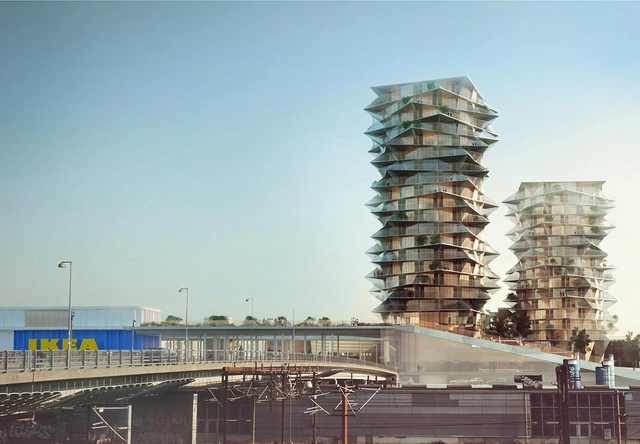
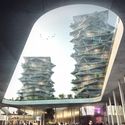
A new project in central Copenhagen will see two Danish practices—Bjarke Ingels Group (BIG) and Dorte Mandrup Architects—create a new urban IKEA store, a budget hotel, and housing linked together by green space. Set to open in 2019, the area—which sits adjacent to Kalvebod Brygge, close to the railway lines that pass through the city core—will be master-planned by Dorte Mandrup while two striking high-rise residential towers, dubbed "Cacti", will be designed by BIG.
Fairy Tales 2017 Competition Winner: Last Day / Mykhailo Ponomarenko. Image Courtesy of Blank Space
When you’re used to the grind of architecture school, breaks can hit you like rain on a warm day—cool at first, but terribly annoying soon enough. While the first few days breeze past as you catch-up on lost sleep and binge-watch Game of Thrones, you realize before long that you’re going insane with nothing to absorb all your new-found energy.
This is where architectural competitions come in handy. They provide a constructive outlet while being deeply engrossing, thus keeping you from hopelessly refreshing Youtube to see if Buzzfeed uploaded a new video. Also, the fact that you’re no longer constrained by the direction of your studio-leader or school program enables you to experiment creatively. With diverse international competitions running at any given time, you can take your pick, depending on your individual interests and the amount of time you want to devote. However, the sheer number of available competitions can be deeply confusing as well. Here we shortlist seven of the most prestigious annual architectural competitions open to students:
Emerging international architecture office KOSMOS has unveiled 6 projects exploring potential collective spaces in the city of Basel, Switzerland. Unveiled during Art Basel, the speculative projects were featured in the Forum Basel exhibition curated alongside Museum Director Andreas Ruby and Stéphanie Savio, and emerging Chilean practice Plan Común. Held at the Swiss Architecture Museum (S AM), the architecture exhibition was held “in reaction to the increasing commodification of urban space today” and dedicated itself to investigating new possibilities for public space in Basel. Check out the projects, with descriptions from KOSMOS, below.
Responding to a competition brief for a new archaeological museum in Nicosia, the divided capital of Cyprus, a proposal submitted by Greek architects Alkiviadis Pyliotis and Evangelos Fokialis uses the traditional elements of the line, atrium and stoa to inform the composition of the envisioned landmark. Titled "Trigonica Simplicitas," the design of the museum is intended to form a new central hub, celebrating Cypriot history and culture through the synthesis of indoor and outdoor spaces on various levels to rethink the function of a museum.
“This place is really Instagrammable, you’ll see what I mean.”
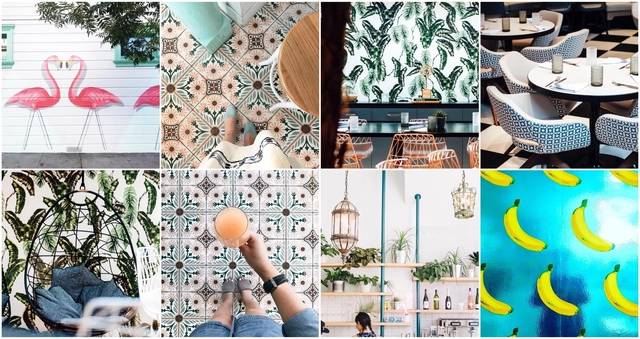
Walking into a tiled entryway and catching a glimpse of the cocoon-shaped swings, I saw fast. Planta, located on a busy street in Downtown Toronto is an Instagram magnet. And they know it. Opened last fall, Planta’s geotagged posts grow daily, with several of the restaurants’ key spaces photographed again and again. With jungle-inspired wallpaper, graphic tiling and a solid 14k following on their own account, the plant-based eatery means business.
Instagram’s parent-company Facebook announced it made $9.1 billion in earnings this quarter on advertising, retaining its longstanding rule over digital advertising alongside with Google’s Alphabet ($26 billion). With Instagram absorbing competitor Snapchat’s story features and increasing the number of sponsored posts it shows this year (yeah, we noticed), it’s not a stretch to say that the social media giant sits at the center of food and beverage trends. But what happens to interior spaces when restaurants set out to be “Instagrammable”?
It was alongside the rise of the Soviet era when the Russian avant-garde movement started one of the most influential creative revolutions in the 20th Century. The Constructivists, forming part of this wave, rewrote the history of art, design and architecture, and their legacy still remains contemporary.

















_(Large).jpg?1501804261&format=webp&width=640&height=580)
_(Large).jpg?1501804268 "© Koen Van Damme")
_(Large).jpg?1501804201 "© Koen Van Damme")
_(Large).jpg?1501804225 "© Koen Van Damme")
_(Large).jpg?1501804239 "© Koen Van Damme")
_(Large).jpg?1501804261)