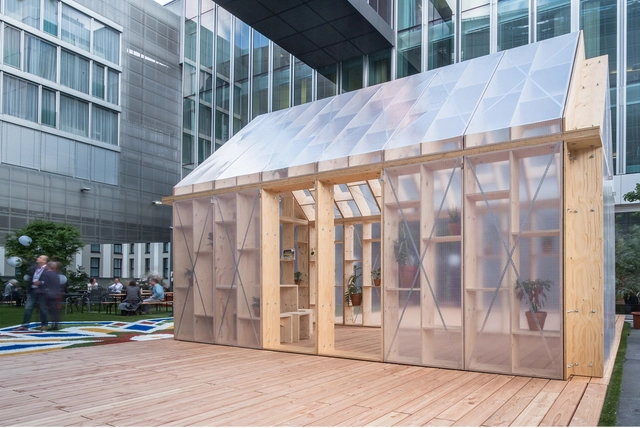
A team of architecture students at the CODE department of the TU Berlin have built PLUG-IN, a pavilion addressing the Home not Shelter! Initiative. Built as a collaborative process between students and refugees, the pavilion was realized under the direction of Prof. Ralf Pasel and his team. PLUG-IN physically expands the living space to creates a responsive project that goes beyond housing needs. The project was specifically proposed and built for the Dutch Embassy in Berlin.
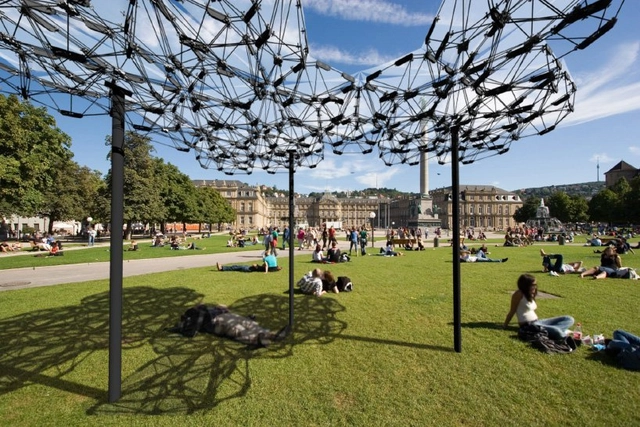
The project Cyber Physical Macro Materials was developed at the University of Stuttgart's Institute for Computational Design and Construction (ICD) to demonstrate a tangible vision of a new dynamic (and intelligent) architecture for public spaces. The agile and reconfigurable canopy is enabled by a combination of distributed robotic construction and programmable matter. Reconfigured using drones, the canopy was created with modular components that could respond in real-time to the climate or sun angles.
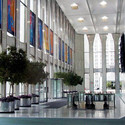
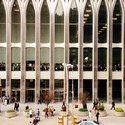
The opening of the World Trade Center Transportation Hub's Oculus will take a rain check on the 17th anniversary of 9/11, according to Steve Coleman, a spokesperson for the Port Authority. Designed by Santiago Calatrava, the 335-foot-long skylight was designed to allow the “Way of Light” to pass through the main hub of the transit hall at 10:28 a.m.—the moment that the North Tower of the WTC collapsed on September 11, 2001. Symbolizing the light that continues to shine through after the darkness of the tragedy, the Oculus opening allows light to fill the massive space as a memorial to the attacks on the twin towers.
A New York City icon that once rivaled structures such as the Statue of Liberty and the Empire State Building, the World Trade Center, colloquially known as the Twin Towers, was one of the most recognized structures in history. Designed by Japanese-American architect Minoru Yamasaki, it held the title of Tallest Building in the World from 1972–1974. Up until its unfortunate demise, the WTC site was a major destination, accommodating 500,000 working people and 80,000 visitors on a typical weekday.
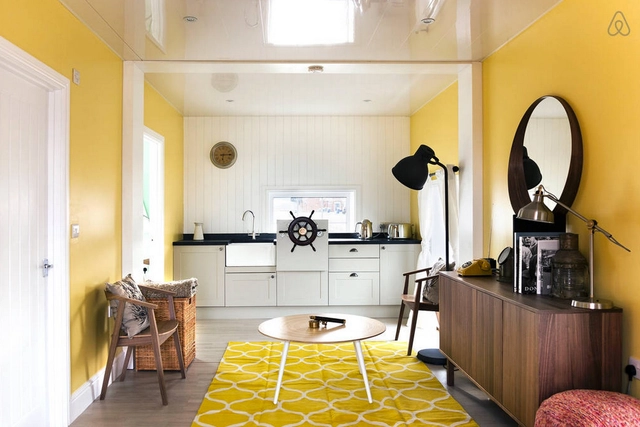
Home-sharing has become a phenomenon in the real estate and housing markets, with design playing a key factor in the success of a property, home, or room. The radical departure from the beige wallpaper and white linen hotel room has opened up a world of possibility for the adventurous traveler, from spending a night on the Great Wall of China to staying in an architectural masterpiece.
To help you design a successful Airbnb, we have provided 25 design tips for homeowners looking to turn their properties into profit. Remember, it's all about first impressions, and having that “curb appeal” will ultimately bring in people seeking one-of-a-kind experiences.
One of the most influential 20th-century architecture schools, the Bauhaus experienced its glory days in the city of Dessau between 1925 and 1932. Under the direction of Walter Gropius, Hannes Meyer, and Ludwig Mies van der Rohe, the emblematic educational complex was a place for work and housing for some of the most renowned personalities of architecture, design, and art of the last century.
Although the school in Dessau operated for a limited time with few people having the opportunity to experience the prolific environment, it left a deep impact on the architectural production that followed. The buildings that are part of the complex - both in Dessau and Weimar - were added to the UNESCO World Heritage List in 1996 and are now open for visitation.






















.jpg?1536534289&format=webp&width=640&height=580)

.jpg?1536534289)

















.jpg?1536166986 "© Manuel Sá")
.jpg?1536166274 "© Manuel Sá")
.jpg?1536166326 "© Manuel Sá")
.jpg?1536166187 "© Manuel Sá")