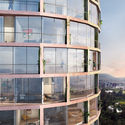
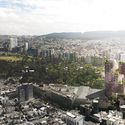
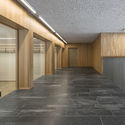
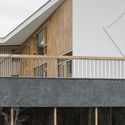
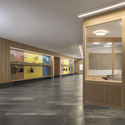
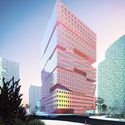
Perkins+Will has unveiled its design for 799 Broadway, a 12-story boutique office building just south of Union Square in Manhattan. The scheme seeks to reinvent the classic NYC loft building with contemporary materials, systems and, and technology. An exercise in designing from the inside out, the midrise scheme features a range of flexible floorplates that extend into a cascade of undulating terraces on almost every floor. The sculptural massing responds to zoning setback regulations, delivering a human-scaled expression with meaningful connections to the outdoors.
https://www.archdaily.com/916209/perkins-plus-will-designs-manhattan-office-building-sculpted-by-setback-restrictionsNiall Patrick Walsh
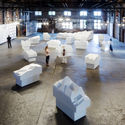
What happens when the sensor-imbued city acquires the ability to see – almost as if it had eyes? Ahead of the 2019 Shenzhen Biennale of Urbanism\Architecture (UABB), ArchDaily is working with the curators of the "Eyes of the City" section at UABB 2019 to set up a discussion on how new technologies - and Artificial Intelligence in particular - might impact architecture and urban life. Here you can read the “Eyes of the City” curatorial statement by Carlo Ratti, Politecnico di Torino, and SCUT. If you are interested in taking part in the exhibition at UABB 2019, submit your proposal to the “Eyes of the City” open call until May 31st, 2019: www.eyesofthecity.net
Comparisons, transpositions and metaphors can be misleading if one does not unpack carefully their point of departure. The notion that the digital age introduces us to a new regime of "eyes on the street", an expression famously coined by Jane Jacobs, requires understanding exactly what the author of The Death and Life of Great American Cities implied when she used it. For Jane Jacobs, the active presence of city dwellers in the street, their unconscious or conscious monitoring of what was going on in their immediate surroundings was the best way to ensure public safety. "The public peace — the sidewalk and the street peace— of cities is not kept primarily by the police, necessary as police are. It is kept primarily by an intricate, almost unconscious, network of voluntary controls and standards among the people themselves, and enforced by the people themselves," wrote Jane Jacobs.
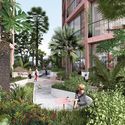
Bjarke Ingels Group and Uribe & Schwarzkopf have designed a 24-story rose-colored tower in Quito, Ecuador inspired by natural beauty, diversity, and the community of the city. EPIQ is BIG’s second building in the city, with a dynamic, porous structure clad in colored titles to echo the beauty of Quito, and to be the face of a new sustainable urbanism in the growing city.
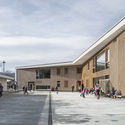
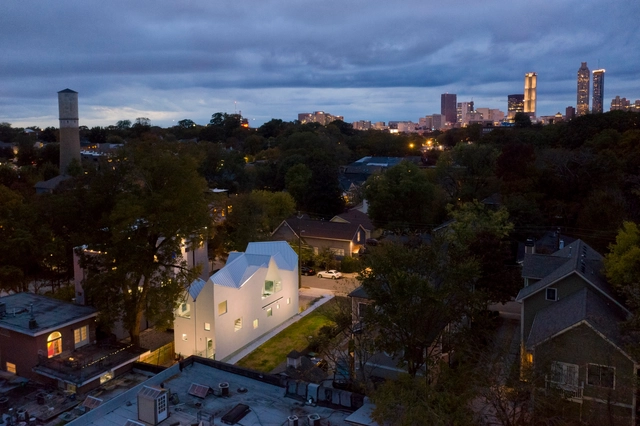
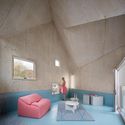
Jennifer Bonner of MALL has been named one of the 2019 recipients of The Architectural League Prize for Young Architects + Designers. Each year, The Architectural League announces six firms as winners of the award, which spotlights young, innovative North American architects and designers. Bonner is known for work that reinvents materials, hacks typologies, and playfully reimagines everyday architectural elements from gable roofs to brick facades.
Architects are often noted for having bad work-life balance, a lot of stress and little free time. How can you take time off while still improving your skills as an architect? Can that time off even give you an extra edge? Compared to other fields, architecture stands out as a field in which you need to “know a little bit about everything." Thus, in order to live up to our name we must also do a little bit of everything, and as they say, a little goes a long way. So with that in mind, here are 11 activities which, while not obviously architectural, just might make you a better architect.
"Soy de Azteca" (Or "I'm from Azteca") is a photographic project by Zaickz Moz that seeks to re-think the expressions of community and identity of the periphery of Mexico City—which is becoming more diffuse and overflows beyond its geographical limits. The objective of this project is to re-think the interpretations of community and identity of the residents of Ciudad Azteca (State of Mexico) manifested in private, public and urban spaces, through photographic series that addresses issues such as appropriation and modification of space habitable, urban development and the sense of community in the neighborhood of Ciudad Azteca.
The particular characteristics of a community give the inhabitants a sense of identity and belonging. Does this happen in any inhabited place? When observing that the history of Ciudad Azteca always exists in relation to Mexico City, it is worth asking if identifying traits have emerged among the inhabitants of Ciudad Azteca. As in other areas of the capital's periphery, it is possible to observe in this group of neighborhoods located in the municipality of Ecatepec the capacity of the locals to build and transform a space into a variety of forms of urban habitat.
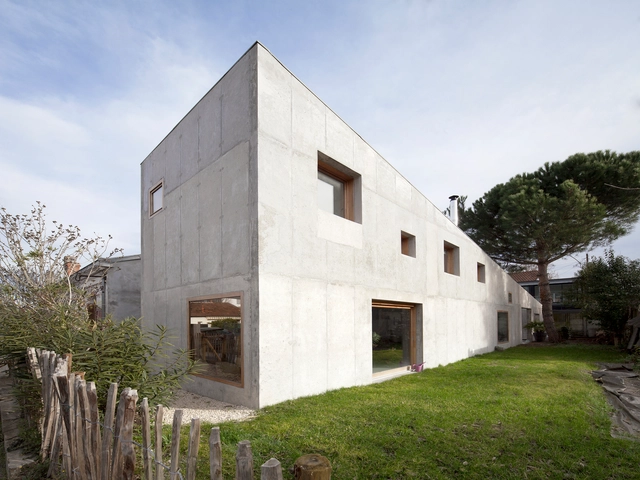
The Fundació Mies van der Rohe, together with BOZAR and UNINA, promotes the European project Artists in Architecture. Re-activating Modern European Houses. An initiative that aims to promote collaboration between artists, architects, students, professionals in the field of heritage and the public in general and at the same time opens an intergenerational and interdisciplinary dialogue that helps to define a contemporary vision and the future approach to conservation, restoration and reuse of a heritage as delicate and at risk as the single-family home.


.jpg?1556796742&format=webp&width=640&height=580)





.jpg?1556705336)