Videos
The Digital Twin . Image via Shutterstock/Videoflow
The emergence of the Digital Twin phenomenon has heralded a great change in terms of urban planning. It essentially presents the city as dynamic, in virtual form. Ensuring every element from the historic fabric, new construction, and public transit is accounted for in one three-dimensional model. Not only does it present key elements in terms of the landscape, but it also encompasses often overlooked conditions such as the presence of light throughout the day, shadows, and the presence of vegetation and trees. All of which contribute to a better preliminary process of site analysis.
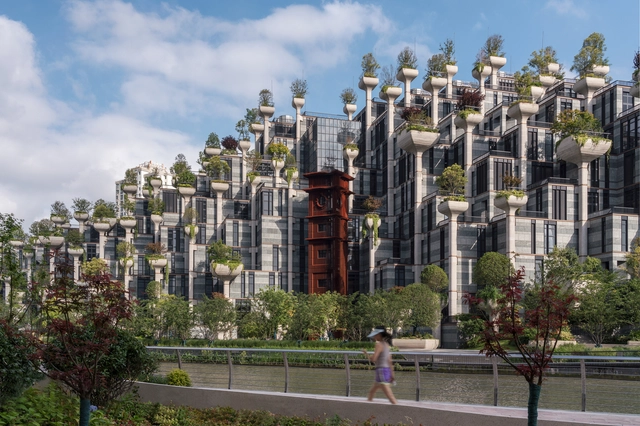
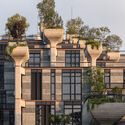
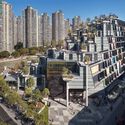
The first phase in the development of Heatherick Studio's 1,000 Trees project in Shanghai was recently inaugurated, showcasing the finished mountain-like structure. The design gives prominence to the structural columns, each topped by a large planter featuring a tree, which becomes the project's main feature. Balancing the requirements for a dense development with the search for a human scale, Heatherick Studio chose to approach the project as "a visual extension" of the neighbouring park, proposing a new topography defined by its integrated greenery.
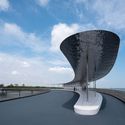
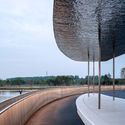
Last year, a series of new museums, expansions and several museum renovations have opened their doors to the public, adding a new dimension to the cultural landscape around the world. From the long-awaited re-opening of the Neue Nationalgalerie in Berlin, to Ryue Nishizawa's Jining Art Museum merging with the landscape, and MVRDV's reflective Art Depot, discover the architecture of the latest venues of art and culture.
Fotografiska Museum has announced its expansion to three new locations in Berlin, Shanghai and Miami, to be housed within existing buildings redesigned by Herzog & De Meuron, Neri&Hu and Rockwell Group. A former department store in Berlin's Jewish Quarter, a 1946 factory building in Miami and a historically significant warehouse complex in Shanghai are the future Fotografiska venues set for completion in 2022 and 2023. Together with the existing locations in Stockholm, Tallin and New York, these will form the world's largest private art museum in terms of size, number of locations, and exhibitions per year.















.jpg?1641932763 "© Ossip van Duivenbode / MVRDV")







.jpg?1639538097 "west view. Image © Hao Chen")
.jpg?1639538002 "north view. Image © Hao Chen")
.jpg?1639538376 "north facade. Image © Hao Chen")
.jpg?1639538340 "multi-purpose hall. Image © Hao Chen")






__苏州昆仑绿建木结构科技股份有限公司.jpg?1636371249 "aerial view. Image © Suzhou Kunlun Green Construction Wood Structure Technology Co.")
__苏州昆仑绿建木结构科技股份有限公司.jpg?1636370949 "changeable mobile station 3. Image © Suzhou Kunlun Green Construction Wood Structure Technology Co.")
.jpg?1636371050 "basic mobile station. Image © Suzhou Kunlun Green Construction Wood Structure Technology Co.")
.jpg?1636371193 "basic mobile station. Image © Suzhou Kunlun Green Construction Wood Structure Technology Co.")