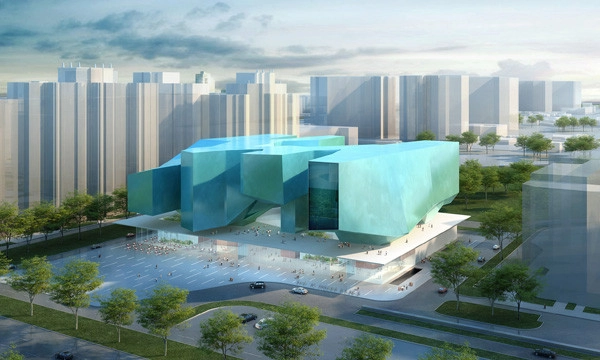
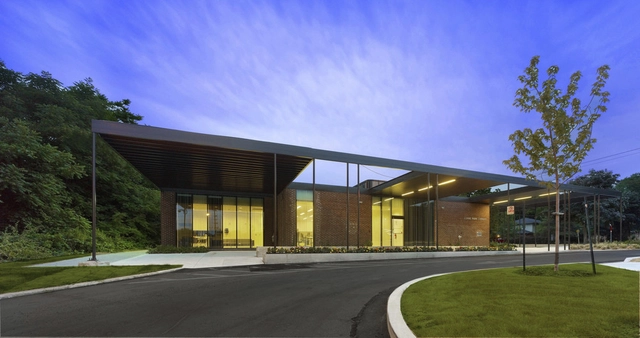
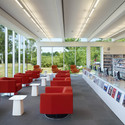
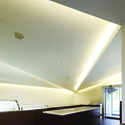
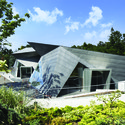
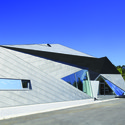
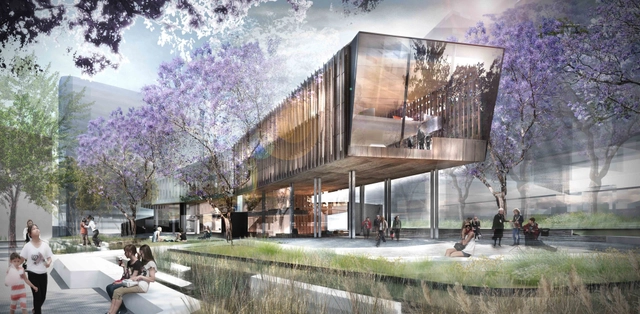
Part park, part urban square and part garden, the public realm of the Green Square Library proposal is a unique landscape offering to this new urban community and is an exemplar of contemporary community public space design and place making. Designed by ASPECT Studios, the public realm is designed to integrate with the program of the library building and facilitate a richness of public experiences and moods by changing scales and tempos. More images and architects' description after the break.
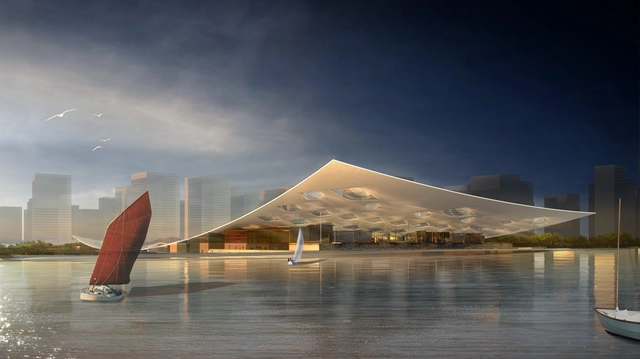
Situated outside the city of Tianjin in Northern China, the proposal for the new National Maritime Museum is designed to house both new and old maritime items with a focus on celebrating the historical achievements of Chinese naval exploration through out time. Designed by Holm Architecture Offce (HAO) + AIthe museum combines all aspects of the maritime world, from aquarium to sailing to education, combining a series of unique visitor experiences under one roof. More images and architects’ description after the break.
first prize / Courtesy of MASSIMILIANO FUKSAS Architetto and SPEECH
Organized by the Polytechnic Museum Development Foundation, the team of MASSIMILIANO FUKSAS Architetto (Italy) and SPEECH (Russia) was recently announced the winner of Architectural Concepts Competition for the Museum and Educational Center of the Polytechnic Museum and Lomonosov Moscow State University. The challenge was to create a museum and educational center for demonstrating most recent scientific and technological discoveries using state-of-the-art multimedia technologies for accommodating multiple displays and exhibitions as well as for conducting scientific educational programs. More images and information on the winning team and finalists after the break.
Designed by Charry C. Bougadellis & Associate Architects+Georges Batzios Architects, their proposal for the Piraeus Museum of Underwater Antiquities, which received an honorable mention, was divided in two elements based on the notion of ‘Viollet-le-Duc’: the negative element being the void, whilst the positive being the vertical and horizontal elements that define a space (walls and slabs). The link between these two elements, which defines the unity of the space is man. Therefore, the architectural space cannot be applied without the presence of man. More images and architects' description after the break.
Designed by UGO Architecture, their 'Culture Island' project is a model of a public library meant for small towns up to 15,000 inhabitants. The starting point for creating their concept was the research carried out in 2010 by the Office for Readership Research of the National Library and the Public Opinion Research Centre TNS OBOP. The research shows that 56% of Poles did not read a single book during the year. Thus, they started to think about how to make the citizens and the authorities of the municipality (the latter will finance the project) interested in the idea of model public libraries in spite of the poor readership. More images and architects' description after the break.
It's official! Danish architect Bjarke Ingelsof BIG has been commissioned to collaborate with Ralph Appelbaum Associates (RAA) and COWI to design the first public LEGO® museum in the company's hometown of Billund, Denmark. The "LEGO® Brand House" and "experience centre" is intended to compliment the non-public "LEGO®Idea House", which is also located in Billund.
Bjarke Ingles, founder of BIG stated: “It's going to be looking at LEGO® from all its different aspects—LEGO® as an art form, its cultural impact. When we were doing the research for it [the LEGO® house], we realized, if you would consider it just an art museum, you would be able to fill it with so much user content of such a high quality...it is one of our great dreams at BIG that we are now able to design a building for and with the LEGO® group. I owe a huge personal debt to the LEGO® brick, and I can see in my nephews that its role in developing the child as a creative, thinking, imaginative human being becomes ever stronger in a world in which creativity and innovation are key elements in virtually all aspects of society.”














.jpg?1365618202&format=webp&width=640&height=580)



.jpg?1365618206 "© Xiazhi")
.jpg?1365618202)