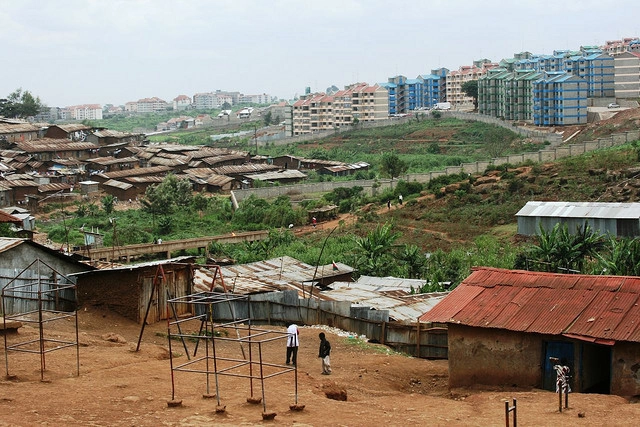
In 2011, UN-HABITAT and Project for Public Spaces (PPS) signed a 5-year cooperative agreement to aspire to raise international awareness of the importance of public space in cities, to foster a lively exchange of ideas among partners and to educate a new generation of planners, designers, community activists and other civic leaders about the benefits of what they call the "Placemaking methodology." Their partnership is helping to advance the development of cities where people of all income groups, social classes and ages can live safely, happily and in economic security and in order to reach these ambitious goals, the duo recently released 10 informative steps that cities and communities can take to improve the quality of their public spaces.
You have to admit it, Hollywood really seems to have a thing for John Lautner; his designs are continuously cropping up in tv-shows, films, cartoons, music videos and even video games. The occasional despondent college professor aside, his exuberant mansions are usually typecast as the bachelor-pads of various flamboyant psycho-paths, pornographers or drug-smugglers. Curbed Los Angeles have compiled this excellent video of the various Lautner-featuring scenes, so we thought that we'd take a closer look at some of his buildings, which tend to pop up in all manner of unexpected places.
Read more about Hollywood's love affair with Lautner after the break...
As we've mentioned before, Irish designer Eileen Gray was undoubtedly one of the most influential, and most overlooked, designers of the 20th century. However, a new Kickstarter campaign aims to put that right once and for all. The campaign is seeking funds to help renovate Gray's seminal house, E-1027, for the production of a feature film about the architect.
Read more about the film, and find out who is slated to play Gray, after the break...
Most critics have responded with outrage (it's "nothing less than cultural vandalism" says Martin Filler), denouncing MoMA's prioritization of corporate needs over cultural value. However, a few are actually defending MoMA's decision, saying the building was never ideal for displaying art anyway. See a round-up of all the opinions - from Davidson to Goldberger - after the break...
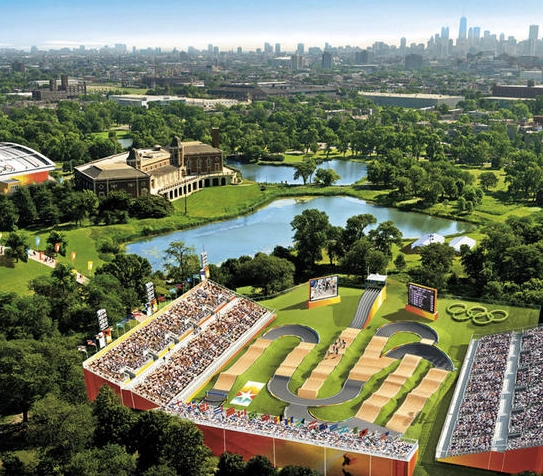
Via the Atlantic Cities "The would-be BMX track in Douglas Park, from Chicago's Bid Book."
In "How (Not) to Host the Olympics," I suggest that, when it comes to Olympic Planning, there is one Golden Rule: “The best thing to do if you’re bidding for the Olympics, Is to Not Get the Olympics.”
Badger follows up in Chicago, a city that bid - hard - for the 2016 Olympics (which will take place in Rio de Janeiro). As she puts it: "We often ask what Olympic cities really get in return for all the money, energy, and construction chaos invested in hosting the world's largest sporting event. But the story of cities that vie for but never win the Games raises a different question.
'What does putting together a bid that is unsuccessful leave you?'"
From Frank Lloyd Wright to Oscar Niemeyer and the 2013 Pritzker Prize laureate Toyo Ito, this short film features a series of excerpts from interviews, speeches and documentaries of the most influential Architects from the past 70 years who have shaped the notion of Architecture. As described by the video’s producer, viaViLi, “this accumulation of scenes some how expresses the condition of Architecture today - its moments of Glory and Misery.”
SOM and CASE has formally launched AEC-APPS, the first crowd-sourced, web-based library for applications used by architects, engineers and construction professionals. This is a one-of-a-kind initiative in the AEC Industry and is a non-profit online community that allows digital tool users and toolmakers to share ideas, tips and resources covering a wide array of applications, ranging from commercially-marketed products to user-created scripts and utilities. After months of beta testing, the site currently hosts more than 500 users who have posted 800 apps that can be used in the design, construction and operation of buildings.
Read more about this new initiative after the break.
There are many ways that the architecture profession has lead the way in environmentally friendly design - but when it comes to the process of creating buildings themselves, the industry works its way through huge amounts of paper. Frank Gehry, through his offshoot technology company Gehry Technologies, is aiming to change that.
The company has recently announced that its GTeam software, which has so far been available for less than a year, will now make use of Box, a cloud based storage system that is well suited to large files associated with complex 3D models that are often required in designing buildings.
Read more about Gehry Technology's new software collaboration after the break
Designed as an experiment on “the architectonics of music,” the basic geometry of the Daeyang Gallery and House was inspired by Istvan Anhalt’s 1967 Symphony of Modules - a uniquely transcribed sheet of music found in John Cage’s contemporary music compendium, Notations. Reminiscent of the “blocky and shard-like shapes” of Anhalt’s sketch, Holl’s design features three copper-clad pavilions punctured by a symphony of carefully placed, rectangular skylights that animate the interior with “bars of light”. As Kennicott describes, Holl uses music as a “powerful metaphor for the dynamic unfolding of experience” (captured in this film by Spirit of Space).
Read Kennicott’sMusic Holl: A Copper Clad Pavilion in its entirety here on Dwell. Continue after the break to compare Steven Holl's sketch above with Anhalt’s Symphony of Modules.
Nearly two years after unveiling the design to the public, Herzog & de Meuron broke ground this morning on the new ‘Grand Stade de Bordeaux’ in France. Surrounded by lush vegetation typically found in this green belt district, the stepped concourse transitions visitors through a forest of slender white columns to the stadium’s bowl, whose form ensures maximum flexibility and optimal visibility for all 43,000 spectators.
Completion is set for 2015, just in time to host the Euro 2016 football championship.
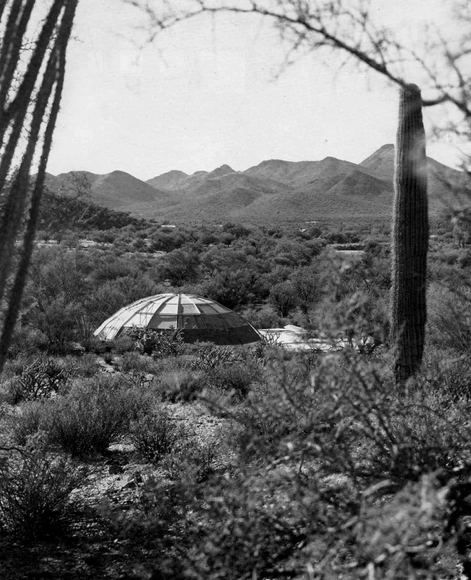
This article, written by Arizona-based architectWendell Burnetteof Wendell Burnette Architects, recounts the story of Paolo Soleri's 'The Dome' in the desert.
A glass house in the desert? Was it an architectural caprice, a folly, or was it a solution to the problems of desert living whose appropriateness is still not recognized? Having had the experience of living in The Dome for a full year, through all the seasons, I felt it incumbent upon myself to take a fresh look at this remarkable work of architecture.
Paolo Soleri, its designer, was born in 1920 in Turin, received a PhD in architecture from the Torino Politecnico, and in 1947 came to America to study with Frank Lloyd Wright, remaining with him for just over a year. Mark Mills, who assisted Soleri in the construction of The Dome, was born in 1921, received an architectural engineering degree from the University of Colorado, and studied with Wright for four years. It was at Taliesin that Soleri and Mills became friends. In 1948, when they and two other apprentices were working on an experimental structure at Taliesin West, which became what is known as the Sun Cottage, there was a misunderstanding with Wright that led to all four of them leaving. Soleri and Mills went to work with a developer, providing design work for some condominiums at the base of Camelback Mountain, below the north face in Paradise Valley. Soleri developed a scheme that involved a tower element supporting a hex form canopy and he and Mills built a mockup of Camelback out of concrete block and wood. It was shortly after this that “the Cli,” as she was fondly called, came along.
ALL THE BUILDINGS IN NEW YORK is a blog, a book, and, above all, illustrator James Gulliver Hancock's love letter to New York City.
As his website reveals, Hancock "panics that he may not be able to draw everything in the world… at least once." Since Kindergarten, he's been obsessed with drawing in meticulous detail (or, as he tells the Atlantic Cities, with a mix of "technicality and whimsy"), a characteristic this native Australian brought with him when he moved to Brooklyn, New York.
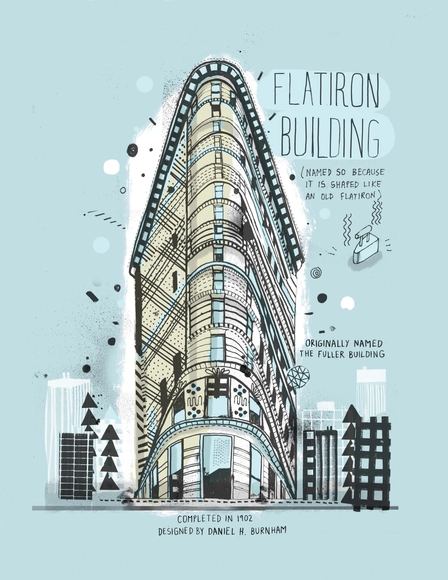
What began as a blog, All The Buildings In New York, to keep track of his many sketches of New York's architecture (particularly the brownstones), is now a book (All The Buildings in New York: That I've Drawn So Far - which includes about 500 drawings). Organized by neighborhoods, it features New York architectural icons from the past and present, including the Chrysler Building, the Flatiron, Apple's 5th Avenue store, as well as the everyday buildings that make up New York's unique cityscape.
See more images from All the Buildings in New York, after the break...
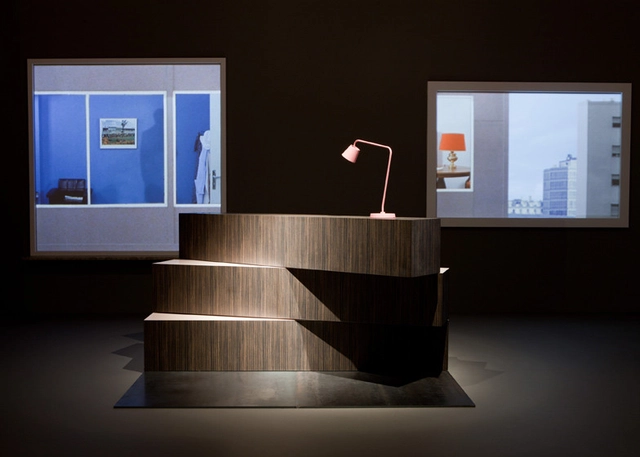
This week in Milan at the 52nd edition of the SaloneInternazionaledel Mobile (aka Milan Design Week), over 2,500 exhibitors showcased an endless collection of the latest international products and home-furnishing designs. Among them included a variety of elegant and intelligently designed items envisioned by some of our favorite architects. Continue after the break to scroll through a list of the best architect-designed products featured at the Milan Design Week 2013.
Having been involved in the creative industries education for over decade now, one of the most common questions students ask in interviews (and parents ask on open days) is about ‘getting a job’ at the end of the course. As if a graduating student can simply go and trade in their degree certificate and swap it for a ‘good job’. If only employment was this easy.
‘Getting a job’ in the Arts has always been a difficult undertaking; with no boxes to tick it can be a complicated process finding an appropriate vacancy - and so ensues the hellish time of resume writing and job interviews.
A drastic [most revolutions are] but more appropriate approach to this situation is not to think of ‘getting a job’ as ‘getting’- the mere word suggests a degree of affordance, of being gifted employment - but rather as ‘creating a job’. ’Creating’ is about being pro-active and entrepreneurial; it involves going out, attending events, talking to people, doing internships and apprenticeships – essentially increasing your exposure. After all, how will employers know they need you in their firm if they only see your skills in a nice little list on a sheet of A4? You must make yourself indispensable, and for that you don’t need a resume. You need guts.
“There are of course the personal feelings — your buildings are like your children, and this is a particular, for us, beloved small child. But there is also the feeling that it’s a kind of loss for architecture, because it’s a special building, a kind of small building that’s crafted, that’s particular and thoughtful at a time when so many buildings are about bigness.” - Billie Tsien, quoted in The New York Times
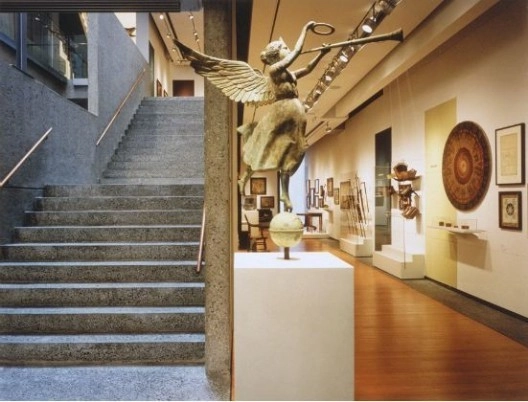
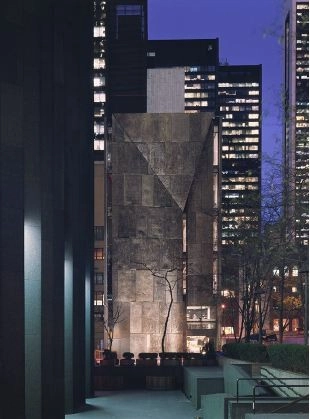
After only 12 years, the Tod Williams & Billie Tsien-designed American Folk Art Museum is slated to be demolished. Despite the acclaim it has received from critics, including high praise from the likes of Paul Goldberger and Herbert Muschamp, and the importance it has been given in New York's architectural landscape, the Museum of Modern Art (MOMA, which bought the building in 2011) reports that it must tear down the building to make way for an imminent expansion.
At the time of its construction, the building was of the first new museums built in New York in over thirty years. Unfortunately, the building will more likely be remembered for its short life, taking, in the words of The New York Timesreporter Robin Pogrebin, "a dubious place in history as having had one of the shortest lives of an architecturally ambitious project in Manhattan."
Read more about the American Folk Art Museum's imminent demolition, after the break...
By now you have probably heard that UNStudio, the Dutch firm led by Ben van Berkel and Caroline Bos, is on target to relaunch this June as an open-source web-based knowledge hub… that, by the way, will still pursue adventurous architecture. We could say they are “launching” this initiative, but it seems more accurate to say they themselves are “relaunching”.
Because of the difficult economic climate in Europe, van Berkel and Bos began to reimagine the practice along the lines of something more fluid, flexible, and agile, a knowledge-based approach to how they work within the office and how they engage the larger world. They are basing this around four topics or “knowledge platforms”: sustainability, materials, organization, and parametrics.