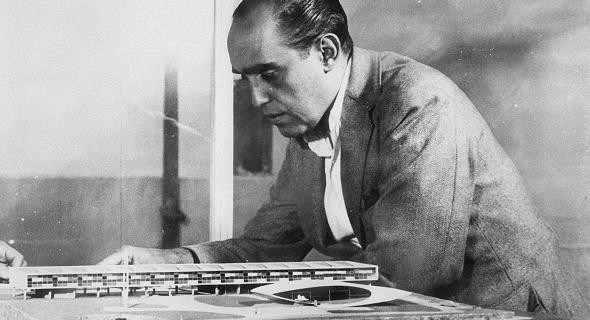
Niemeyer observa maquete da escola projetada em Belo Horizonte (MG). Image Courtesy of ON
It's been exactly one year since the world first mourned the passing of a great master of 20th century architecture: Oscar Niemeyer.
After 104 years of life, the renowned architect left a profound legacy. His works - known for their impressive curves, embrace of light, and profound relationship to their surroundings - made him an icon. Not just in Brazil, but the world.
Destruction of Pruit-Igoe. Image Courtesy of US Department of Housing and Urban Development
This article by Chris Knapp, the Director of Built-Environment Practice, originally appeared on Australian Design Review as "The End Of Prefabrication". Knapp calls for the end of prefabrication as a driver for design, pointing out its century-long failure to live up to its promise, as well as newer technology's ability to "mass produce difference".
Prefabrication – there is not another word in the current lexicon of architecture that more erroneously asserts positive change. For more than a century now, this industrial strategy of production applied to building has yielded both an unending source of optimism for architecture, and equally, a countless series of disappointments. This is a call for the end of prefabrication.
Foster + Partnershas joined forces with Heatherwick Studio to design the new Bund Finance Centre (BFC) in the heart of historic Shanghai. The mixed-use, waterfront destination will serve as the “end point” to the city’s most famous street, as well as a prime connection between the old town, the Bund, and the new financial district.
Los Angeles-based cinematographer Tomas Koolhaas is nearing completion of his highly anticipated film, REM. The feature length documentary, which focuses on the work of Tomas’ famed father, Rem Koolhaas, is the first architectural film to “comprehensively explore the human conditions in and around Rem Koolhaas' buildings from a ground level perspective.” Rather than lifeless still shots and long-winded, intellectual discourse, REM exposes the one thing that gives each building function and purpose: how it is used by people.
So far, REM has been funded entirely by grants. However, in order for Tomas to collect the necessary funds to complete post-production, he has turned to you by launching a Kickstarter campaign.
Watch REM's official trailer above, which follows a parkour expert as he moves through the Casa De Musica in Porto, and follow us after the break for Tomas’ exclusive interview with Kanye West, who comments on his work with OMA at the 2012 Cannes film festival.
At the annual Greenbuild International Conference in Philadelphia last week, the US Green Building Council (USGBC) finally announced the latest version of LEED. Aiming to make a larger forward step than previous versions, LEED v4 is described by Rick Fedrizzi, the CEO and president of USGBC as a "quantum leap". But what are the key changes in the new LEED criteria, and what effect will they have? Furthermore, what problems have they yet to address? Read on to find out.
The design for the Qom Central Building of Construction Engineering Organization by Partar Architecture Studio began with “a key question that discussed the feasibility and impossibility of imagining a unique design which best suits the spatial quality of traditional Iranian architecture." Partar’s design process was based on this challenge, and has led to an interesting proposal that attempts to bridge the art of architecture and the technology of construction using an understanding of the phenomenological aspects of Persian art and ornament, coupled with traditional Persian building techniques.
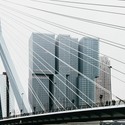
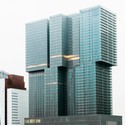
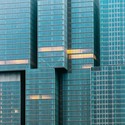
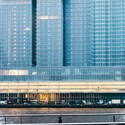
All images are from photographer Richard John Seymour,who caught Rem Koolhaas' recently completed De Rotterdam building on a broodingly foggy morning.
At the opening of the newly constructed De Rotterdam building in his home city, Rem Koolhaas spoke at length about how this "vertical city" was designed to appear scaleless, despite its urban context. More about what Koolhaas had to say about the project and the city, after the break...
London's Tate Britain, a partner gallery to the Tate Modern (who recently appointed Herzog & de Meuron to design a new extension), recently unveiled Caruso St. John's transformation of the oldest part of the iconic Grade II* listed Millbank building. The £45 million project to restore, renovate and reinterpret one of the UK's most important galleries has been met with a largely positive critical response; read the conclusions of The Financial Times’ Edwin Heathcote, The Guardian’s Oliver Wainwright, The Independent's Jay Merrick, the RIBA Journal's Hugh Pearman, and the Architects’ Journal’s Rory Olcayto, after the break…
"When you find a piece of stone which is three or four hundreds years old, then you understand the notion of time as more than what we can experience as human beings. At that moment the old thing might be beautiful, it might be ugly. It doesn't matter, but it gives you a sense of profound time, and then you understand your history and ancestors that lived in a different world, different from the one we are in now."-Yung Ho Chang
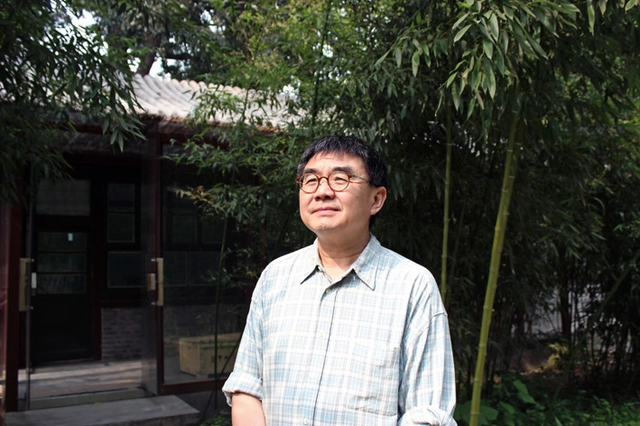
Located in Beijing’s Yuanming Yuan Park, next to the ruins of the mixed-style Baroque Palace, Yung Ho Chang's office is in an ancient wooden dwelling, surrounded by vegetable gardens grown by the architects of the studio.
In this conversation, Yung Ho, who established China’s first independent architectural office, Atelier FCJZ in 1993, laying the foundation of contemporary practice in China, talks about his story, describing a Beijing which has disappeared as well as the contemporary Beijing and its "New Beijing Sky." He talks about architecture using references from movies, literature, art and artists, describing his approach to architecture in accordance with his philosophy of life.
Tatiana Bilbao S.C.'s design for Paperhouses, The Module House. Image Courtesy of Paperhouses
“Architecture does not change anything. It’s always on the side of the wealthy. The important thing is to believe that it can make life better.” -- Oscar Niemeyer
As much as we'd care to deny it, Niemeyer makes a valid point here. Architecture is almost always "on the side of the wealthy"; the profession, as it has existed for about a century, rarely changes anything; and yet - and yet - it can make life better. If only for a select few.
But what if architecture could make life better for the many. What if good-quality, life-bettering architecture were open-source and available to download off the internet? For free?
In Design Intelligence's annual rankings of US Architecture Schools, released earlier this month, there is certainly a lot to talk about. Of course, plenty will be said about what is shown immediately by the statistics, and rightly so - but just as interesting is what is revealed between the lines of this report, about the schools themselves and the culture they exist within. By taking the opinions of professional architects, teachers and students, the Design Intelligence report exposes a complex network which, when examined closely enough, reveals what some might see as a worrying trend within architectural education.
One of Detroit's most prominent vacant sites is slated to become one of its most iconic buildings. SHoP Architects will partner with Detroit-based Hamilton Anderson Associates to transform the site formerly occupied by Hudson's Department Store. Located at Grand River and Gratiot in the city's Central Business District, the two-acre site has remained a scar in the urban landscape since the implosion of the Hudson's building in 1998.
https://www.archdaily.com/452116/shop-architects-selected-for-design-of-iconic-site-in-downtown-detroitRennie Jones
The Kolkata Museum of Modern Art (KMOMA), Herzog & de Meuron’s first project in India, has broken ground in the new district of Rajarhat. The new museum seeks to embrace the city’s renowned cultural past and ultimately transform it into India’s “Art City”. Programs ranging from high-end gallery and art restoration facilities, to artist studios and an outdoor performance theater aims to empower local artists so they may play a critical role in the evolution of their community.
Now in its 5th edition, the Bi-City Biennale of Urbanism / Architecture (UABB) is the only biennial exhibition in the world to be based exclusively on the themes of urbanism and urbanization. The Biennale is co-organized by Shenzhen and Hong Kong, two of the most intensely urban cities in the world, where political and economical contexts have shaped unique urban dynamics.
The Hong Kong Biennale is led by Chief Curator Prof. Colin Fournier along with Joshua Lau and Allen Poon of TETRA and Travis Bunt and Tat Lam of URBANUS. As reported earlier, the Shenzhen edition will be curated by Ole Bouman and Team Li Xiangning + Jeffrey Johnson.
As Asia’s leading architecture, design and planning event, it will exhibit work by leading international and local design professionals and engage in a three month cultural dialogue that will include satellite exhibitions, performances, fi lm screenings, forums, workshops, guided tours and lectures.
The Biennale "will be informed by the singularity of Hong Kong but it will not be primarily about Hong Kong, just as the Venice Biennale is not about Venice: it will be about the cities of the world, making use of the unique bi-city setting of the Biennale as a platform to address global issues in a visionary and critical way."
ArchDaily will be present at the opening of the Shenzhen edition to bring you all the insights of the event.
The concept of the open plan revolutionized architecture - promising light, space, and effortless collaboration (not to mention a more cost-effective way of getting lots of people into one space). Today, it's practically become a standard of design - but at what cost?
A new report from researchers Jungsoo Kim and Richard de Dear, published in the Journal of Environmental Psychology, concludes that the open plan comes with some serious collateral damage - namely a lack of "sound privacy" - which outweighs its positive qualities. What's more, according to their results, the open plan doesn't even make a measurable improvement in communication at all.
When Kanye West spoke with students at my alma mater on Sunday evening, he said “I really do believe that the world can be saved through design, and everything needs to actually be ‘architected.’” In the social media frenzy that followed, a recurring response that I saw on architecture-centric sites was to snicker at West’s use of the word “architect” as a verb. For many, this was symbolic of West’s ignorance and hubris as he presumed to talk about something without knowing anything.
Except, of course, that “architect” is well recognized as a verb. Dictionaries say so, architects say so, and academics say so. If you’re architect Doug Patt and call yourself howtoarchitect on YouTube, you get a contract from MIT Press to write a book—called How to Architect. If you are the French philosopher Louis Marin, you can suggest that “the castle and gardens of Versailles ‘architect’ the Prince to make him not only the absolute of political power, but the center of the cosmos in its entirety,” and you will be counted among the most eminent semioticians of the twentieth century. If you are Harvard architecture theorist K. Michael Hays, you might stand up at an academic conference and say, “There are only certain things that can be done at this moment. Not just anything can be architected at this moment, right? There are limits.” When you do, people will nod and applaud.
But if you are Kanye West and you suggest that “everything needs to actually be ‘architected,’” it disqualifies you to speak about architecture.

.jpg?1386258546&format=webp&width=640&height=580)

.jpg?1385617247&format=webp&width=640&height=580)


_Helene_Binet.jpg?1385474415)
.jpg?1385572640&format=webp&width=640&height=580)