

This article is part of our new Opinion section, a format for argument-driven essays on critical questions shaping our field.

This article is part of our new Opinion section, a format for argument-driven essays on critical questions shaping our field.

The United Nations General Assembly has voted to promote the use of world map projections that more accurately represent the relative size of continents. The resolution was presented during a session at the UN headquarters in New York on September 4 and received 164 votes in favor, with one country voting against and six abstaining. Sponsored by Togo, the resolution encourages governments, educational institutions, international organizations, and technology companies to use equal-area projections when geographic scale is relevant. The resolution does not formally replace or prohibit the use of the Mercator projection, which has been widely used since the 16th century. Instead, it calls for greater use of projections that preserve the relative area of landmasses and encourages education about the limitations of representing the Earth's curved surface on a two-dimensional map. The 2018 Equal Earth projection is identified as one example of a map that more accurately represents continental scale.

"Architecture that holds multitudes." This is the phrase Studio NEiDA uses to introduce itself, making its position toward the world clear: to listen to and respect the plurality of existences that move through each context. More than a statement of principles, the phrase seems to function as a method. What does it mean, after all, to design spaces capable of sheltering not only people, but also memories, knowledge, and conflicts?

Across different climates and building cultures, many contemporary projects are working with local ways of building in new ways. Earth walls, bamboo structures, shaded thresholds, and collective construction processes are being reconsidered not as references, but as tools for the conditions architecture is facing now and will continue to face.

The Pan-African Biennale (PAB) has announced the official selection of participants for its inaugural 2026 edition, set to take place from September 7 to 11, 2026, at the Kenyatta International Convention Centre in Nairobi. Conceived as the first continental architecture biennale dedicated to spatial practices from and within Africa, the event will bring together architects, studios, research collectives, and material practitioners from across the continent. Additional participants, keynote speakers, and contributors are expected to be announced in the coming weeks.

Modernism in architecture was perhaps the first truly global building design philosophy. Established at the beginning of the twentieth century, its early proponents were heavyweights from Europe, such as Le Corbusier, Walter Gropius, and Mies van der Rohe. In 1923, Le Corbusier published his seminal written work, usually translated into English as Towards a New Architecture. Newness, and a rejection of history, was one of the central tenets of modernism. This manifested itself in the use of new materials such as steel and concrete, which gave rise to an unprecedented freedom of formal expression.

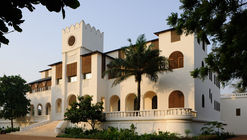
In late 2024, an event was held in the grounds of the recently refurbished colonial-era Palais de Lomé in the capital of Togo. Students from the architecture university of Lomé were attending the first Lomé Architecture Encounters (RAL #1), curated by the transdisciplinary Studio NEiDA, and which involved lectures, film screenings, workshops, and building visits. A parallel exhibition displayed the country's most significant architecture through history. The purpose of the event was to explore the architectural heritage of Togo, and it would be the start of a journey that crosses borders, asking questions about the conservation of modern heritage. Unlike colonial buildings like the Palais de Lomé itself, which are more appreciated and readily restored, neglected modern buildings like the Hôtel de la Paix require creative, bottom-up approaches to return them to their former vitality.

Studio NEiDA operates at the intersection of architectural practice, research, and curatorial work, with a consistent focus on how buildings emerge from the material and cultural conditions of a place. Rather than treating materiality as a finishing language, the studio frames it as the beginning of an architectural narrative—starting from what is locally available, they look at what craft knowledge exists on the ground, and how those resources and skills situate a project within an architectural lineage. This approach foregrounds limitations and possibilities as productive forces, and positions design as an iterative process of aligning spatial intent with the realities of construction culture and vernacular intelligence.
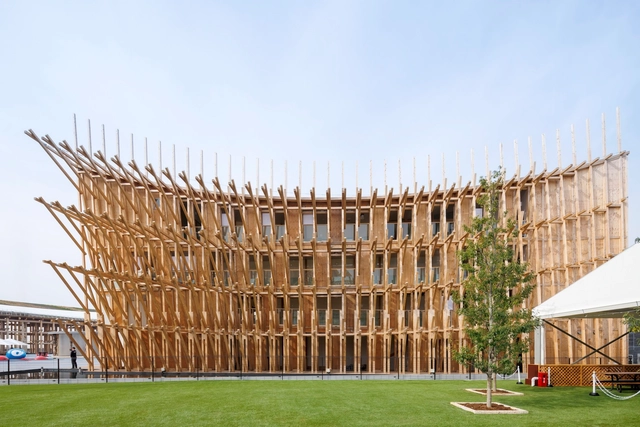
In a global landscape marked by accelerated change, 2025 emerged as a decisive year for architecture—not only because of the major events that animated the international circuit, but above all because of the voices that stood out within them. From the Venice Architecture Biennale to Expo Osaka, pavilions and installations from the Global South ceased to function as mere exhibition gestures and instead asserted themselves as territories of memory, resistance, and imagination, articulating narratives that expand the horizons of contemporary architectural debate.

Vernacular architecture is often referred to as harboring lessons for creating low-energy buildings and the fight against climate change. Yet, as weather patterns are changing, there are cases where traditional building techniques are themselves becoming at risk. As well as changes in temperature, different regions have faced becoming wetter or drier, experiencing increased risk of droughts, flooding, storms, and changes to local flora. The painted houses of Tiébélé in Burkina Faso, recognized as a UNESCO World Heritage Site, are one example.