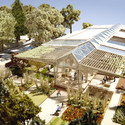
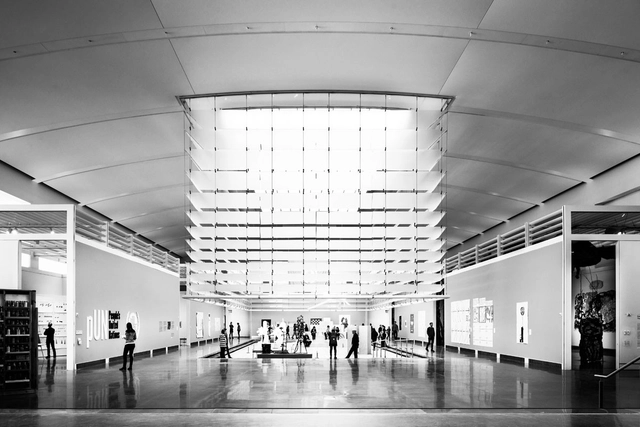
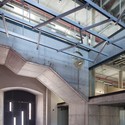
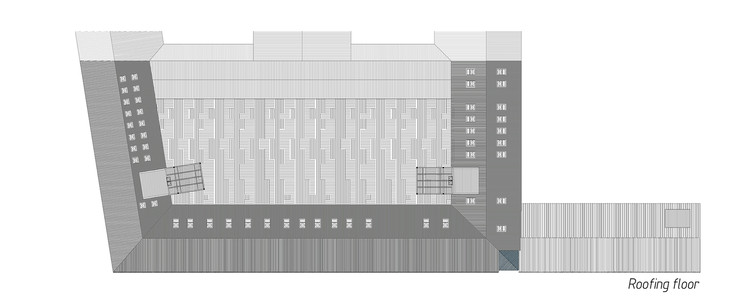
In January of this year, the latest work by Smiljan Radic, the Chilean architect chosen to design the next Serpentine Pavilion, opened to public acclaim. The Museum of Pre-Columbian Art (Museo de Arte Precolombino), located in Santiago de Chile, is a restoration project that managed to sensitively maintain an original colonial structure - all while increasing the space by about 70%.
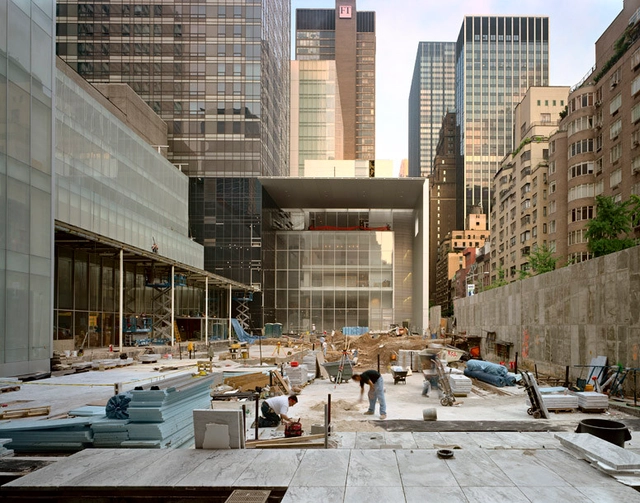
What appears here is not strictly a battle between an institution that wants to reflect the spirit of the time vs a building that is inherently specific to its place. It represents a lost design opportunity. What if the American Folk Art Museum had been considered an untouchable civic space in the city of New York, much like the The Museum of Pre-Columbian Art is for the city for Santiago? Then a whole new strategy for adaptive reuse would have emerged.
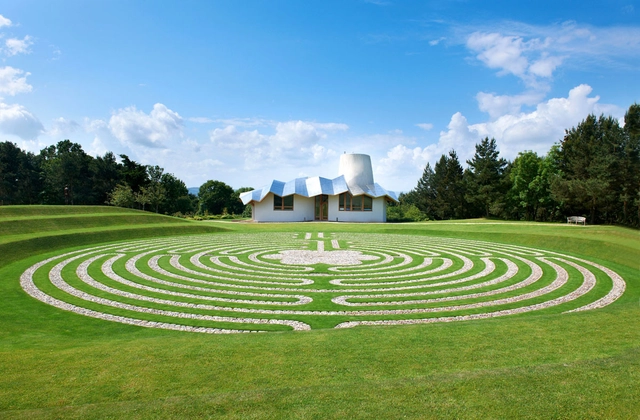
Dundee, Scotland, 2003 by Frank Gehry / Courtesy of Maggie's Centres. ImageThe third center was designed by Frank Gehry, a close friend of Maggie's. “Frank gave us so much publicity, and allowed us to raise the money,” Jencks says. Each center is self-financed through donations.
Maggie's Centres are the legacy of Margaret Keswick Jencks, a terminally ill woman who had the notion that cancer treatment environments and their results could be drastically improved through good design. Her vision was realized and continues to be realized today by numerous architects, including Frank Gehry, Zaha Hadid, and Snøhetta - just to name a few. Originally appearing in Metropolis Magazine as “Living with Cancer,” this article by Samuel Medina features images of Maggie's Centres around the world, taking a closer look at the organization's roots and its continued success through the aid of architects.
It was May 1993, and writer and designer Margaret Keswick Jencks sat in a windowless corridor of a small Scottish hospital, dreading what would come next. The prognosis was bad—her cancer had returned—but the waiting, and the waiting room, were draining. Over the next two years until her death, she returned several times for chemo drips. In such neglected, thoughtless spaces, she wrote, patients like herself were left to “wilt” under the desiccating glare of fluorescent lights.
Wouldn’t it be better to have a private, light-filled space in which to await the results of the next bout of tests, or from which to contemplate, in silence, the findings? If architecture could demoralize patients—could “contribute to extreme and mental enervation,” as Keswick Jencks observed—could it not also prove restorative?
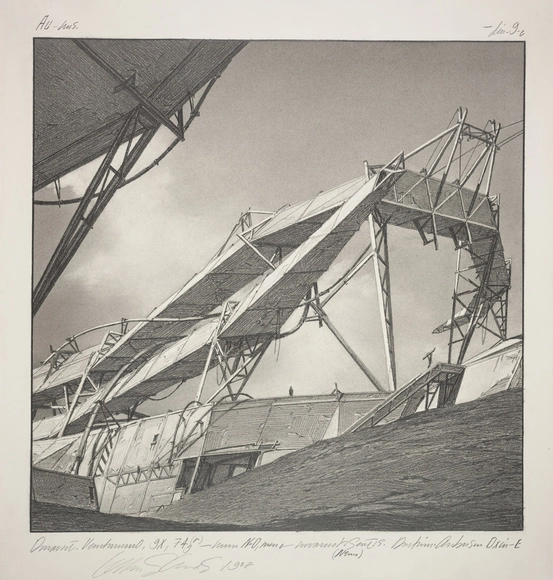
Unified Urban Field. Image Courtesy of Estate of Lebbeus Woods
This summer, the drawings, theories and works of architect Lebbeus Woods are headed to the city that Lebbeus considered home. After a five-month stay at SFMOMA, the exhibit "Lebbeus Woods - Architect" will be at the Drawing Center in SoHo, Manhattan until mid-June. The following story and overview of the exhibition, by Samuel Medina, originally appeared at Metropolis Magazine as “Coming Home".
It’s all too biblical an irony that Lebbeus Woods—architect of war, catastrophe, and apocalyptic doom—died as strong winds, rain, and waves barreled down on Manhattan, his home for some 40-odd years. Woods passed the morning after Hurricane Sandy flooded Lower Manhattan, almost as if the prophet had succumbed to one of his turbulent visions. But this apocryphal reading is just one way to view Woods’s work, which, as often as it was concerned with annihilation, always dared to build in the bleakest of circumstances.
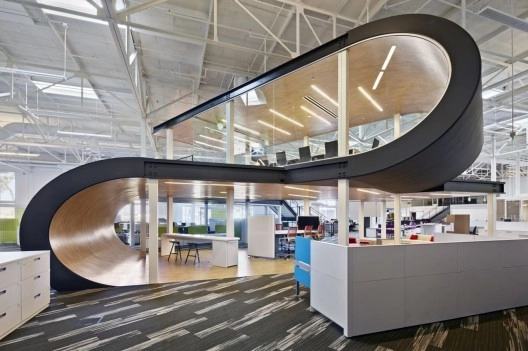
Grimshaw Architects' dual focus on industrial and architectural design will be celebrated this month in a featured exhibit at Milan Furniture Fair. In this article, originally published by Metropolis under the title "Down to the Details," author Ken Shulman presents the firm's evolution in the context of the exhibit, touching on the projects being presented and more intriguingly — on how they are being presented.
Shortly after he joined Grimshaw Architects, Andrew Whalley was tasked with putting together an exhibition at the Royal Institute of British Architects (RIBA) in London. Titled Product + Process, the 1988 show was decidedly counter-current—a parade of pragmatic, largely industrial structures Grimshaw realized in the UK in the face of surging postmodern fervor. Featured projects included the transparent building the then 15-person firm designed to house the Financial Times’ London printing facilities, and a flexible, easily reconfigurable factory Grimshaw built for Herman Miller in Bath. But it wasn’t the selection of projects that caught the public eye. “We asked our clients to take apart pieces of their buildings, and then rebuild them for the exhibition,” says Whalley, now deputy chairman of Grimshaw. “This wasn’t a typical show of architectural drawings and models.”
Andrew Carnegie once said, “Aim for the highest.” He followed his own advice. The powerful 19th century steel magnate had the foresight to build a bridge spanning the Mississippi river, a total of 6442 feet. In 1874, the primary structural material was iron — steel was the new kid on the block. People were wary of steel, scared of it even. It was an unproven alloy.
Nevertheless, after the completion of Eads Bridge in St. Louis, Andrew Carnegie generated a publicity stunt to prove steel was in fact a viable building material. A popular superstition of the day stated that an elephant would not cross an unstable bridge. On opening day, a confident Carnegie, the people of St. Louis and a four-ton elephant proceeded to cross the bridge. The elephant was met on the other side with pompous fanfare. What ensued was the greatest vertical building boom in American history, with Chicago and New York pioneering the cause. That’s right people; you can thank an adrenaline-junkie elephant for changing American opinion on the safety of steel construction.
So if steel replaced iron - as iron replaced bronze and bronze, copper - what will replace steel? Carbon Fiber.
Last year, I wrote about doing away with the title “intern,” saying the word “should be banished from the profession.” The post, titled, No More Interns, caused quite a flurry of responses, some quite angry, in fact. Some respondents defended the title, saying a title is just a title; others launched attacks against it, saying it connotes someone unskilled or untrained.
For the record, I still think we should get rid of it — not simply because it is demeaning and diminishing to individuals who have gone through the rigorous educational stages of the profession, but because it makes the profession look antiquated. Think about where you find “intern” used today and what it generally implies: volunteer, unpaid/low-paid, student, temporary, trainee, to name a few. Imagine how clients from progressive business cultures view it. Also, from the standpoint of business, doesn’t it make sense that people would pay more for architecture not done by “interns”? I would pay more for “associates.”
The Graduate Architecture, Landscape, and Design Student Union (GALDSU) at the University of Toronto recently published the results of its first mental health survey, which asked students to reflect on their experience at the John H. Daniels Faculty of Architecture, Landscape, and Design. Many past and present students have met the findings, which paint a blatantly bleak picture of the architecture student experience, with little to no surprise. The report brings the issue of poor mental and physical health in architecture schools to the forefront of our consciousness; however, the cool response it has elicited undercuts the initiative and raises important questions. If we were already aware of the problem, why hasn't change already been initiated? Will this always be the accepted, brutal reality of architecture education?
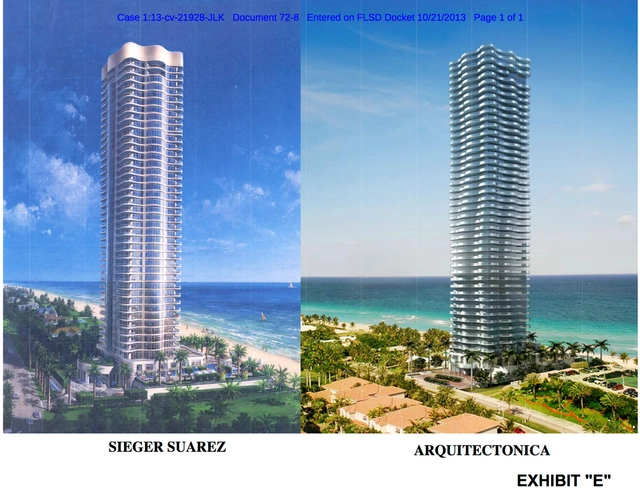
Courtesy of Mitch Tuchman. Source of images: U.S. District Court for the Southern District of Florida, Miami Division
When an eminent jurist asks, “What does a copyright of an architectural work truly protect?” you may be certain the question is not rhetorical. The U.S. Copyright Act does provide protection from infringement for architectural works, but it does so in terms so ambiguous that a judge might wonder, as did federal district court judge James Lawrence King in a case he decided earlier this year, whether broadly applicable standards for determining infringement even exist. Finding “the usual analysis … too vague and the language misleading,” King blazed a trail of his own in Sieger Suarez Architectural Partnership v. Arquitectonica International Inc., 2014 U.S. Dist. LEXIS 19140, proposing detailed guideposts for future courts to follow.
Sieger Suarez involved two Miami architectural firms and a 43-story condominium tower nearing completion in suburban Sunny Isles. The Sieger Suarez firm was engaged in 2000 by the project’s first owner. When the project, now known as Regalia, changed hands, the new owners dropped Sieger Suarez and engaged Arquitectonica in 2006. This is a scenario made familiar in scores of disputes involving allegations of infringement of architectural works.
Befitting a beachfront property with floor-through units starting at $7 million, both designs present dramatic, undulating exteriors. “When facing any of the buildings' four sides,” King wrote in his opinion, “the façades create the impression of a wave rippling horizontally across the sides of the buildings.” Further, in cross-section, both buildings reveal what King described as a “flower shape,” “a stylized rectangle, with gently rounded corners and an outward bulge more-or-less in the center of each of the four sides.” Should this flower shape, combined with the wavelike exteriors, have been enough to sustain Sieger Suarez’s claim of infringement against its competitor and the property’s owners?
The results of this Court Case, and what they could mean for architectural copyright in general, after the break...
A few weeks ago, ArchNewsNow carried an article from the Orange County Register about the increasing popularity of “crowdsourcing” architectural design. You might already be familiar with the crowdsourcing concept: using the Internet to gather solutions to virtually any problem or task from people all over the world. The idea has been used to generate solutions to provide clean drinking water in third-world countries, to creating entire websites such as Wikipedia. Such activities are generally regarded as “disruptive,” in the parlance of the moment, in that they offer alternative ways of achieving a result that has traditionally been accomplished through other means. (ArchNewsNow is “disruptive” in the sense that it offers an alternative outlet for architectural news that impacts the traditional architectural publishing world of print media.)
Read on to find out why this "disruptive" new trend is nothing to fear
https://www.archdaily.com/497828/why-criticisms-of-crowdsourcing-don-t-add-upMichael J. Crosbie
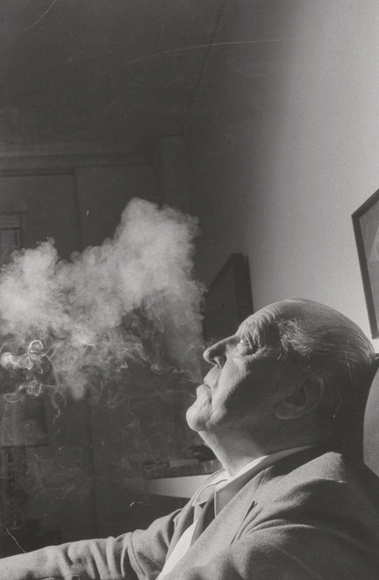
Mies van der Rohe with smoke, 1957; photographed for Life magazine. Image Courtesy of Frank Scherschel/Time & Life Pictures/Getty Images
This review of Detlef Mertins' book "Mies" - by Thomas de Monchaux - originally appeared in Metropolis Magazine as "Mies Reconsidered". According to de Monchaux, Mertins reveals the modernist master as a voracious reader who interpreted a wide variety of influences to arrive at his stripped-down style.
The quintessential page of the 528 that make up Detlef Mertins’s monumental new monograph on Ludwig Mies van der Rohe—entitled simply Mies (Phaidon, 2014)—is 155. There, you will find a reproduction, a page within a page, of page 64 of Romano Guardini’s 1927 book Letters from Lake Como—a book about modernity and human subjectivity—with Mies’s own annotations penciled in the margins, in a surprisingly ornate and delicate hand.
And there, you will find Mertins’s notes on Mies’s notes on Guardini: “Of all the books in Mies’s library, Guardini’s Letters is the most heavily marked. Mies highlighted passage after passage with bold and rapid margin strokes and wrote key words diagonally and in large script across the first pages of many of the chapters: Haltung (stance), Erkenntnis (knowledge), Macht (power).” Mertins’s vivid marginality, his attention to the divine details along edges, recalls the experience of reading the Talmud, that commentary on Jewish law and scripture in which, by marking and emending earlier readers’ marks and emendations, generations of rabbis enacted an intimate conversation across time and space.
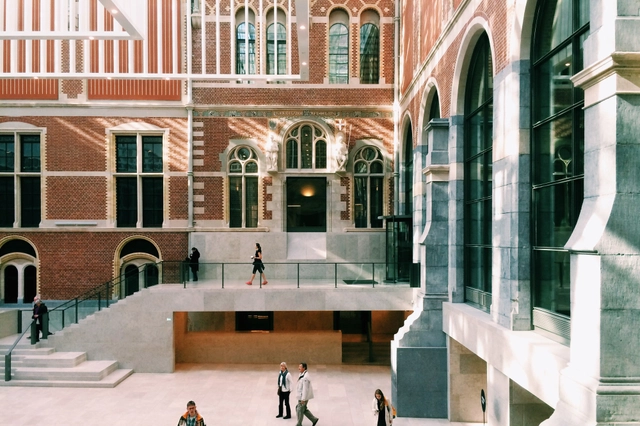
The Rijksmuseum, which reopened last year after a decade of restoration and remodelling, is a museum dedicated to “the Dutchness of Dutchness.” Pierre Cuypers, the building's original architect, began designing this neogothic cathedral to Dutch art in 1876; it opened in 1885 and has stood guard over Amsterdam'sMuseumplein ever since.
Over the centuries, the building suffered a series of poorly executed 'improvements': intricately frescoed walls and ceilings were whitewashed; precious mosaics broken; decorative surfaces plastered over; and false, parasitic ceilings hung from the walls. Speaking in his office overlooking the Rijksmuseum’s monumental south west façade, Director of Collections Taco Dibbits noted how the most appalling damage was incurred during the mid-20th century: “everything had been done to hide the original building […but] Cruz y Ortiz [who won the competition to redesign the Rijks in 2003] embraced the existing architecture by going back to the original volumes of the spaces as much as possible.”
For Seville-based Cruz y Ortiz, choosing what to retain and what to restore, what to remodel and what to ignore were, at times, difficult to balance. Cruz y Ortiz found their answer in the mantra: 'Continue with Cuypers'. They threw the original elements of the building into relief but did not act as aesthetes for the 'ruin'. In contrast to David Chipperfield and Julian Harrap's restoration of Berlin'sNeues Museum, for instance, Cruz y Ortiz rigorously implemented a clean visual approach that favoured clarity over confusion. What is original, what is restored, and what is new mingle together in a melting pot of solid, understated architectural elements. Sometimes this approach contradicted Cuyper's original intentions; however, more often than not it complements them in a contemporary way.
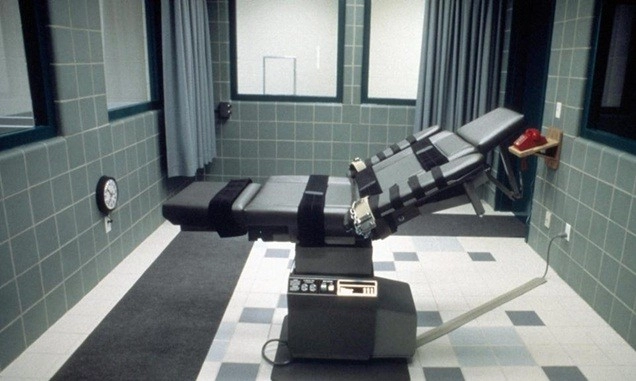
We think of architectural regulations as being there to ensure that buildings are safe for the public. But what if a building’s harm is not caused by unexpected structural failure but by the building performing exactly as intended? Can a building designed to facilitate human rights violations amount to a violation in itself? And what is the responsibility of the architects involved? These are the questions at the centre of the current debate in America around the architectural profession’s involvement in prison design.
Read on for more on the ethics of prison design after the break
In this article, originally appearing on the Australian Design Review as "Tolerance and Customisation: a Question of Value", Michael Parsons argues that the complex forms made possible by digital fabrication may soon be victims of their own popularity, losing their intrinsic value as they become more common and the skill required to make them decreases.
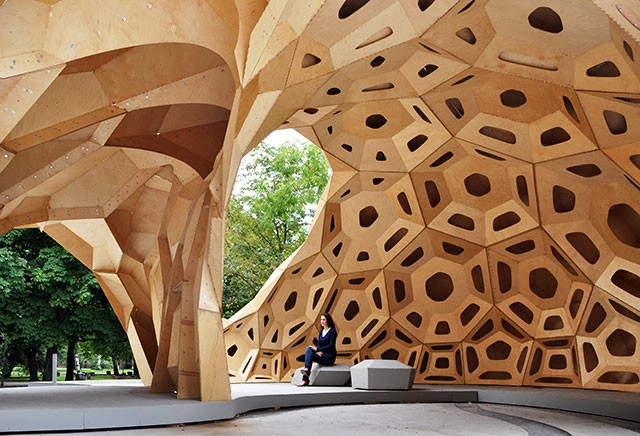
The idea of tolerance in architecture has become a popular point of discussion due to the recent mainstreaming of digital fabrication. The improvements in digital fabrication methods are allowing for two major advancements: firstly, the idea of reducing the tolerance required in construction to a minimum (and ultimately zero) and secondly, mass customisation as a physical reality. Digital fabrication has made the broad-brushstroke approach to fabrication tolerance obsolete and now allows for unique elements and tolerance specific to each element. The accuracy that digital fabrication affords the designer, allows for the creation of more complex forms with greater ease and control. So far, this has had great and far reaching implications for design.
Read on to find out how this ease of form-making could diminish the success of complex forms.
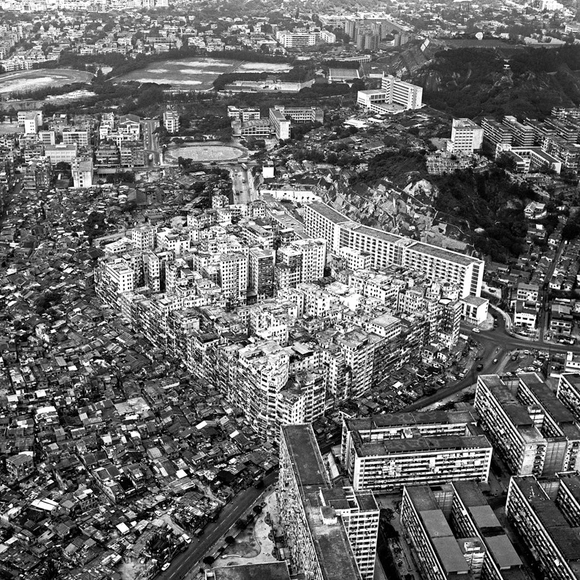
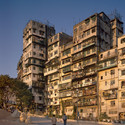
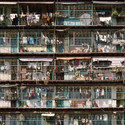
The early phases of the Walled City were characterised by predictable building typologies and the buildings were constructed on the principle of squatters’ rights, with random construction on spots of available land by whoever got there first. Alleyways and passages evolved – unplanned – into the established ‘map’ of the City, which would remain until it came down. A basic electric supply existed, increasingly burdened by illegal connections that frequently overloaded the system, and the few standpipes supplied the only water. As the need to accommodate the ever growing residential and commercial populations forced it to in the 1960s, the building typology of the Walled City made the leap from two- to three-storey residential structures to taller, six- to seven-storey ones. This represented an important threshold, because at these greater heights the buildings unavoidably became more complex and required greater labour to realise, reinforced concrete, more investment, and so on. They also required a different way of living. Water had to be transported up to the higher floors by hand. Likewise the propane gas canisters that furnished fuel to cook or heat water.
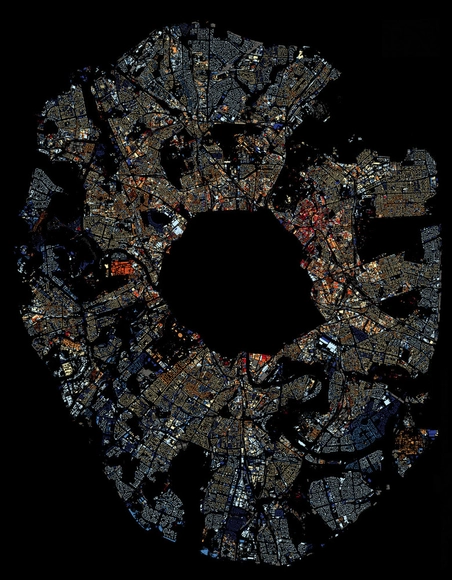
In Archaeology of the Periphery, a publication emerging out of the Moscow Urban Forum, a variety of specialists tackle the issue of a strategy for the development of Moscow's metropolitan area. As one of the best examples of urban concentric development, teams of engineers, architects, planners, economists and sociologists, studied the Russian metropolis with a pointed focus on the periphery—specifically the territory between the Third Ring Road and the Moscow Ring Road. Using an "archaeological" approach, the study reveals entrenched and hidden planning structures in order to increase the awareness and attractiveness of the periphery. Archaeology of the Periphery argues that examination of the city's fringe requires different methods of analysis than would be applied to traditional city centers.
"As the centre sets a certain quality of life and serves as a benchmark for the entire city, the high "gravitation" of the centre makes the signs of urban life invisible on the outskirts. Different optics are required in order to work with the non-central urban space. The tactic of "taking out" the centre and "sharpening the focus" on the peripheral territory will reveal what has been obscured and help identify the processes that take place, study potential, support or control the current forces at play.
The term "periphery," which is based on the opposition to a semantic centre is used in a wide range of scientific fields. The myriad of approaches underlines the ambiguity of the phenomenon and at the same time provides a base for an multidisciplinary research. This research was performed by experts in sociology (S), politics (P), architecture and urban planning (A), culture (C), economics (E) and big data (D). Methodology — SPACED — allows a broader view of the actual and potential intersections, going."
Dauphin Island, located off the coast of Alabama in the Gulf of Mexico, is known for experiencing perpetual and catastrophic hurricanes. When a storm hits the small island of around 1,200 people, it often washes away much of the coastline with it, leaving residents to rebuild their homes again and again following every big storm.
Artist Dionisio González became fascinated by this society's ability to endure creation and destruction in such rapid succession, willingly succumbing to the whims of nature's cycles time and time again. The artist, who has always held an interest in architecture, embarked on a mission to design surreal structures that would better suit the fraught island's populous, fusing fantasy with the inhabitants' inevitable reality.
More on González's surreal architectural images, after the break...
https://www.archdaily.com/494404/surreal-renderings-of-disaster-resistant-structuresPriscilla Frank



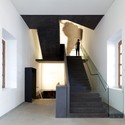


.jpg?1397700541 "Fife, Scotland, 2006 by Zaha Hadid Architects / © Werner Huthmacher. ImageAll sharp angles and painted a sinister black, Zaha Hadid's Fife center isn't the first thing you'd expect from a Maggie's Centre. The exterior invited comparisons to a bunker, despite the airy, humane spaces within. \"Zaha got a lot of criticism and her building is bloody good,\" Jencks says of his former student's design. The building was the architect's first in the UK.")