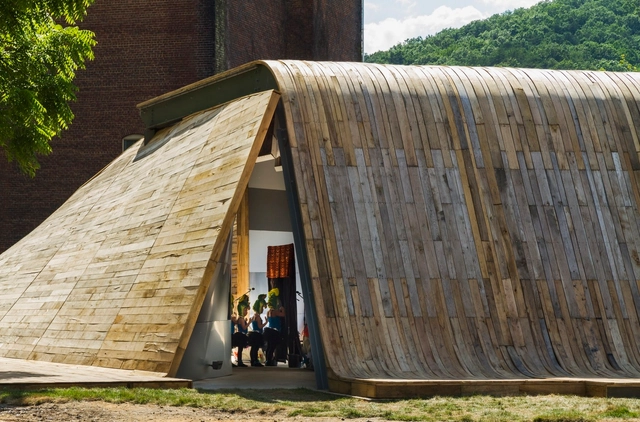
Even as technology advances—leaving many of the old ways of building obsolete—certain traditional crafts and building techniques continue to captivate our imaginations with their simple ingenuity and unimpeachable effectiveness. Although used for millennia, the process of temporarily turning rigid members of wood into pliable, twistable, bendable noodles of lumber remains a favorite woodworker’s trick, capable of producing whimsical transformations and otherworldly forms from the most natural of materials.
Artfully dancing together to the beat of their own drum, the familiar look of the New York skyline has now been broken up by an eye-catching pair of skyscrapers on the banks of the East River. The dual copper-clad residential towers are reminiscent of a couple dancing, leaning back slightly and linked together by a bridge with a metallic reflecting finish half-way up the tower. The glass for the 100-meter-high skybridge for this extraordinary project was created by the Swiss specialists Glas Trösch which developed a complex, double-insulating glass with an internally laminated, metallic web to give a glossy finish.
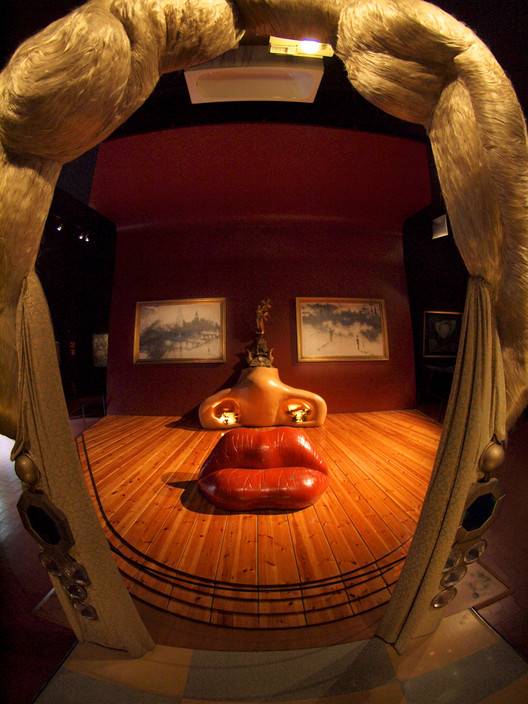
In 1924 writer André Breton penned the Surrealist Manifesto, which called to destabilize the divides between dreams and reality, between objectivity and subjectivity. For many architects who had been—and continue to be—interested in the fundamental role of the built environment, Breton’s surrealist thinking provided a rich resource to examine the role architecture plays in forming reality. Since then, from Salvador Dali and Frederick Kiesler to Frank Gehry, Surrealism has profoundly shaped architecture in the 20th century.
In the ambit of architecture, much of the twentieth century is marked by a production that reads, in general, as modern. The foundations of this work have been the subject of discussion for at least six decades, bringing together conflicting opinions about the true intention behind the modern gestalt.
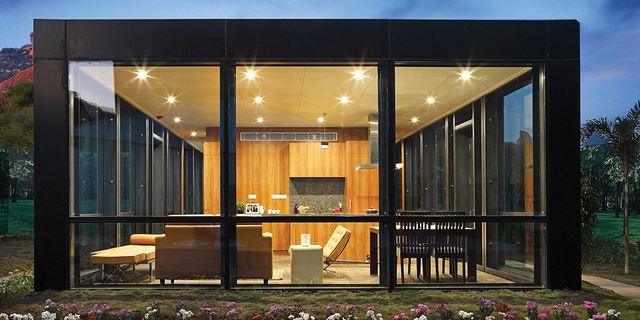
At KEF Infra One—a prefabrication plant outside of Krishnagiri, India—houses, cafeterias, and hospitals roll off an assembly line, as do the premade doors, windows, bathroom fixtures, and furniture to be installed within them. It’s a one-stop shop that makes building a house as easy as buying the food, dishes, and cookware for a family dinner in one fell swoop at Target.
The demands on infrastructure in India are huge. Given the country’s decentralization and its building trades’ reliance on manual labor, this level of modular building integration has been a far-off dream across all sectors. KEF Infra says it’s the only such facility in the world, integrating design, engineering, and fabrication to assemble building kits that provide far more than four walls and a roof, right out of the box.
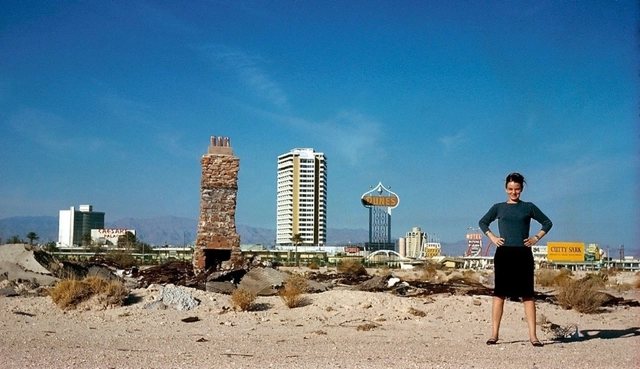
There’s something irresistible about Robert Venturi and Denise Scott Brown’s architectural romance. They met when they were both young professors at the University of Pennsylvania; Scott Brown held seminars in city planning, and Venturi gave lectures in architectural theory. As the story goes, Scott Brown argued in her first faculty meeting that Frank Furness’ masterful Venetian gothic library should not be torn down to build a plaza (then a dissenting opinion). Venturi approached her after the meeting, offering his support. As Paul Goldberger wrote of the couple in 1971, “as their esthetic viewpoints grew closer and closer, so did their feelings toward each other.” Architecture lovers can’t help but love the architect-lovers.
YACademy launches Architecture for Exhibition, a high-level training course offering 8 scholarships and internships in internationally-renowned architectural firms.
Architects are always trying to be more efficient and adding more value for clients. But with most software, rendering is very time-consuming, impairing efficiency significantly. It is exhausting for designers when the process of visual processing uses energy that would be better invested in design and architecture itself.
With the Enscape plugin, real-time rendering and virtual reality can help to remedy this situation. The plugin integrates as a toolbar in the popular design platforms Rhino, Revit and SketchUp, with a version for Archicad also currently in development. Because the software is a plugin for these popular programs, architects do not need to learn to use new software, but work in their familiar system with some additional features. And since the software runs on the local graphics card, projects do not have to be uploaded to the cloud.
If you’re reading this post then it's likely that you are either an architect, or you’re dating one. If you belong to the former group, we salute you and all your hard work. But if you belong to the latter, this list might serve as a reminder of how lucky you are to be with somebody with the unique talents and traits of the architect—and that's not to mention the obvious fact that you could end up living in a beautiful house with the most beautiful furniture.
A decade ago, a wave of striking architecture invaded major Chinese cities as the country prepared for the 2008 Beijing Olympics and 2010 Shanghai World Expo. Internationally renowned architects proposed and developed over-the-top structures, which soon became new symbols of the country. These iconic buildings helped mark Beijing and Shanghai as the major entry points to China, but as time progressed, the phenomenon spread to other, lesser-known Chinese cities. As these "second tier" cities thrived, their governments wanted to improve living standards and develop their own trademark, resulting in new theaters, stadiums, schools, and office towers.
Having focused on Beijing and Shanghai in his first series of photographs, Kris Provoost has continued his "Beautified China" series with a deeper look at buildings in 12 Chinese cities throughout the country, from Harbin to Hong Kong. The project continues under the same premise: 20 minimalist photos taken over the past 8 years of striking architecture built in the last decade.
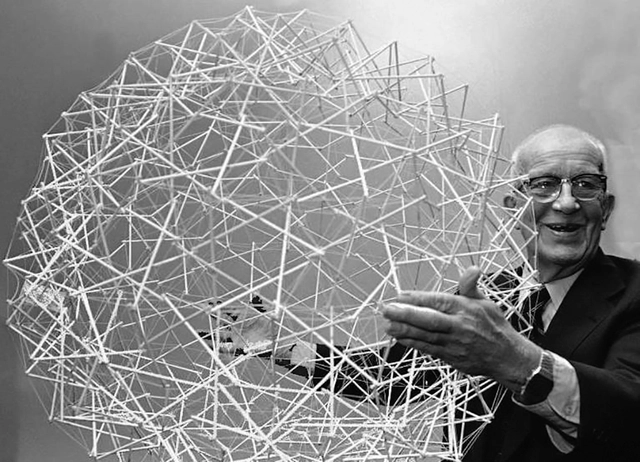
Through his extensive research, inventions and structural experiments, Buckminster Fuller created the term tensegrity to describe "self-tensioning structures composed of rigid structures and cables, with forces of traction and compression, which form an integrated whole" [1]. In other words, tensegrity is the property demonstrated by a system that employs cables (traction) and rigidity of other elements (usually steel, wood or bamboo) capable of acting under the intrinsic stresses (traction and compression) together and simultaneously, giving greater resistance and formal stability. It creates an interconnected structure that works biologically like muscles and bones, where one element strengthens the other.
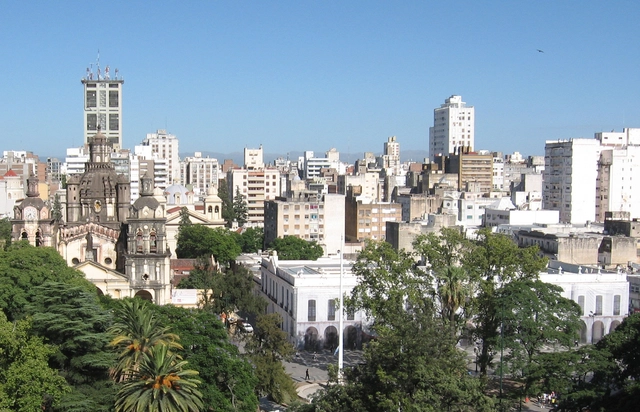
Located in the central region of Argentina, the historic city of Córdoba is the second most populated city in the country; which means it can be considered an important center for culture, education, and finance. Its dense historic center is characterized by the presence of brick -a product of the work of Togo Díaz- and the particular landscape that links the urban with the natural, resulting in an exclusive atmosphere that invites us to walk its streets.
The characteristic culture of Córdoba is evident in its urban public spaces, its natural streams and its pedestrian areas; where one can appreciate the heterogeneity of classical, modern and contemporary architecture. Below is a list of 15 sites that every architect should visit.
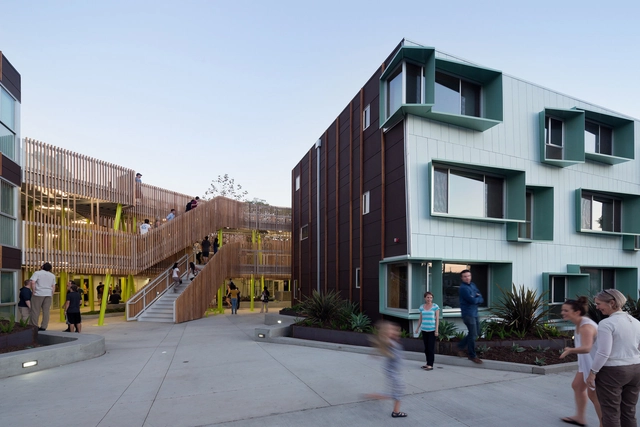
When we think of public housing architecture in the United States, we often think of boxes: big, brick buildings without much aesthetic character. But the implications of standardized, florescent-lit high-rises can be far more than aesthetic for the people who live there. Geographer Rashad Shabazz, for one, recalls in his book Spatializing Blackness how the housing project in Chicago where he grew up—replete with chain link fencing, video surveillance, and metal detectors—felt more like a prison than a home. Accounts of isolation, confinement, and poor maintenance are echoed by public housing residents nationwide.
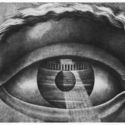
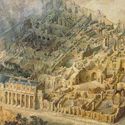
Throughout history, architects have used sketches and paintings to display to their clients the potential outcomes of the projects rattling around their minds. Since Brunelleschi’s adoption of drawn perspective in 1415, architectural visualizations have painted hyper-realistic imaginings of an ideal, where the walls are always clean, the light always shines in the most perfect way, and the inhabitants are always happy.
With technological advances in 3D modeling and digital rendering, this ability to sell an idea through a snapshot of the perfect architectural experience has become almost unrestricted. Many have criticized the dangers of unrealistic renderings that exceed reality and how they can create the illusion of a perfect project when, in fact, it is far from being resolved. However, this is only the natural next step in a history of fantastical representations, where the render becomes a piece of art itself.
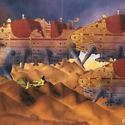
Below is a brief history of the interesting ways architects have chosen to depict their projects—from imagined time travel to the diagrammatic.
As part of our 2018 Venice Architecture Biennale coverage, we present the completed Argentinian Pavilion. Below, the curatorial team describes the exhibition in their own words.
Horizontal Vertigo, Argentinian Pavilion at the Venice Biennale 2018, delves into the notions of humanity and democratic spirit as proposed by Freespace, by establishing a cross-cutting dialog between geography, place, and architecture.
The exhibition, curated by the architects Javier Mendiondo, Pablo Anzilutti, Francisco Garrido and Federico Cairoli, is an invitation to rethink our territory as a collective construction and discover architecture in its capacity to convey unexpected generosity in every project.
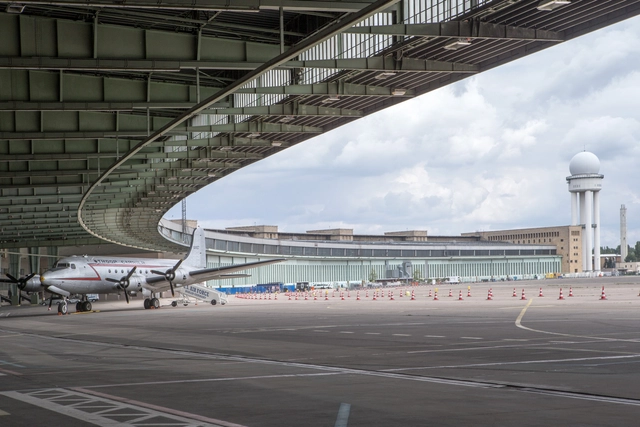
The story of Berlin’s Tempelhof Airport never quite ends.
Located just south of the city’s hip Kreuzberg neighborhood and only fifteen minutes by bike from the city center, the disused former Nazi complex—with its terminal, hangars, and massive airfield—occupies nearly 1,000 acres of prime real estate in the ever-growing German capital. In any other metropolis, this land would have been snatched up by a developer years ago, but in Berlin, creative reuse has prevailed over conventional narratives of redevelopment.
Architects from all over the world showcase their modern, innovative concepts with ceramic materials: nearly 600 projects from 44 countries had been submitted. The winners of the Wienerberger Brick Award 2018 impressed with bold and creative architectural concepts for sustainable and forward-looking living spaces.
The Wienerberger Brick Award provides architects from all over the world with an opportunity to showcase modern, innovative architecture with ceramic materials. It aims to inspire architects and people alike, to share design concepts and explore new ways of fulfilling built ideas. 2018 marks the eighth time that Wienerberger is presenting this internationally established award. Nearly 600 projects from 44 countries were submitted, this year with a particularly strong European focus.







_exhibition.jpg?1530836440&format=webp&width=640&height=580)



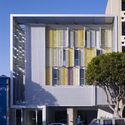
.jpg?1527852711 "The Navy Green development in Brooklyn was a key case study in the report. Here, the supportive housing from that development, designed by Architecture in Formation and Curtis + Ginsburg. Image © Tom Powel Imaging")
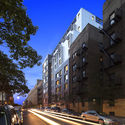
.jpg?1527852699 "The Tetris Apartments in Ljubljana, by OFIS Arhitekti, were identified by the report as a case study for their massing. Image Courtesy of OFIS Arhitekti")



.jpg?1527355326&format=webp&width=640&height=580)