

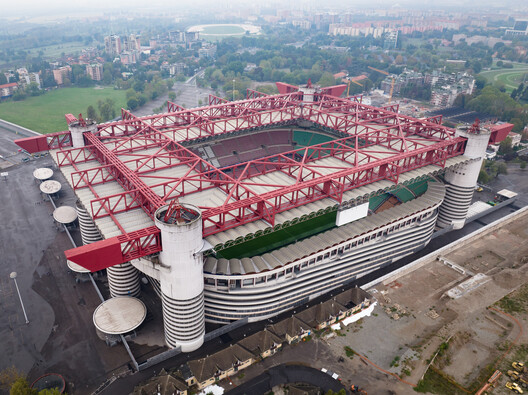
On September 30, 2025, AC Milan and Internazionale Milano football clubs announced that the Milan City Council had given preliminary approval for the sale of San Siro Stadium, officially named the Giuseppe Meazza Stadium, one of the city's most recognized sports venues. Located about six kilometers from central Milan, the stadium is among the largest in Europe and was spared from demolition in 2023 after the Regional Commission for the Cultural Heritage of Lombardy recognized its cultural significance.
According to the clubs' joint statement, the City Government's latest decision will enable the design of a new international-standard stadium alongside an urban regeneration project for the surrounding area, reportedly led by Foster + Partners and MANICA. The announcement comes only months before the Milano-Cortina 2026 Winter Olympics, an event that will initiate the farewell period for San Siro as an active venue.
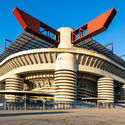
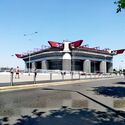
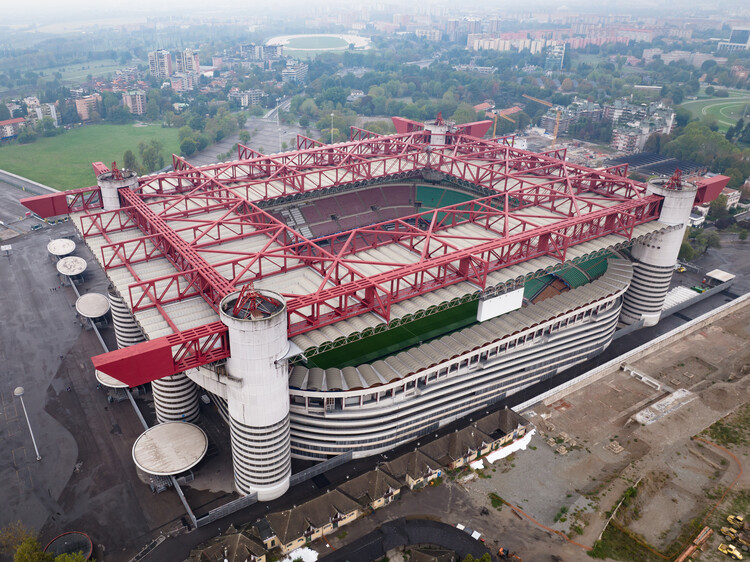

Originally inspired by English stadiums, San Siro was inaugurated on September 19, 1926. The original structure comprised four straight grandstands accommodating up to 35,000 spectators. Its capacity was expanded in 1935, when the City of Milan acquired the facility and added four connecting curves between the existing stands. In 1955, a new load-bearing structure increased capacity to 85,000 and introduced the helical ramps that reshaped its architectural identity. Since the 1970s, in addition to hosting matches for Milan and Inter, the stadium has also served as a major venue for national and international concerts. It meets UEFA Category 4 standards, the highest classification in European football. Structurally, the stadium relies on four corner towers and seven intermediate towers supporting prestressed concrete box beams that carry the bleachers. The corner towers extend beyond the seating tiers to reach the roof structure.
The City Council's approval of the stadium sale was welcomed by both clubs, who had previously stated they might relocate outside Milan if the plan were rejected. According to their statement, the decision "will lead to the creation of a new stadium meeting the highest international standards - a world-class facility destined to become a new architectural icon for Milan and a symbol of football passion worldwide." According to Euronews, around 90 percent of the existing stadium will be demolished, while a heritage section in the second tier is expected to be preserved. The sale includes both the stadium and adjacent land, as part of an urban regeneration project covering approximately 281,000 square meters near Milan's city center. Discussions about redeveloping the site date back to 2019, including alternative proposals such as Populous's project announced in 2021 and the International Forest Stadium by Stefano Boeri Architetti, ARUP, Fabio Novembre, and Balich Wonder Studio in 2022.


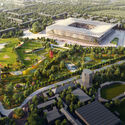
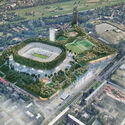
Foster + Partners and MANICA, an architectural firm specializing in large-scale sports and entertainment venues, are expected to present a design for a 71,500-seat stadium to be built next to the current site. According to Domus, the new design will feature two large rings with optimized sightlines for spectators. Milan and Inter plan to submit the urban development plan to the City of Milan during the first half of 2026, while San Siro will continue to host matches until the new facility is completed. The clubs intend for the new stadium to be ready ahead of the 2032 European Championship, which Italy will co-host with Turkey. However, as reported by Reuters, plans to demolish San Siro and replace it with a new facility have faced opposition from political figures, local residents, and heritage groups seeking to preserve one of Italian football's most iconic venues.

Recent announcements from Foster + Partners include a new timber residential project in Gstaad, Switzerland; the proposed IOTA Seoul I mixed-use development in Seoul, South Korea; and a retail plaza on the northern bank of the Golden Horn in Istanbul, Türkiye. Among the firm's recent sports-related projects are the modernization of Manchester United's first-team building at the Carrington Training Complex, and its appointment earlier this year to develop a master plan for the Old Trafford Stadium District. The latter project envisions a new stadium that would become the largest football venue in the United Kingdom, with a capacity of 100,000 seats.


