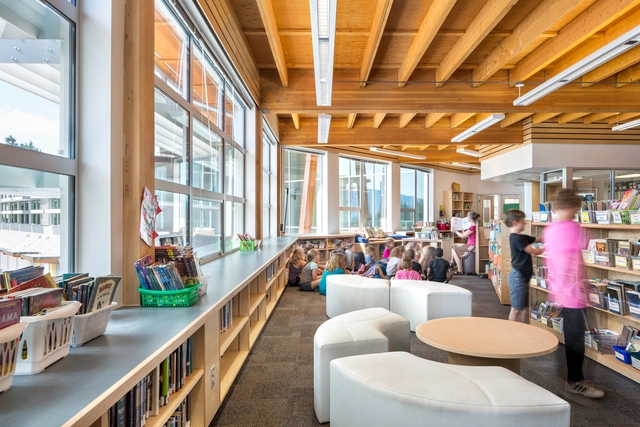
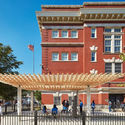
Gibsons Elementary, Gibsons, BC. KMBR Architects Planners Inc. Photo credit: Ed White Photographics. Image Courtesy of naturallywood.com
How does school design influence the process of teaching and learning? Understanding current educational design trends and methodologies is key to designing healthy spaces for students to develop their social and academic capacities.
If we look at the evolution of school design through time, we can see that each period has its own challenges and preferences. Today's main challenge in school design is to create spaces that can integrate open learning environments that incorporate diversity of learning spaces, social interaction and sustainability.
The architecture industry seems to constantly be on the lookout for new materials and methodologies that better incorporate sustainability. One material which has stood the test of time, while also finding space for innovation, is wood. In this context, British Columbia (Canada) stands out as one of the world's largest exporters of wood products, and has successfully applied a number of strategies to maximize its use in sustainable design. One notable example, which will be explored in this article, is the use of wood in schools.
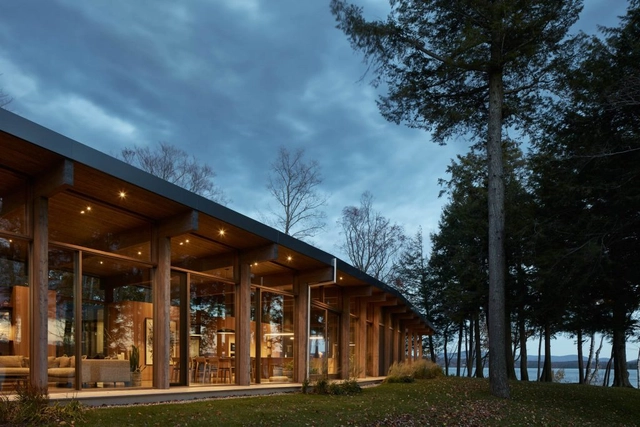
Lac-Brome House - Art Massif Glulam Wood Structure. Image Courtesy of Carbon Fixers
Timber construction and its benefits is moving into the BIM space for even more sustainable uses. A new BIM-integrated web application, called Carbon Fixers (which expands on its Offsite Wood plug-in for Revit), pre-calculates the carbon-benefit of choosing timber and other bio-sourced materials in early design.
Carbon Fixers lets you rapidly build a scenario using only basic architectural program information, such as the type, size, and number of stories in the building. For advanced users, preferences can be saved for firms with a regional expert dashboard, side-by-side comparisons and detailed assemblies.
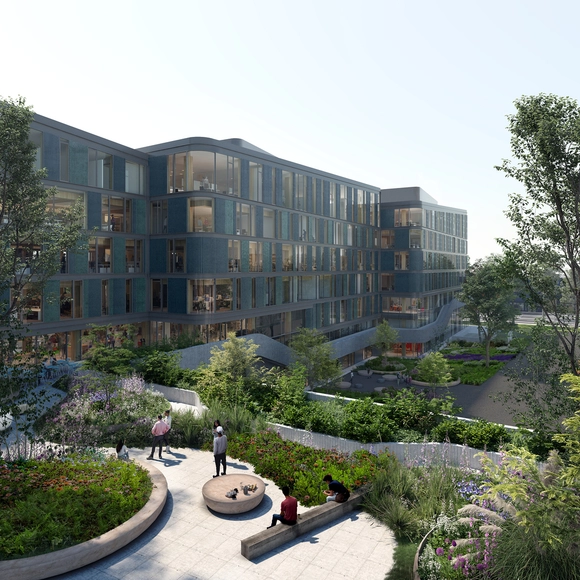
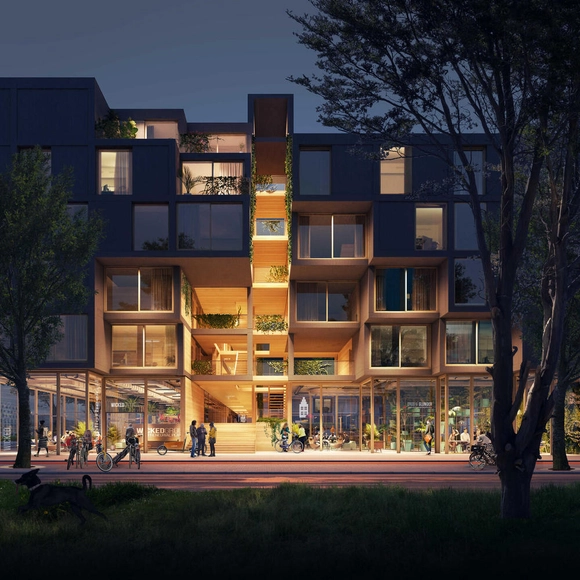
HA-HA, in partnership with BIK Bouw and Wooncompas Housing, will develop four social housing blocks for the community of Ridderkerk, near Rotterdam, Netherlands. The project uses materials from the existing social housing estate, built in the 1950s, and employs an innovative modular-timber system to create sustainable human-centered housing. The old buildings are planned to be disassembled and their components reused and integrated into the new development, which will increase the number of affordable units by 13%.
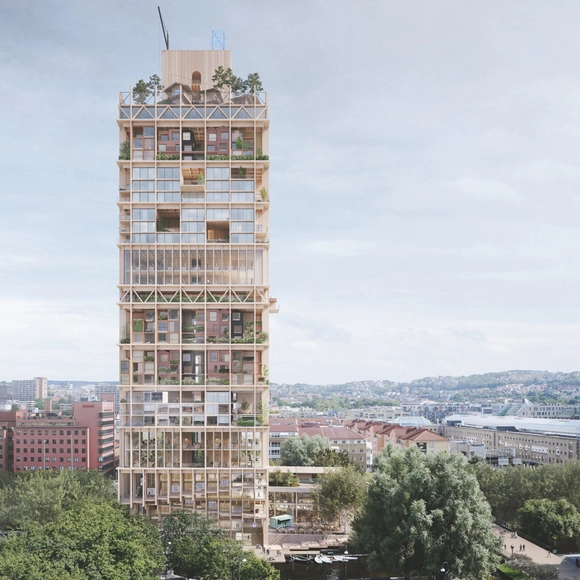
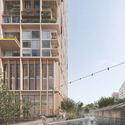
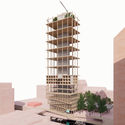
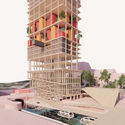
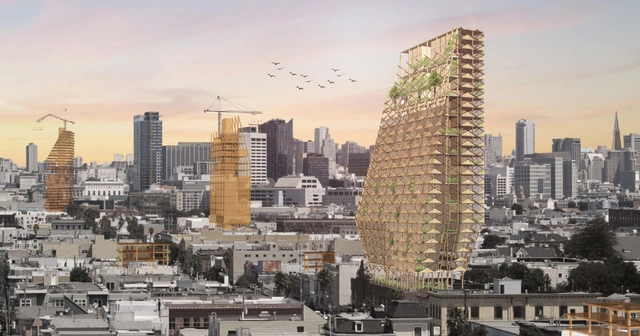
Haptic and Ramboll conceptualize a novel structure that hopes to eradicate the need for demolition. The timber high-rise construction is built for maximum flexibility and longevity, being able to change its configuration and, consequently, its functions to adapt to the city’s changing needs. The design concept is based on the idea of maximizing the potential of sites in inner-city neighborhoods. To exemplify the regenerative potential of this model, the architects have applied the concept to a tight urban area in the center of Oslo, Norway.
Henning Larsen Reims School. Image Courtesy of Henning Larsen
Henning Larsen has been selected among 40 international architecture firms to design NEOMA’s new French Business School, in Reims, France. The Danish firm's hybrid timber design combines innovation, environmental consciousness, and a focus on student life, setting to accommodate over 4,000 students across a 26,000 sqm campus. Construction is expected to start in spring of 2023, and is scheduled to be open for the start of the 2025 academic year. Along with Henning Larsen, the winning team includes Patriarche, Egis, Elioth, Etamine, Acoustb, and Creafactory.
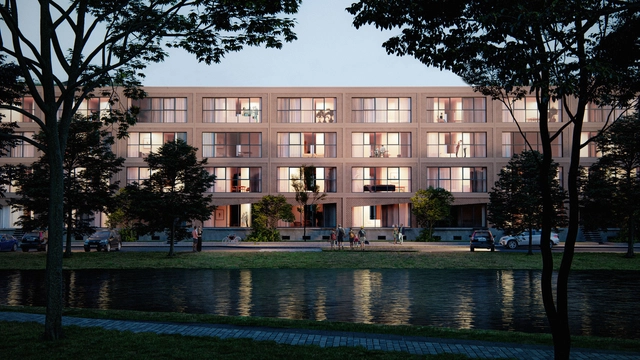
The first wooden housing modules of Juf Nienke, a new circular prefabricated timber housing project by SeARCH, RAU, and DS landscape architects, has been installed in Amsterdam. The project will feature 61 rental homes made entirely of wood, and will sit at the entrance of Centrumeiland, a newly raised piece of land on Lake IJmeer that features 1500 housing units. It is set to be one of the most sustainable apartment buildings in the Netherlands, incorporating an innovative cross-laminated timber construction and utilizing recycled materials.
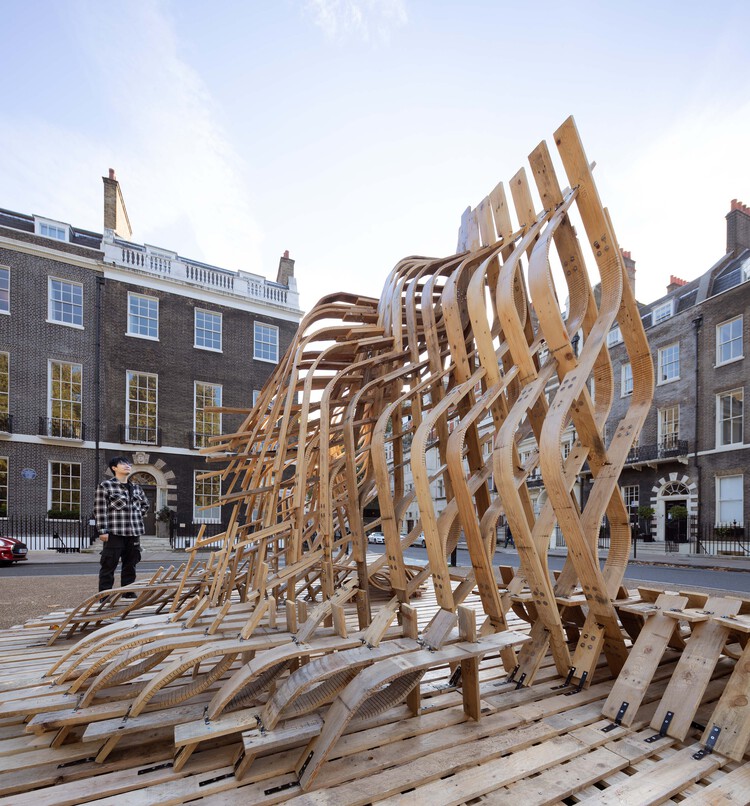
In collaboration with architecture practice Hassell, Architectural Association's Association's Emergent Technologies and Design (EmTech) programme created a reclaimed wood pavilion, exploring the convergence of computational design, new construction technologies, and material reuse. Titled Re-Emerge, the project addresses the issue of limited material resources, exploring the architectural potential of material recycling in the context of generative design.
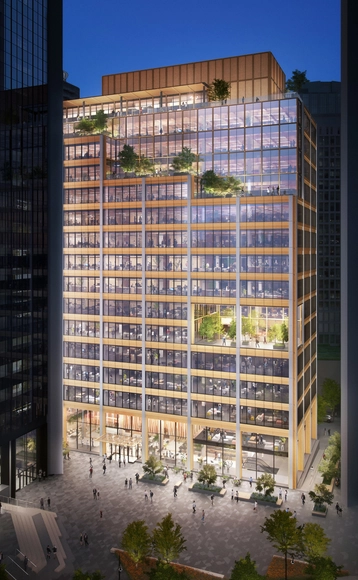
Kohn Pedersen Fox Associates has released images of its latest project, the Burrard Exchange, a hybrid mass timber office building at the Bentall Centre in Vancouver, Canada. The structure will be the first timber project designed by the architecture firm and is set to be one of the tallest of its type in North America.
Skidmore, Owings & Merrill (SOM) has collaborated with University of Michigan Taubman College to create the SPLAM [SPatial LAMinated timber], a robotically-fabricated timber pavilion for the 2021 Chicago Architecture Biennial. The pavilion employs prefabricated framing panels manufactured using robotic technology, and will serve as an open-air education facility and gathering space for a school in Chicago. The pavilion was inaugurated on September 17, with the opening of the Chicago Biennial, and will remain on display until December 18th.
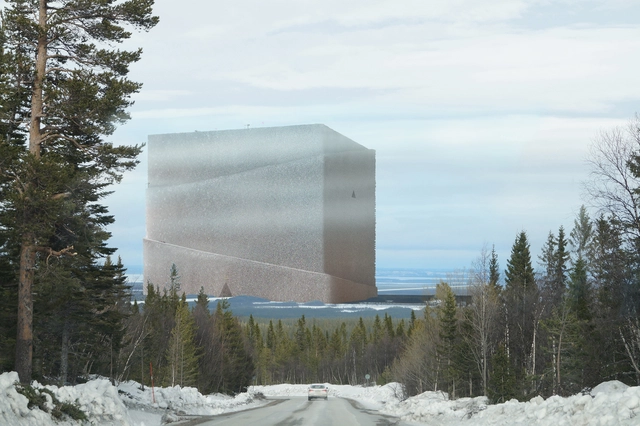
To reduce the “green” half of Sweden’s carbon emissions caused by the forest industries, Anders Berensson Architects have proposed to build the worlds largest timber structure titled the Bank of Norrland. The design aims to store carbon dioxide and a year's worth of timber production, ensuring the continuity of the Swedish construction and manufacturing industries regardless of weather and consumption.
The potential for mass timber to become the dominant material of future sustainable cities has also gained traction in the United States throughout 2018. Evolving codes and the increasing availability of mass timber is inspiring firms, universities, and state legislators to research and invest in ambitious projects across the country.
https://www.archdaily.com/905601/4-projects-that-show-mass-timber-is-the-future-of-american-citiesNiall Patrick Walsh
Ronald McDonald House of British Columbia . Image Courtesy of reSITE
In a Design and the City episode - a podcast by reSITE on how to make cities more liveable - Vancouver-based architects Michael Green and Natalie Telewiak advocate for more sustainable building on Earth, with a special mention for one of their preferred materials - wood. The interview sees the two architects balance the benefits and disadvantages of mass timber construction, which they are a strong proponent of as evidenced by their project T3, a LEED Gold Certified, seven-story timber office building in Minneapolis, Minnesota.
Talking to the Louisiana Channel, iconic Japanese architect Kengo Kuma discusses the many influences that have shaped his work - and also delves into the impact that the ongoing pandemic has had on the architectural field. In the interview, Kuma describes how influential his early upbringing was to his architectural career. Growing up in a small wooden house in the 1950s - originally built in 1942, would go on to guide his architectural perchance of using wood in his projects. Kuma also mentions Japanese architect Kenzu Tange as a key inspiration and cites Tange's Yoyogi National Gymnasium - constructed for the 1964 Summer Olympics in Tokyo - as a project that would influence him towards an architectural career.
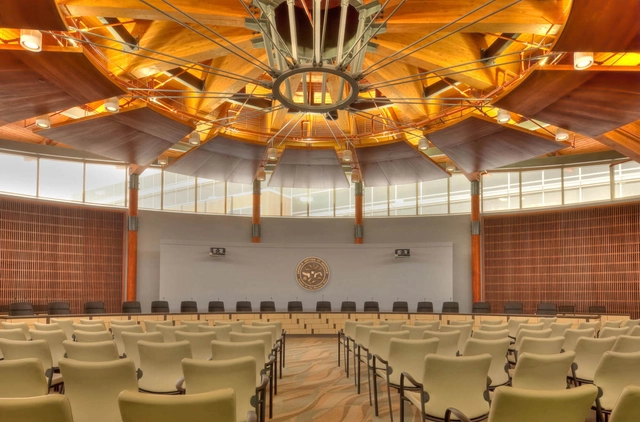
The rising popularity of mass timber products in Canada and the United States has led to a rediscovery of fundamentals among architects. Not least Indigenous architects, for whom engineered wood offers a pathway to recover and advance the building traditions of their ancestors. Because timber is both a natural, renewable resource and a source of forestry jobs, it aligns with Indigenous values of stewardship and community long obscured by the 20th century’s dominant construction practices.
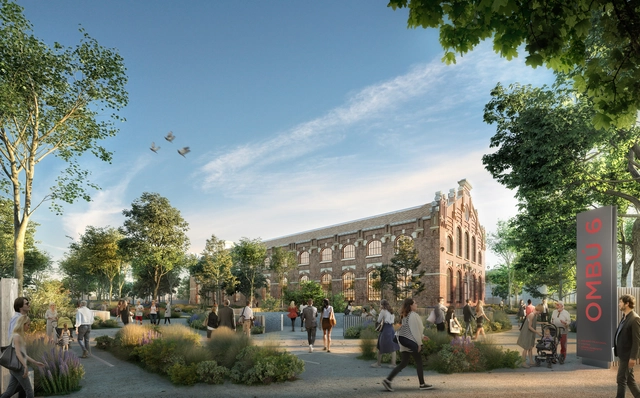
General view of the revitalised industrial building sitting in a landscaped garden. Image Courtesy of Foster + Partners
Foster + Partners is leading massive refurbishment works on a historic building in Madrid. The renovation project that will put in place an office building for Acciona, seeks to revitalize an abandoned old industrial building built in 1905, generating over 10,000 square-meters of new spaces.
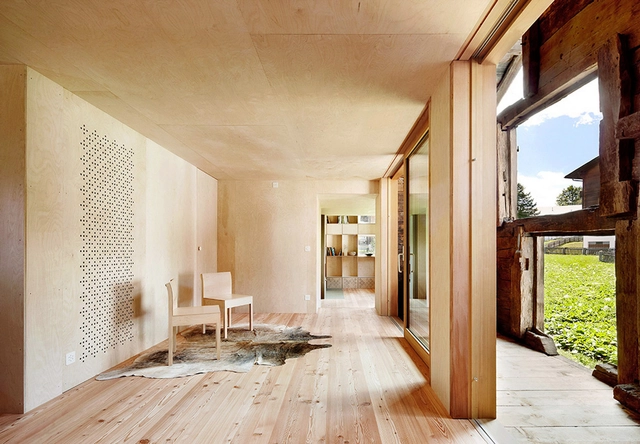
Since immemorial time, humans have constructed their shelter and homes using wood. Gradually these structures grew more complex, but wood has continued to play a fundamental role in architecture and construction. Today, especially due to growing concerns about climate change and carbon emissions, wood has been regaining significance as an important building material for the future, if used consciously and sustainably. Wood’s structural performance capabilities make it appropriate for a broad range of applications—from the light-duty repetitive framing common in low and mid-rise structures to the larger and heavier, often hybrid systems, used to build arenas, offices, universities and other buildings where long spans and tall walls are required.
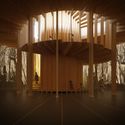
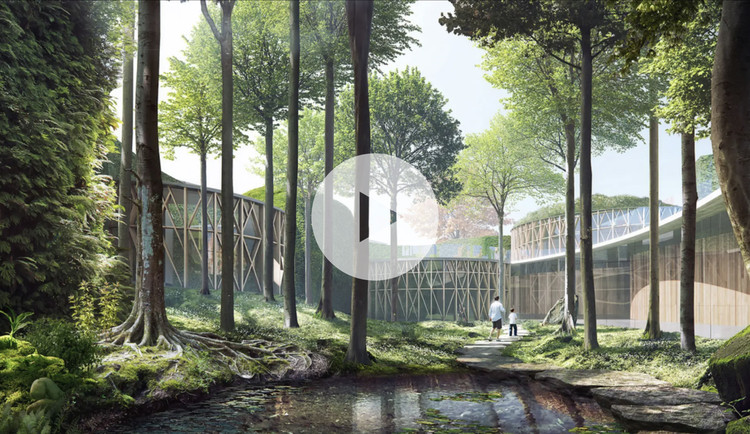
Stefano Boeri Interiors has unveiled images of his latest circular wooden installation, in an open-air setting of contemporary art. Entitled TREE-ROOM, the project in which “humans and living nature come together, between meditation and contemplation”, is designed for Arte Sella and is located in the garden of Villa Strobele in Val di Sella, in Northern Italy.
Team V Architectuur, an architecture office based in Amsterdam, is designing the new Dutch timber hybrid head office for DPG Media at the Amstel Business Park in the Netherlands. In collaboration with DELVA Landscape Architecture/ Urbanism for the landscape and outdoor space, the project will generate a 46.000 square meter of healthy and sustainable working environment.











.jpg?1632206620&format=webp&width=640&height=580)
.jpg?1632206607 "© Kendall McCaugherty © Hall+Merrick Photographers")
.jpg?1632206604 "© Kendall McCaugherty © Hall+Merrick Photographers")
.jpg?1632206620 "© Kendall McCaugherty © Hall+Merrick Photographers")
.jpg?1632206620)






.jpg?1603183617&format=webp&width=640&height=580)
.jpg?1603183812 "© Giacomo Bianchi")

.jpg?1603182934 "© Giacomo Bianchi")
.jpg?1603183917 "© Giacomo Bianchi")
.jpg?1603183617)