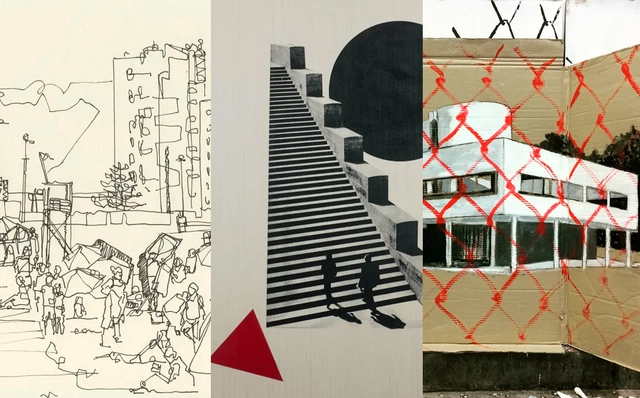
In March 2021, ACO and AIT-Dialog successfully launched a virtual tour through the seven continents of the world - inviting architects, urban planners, engineers and landscape architects to become part of "beyond.aco | architecture across continents". Now the journey continues: join them at their next live event on 15 November 2023 at 5 p.m. (CET) for a set of inspiring lectures. The focus is on responsible architecture in times of global change and climate challenges. Renowned architects and experts from different parts of the world will discuss various topics and examine the issue from ecological, social, societal and economic perspectives.
In the ever-evolving world of architectural visualization, Chaos Vantage is emerging as a valuable tool for architects, designers, and creative professionals who want to get a fresh, photorealistic perspective on their V-Ray projects in real-time. So, why should professionals consider exploring Chaos Vantage, in addition to the tools that already exist? This article will delve into its advantages, particularly in the realms of real-time, super-fast rendering, and photorealism.
Each architectural style intrinsically relates to a specific context, period, or place. An illustrative example is the region of the United States, which was strongly influenced by the period of British colonization in the Americas (17th-18th centuries). In this context, dwellings emerged that adopted a distinctive architectural language. Moreover, the large distances between major cities in many areas of the country had a significant impact on the configuration of domestic architecture, resulting in the inclusion of barns and other structures that served various functions in addition to housing. This architectural style is characterized by its rectangular floor plan, two-story structures, gable roofs, and wooden cladding on the facade. These elements constitute an integral part of the vernacular expression of the houses from that time.
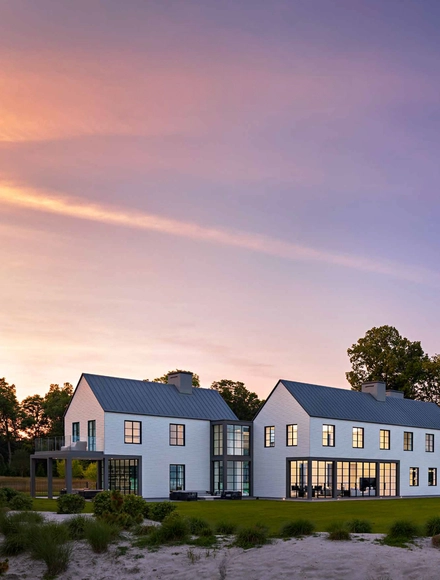
Speaking specifically of gable roofs, they are the feature most associated with the traditional aesthetic of dwellings developed between the 17th and 19th centuries, as well as later ones. One example is the Beachside House, which is a contemporary project documented in Swisspearl Architecture Magazine. This settlement is located on the shore of Long Island Sound, which divides Connecticut from Long Island, New York. With its four gable-roofed structures, covered with light-toned fiber cement panels, it seeks to be an abstraction of New England vernacular architecture.
https://www.archdaily.com/1008129/the-beachside-house-a-case-study-of-vernacular-inspired-architecture-using-modern-materialsEnrique Tovar
The IE School of Architecture and Design is back with its Business of Design Series, where design meets business. The lecture series will explore a dynamic set of themes closely aligned with the Master in Business for Architecture and Design (MBArch), which is structured to enable architects and designers to become better managers, business developers and entrepreneurs.
The ICONIC AWARDS 2023: Innovative Architecture –awarded by the German Design Council– honors the best achievements in architecture, pioneering interior and product design, outstanding brand communication and a particularly innovative use of materials in the architecture sector. The winners are examples of design excellence and inspiring solutions for current challenges. The international jury of experts emphasizes the importance of visionary design that is not only aesthetically inspiring but also ecologically and socially influential.
From 620 submissions from over 30 countries, the jury selected 62 pioneering projects for the “Best of Best” award. In addition, the special prizes “Architects of the Year”, “Interior Designer of the Year” as well as the honorary prize “Architects’ Client of the Year” were awarded. The award winners were honored at the BMW World in Munich on 4 October, 2023.
The small town of Illueca lies in a rift valley, flanked by the massifs of the Sierra de la Virgen and Sierra de la Camamila mountain ranges, which run close to the Moncayo Nature Reserve (Zaragoza, Spain). It is in this setting that Permán & Franco Architects Studio have built a primary-care health center, with a distinctive design and ventilated façade by Faveker.
The Illueca Health Centre stands in a new development area of the town, providing the region with healthcare services, including 11 nearby towns and villages. It was built on an almost 1,400 m2 plot of land featuring an over two-meter drop between the entrance at street level and the land used as a base for the building.
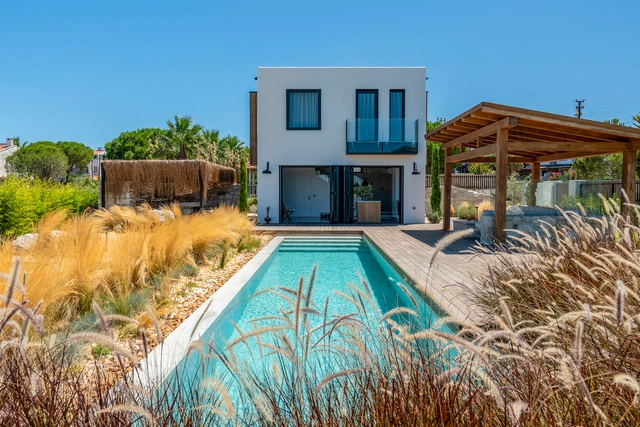
Archaeological findings suggest that the Great Bath of Mohenjo-Daro, the "oldest public water tank in the world," was constructed during the 3rd millennium BC. The significance of this impressive millennia-old structure is unknown, but it is generally believed to be linked to some form of purification ritual of the mysterious Harappan Civilization in the Indus Valley —the first civilization to develop urban planning. Indeed, throughout history, water has consistently captivated human fascination, from ancient ceremonial practices to the modern leisure and sports pools we see today. Whether situated indoors or outdoors, these structures represent a fusion of architectural design and landscape. However, it's no secret that establishing, operating, and maintaining pools involve substantial financial commitments. Every phase of the construction process, from the initial foundations to the meticulous steps of waterproofing, plastering, tiling, and the intricate installation of mechanical and electrical systems, requires significant investment and attention to detail. Therefore, the use of top-tier materials, cutting-edge technical equipment, and the highest level of skill is not merely advisable but absolutely essential.
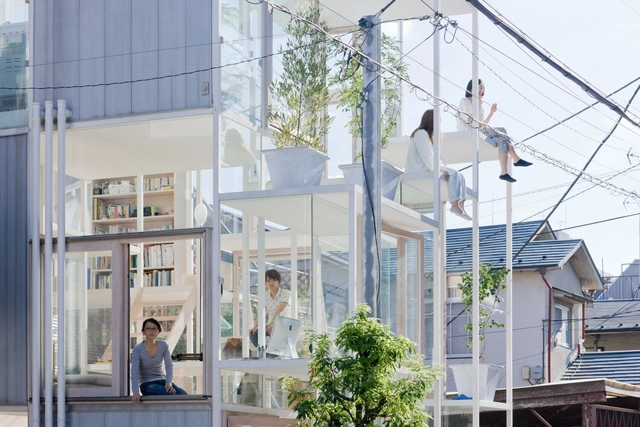
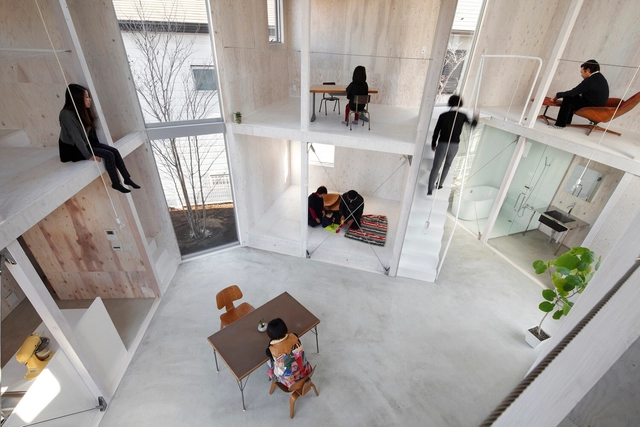
House in Kashiwa / Yamazaki Kentaro Design Workshop. Image Courtesy of Naoomi Kurozumi Architectural Photographic Office
Similar to a chameleon that changes color to blend in with its environment, architecture must constantly evolve and adapt to changing demands. A few decades ago, homes used to be associated solely with private life and rest, while workspaces were exclusively designed for just that: work. It was common for each use to be separated into its own room, making enclosed, rigid spaces the standard norm for architects to follow. That is, of course, until new living and working patterns blurred these boundaries to respond to contemporary trends.
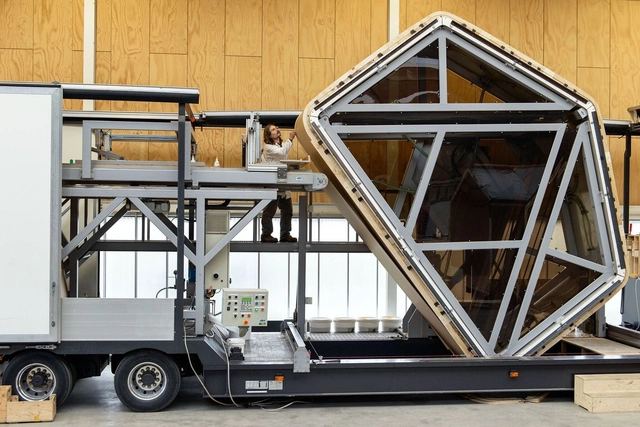
Modular Eco-Housing . Image Cortesia de Yvonne Witte
When we talk about technology, we often think of robots, supercomputers, data centers or smartphones. But technology also refers to the invention of the first chipped stone tools or the development of the steam engine, which brought about the first Industrial Revolution. The term comes from the combination of the Greek words techne (art, craft) and logos (word, speech) and is nothing more than the application of knowledge to achieve goals in a specific and reproducible way, for practical purposes. In the construction industry, which moves large amounts of resources and people, more technology means incorporating new methods, tools, automation and software that can improve efficiency. As a historically innovation-resistant industry, the construction sector has a huge impact on the environment due to its carbon emissions and exploitation of raw materials. However, as it turns to the digital world, builders have seen technology as a means to optimize practices and identify, build, and manage their projects.
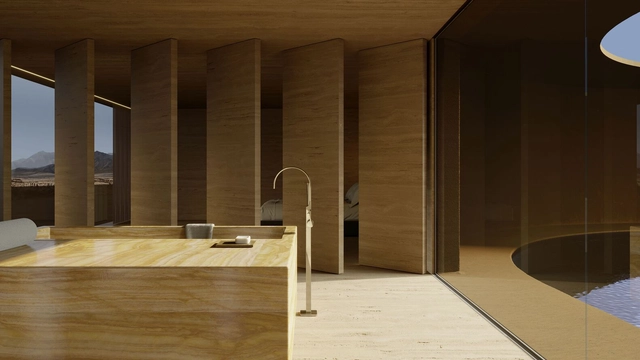
Inspiring applications of the MEM collection in architectural settings inspired by AI. Image Courtesy of Dornbracht
In addition to contributing to the functionality of the space, bathroom fittings underlie the overall aesthetics of a chosen design style. Within their technical features –as well as the possible materials, finishes, and styles–, fittings play a role in both the visual appeal of a space, while also focusing on comfort and user experience. This is part of Dornbracht's continuous re-imagination of bathrooms as living spaces, in which the brand seeks to create innovative solutions based on proportion, precision, progressiveness, performance, and personality.
Among Dornbracht’s series, the MEM collection includes a complete selection of minimalist bathroom fittings for washstands, showers, and tubs. In collaboration with ethical design brand Nature Squared and Italian craft manufacturer Glass Design, the collection’s original design has been enriched with versatile new features for customizing bathrooms. These features are created through the combination of high-quality materials with sustainable craftsmanship and the incorporation of futuristic artistic crystal glass.
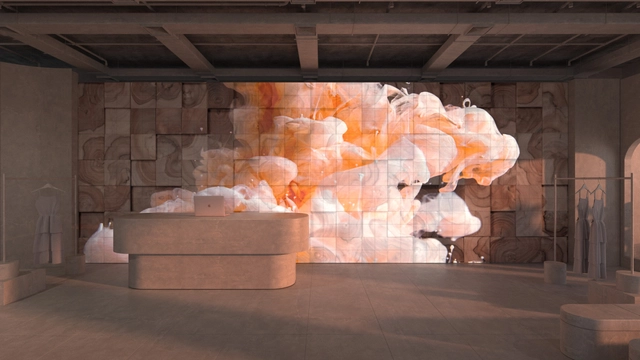
As the realm of interior design continues to evolve with new technologies, "living walls" have emerged as an innovative new concept. The new ArtMorph luminous wall panel is a one-of-a-kind product that deftly combines lighting and display technology with the added benefit of a unique texture selection. Its adaptability and customizable solutions allow it to blend into an array of environments, opening up possibilities for interiors that elevate visual storytelling, going beyond the constraints of traditional design.
Nowadays, the term “utopia” is used to describe an idea that seems unattainable —at least in the contemporary context— intrinsically related to philosophical, scientific, urbanistic, and architectural concepts, among others. The close connection between utopias and architecture is evident, as this discipline is often associated with imagination. Some notable examples include “The Unreliable Utopia of Auroville's Architecture” and “The City in Space: A Utopia”by Ricardo Bofill. In this context, architects and designers alike use design as a means to develop innovative and disruptive ideas through various elements.
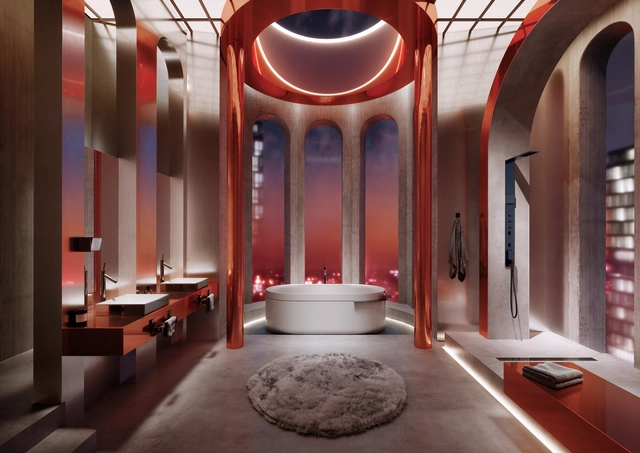
Although considered an idealized concept that does not exist, some designers have ventured into exploring the notion of utopia. AXOR, in conjunction with the Valencia-based design studio Masquespacio, has turned the page by conceiving and bringing to reality a new bathroom concept for a unique hotel suite that embodies their vision of personal luxury. Titled “Utopian Dream”, this design response blends vibrant colors with unexpected details, a combination that this duo defines as a mystic experience above the clouds.
https://www.archdaily.com/1007798/balancing-neoclassical-and-futuristic-design-the-utopian-dream-bathroom-conceptEnrique Tovar
Moving towards a sustainable future is a global challenge that involves all disciplines working together. According to the 2021 Global Status Report for Buildings and Construction, almost 40% of carbon emissions come from the construction industry. This places a heavy responsibility on the industry, which must be open to exploring innovative strategies, technologies, and materials in order to pave the road towards a universal sustainability goal: reaching carbon neutrality by no later than 2050.
With that in mind, this article presents three specific products and systems –low-carbon glass, low-carbon concrete, and lightweight materials– that architects are applying in their projects to contribute to a low-impact architectural design.
Good architectural design can encompass a myriad of aspects, but can be generally regarded as buildings/constructions that are planned, designed and devised to be functional, aesthetic and durable. They can often be timeless designs, made for the benefit of the people who will inhabit them, and demonstrate a multi-disciplinary approach to space and interaction design. This is the spirit of the A’ Design Award and their “Good Architectural Design” super-category, which seeks to reward the best in architecture and design around the world.
https://www.archdaily.com/1007767/a-good-architectural-design-20-exemplary-winners-from-the-2022-2023-cycleDaniela Porto
How can a building be more efficient? It is a concern that architects face on a daily basis, as they try to keep up with the demands of an industry that is increasingly aware of its environmental impact. Today more than ever, there is an effort to design buildings that integrate sustainability, efficiency and thermal comfort, which are fundamental pillars of a healthier built environment.
Having an effective solar control strategy is crucial to achieving a more efficient architecture. In addition to providing solar protection and economic savings, these strategies also carry benefits in terms of aesthetics, acoustics, thermal comfort, durability and maintenance.
Construction administration processes can pose significant challenges to project productivity. The processing of submittals and requests for information (RFIs—a necessary part of the project lifecycle) is a tedious and time-consuming task for most project teams. In the case of larger projects, teams can be flooded with thousands of submittals and hundreds of RFIs.
The AEC industry is moving at a lightning-quick pace, requiring architects and engineers to quickly process and resolve RFIs and submittals to maintain their tight deadlines and keep costs within budget, which poses an ever-present challenge for teams.
This year, the torch of the World Capital of Architecture passed from Rio de Janeiro to Copenhagen. For Audrey Azoulay, Director-General of UNESCO, “Copenhagen will build upon Rio’s achievements, by continuing to show the way in which architecture and culture can respond to the challenges of our time, especially in the environmental field.”
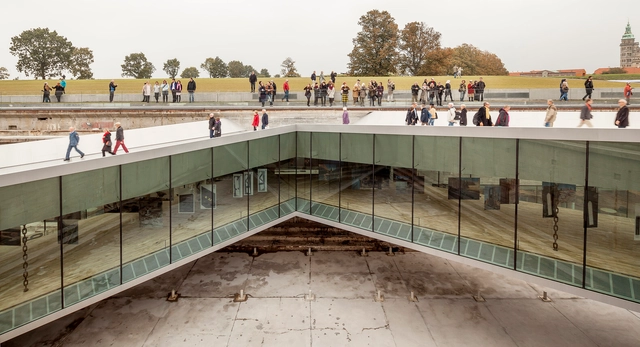
Through the perspectives of various Danish architects, such as Marie-Louise Høstbo, Head of Design at Fritz Hansen, we venture into the unique character of North Copenhagen. Exploring some of her favorite locations –all of which exemplify the city’s culture and sustainable approach– we analyze how Copenhagen upholds a strong legacy and how architecture and urban development play an essential role in shaping its urban identity, while promoting sustainability and liveability. From the serene coastal escape at Bellevue to the reimagined dry dock echoing the city’s maritime history, Høstbo showcases how the World Capital of Architecture seamlessly integrates “design, art, and architecture from the past, present, and future.”
Digitization has revolutionized the way we experience art on platforms like SINGULART, which combines multiple influences from various artists.. Image Courtesy of SINGULART
The relationship between art and architecture is a recurring topic of discussion, seeing as architecture can be positioned at the intersection of structure, technology, and aesthetics. Despite the utilization of technical knowledge, architecture, and interior design also incorporate artistic concepts into their processes. From captivating illustrations during the design development phase to murals and artistic pieces that form an integral part of spatial conception, art plays an essential role in architectural production and society.
In the context of contemporary society, many of our activities are carried out digitally, from booking accommodation for travel to manufacturing materials and creating art exhibitions. In this sense, digitalization has also permeated the art world, conceiving initiatives like SINGULART, which challenges the traditional concept of art galleries by existing in a digital format. This platform combines works from various sources of inspiration and artistic techniques, encompassing everything from sketches and paintings to architectural photography. It fuses multiple influences from various contexts, including architectural work.
https://www.archdaily.com/1006625/from-sketch-to-painting-a-digital-art-gallery-to-inspire-everyday-architectural-workEnrique Tovar