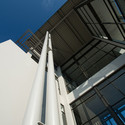
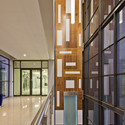
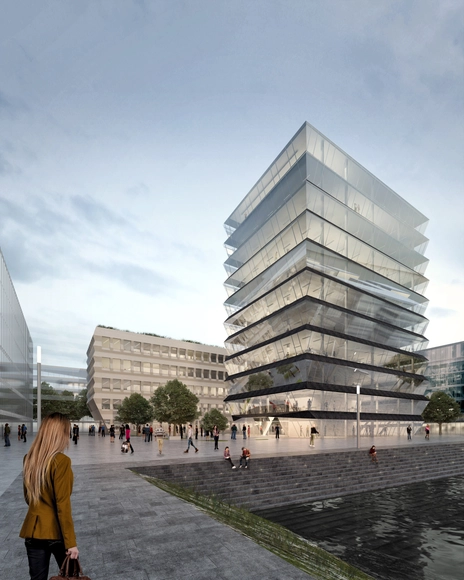
MVRDV, together with Munich-based morePlatz, have been selected among seven teams in an international competition to design two office buildings in Mainz, Germany. The five- and eleven-story “Hafenspitze” structures are expected to spearhead the transformation of the former Zollhafen industrial harbor, which plans to become a new mixed-use city quarter over the coming decades.
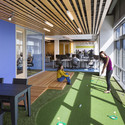
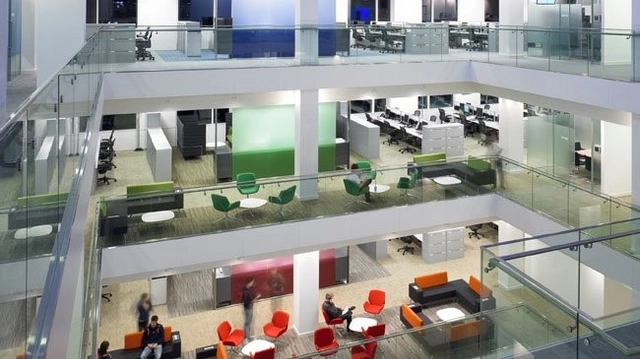
How much impact can the configuration of an office have? Microsoft, Thames Valley Park by Perkins+Will. Image Courtesy of David Churchill
We spend a lot of time and effort debating and researching how to design the perfect office - perhaps too much time, according to Rachel Casanova, a Principle and Director of Workplace at Perkins + Will. In this post, originally published by Metropolis Magazine as "When the Open Office Isn't Always the Problem or Solution", Casanova argues that we ought to be thinking about office design more holistically, taking into account not just the physical space of the office, but also how the client runs their workplace. At best, design can catalyse a more nurturing office environment, but for each company the way to achieve this may be different; there is no 'one-size-fits-all' office solution. Read on after the break to find out why.
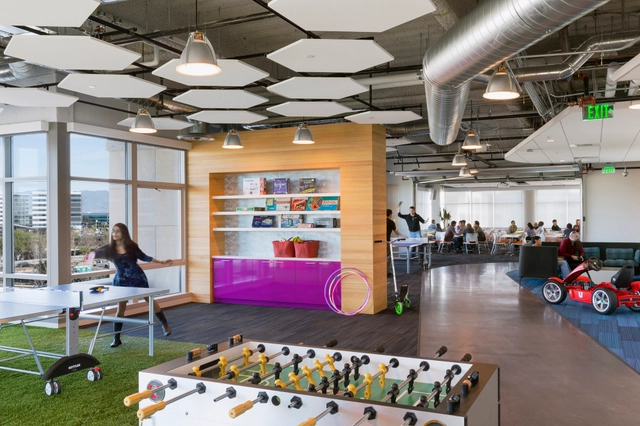
Of all the changes in architectural typologies in recent years, one of the most dramatic - and the most documented - is the transition from corporate to more casual, 'fun' office buildings. This change has infiltrated companies from tiny 5-person start-ups to Silicon Valley giants, and while it has been pioneered by tech and media companies it has certainly not been limited to them.
Most analysis of this change focuses on work patterns created by new technology or the demands of the 'millennial' worker, but this post originally published on Means the World - the blog of NBBJ - examines the shift away from the corporate office as a product of not just what these building are but what they represent about us as a society, arguing that "when today's workers look at the midcentury office, they see a symbol of exclusion."
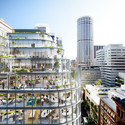
Amazon has confirmed plans to move more than 5,000 of its London employees into a Foster + Partners-designed office building planned for Shoreditch High Street. On hold since January 2012, the £290 million mixed-use scheme will compete with Amazon’s Farringdon office to serve as the online retailer’s new UK headquarters.
For many years, the world of office design remained relatively stagnant, with a light, open plan office floor and a generously-sized cubicle about as much as most employees could hope for. But recently all this has changed: the world of the technophilic, fun loving "Generation Y" has taken over, and with it come offices that mix the best elements of the traditional office with design culled from living rooms, coffee shops and children's playspaces. This will remain the future of office design for some time - or will it? According to Dr Michael O'Neill, senior research strategist at Haworth, the Gen-Y office's days are already numbered, as he explains in this article originally published by Metropolis Magazine. Read on after the break to find out why.
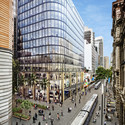
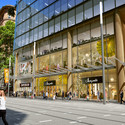
Sydney's historic George Street is about to receive a major facelift with the soon-to-be built 333 George Street, an 18 storey mixed use office and retail tower. Designed by Grimshaw Architects and executive architects Crone Partners for Australian property developer Charter Hall, the minimal glass and steel tower will contrast the historic structures on Sydney's well-preserved original high street, with a 15 storey 12,500 square metre contemporary office tower tower atop a three storey 2,100 square metre retail podium.
Read on after the break for more on Sydney's newest tower.
























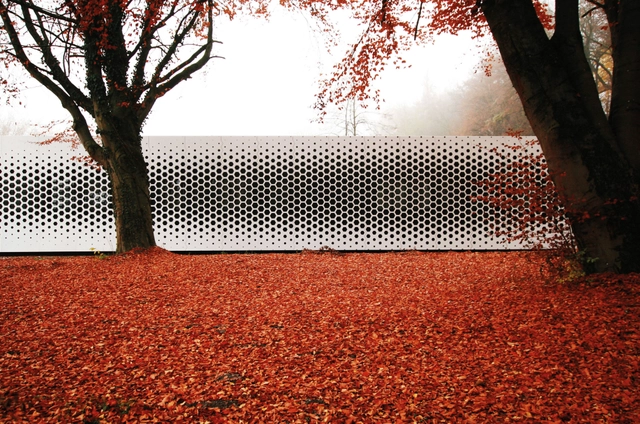
_HR.jpg?1409634359 "© Bettina Kirmeier")
_HR.jpg?1410200793 "Courtesy of Format Elf Architekten")
_HR.jpg?1410200759 "Courtesy of Format Elf Architekten")
_HR.jpg?1410200773 "Courtesy of Format Elf Architekten")