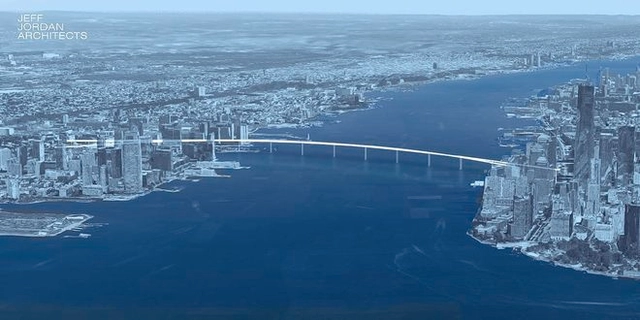
Courtesy of Jeff Jordan Architects, via http://libertybridgeorg.wix.com/libertybridge
Despite being separated by only a few miles, Manhattan and Jersey City seem much further apart; the Hudson River forces commuters to take long, roundabout routes or rely on the over-worked PATH system. Inspired by a need for connectivity between the two cities, Kevin Shane began conceptualizing a new pedestrian bridge, dubbed Liberty Bridge, which would connect Jersey City to Battery Park. Read more about this conceptual proposal after the break.
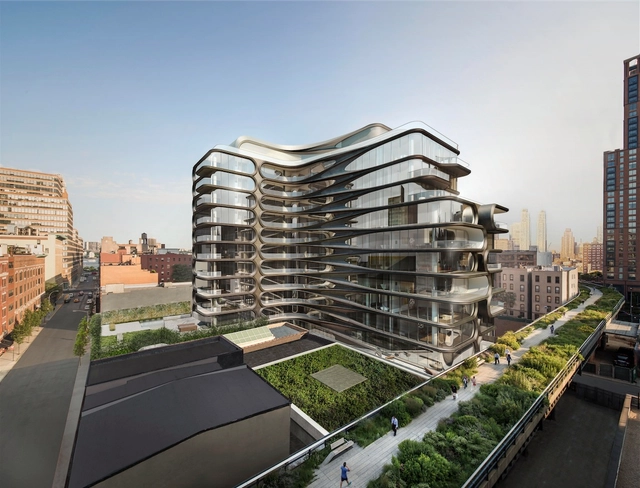
“I’ve always been fascinated by the High Line and its possibilities for the city. Decades ago, I used to visit the galleries in the area and consider how to build along the route. It's very exciting to be building there now,” said Zaha Hadid. “The design engages with the city while concepts of fluid spatial flow create a dynamic new living environment.”
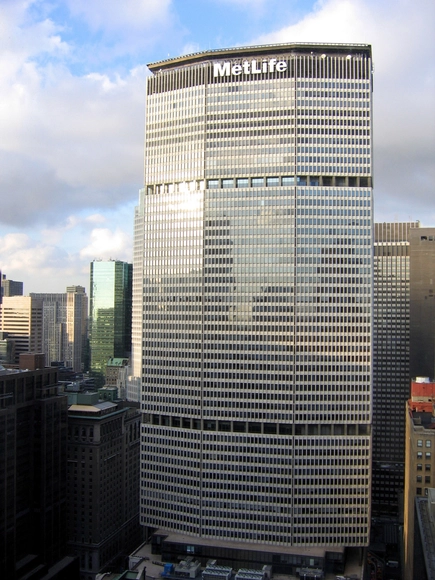
Metals in Construction magazine has launched a competition for architects, engineers, students, designers, and others from all over the world to submit their vision for recladding 200 Park Avenue, built a half-century ago as the world’s largest corporate structure, the Pan Am Building (now the MetLife Building).
The mandate is to reimagine this New York City icon with a resource-conserving, eco-friendly enclosure—one that creates a highly efficient envelope with the lightness and transparency sought by today’s office workforce while preserving and enhancing the aesthetic of its heritage. Entrants may now register on the competition's official website. The deadline for final submission is February 1, 2016.
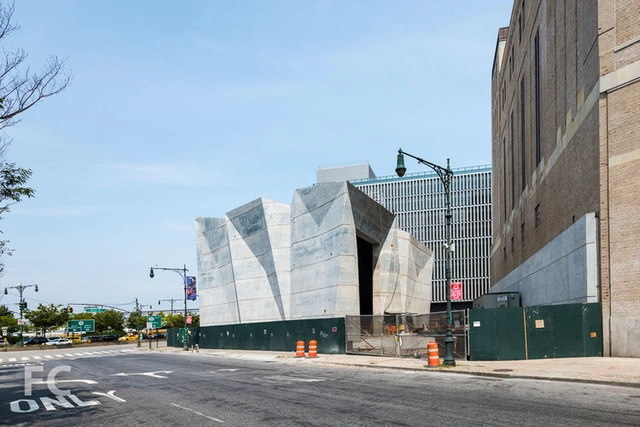
New York City is replacing one of its 40 salt sheds on the Gansevoort Peninsula with a new, origami-like structure by Dattner Architects at Canal St/West St, along the Hudson River. Once completed, the shed will rise almost 70 feet tall and hold over 4,000 tons of salt in its six-foot thick concrete walls. In response to the complaints leveled against the Sanitation Garage across Spring Street from the new salt shed, Dattner Architects deliberately created a monolithic, crystalline form to contrast the scrim-like façade of its neighbour.
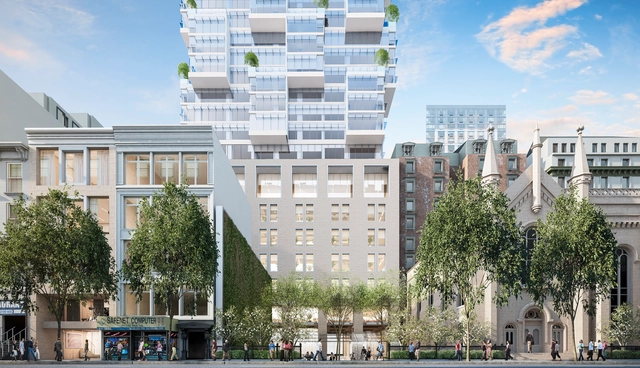
Images of Moshe Safdie's first New York project has been released. Planned to rise on a Manhattan site at West 30th Street, between Broadway and 5th Avenue, the 64-story mixed-use tower will feature a limestone base that compliments and serves its historic neighbor: the Marble Collegiate Church, one of the Collegiate Churches’ five ministries.
The building "will be distinguished by its vertical massing, which breaks down the scale of the tower into a series of three-story-high, offset projections," says Safdie Architects. "The offset projections also provide energy efficiency by self-shading the tower’s facade, further enhanced by additional sun shading at the south facade."
For the latest episode of The Urbanist, Monocle 24's weekly "guide to making better cities," the team explore the role of bilateral inspiration between metropolises across the world. Examples of cities relying on one another to draw lessons from and progress can be seen across the world: from the ways in which London and New York City tackle similar urban problems, to how a bike-sharing scheme in Paris has proven to be contagious. The show also visits Vienna, where its Imperial heritage is being imitated the world over, and the show ponders whether the fact that every continent "claiming to have its own Venice" is actually a good thing?
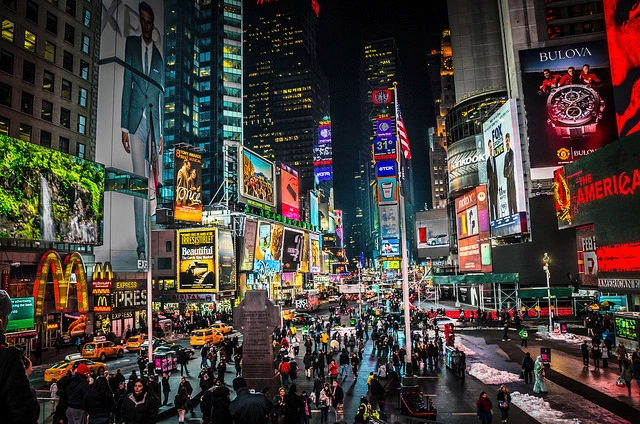
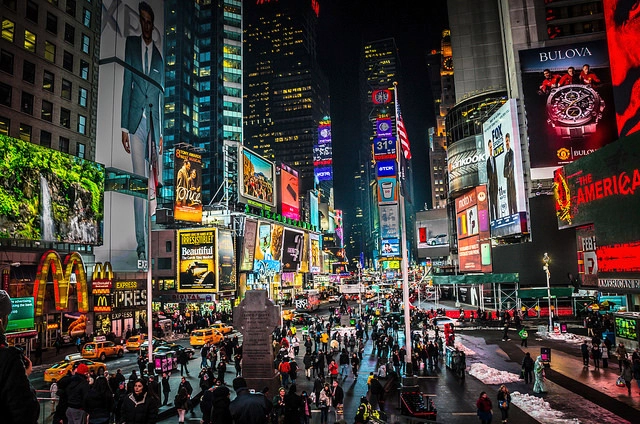
Danish architect and urban planning expert Jan Gehl has weighed in on New York Mayor Bill de Blasio's threat to remove Times Square as a"kneejerk reaction" to aggressive panhandling. Recounting beloved square's evolution, Gehl argues that public spaces need more than just to exist: "Civic culture needs cultivating and curating... Public spaces like Times Square are the great equalizer in cities: Improvements in the public realm benefit everyone. The city should view the challenge of Times Square’s pedestrian plaza not as a reason for retreat, but as a call to create a diverse, dense, intense experience of public life that we can all enjoy." Read Gehl's remarks, here.
ArchDaily is continuing our partnership with The Architectural Review, bringing you short introductions to the themes of the magazine’s monthly editions. In this introduction to the August 2015 issue, AR editor Christine Murray takes on the disheartening architectural scene in North American cities from New York to Toronto, arguing that "NYC is not where we found a new American architecture" and asking: "Why not give the young guns a tower or a Whitney, let them stretch their legs?"
The latest New York towers are more billboard than building. Like celebrity-endorsed perfume - fancy box, smelly water - the architecture matters less than the artist and his (yes, they are all men) pen’s effluent black-ink concept scrawl.
Please join us for the exhibition opening of Sea Level: Five Boroughs at Water's Edge, and a conversation with author and curator Robert Sullivan, and photographer Elizabeth Felicella. The two will engage in a wide-ranging discussion on the collaborative panorama exploring the past and future of New York City's expansive waterfront.
This day-long symposium, the first of its kind, will cover topics ranging from urban climatology to building materials, with case studies and recommendations for the future.
The threat of extreme heat will intensify. Even United States President Obama has told us that the planet’s temperature is rising and that we must come to grips with that inevitability. The last decade was the hottest on record worldwide, and large cities are warming faster than the planet. Scientists predict that extreme heat events – already more deadly than all other weather-related events combined – will become more frequent. Extreme heat reduces productivity, exhausts greenery, compromises infrastructure, destroys property, and strains the economy and resources alike.
The Japan Foundation, New York and The New School’s Parsons School of Design, Design Studies and Industrial Design programs present “Japanese Design Today: Unique, Evolving, Borderless ‐ with Hiroshi Kashiwagi and Yoshifumi Nakamura” on Tuesday, September 8, 2015 at 6:30 p.m. at The Bob and Sheila Hoerle Lecture Hall/Hoerle Lecture Hall, UL105, University Center, The New School, 63 Fifth Avenue, New York, NY 10003. Hiroshi Kashiwagi, professor at Musashino Art University and architect/ furniture designer Yoshifumi Nakamura will each discuss the evolution, distinguishing characteristics, and current state of Japanese design today.
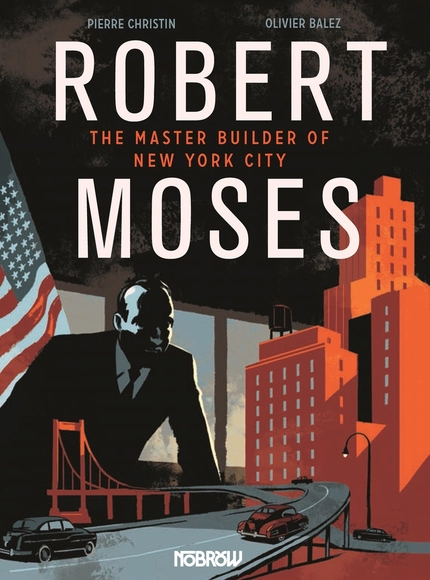
Robert Moses, the planner-politician-architect who infamously built overpasses too low for buses to bring New York’s urban poor to his beaches, is the subject of a new graphic novel by Pierre Christin and Olivier Balez titled Robert Moses: The Master Builder of New York City. Admirable for its candid rawness, their profile of perhaps the most polarizing and important figure in American planning history is no lionizing eulogy. The impressive triumphs of Moses’ tenure are juxtaposed with unsparing accounts of his regrettable social policies and the often-shortsighted consequences of his public infrastructure. For each groundbreaking feat of structural engineering and political mobilization, there is another story told of his callous social engineering, the consequences of which reshaped the lives of New Yorkers as much as his architecture.
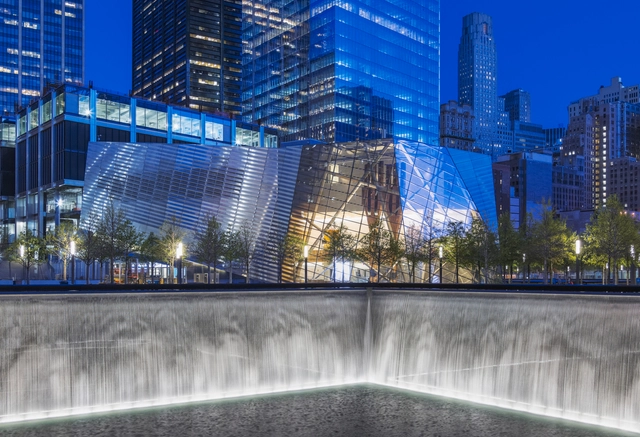
Sounds of rushing water have been reported behind the walls of the lower concourses of the World Trade Center site. As DNAinfo reports, rumors say officials have found an underground leak within the newly built complex and fear that it may be coming from the 3,200-foot-long slurry wall that separates the site from the Hudson River.
Frustrated with the congestion of panhandlers, Mayor Bill de Blasio has shocked New York City dwellers by threatening to remove their beloved Times Square. As New York Times' architecture critic Michael Kimmelman reports, this comes at a time when dwellers fear that quality of life is declining in the city: "Entertaining the demolition of the plazas, the mayor sends a message that New York can’t support the sort of great pedestrian hubs that thrive in competing cities around the globe." Blasio said he will look into the "pros and cons" of returning Times Square to traffic. Read Kimmelman's full report on Blasio's threats, here.
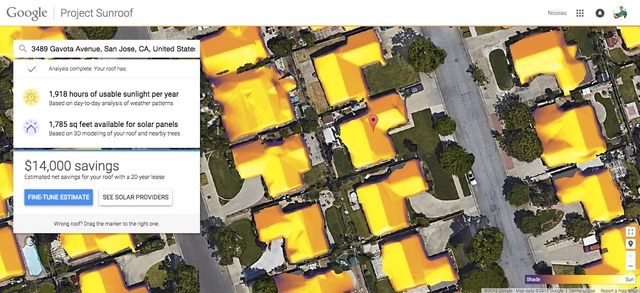
Google is in the unique position to truly understand what people want. As millions key in their questions, the search giant is actively working to provide better answers. When it comes to questions about solar energy, Google wondered, “If people are lost trying to get answers about solar, why don’t we give them a map?” And so, the tech company announced the beta launch of Project Sunroof: a tool “to make installing solar panels easy and understandable for anyone.”
In a post on Google’s Green Blog, engineer Carl Elkin addressed common misconceptions about the viability of solar energy for the average owner by saying “many of them are missing out on a chance to save money and be green.” Sunroof hopes to be the answer that gives people clear, easy to understand answers.
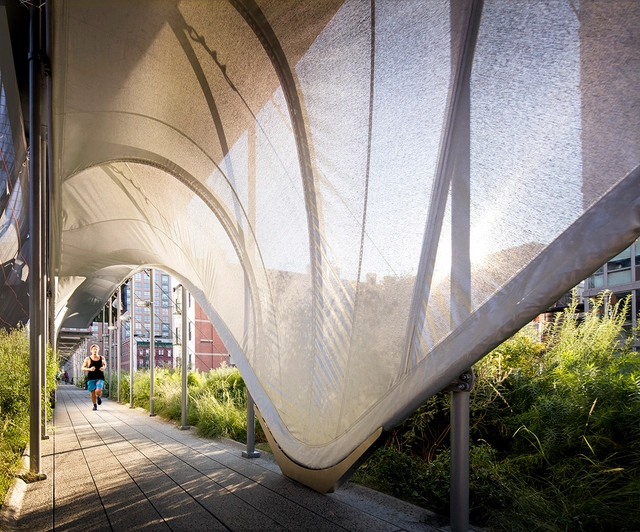
With the construction of their High Line-adjacent residential building 520 West 28th Street, Zaha Hadid Architects have constructed a temporary construction shelter to protect pedestrians in the event of any falling construction materials. However, as is often the case with Zaha Hadid designs, this is a construction shelter unlike any other, serving as a protective shelter but also as an artistic installation.
Named Allongé, the installation is "is inspired by the connectivity and dynamism of movement along the High Line," allowing visitors to the High Line to move through 34 meters (112 feet) of sweeping metallic fabric supported by a curvilinear steel frame, offering a spatial experience that foreshadows the presence of Hadid's building at the site.
The recent announcement by Governor Cuomo and Vice President Joe Biden of plans to “rebuild” La Guardia Airport at a cost of $4 billion was described in a Page One caption in The Post as “the end of an error,” a reference to the airport’s reputation that became tarnished over the years. Last October, Biden remarked that if someone had taken him to LaGuardia, he’d think he was in “some Third World country.”
Since its opening in 1939, when it accommodated “flying boats” at its Marine Air Terminal, the airport has not kept up with the growth of jumbo jets and air travel in general, but in the days of the Super Constellation passenger planes with their triple-tails and sloping noses, it was a very nice Art Deco place.
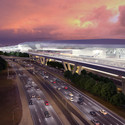
The published renderings that accompanied the announcement were not terribly reassuring, as they depicted a very long curved terminal with gangly tentacles raised over plane taxiways that hinted at torsos of praying mantises: an awkward rather than a graceful vault.
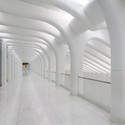
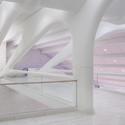
Toronto-based architectural photographer Michael Muraz has shared with us some of the first images seen inside Santiago Calatrava's nearly complete World Trade Center Transportation Hub. Set to open this year, the "glorious" birdlike structure boasts a 355-foot-long operable "Oculus" - a "slice of the New York sky - that floods the hub's interior with natural light, all the way down 60-feet below street level to the PATH train platform.
Though its been shamed for being years overdue and $2 billion over budget (making it the world's most expensive transit hub), the completed project is turning heads. Take a look for yourself after the break.