
-
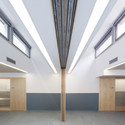
Architects: EC Compta Arquitectes S.L.
- Year: 2012
-
Professionals: Ferrovial


Most parking is free - but that doesn’t mean it doesn’t have a high cost. A recent podcast from Freakonomics Radio examined parking in US cities, investigating the “cost of parking not paid for by drivers” - a cost paid not just by the government, but by the environment - due to congestion and pollution caused by people searching for kerbside parking. For example, in a 15 block area of Los Angeles the distance traveled by drivers looking for parking is equivalent to one trip across the USA per day.
One potential solution which they discuss is a San Francisco project called SF Park, which makes use of sensor technology to measure the demand for parking in certain areas of the city and adjust price according to demand. In theory, this would create a small number of empty spaces on each block and dramatically reduce the time that many drivers spend cruising for parking spaces.
Though the idea is certainly an intelligent approach to the problem of kerbside parking, unsurprisingly all this talk of supply, demand and pricing sounds very much like an economist's answer to a problem. But what can designers do to help the situation?
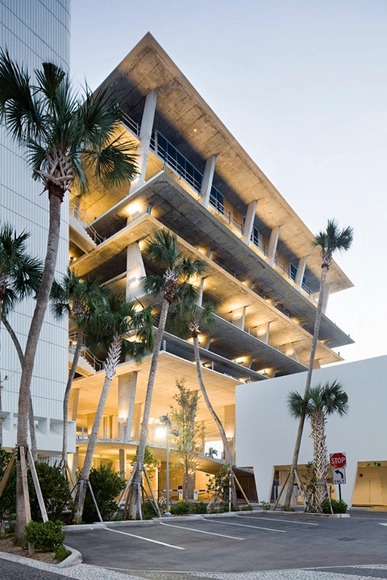
Perhaps, from the designer’s point of view, the real problem with kerbside parking and surface lots is that they are always seen as a provision “coupled with” a building or area of the city. There have been a number of attempts by architects – some successful and some tragically flawed – to make parking spaces less of a rupture in a city's fabric and more of a destination in themselves. Could these point to another way?
Read about 3 examples of parking’s past, and one of its potential future, after the break...
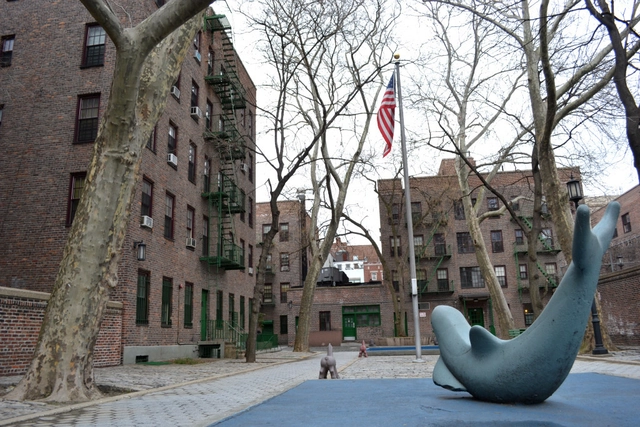
For the past four decades, as cities faced financial pressures, high-rise public housing met its decline. Cities throughout the country demolished public housing that was failing financially and socially, like Chicago's Cabrini-Green Housing Project whose demolition was completed in 2011, to make way for mixed use developments that encouraged economic and social diversity by way of the HOPE VI Program. This strategy resulted in the uprooting and relocation of former residents who faced uncertainty throughout the process.
The New York City Housing Authority (NYCHA) stands out among housing authorities in the United States due to its size - 179,000 units in 2,600 buildings across the city - and the fact that the buildings are relatively well maintained. NYCHA has avoided resorting to demolitions to deal with its issues, instead resorting to special police services that costs NYCHA a purported $70 million a year. Over the past decade NYCHA has been underfunded by approximately $750 million causing backlogs in necessary repairs.
To address the mounting costs of public housing, New York City's Mayor Bloomberg has proposed an infill strategy that would attract developers onto NYCHA land and create a new layer of commercial space and residential units in public housing developments. The goal over the next five years is to develop methods of preservation for the housing development and promote mixed-use and mixed-income developments to generate income for NYCHA.
More on the plan after the break.
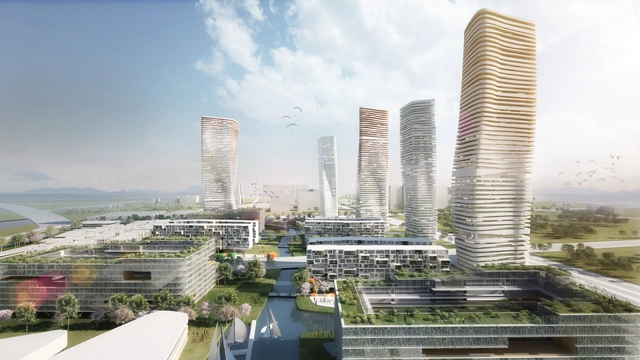
ATENASTUDIO, in collaboration with Archmaster studio, has developed a masterplan for a new district in Wuxi, China, which takes a 200,000 sqm buildable zoning lot to present two main keywords which are the base of all design choices and that can be defined as generator elements of all the project: landscape and waterscape. The intention is to emphasize to the maximum the presence of water making it become a diffuse system, introducing it inside the area and in every part of the project, and using it as if it was a “3D liquid material”. More images and architects' description after the break.
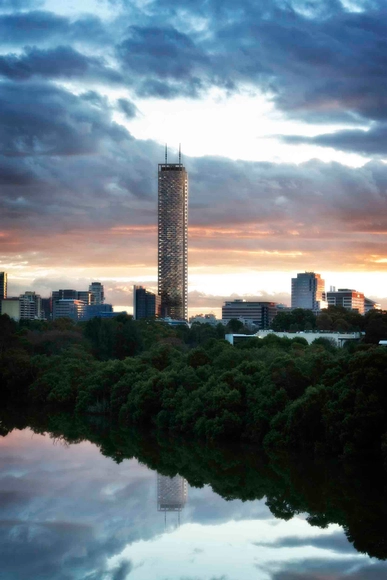
Emerging from a design excellence competition held by the Parramatta City Council, the Aspire Tower, designed by Grimshaw Architects, is a landmark mixed-use tower set to establish a new benchmark for innovative, passive-environmental design in Australian high-rise developments. Designed to act as a catalyst project for Parramatta Square, the tower provides high density, urban residential living which is not only affordable but also sustainable. More images and architects' description after the break.
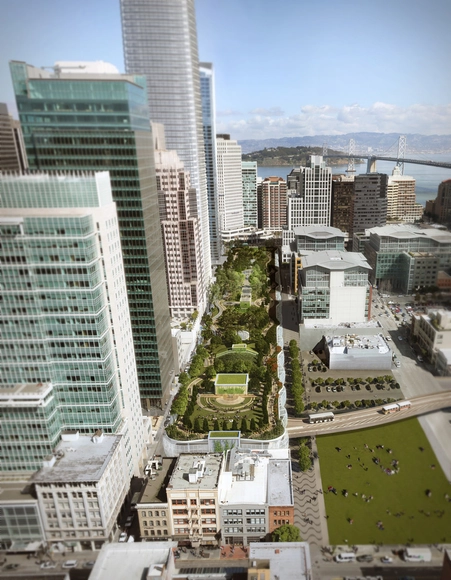
The revamped Transbay Transit Center in downtown San Francisco broke ground earlier this week, a project that will introduce a 1.5 million square foot development that will be part transportation hub, part public park and urban space, and part offices and retail establishments. The massive undertaking, designed by renowned architecture firm Pelli Clarke Pelli will bring together 11 systems of local and national transportation, serving 45 million people per year. In addition to securing access to myriad transit lines, the project will also provide downtown San Francisco with a 5.4-acre rooftop park, designed by PWP Landscape Architecture, along with numerous cultural programs. The project is budgeted at 4.2 billion dollars and is projected for completion in 2017. It is funded in part by the construction of a 1,070-foot tower that is adjacent to the Transbay Transity Center. It is also designed by Pelli Clarke Pelli and is slated to be the tallest tower in San Francisco. The tower will secure 60 stories of office space and jobs and will contribute to the projected $87 billion of revenue through 2030.
Join us after the break for more details on this project.
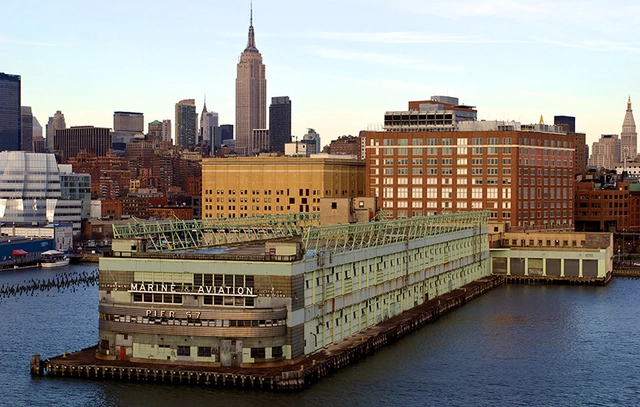
New York's City Council have unanimously backed a proposed plan to restore and redevelop the aging giant that is Pier 57. Built in 1952, the 300,000 square foot pier was hailed by Popular Mechanics as a 'SuperPier' for its vast size and unconventional construction, as most of the pier's weight is supported by 'floating' air-filled concrete cassions. The pier was originally used as a bus depot by the New York City Transit Authority, however it has been lying vacant since 2003. The latest decision brings a concrete end to years of speculation as to what the fate of the pier would be.
Read more about the proposal after the break...
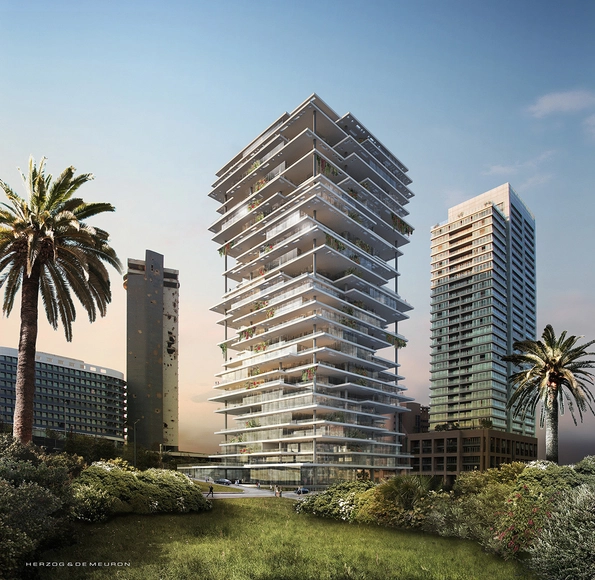
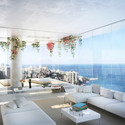
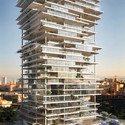
Beirut Terraces rethinks the concept of the skyscraper, creating a vertical village composed of thin, elegant platforms layered in a playful formation. By offering lavish outdoor spaces, breathtaking views, and meticulously composed lofts, architects Herzog & DeMeuron bring an unprecedented way of living to crowded and dense Beirut.
More on these contemporary living spaces after the break...

East Moline, Illinois will soon have an all new, highly developed waterfront mixed use area that will include park space, retail and commercial areas and luxury apartments along its Mississippi River front. The $150 million development will be a host to 300 apartment units, senior citizen housing, condominiums, storage facilities, a sports recreational center, medical facilities and a variety of amenities that includes neighborhood retail shops, food courts, banks, pharmacies and restaurants, hotels and a central park with will include a band shell. At over 3.5 million square feet, Fountainhead Quad Cities, developed by Beitler Real Estate Services with James DeStefano of LVD Architecture as the master planner, will bring new residents to the area while attracting the thousands of motorists that pass through the region today.
More after the break.

Development corporation ADIM Nord with MVRDV and de Alzua+ have been announced the winners of an urban renewal competition in the French town of Villeneuve d’Ascq. Dubbed ‘The Beam’, the winning proposal will transform a cluster of disused parking lots and a former petrol station into a dense, pedestrianized haven, whose 15,000 square meters of offices, retail space and lodging will hover over the adjacent motorway as a icon of a larger urban regeneration effort for the town center.
More information on The Beam after the break...
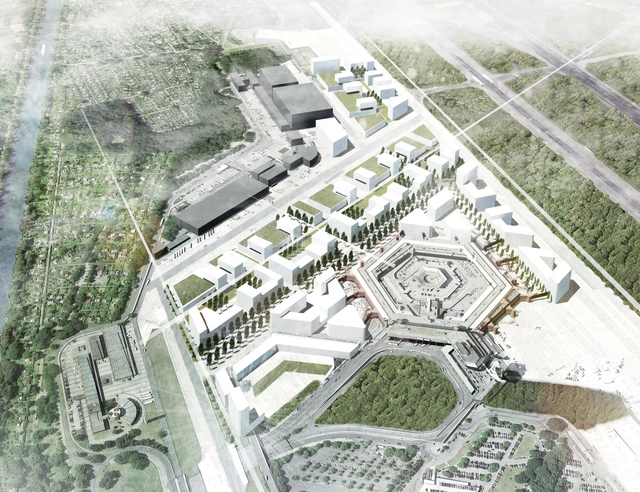
The architecture student team collaboration of Dagmara Sietko- Sierkiewicz and David Weclawowicz of the Wroclaw University of Technology shared with us their first prize winning proposal in the AIV Schinkel- Wettbewerb 2013 competition. With this year’s topic of "TXL transformation", their challenge was to develop a quarter made from a new typology of hybrid-buildings, containing a manufacture (production hall), flats and retail services after closing the airport Berlin Tegel in the year 2014. This winning concept focuses on using the production facilities after hours as a leisure destination. More images and architects’ description after the break.

Foster + Partners have received the green light from the Lambeth Council for three mixed use towers on the 20-21 Albert Embankment in London. Ranging from 15 to 27 stories, the curved steel and glass structures will provide the area with 253 apartments, including affordable homes for senior living, along with offices, restaurants and a residents’ bar, gym, pool and spa.
Grant Brooker, Senior Partner at Foster + Partners: “We are absolutely delighted that 20-21 Albert Embankment has received planning permission – working alongside our clients at St. James and with great support from Lambeth and the GLA, we hope to transform this important and highly visible site into a vibrant riverside community that sets a benchmark for the regeneration of this part of the river.”
More after the break...
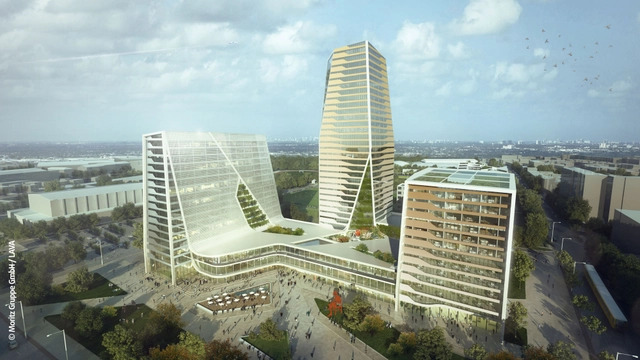
Conceived by visionary developer Moritz Gruppe and designed by internationally acclaimed architects, LAVA, the three towers of gold, silver, and bronze and three diagonal shaped city blocks make up THE:SQUARE³, a new mixed use development inspired by sport that revitalizes a unique urban quarter in Berlin. With the theme, 'Life, Nature, Sports', their mixed-use concept is perfectly adapted and related to the nearby environment and reflects the local centre of excellence for high-performance sport, promotes local, national and global sports, generating positive social, health and economic benefits to the area. More images and architects' description after the break.
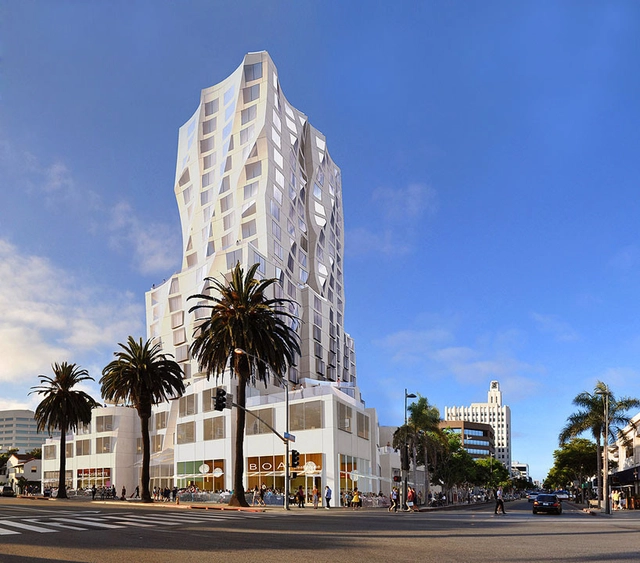
Developers M. David Paul Associates and the Worthe Real Estate Group have commissioned Frank Gehry to design a mixed-use hotel and residential tower in his hometown of Santa Monica, California. The 22-story “Ocean Avenue Project” aims to stimulate the coastal city’s economy with street-level restaurant and retail space below a 125-room hotel and 22-unit condominium tower topped with a rooftop observation deck. As for accommodating the car-centric lifestyle of the West Coast, resident and visitor parking will be available in a three-story subterranean garage beneath the tower. In addition, the developers plan to integrate a 36,000 square foot museum campus that will add a cultural perk to the development just North of its two-acre site.
Although this project looks promising, the 244-foot, Gehry-esque tower is currently pending approval from the City. A vote by the end of March will decide its fate.
More images of the “Ocean Avenue Project” after the break...
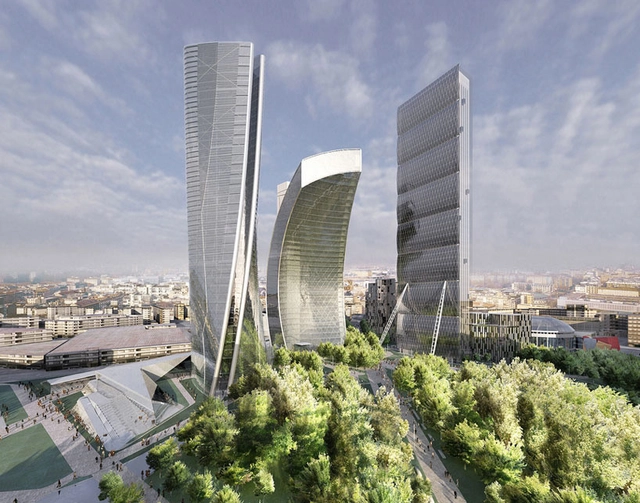
CityLife Milano is an ambitious commercial and residential development on Milan's historic former trade fair grounds: the Fiera Milano. On the surface, over half of CityLife Milano will be covered with upwards of 168,000 square meters of landscaped parkland dedicated to pedestrians and bicycles. This lush, pedestrianized space will be centered around a grand new piazza - 'piazza delle tre torri' - shaped by a trio of towers and surrounded by a cluster of residences, all designed by three world-renowned architects. As previously mentioned, Arata Isozaki and Andrea Maffei has contributed the Isozaki Tower, which is planned to become the tallest skyscraper in Italy at 202 meters and built alongside the curved, 150 meter Libeskind Tower. To complete the triad, Zaha Hadid has designed a twisting, glazed tower, which will rise 170 meters into the skyline.
More on the Hadid Tower and surrounding development after the break...
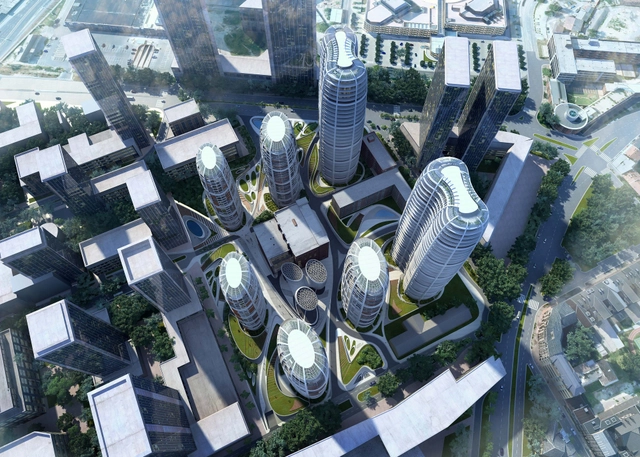
The design for the Bratislava Culenova New City Center by Zaha Hadid Architects is based on a dynamic field strategy which aims to organize the city's new city center program along a gradient of circular and elliptical patterns. In a series of larger tower extrusions, a fluid field emerges from its underlying matrix to activate the ground throughout the whole site and provide public spaces of the highest quality. More images and architects' description after the break.
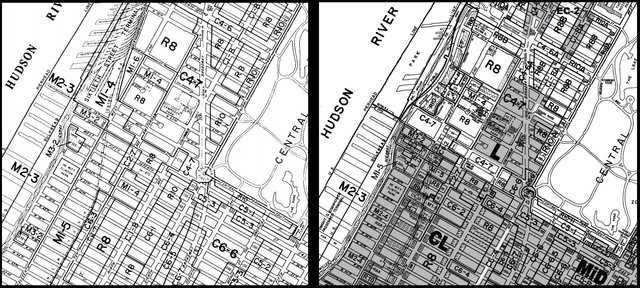
Let’s dump the word “zoning,” as in zoning ordinances that govern how land is developed and how buildings often are designed. Land-use regulation is still needed, but zoning increasingly has become a conceptually inappropriate term, an obsolete characterization of how we plan and shape growth. - Roger K. Lewis
Zoning, just over a century old concept, is already becoming an outdated system by which the government regulates development and growth. Exceptions and loopholes within current zoning legislation prove that city planning is pushing a zoning transformation to reflect the goals and needs of city building today and in the future. To determine how zoning and land use need to change we must first assess the intentions of future city building. Planners and architects, legislators and community activists have already begun establishing guidelines and ordinances that approach the goals of sustainability and liveability. The AIA has established Local Leaders: Healthier Communities through Design and has made a commitment to the Decade of Design: Global Solutions Challenge. NYC has come up with Active Design Guidelines: Promoting Physical Activity and Health in Design and its Zone Green initiative in regards to updating its zoning resolution. Philadelphia has augmented its zoning to include urban farms and community gardens. It is safe to assume that many other cities will follow this precedent.