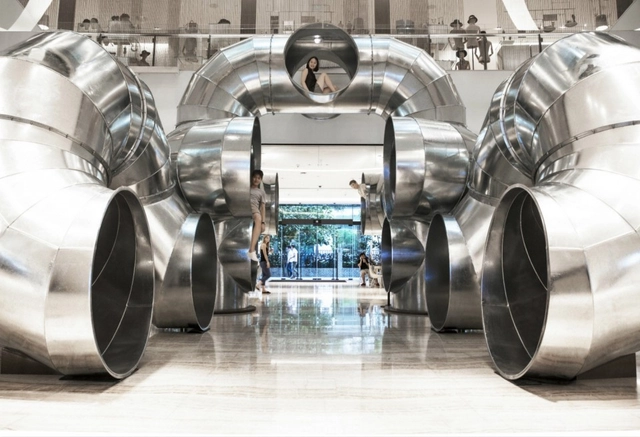
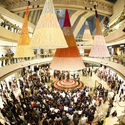
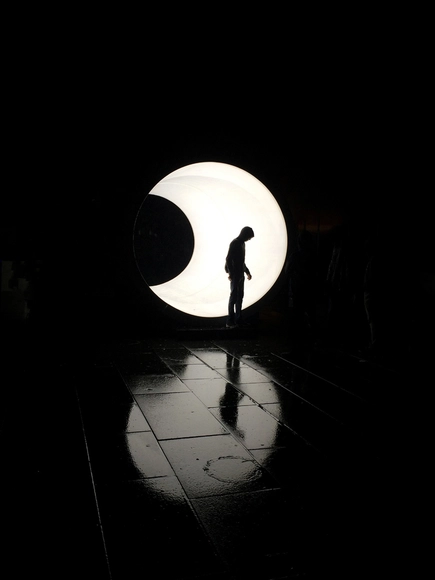
The KulturRegion Stuttgart successfully wrapped its three-week Aufstiege ("Ascents") Light Art Festival in October. Curated by Joachim Fleischer, the festival showcases work by over 40 artists from 10 countries. The 37 installations were available for viewing nightly from 8 p.m. to midnight across 25 cities near Stuttgart, and particularly popular exhibits have been extended.
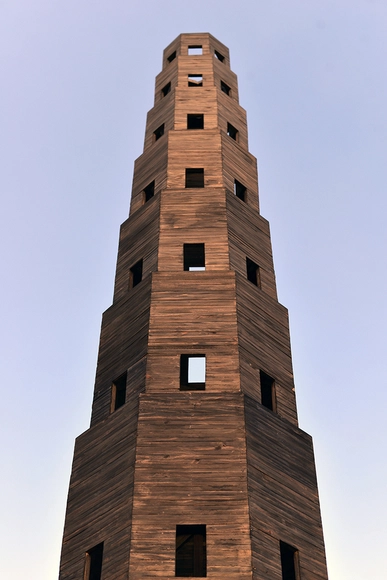
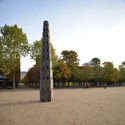
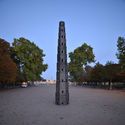
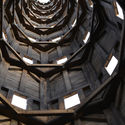
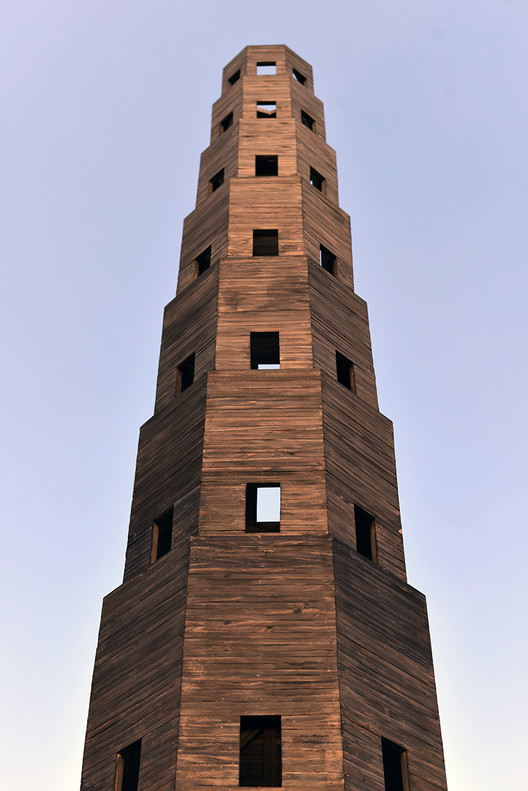
Chilean studio Pezo von Ellrichshausen has erected a temporary wooden tower of “an ambiguous” scale in the Jardin des Tuileries in Paris. Named the “Deci Pavilion,” the structure is made up of ten stacked octagonal wooden drums of decreasing size. While in reality only large enough to hold one visitor at a time, the column’s form and relationship to its surroundings give it the presence of a much larger structure.
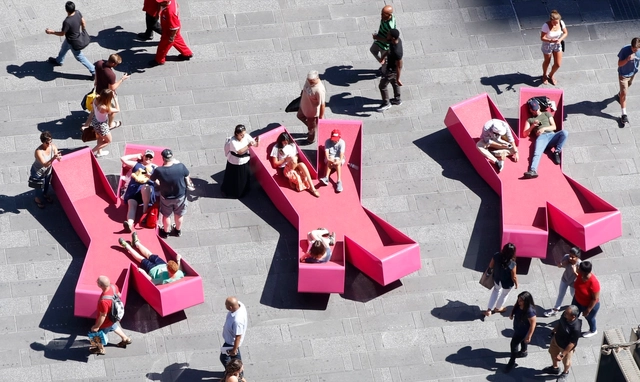
Adding to the ever-changing public landscape of Times Square, German artist and architect J. Mayer H. has unveiled XXX TIMES SQUARE WITH LOVE, three bright-pink, X-shaped custom lounge chairs that allow visitors to lie back and take in the cacophony of lights and sounds for which Times Square is famous. Originally inspired by the “X-like” intersection of Broadway and 7th Avenue, the name also serves as a cheeky reference to the adult theaters and sex shops that once lined the square before its revitalization in the 1990s.
Burning Man 2016 is underway in the temporary city of Black Rock City, Nevada – meaning for one week, thousands of festival goers will romp through the desert taking pictures of the hundreds of art and architectural installations constructed for the event. This year's theme is "DaVinci's Workshop," inspiring sculptures based off the artist's famous inventions and artworks, including a large-scale interpretation of the Vitruvian Man on a circular frame.
Read on to see some of the best structures and installations found at Burning Man 2016.
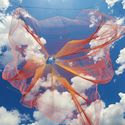
Janet Echelman has completed her most recent aerial net sculpture in downtown Greensboro, North Carolina. Made up of over 35 miles of technical twine woven into 242,800 knots, the sculptures adds a new ephemeral presence to the sky above the city’s new LeBauer Park. Entitled “Where We Met,” the sculpture’s form and composition were inspired by Greensboro’s history as a railroad and textile hub.
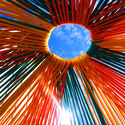
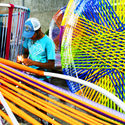
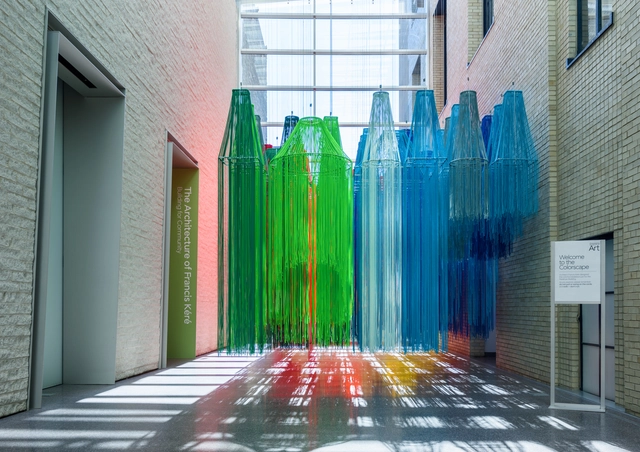
Currently on display at the Philadelphia Museum of Modern Art, Award-winning African architect Diébédo Francis Kéré has created Colorscape, a installation made from steel and brightly-colored fiber, to accompany his first solo show in the United States. The exhibition is titled The Architecture of Francis Kéré: Building with Community, and features of a retrospective of the architect’s career that includes material artifacts, tools and scale-models created for stand-out projects in both Africa and Europe.
“They are projects that cannot be bought, cannot be owned, cannot be possess, to be kept; they are projects in total freedom. Nobody can own this, because if you own something, it’s not free.” -Christo
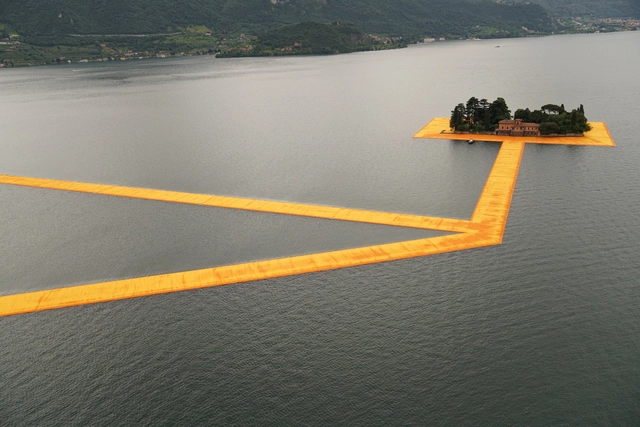
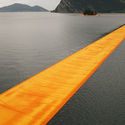
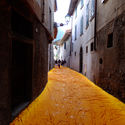
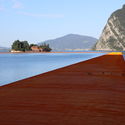
In this latest video from NOWNESS, Bulgarian artist Christo explains the fleeting nature of his most recent work, The Floating Piers, a floating dock system wrapped in yellow fabric that connects the towns of Sulzano and Peschiera Maraglio to the island of San Paolo in Italy’s Lake Iseo. First conceived by Christo alongside his late wife and creative partner Jeanne-Claude in 1970, The Floating Piers is in the midst of its 16 day run, lasting until July 3rd. After the conclusion of the exhibition, all components will be removed and industrially recycled, leaving its site precisely the way it was found.
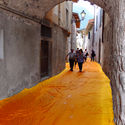
Beginning this week, and lasting for only sixteen days, visitors to the Italian Lake Iseo can "walk on water." The Floating Piers is the work of Christo and Jeanne-Claude, based on an idea first conceived in 1970. Built using 100,000 square meters of shimmering yellow fabric, carried by a modular floating dock system of 220,000 high-density polyethylene cubes, the installation—which sits just above water level—undulates with the movement of the lake.
According to Italian news source, Leggo, two people were "seriously injured" and the installation was "evacuated" on its opening day due to the quantity of visitors and inclement weather conditions.
Those who experience The Floating Piers will feel like they are walking on water – or perhaps the back of a whale.
Israel has unveiled its theme for the 2016 Venice Biennale: “LifeObject: Merging Architecture and Biology”. Their pavilion will be comprised of a large-scale sculptural installation and seven speculative architectural scenarios relating to Israel. The exhibition will focus on the relationship between biology and architecture, acting as a “research oriented platform.”
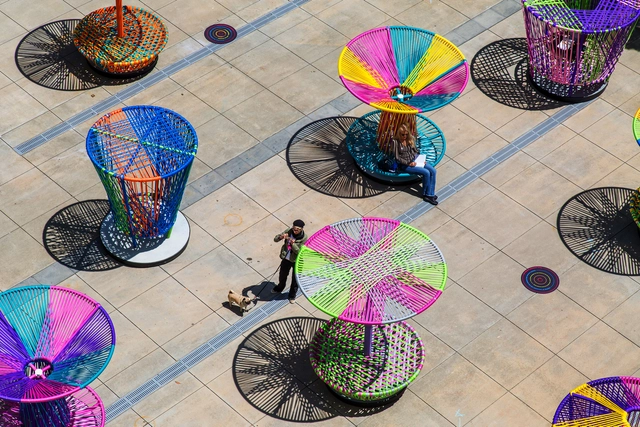
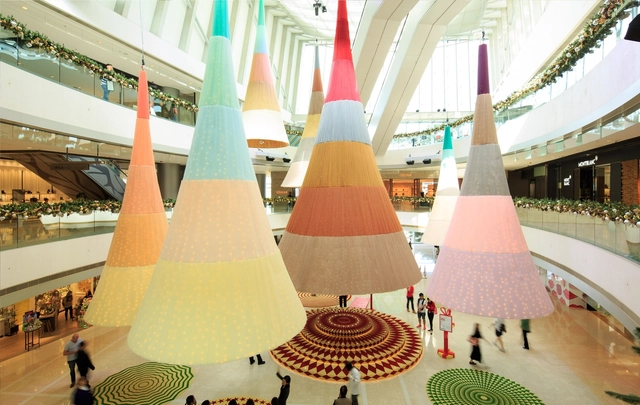
Colorful, woven spinning tops decorated the lawn at Houston’s Discovery Green park from November 14, 2015-March 22, 2016 as part of an interactive art installation by Mexico City designers Héctor Esrawe and Ignacio Cadena. Dubbed Los Trompos, the installation featured twenty, 3D structures that also doubled as seating. Only two or more people working together could make the tops spin, “fostering an engaging connection.”
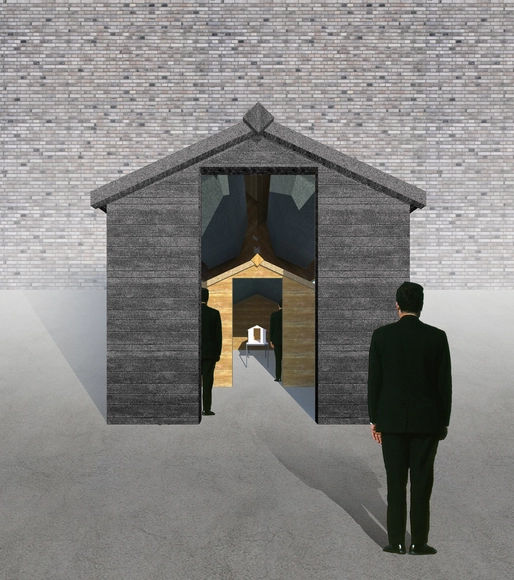
Sto Werkstatt have announced that Sam Jacob Studio will be creating "a unique installation" for their London gallery space that will "explore the exchange of information between digital and physical worlds." Entitled One Thing After Another, the project has its origins with what Jacob considers the most mundane, yet essential form, of architecture: the garden shed. The structure will be 3D-scanned to create a digital copy which will then be processed and scaled to fabricate a new CNC’d version from Verolith, a lightweight type of volcanic stone made of 90% perlite.
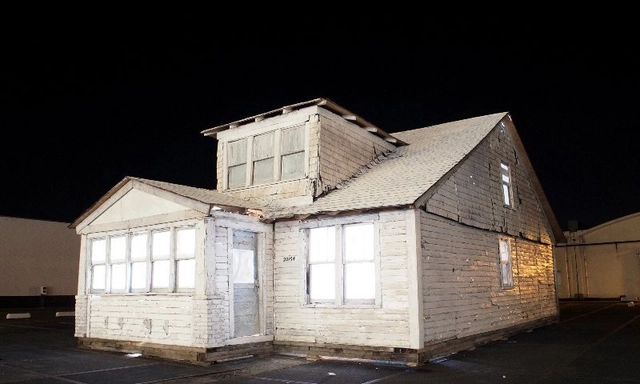
An empty house from Stoepel Street 20194, Detroit, is now in Rotterdam, The Netherlands. In this article for The Guardian, artist Ryan Mendoza describes his impetus and process for translocating a worn, abandoned former family home from one continent to another – as well as the statement he hoped to make. "When I arrived in Detroit in March 2015 I realised that this city – in the country I had left in 1992 out of distaste for its nationalistic, isolationist, police-dog mentality and its privatised prison system, [...] had, aside from the positive developments that were mostly in the downtown area, begun to look like a war zone."
Part street furniture, part data visualization, Guto Requena’s “I am” installation in São Paulo invited passers-by to interact with the city and connect with one another. Observers were asked to sit on a bench and take a picture of themselves, while also selecting which of six emotions they were feeling at the time: love, joy, surprise, anger, fear or sadness.
Each emotion was associated with a color through which the photo was filtered before appearing on the main façade of the FIESP Building along Paulista Avenue. The images then faded into a graph to colorfully display the predominant emotions at the moment.
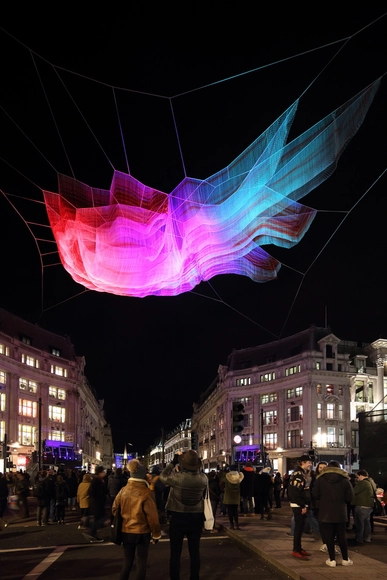
London is the latest city to host one of Janet Echelman's stunning net sculptures. Suspended 180 feet above Oxford Circus, the city's busiest intersections, the colorful floating form was inspired by 1.8 - "the length of time in microseconds that the earth’s day was shortened" as a result of Japan's devastating 2011 earthquake and tsunami.
"The sculpture’s form was inspired by data sets of the tsunami’s wave heights rippling across the entire Pacific Ocean," says the studio. "The artwork delves into content related to our complex interdependencies with larger cycles of time and our physical world. The sculpture’s net structure is a physical manifestation of interconnectedness – when any one element moves, every other element is affected."



.jpg?1478845392 "© Robert Seidel")










.jpg?1463319513&format=webp&width=640&height=580)