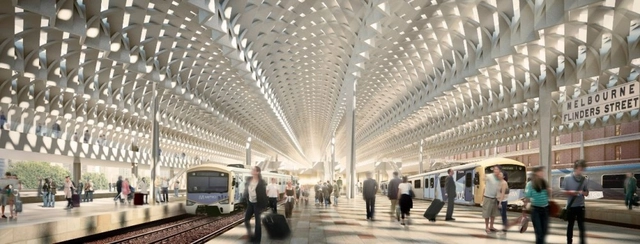
Despite not winning the "People's Choice Award," HASSELL and Herzog de Meuron have, with a unanimous vote, won the competition to design the Flinders Street Station in Victoria, Australia.
As the Guardian reports, Victoria's premier, Denis Napthine, noted that the proposal displayed a "beautiful and compelling integration of aspects of the original station design [...] The design was judged to offer the best experience for rail travellers with a layout that was spacious, comfortable and easy to get around."
Nevertheless, the "People's Choice" poll, which garnered more than 19,000 participants, had preferred a proposal from a team from the University of Melbourne: Eduardo Velasquez, Manuel Pineda and Santiago Medina. Find an image from this proposal, after the break...
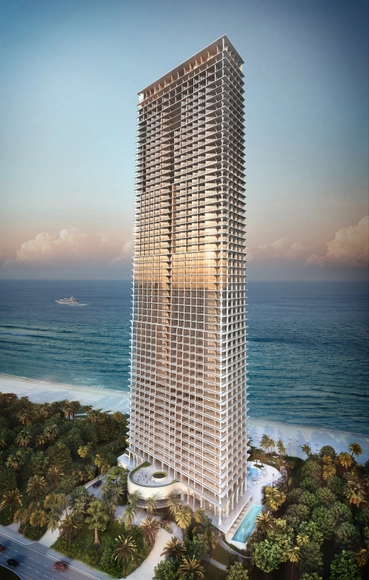
Fortune International has released images of a 57-story, Herzog and de Meuron-designed residential tower in Miami. With interiors by Parisian firm PYR and landscape by Raymond Jungles, the Jade Signature promises to bring high design to Sunny Isles, Florida. Described as “contemporary houses in the sky,” units will feature ample outdoor terrace space and large windows to frame views of the horizon. Six Sky Villas feature double height living areas and the two Signature penthouses each boast 360-degree views and a large terrace pool.
More images of Jade Signature and a video after the break…
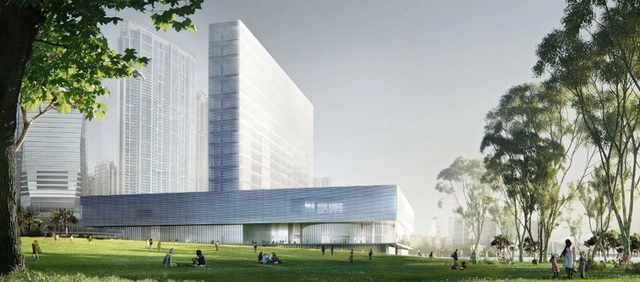
West Kowloon Cultural District Authority has appointed Herzog & de Meuron and TFP Farrells to design a new museum for visual culture on the edge of a reclaimed, 14-hectare park in Hong Kong’s Victoria Harbour. Focusing on 20th and 21st century art, design, architecture and moving image, M+ will be one of the first projects to be completed in the West Kowloon Cultural District, and a key venue in creating interdisciplinary exchange between the visual arts and the performing arts in Asia.
In a recent interview, Spiegelspeaks candidly with three architects who have one thing in common: projects in Germany plagued by severe delays and spiralling costs. Christoph Ingenhoven is head of Ingenhoven Architects, designers of train station Stuttgart 21. Meinhard von Gerkan of Gerkan, Marg and Partners is responsible for the Berlin Brandenburg International Airport, and finally Pierre de Meuron represents Herzog & de Meuron, designers of Hamburg's Elbphilharmonie.
These projects are well known in Germany as much for their designs as for their construction costs, and Spiegel is not shy about getting to the bottom of these controversies. Of course, the architects themselves have their own ideas about the bad press (namely that they're being unjustly blamed). Meinhard von Gerkan, for example, says:
"It's a big mistake to voluntarily serve as a figurehead, because then everyone knows whom to target. We are these figureheads, not the clients and not the construction companies. And we are liable for everything."
More of these gems from the architects, after the break....
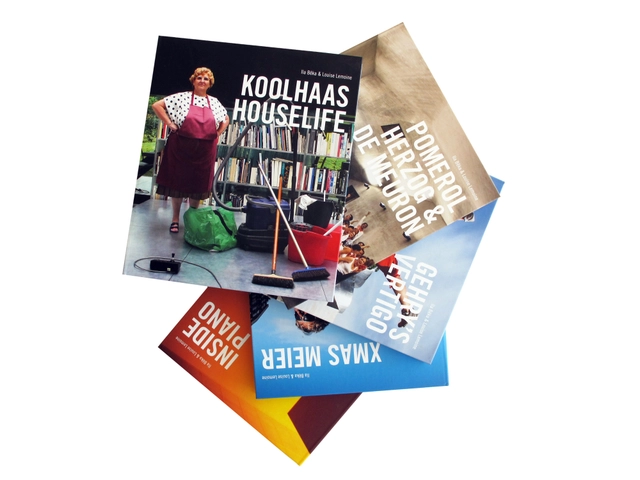
Thanks to the courtesy of our friends from Beka & Partners, we are giving you the chance to win one of the five DVD-Books of the Living Architectures collection.
"Living Architectures” is a series of films that seeks to develop a way of looking at architecture which turns away from the current trend of idealizing the representation of our architectural heritage.
"Which architect would you like to see next in the Living Architectures series and why?"
You have until June 24 to submit your answer. Winners will be announced and contacted during the same day.
For more information about the DVD-Books you can check the trailers after the break, or go to www.living-architectures.com for more details. Good luck!
Segal's proposal for the National Library of Israel
UPDATE: Israeli architect Rafi Segal appears to have abandoned his case to be reinstated as designer of the National Library of Israel. This decision comes after the client announced that it had signed a contract with Pritzker Prize-winning practice Herzog & de Meuron, who was initially chosen in April and triggered Segal’s demand to be reinstated. Now that the Swiss duo has officially signed onto the project, Segal has requested a withdrawal without prejudice. Before the hearing scheduled for September 12, 2013, Segal asked the court to withdraw the case. The court overruled his objections and granted HyperBina a compensation of fees and costs.
Official statement from the National Library Construction Company:
After carefully considering six international architecture firms - Ammar Curiel; Frank Gehry; Herzog & de Meuron; Kimmel Eshkolot, Kolker Kolker Epstein and Renzo Piano - an esteemed selection committee has chosen Herzog & de Meuron to design the new National Library of Israel in Jerusalem. The result comes after a controversial first attempt that ended in the dismissal of the initial competition winner for alleged copyright infringement.
Most parking is free - but that doesn’t mean it doesn’t have a high cost. A recent podcast from Freakonomics Radio examined parking in US cities, investigating the “cost of parking not paid for by drivers” - a cost paid not just by the government, but by the environment - due to congestion and pollution caused by people searching for kerbside parking. For example, in a 15 block area of Los Angeles the distance traveled by drivers looking for parking is equivalent to one trip across the USA per day.
One potential solution which they discuss is a San Francisco project called SF Park, which makes use of sensor technology to measure the demand for parking in certain areas of the city and adjust price according to demand. In theory, this would create a small number of empty spaces on each block and dramatically reduce the time that many drivers spend cruising for parking spaces.
Though the idea is certainly an intelligent approach to the problem of kerbside parking, unsurprisingly all this talk of supply, demand and pricing sounds very much like an economist's answer to a problem. But what can designers do to help the situation?
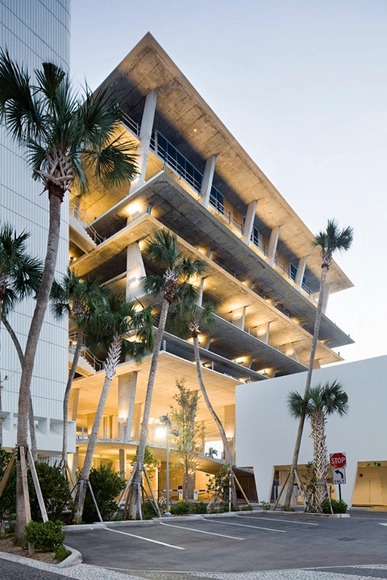
Perhaps, from the designer’s point of view, the real problem with kerbside parking and surface lots is that they are always seen as a provision “coupled with” a building or area of the city. There have been a number of attempts by architects – some successful and some tragically flawed – to make parking spaces less of a rupture in a city's fabric and more of a destination in themselves. Could these point to another way?
Read about 3 examples of parking’s past, and one of its potential future, after the break...
Nearly two years after unveiling the design to the public, Herzog & de Meuron broke ground this morning on the new ‘Grand Stade de Bordeaux’ in France. Surrounded by lush vegetation typically found in this green belt district, the stepped concourse transitions visitors through a forest of slender white columns to the stadium’s bowl, whose form ensures maximum flexibility and optimal visibility for all 43,000 spectators.
Completion is set for 2015, just in time to host the Euro 2016 football championship.
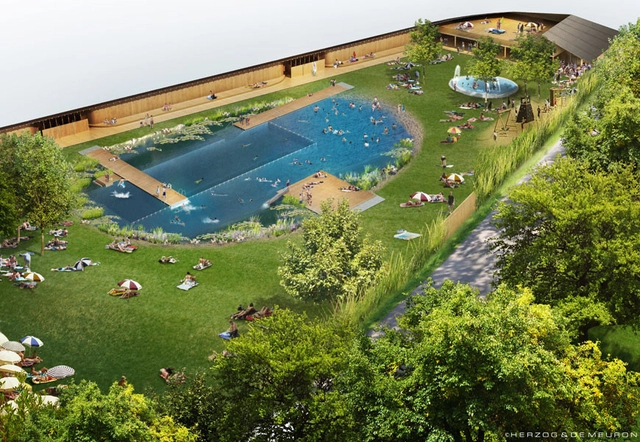
In 1979, just a year after founding their practice, Herzog & de Meuron won a competition to design a public swimming pool for the Swiss municipality of Riehen. After developing several unrealized iterations over the following years, the project was put on hold indefinitely in 1982. Twenty-five years later, in 2007, Herzog & de Meuron were commissioned to rethink the project and proposed to abandon the conventional pool concept with its mechanical and chemical water treatment systems in favor of a pool closer to natural condition with biological filtration.
Out of 140 architects considered, 12 architects have been selected by the Nobel Foundation to compete to design their new home, a Nobel Center in Blasieholmen, Stockholm. The conspicuously European selection, chosen for their "design and artistic abilities and experience working in intricate urban environments," includes some very big names - including BIG, David Chipperfield Architects, Herzog & de Meuron, and OMA. The only non-Europeans to compete will be SANAA's Kazuyo Sejima and Ryue Nishizawa.
See the full list of competitors, and more information on the competition, after the break...
First envisioned back in 2003, the enormous crystalline glass structure stands nearly complete on top a historic warehouse on the edge of the River Elbe. Rising costs, delayed schedules and legal issues with the contractor, has plagued this magnificent concert hall with controversy. However, according a report in the German news magazine Der Spiegel, contractor Hochtief has initiated a new deal to ensure the completion of the concert hall.
A revised contract, which is expect to adjust the architect’s fee’s to €94 million (€17 million over the original project cost), has projected Elbphilharmonie will be completed within the next four years. The news is bittersweet, as the architectural community and the residents of Hamburg have been waiting years for this highly anticipated concert hall to be complete, yet they cringe at the news of an overblown €575 million price tag.
After two years in waiting, Porta Volta, the project by Swiss firm Herzog & de Meuron to redevelop Milan's north-western Spanish gate, has finally broken ground. The project, which spurred some controversy when architect and critic Vittorio Gregotti accused the Swiss-led project of being an act of “architectural colonialism,” is nevertheless scheduled to be completed in 2015.
ArchDaily’s previous coverage of Herzog & de Meuron‘s 56 Leonard Street was around the time when construction was just about to begin. Now four years later, construction seems about ready to restart, according to bdOnline. Join us after the break for more details.
Herzog & de Meuron’s exhibition at the Biennale is focused on the architecture of a symbolic project, with a complex history: The Elbphilharmonie, a concert hall on top of a former industry in Hamburg, which also includes a 250 room five-star hotel, and 47 apartments. The project, in a very advanced state, remains halted since last year due to legal issues with the contractor.
In the exhibition, the history of the project is documented with three-dimensional representations of the complex building services; camera shots panning through the construction site; and large-scale models, whose spatial and physical presence represent what the architects wished and still wish to foreground: architecture.