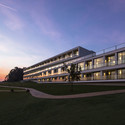
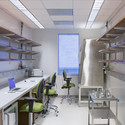
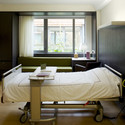
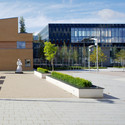
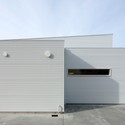
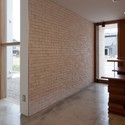
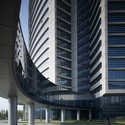
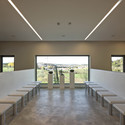
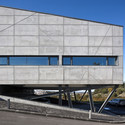
Responding to the demand for healthcare services in rural Southeast Asia, Building Trust International launched an international competition - Moved to Care - to envision flexible and relocatable healthcare facilities. Over 200 entrants participated; one professional winner, a multi-disciplinary team from the USA, and one student winner were honored. Check out their winning proposals, after the break...
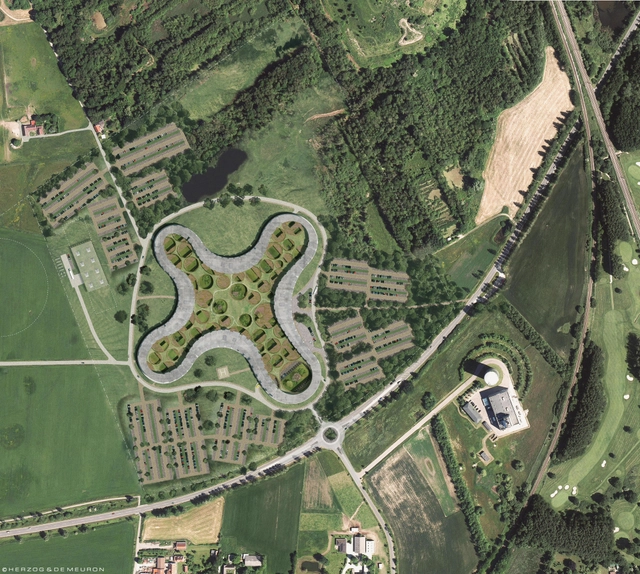
Herzog & de Meuron and Vilhelm Lauritzen Architects have been announced as winners of an international competition to design one of Denmark’s largest hospitals: Nyt Hospital Nordsjælland. Selected ahead of six other practices, including BIG and C.F. Møller, Herzog & de Meuron’s nature-inspired proposal will provide the New North Zealand Hospital with a 124,000 square meter facility that serves 24 medical departments and provides over 660 beds.
“The hospital organically reaches out into the wide landscape. Simultaneously its soft, flowing form binds the many components of the hospital,” described the architects. “It is a low building that fosters exchange between staff and patients, and it has a human scale despite its very large size.”
Architects von Gerkan, Marg and Partners (gmp), with partners JB Ferrari, have won first prize in an international competition to design a new children’s emergency unit at the Lausanne University Hospital in Switzerland. The 85-bed hospital will feature a terraced inner courtyard with conservatory, which will serve as a protected outside play area, that offers ample natural light and space for plant-life.
Parkland Memorial Hospital in Dallas, designed by a joint venture between HDR + Corgan. HOK is responsible for the hospital’s furnishings and equipment, and has also been executing a study of the role of furnishings and artwork in inpatient care. Image Courtesy of HDR + Corgan
This article, written by Kim A. O'Connell, and first published on the AIA website as "Is there a Doctor in the Firm? (Or a Nurse in the Studio?)" discusses the growing overlap between architects and healthcare professionals, who collaborate or even learn both disciplines to design more effective healthcare architecture - relying on research more rigorously than ever before.
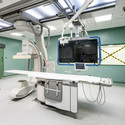
Since it opened last fall, a cardiac hospital in Bulgaria is already operating at full capacity and is among the most technologically advanced of its kind in Europe. Project delivery for the City Clinic in Sofia was remarkably fast—only a year from the time Dallas-based HKS Architects was hired until doctors began seeing patients. A former car dealership was renovated to create the 38,000-square-foot, 55-bed facility, helping to expedite matters.
The other major contributing factor may have been that, from its earliest beginnings, a physician played a leading role—from landing the project to identifying specific medical needs and seeing the design through to completion. It's a model that seems to be taking hold in architecture. More and more, architecture firms are bringing health professionals into their design studios to help them create the next generation of healthcare architecture.
Read on after the break to find out how this shift is producing better buildings for healthcare
https://www.archdaily.com/481382/doctors-in-the-studio-the-right-medicine-for-healthcare-architectureKim A. O'Connell